
Lee H. Roberts
11/11/2024 | 26m 46sVideo has Closed Captions
Lee H. Roberts, chancellor of UNC-Chapel Hill, discusses higher education with David Crabtree.
Lee H. Roberts, University of North Carolina at Chapel Hill’s 13th chancellor, discusses his experience, how he has navigated his new role and the future of higher education with David Crabtree, PBS North Carolina’s CEO.
Problems playing video? | Closed Captioning Feedback
Problems playing video? | Closed Captioning Feedback
Focus On is a local public television program presented by PBS NC
Lee H. Roberts
11/11/2024 | 26m 46sVideo has Closed Captions
Lee H. Roberts, University of North Carolina at Chapel Hill’s 13th chancellor, discusses his experience, how he has navigated his new role and the future of higher education with David Crabtree, PBS North Carolina’s CEO.
Problems playing video? | Closed Captioning Feedback
How to Watch Focus On
Focus On is available to stream on pbs.org and the free PBS App, available on iPhone, Apple TV, Android TV, Android smartphones, Amazon Fire TV, Amazon Fire Tablet, Roku, Samsung Smart TV, and Vizio.
Providing Support for PBS.org
Learn Moreabout PBS online sponsorship- Hello, I'm David Crabtree.
What's it like to be the chancellor of the oldest public university in the United States?
We'll talk with the 13th chancellor of the University of North Carolina at Chapel Hill: Lee Roberts.
- [Announcer] Quality public television is made possible through the financial contributions of viewers like you who invite you to join them in supporting PBS NC.
[pleasant music] [bright warm music] [bright warm music continues] - Chancellor Roberts, first, thanks for your time.
I know times are very busy now, and it's good to talk with you.
- David, thank you for being here.
Appreciate your being here in Chapel Hill.
- You are the 13th chancellor of the University of North Carolina Chapel Hill, the oldest public university in the country.
It's quite a heady position.
How does all of this fall on you?
- You know, it's such a remarkable place, David.
I couldn't feel more honored, more grateful to be asked to step into this role.
You're right, it's our 230th academic year.
We just celebrated the 231st anniversary of the laying of the cornerstone of our oldest building, Old East, which is still in operation.
And I hope that for every one of those 231 years, the people who have sat in my position have felt as honored and as grateful as I do to be entrusted with this responsibility.
It's a remarkable institution.
If we didn't have Carolina, we would all be trying to figure out how to create it.
- Each of your predecessors brought their own style, their own vision, a collective sense of wanting to really push for the greater good for the state.
What does Lee Roberts bring that might be a little different?
- Well, you know, I don't have a traditional academic background, David.
As you know, I come from the private sector.
I did spend time as state budget director.
I served on the UNC System Board of Governors, and I've done some other boards and things like that to try to serve the public interest here in North Carolina.
But my hope is that my experience in management and finance and budgeting and administration will combine with the significant academic expertise that's already here to serve the university and help the university serve the people of North Carolina.
- You know, for people who might not spend much time on a college campus or maybe they've forgotten what it was like, there's a great energy and synergy that comes from being around these students.
- There's no question about it.
Our students are extraordinary.
Somehow, each one is more impressive than the one before.
And there's also something intangible about a college campus.
So E.B.
White said that the reading room of a college library is the very temple of democracy.
And that's especially appropriate as we sit here in the historic Wilson Library, one of the most beautiful buildings here in North Carolina and specifically built to instill that sense of grandeur of the awe of learning and of education in the students and of the people of the state.
This is a remarkably special place.
You can feel it in the air.
- Also, for people who might not spend a lot of time here, they could be surprised to learn that between students, faculty, staff, you've got some 44, 45,000 people on this campus.
That's a small city.
- That's right.
- There have to be strategic plans and goals of how you manage this.
So you've stepped into managing the small city.
Talk a little about that.
- Well, some people would say you don't really manage Chapel Hill.
I heard President Clinton say one time that the presidency was like being director of a cemetery.
There's a lot of people underneath you, but nobody is listening.
And sometimes I feel that way.
But the truth is, the university is highly decentralized.
It's a complex organization and it is, as you say, a very large organization.
And so aligning the university in a particular strategic direction can be a challenge.
That said, we have some progress to make in some important areas.
We need to figure out our strategy around artificial intelligence, easily the most important technological development, I believe, of our careers.
We're a leading global research university.
What's our research strategy around generative AI?
Not only for research, but how are we going to deploy it internally to make the university run better?
How are we going to use it in the classroom?
Both for students who are interested in computer science and data science, but also for all the other students.
Even if you're a history major, an English major, AI is going to affect the way that you're taught and that you learn.
So we need to make progress on that front.
We have a challenge around enrollment.
The state of North Carolina, as everyone who lives here knows, continues to grow very quickly.
Carolina hasn't grown very much, and so every year we enroll a decreasing percentage of North Carolina's graduating high school seniors.
If we don't do anything, that number will continue to go down as the state grows and we stay flat.
We used to be about 5% of North Carolina's graduating high school seniors that we enrolled.
Now it's 3.5%.
Do we want that number to continue to fall or do we want Carolina's enrollment to grow at least somewhat over time?
And then, you know, we're really excited about this new school.
It might not sound like a big deal, but creating a new school is not something that happens very often at a university like Carolina.
And the new school is focused on civic life, what it means to be a citizen in a democracy, leadership, public engagement.
It's off to a very strong start.
- Why is that school so important?
- Well, I think if you look around David, we don't suffer from a surplus of civil discourse in America.
And I think universities used to think that was part of their role to teach students how to be citizens.
And we've seen very strong student demand.
We have the minor up and running for the new school, heavily oversubscribed, we'll have the major stood up here soon.
And we've done a terrific job.
Our new dean has done a terrific job hiring, really a world-class faculty for the new school.
So we're pretty excited about it.
- You talked a moment ago about coming from the world of finance.
- Mm-hmm.
- What drew you to numbers?
- Well, you know, I said when I was budget director that the nice thing about the budget is you never had to wonder what the most important priorities were.
The biggest line items are going to be the most important.
That's where you're spending the most taxpayer money.
And that's true for finance more generally.
There's something very objective about the world of finance, but it's also, in a lot of ways, the secret energy that runs through most things.
You know, I taught a class in public budgeting before I came into this role after serving as budget director to graduate students, students getting a master's in public policy.
And I used to say to them, everything comes back to the budget sooner or later.
You can talk about your priorities and your objectives, but until you have funding, at least in the public sector, and it's true, I think, in most areas, until you understand the budget, until you have your priorities allocated in the budget, you haven't made very much progress.
- Governor McCrory said you were the best listener he had ever known.
Others say, "Lee Roberts is a listener.
He absorbs the thoughts of others and then addresses their concerns."
How did you develop that skill?
- Well, I've always thought that you learn more by listening rather than by speaking.
But in a role like this where we have such an enormous, diverse institution and coming from outside, I don't think you'd be doing your job if you didn't spend a lot of time listening to people and trying to learn.
You know, we've got this incredible employee base here, dedicated long-term faculty and staff.
Was just an event last week for our long-term employees, four employees have been here at Carolina for 50 years, two for 55 years.
And so there's an enormous wealth of institutional knowledge and expertise here that I'd be foolish not to try to learn from.
- There was also an event here recently where you were officially installed as the chancellor.
- Indeed.
- And I was quite taken with your address and the metaphor you used of trees and trees on this campus and leaves on the trees and different colors, the thought process to come up with that metaphor, and quite honestly, chancellor, I thought, "Man, I wish I thought of that.
What a great thing to use."
What were some of the responses you heard from- - Very positive responses.
But look, David, the least important thing that happened last Friday on University Day was my installation.
What was important about it to me was the celebration of the university and its role in serving the people of the state.
And that's what I was trying to say with the tree analogy.
That the trees grow tall and strong because of their roots.
And for Carolina, our roots are here in the state.
We've been nurtured and supported by the people of this state for over 230 years.
You can't walk around this campus without being struck by the grandeur of our trees, but it's the roots in the rich North Carolina soil that allow them to grow so strong.
- Yeah, you can't walk around this campus, as we mentioned earlier, without noticing the energy of students, the positivity of students.
And as a father and now grandfather myself, I know times changed for young people.
Behavioral health, being concerned about the mental health of students is a major priority on college campuses.
How is that here?
- It's a huge priority here at Carolina.
We've made significant investments in the mental health and wellbeing of our students.
And not just our students, but also our faculty and staff.
As you say, 44,000 people working and studying here.
We have more to do.
It's gonna continue to be a priority for us, but we also serve the whole state when it comes to mental health.
So our Carolina Across 100 initiative puts Carolina's resources into all 100 counties, and mental health has been a crucial part of that effort.
- A lot of times people will ask a question along the lines of "What keeps you up at night?"
So I'm coming from that direction, but I really wanna know what's the first thing you think of in the morning?
- You know, I really do, it sounds a little bit corny, but I really do try to make sure that I'm doing everything I can to fulfill the responsibilities of this role.
We're really excited that Mia Hamm is going to be speaking at graduation, one of the greatest athletes ever to put on a Tar Heel uniform, one of the greatest athletes in his or her sport for anybody, all time, no exaggeration.
But when we asked her to give the graduation speech and she accepted, she said, "I'm going to give it everything I have," which is no surprise to anybody who's followed her career, but that's what I've tried to do as well.
I don't mean to compare myself to an incandescent talent like Mia Hamm, but I really am trying my best to bring everything I have to this role.
- On that note though, were you a soccer player?
- You know, I played a little bit of youth soccer growing up, but I was never a candidate to play for the Heels.
- [chuckles] Okay.
A lot of people know of your background and a lot of people don't.
You grew up in a household of journalists, you're married to a journalist.
- True.
- Your mom and dad both.
You grew up in a political household with your grandparents.
Again, really heady stuff.
What was it that allowed you to say, "I'm going to take a different path," or what propelled you to take a different path?
- You know, it's an interesting question, and you're right.
Both my maternal grandparents were members of Congress from Louisiana.
My parents are both political reporters.
My wife is a journalist, went to journalism school.
She's an author and writer.
And when I was growing up, I thought I would be a lawyer probably in Washington.
And I saw a lot of that when I was a kid.
And so I did go to law school in Washington and it wasn't until I was in law school that I started thinking that maybe I would be interested in doing something more in the financial realm than practicing law.
I ended up practicing law in D.C. for a couple of years, but moved from there into finance.
It's great training, going to law school, but I always tell young people, "Don't go to law school to try to figure out if you want to be a lawyer."
There are easier ways to do that.
- What was it like at the dinner table of the Roberts household?
- You know, there certainly was quite a bit of discussion of politics and policy all the time.
My parents are political junkies and that's what they're interested in and wanted to talk about.
But you know, when you're growing up, you don't really know anything different.
- You talked about your grandparents both being in Congress, your grandmother was also ambassador to the Vatican.
- She was.
- Did that allow you to have access to those things, those mystical magical things that so many of us find there in St. Peters Square?
- You know, we used to say that my grandmother had the hardest job in the federal government because she had to represent President Clinton to the pope.
And we were living in London while she was in Rome.
And that was a lot of fun because we were the closest family and we would spend a lot of time in Rome visiting with her.
It was an extraordinary experience for us.
A remarkable inspiration for her, I think she was 81 or 82 years old when she accepted the post and moved to Rome as an octogenarian.
So that's motivational and hopefully inspiring.
- I don't know how many books she may have written, but I remember one in particular, I think I have the title right, chancellor, "Behind the Veil"?
- She wrote a memoir called "Washington Through a Purple Veil."
- "Through a Purple Veil."
Thank you.
- Indeed.
- Which was remarkable talking about the role of women at the time, her husband, Hale Boggs, first went to Congress.
- It's true.
So my grandfather was elected to Congress from Louisiana in 1940.
And so they were a young married couple.
At the time, he was the youngest person ever in the history of the United States to be elected to Congress.
So they were kids, and here they are moving to Washington from New Orleans and trying to figure out what it is to be a member of Congress and the wife of a member of Congress.
And the '40s and '50s and '60s were obviously a different time in Washington than they are today, but that's the environment that my mother and her siblings grew up in.
And it was a lot of fun when I was growing up to hear from my grandmother and my mom what Washington was like in those days.
- And the wives, correct me if I'm wrong, I'm harking back to the book and what your grandmother wrote.
The wives had to sit at a certain place in the House of Representatives, in the gallery.
And were they required to wear a veil at times?
- I don't know if they were actually required to wear a veil or if that was just common practice, but the truth is, these women in the days before it was common for women to run for Congress on their own were powerhouses.
They were running their husband's congressional offices as my grandmother did.
They were running constituent service operations.
My grandfather was lost in a plane crash in '72, and my grandmother ran in a special election to fill his seat.
By the time she ran for Congress in her own right, she knew what the job of being a member of Congress was inside and out.
She was an integral part of my grandfather's ability to serve in his role.
- You know, I ask you these questions because all of our lives shape us into who we are, and they prepare us for where we are now.
So as you look at the preparation of students at this university for their future, maybe not necessarily the immediate job market, but as they're prepared to move forward, how do you want them shaped?
- I think what's important for students to think about is the 50-year-plus career that they're likely to have and trying to learn particular applied skills in the of pace of technological change that we see in the workforce now, I think is a very difficult thing for students to try to calibrate.
I hope that they look at the pace at which technology is changing, we talked about AI, and say, "I need to learn skills in critical reasoning, analytical thinking, communication, skills that are gonna serve me well over the course of my career, no matter what happens with a particular kind of technology."
That's what a broad liberal arts education should be all about.
- And to parents or grandparents that might not understand that as thoroughly as you do or others do at a given time of marketability thoughts, higher education thoughts, "learn a trade" type thoughts, how do you bring them along even more deeply?
- Well, look, getting a job is crucial.
I don't mean to diminish the importance of that at all.
That's why most students come to Carolina.
It's why most students go to college generally.
But I encourage students to think beyond that first job that they're going to get out of college and think about the entire span of their careers.
That's not always easy for an 18-year-old or a 22-year-old to do, I've got three kids that age myself, but you only get one shot, generally, at your college education.
And I think you're best served by taking the longer-term view.
- And I think you're right, you do have that one shot.
And then there are some of us along the way that decide we're going to be learners later in life.
Those students are also welcomed here.
- Of course.
No, we have a significant focus, as does the entire UNC system, on adult learners, on lifelong learners.
The Project Kitty Hawk initiative, which is trying to take the resources of the whole UNC system and make them more accessible online to adult learners, folks who might not have the time to be on a college campus every day.
Those are crucial initiatives if we're going to make sure that we're tapping into the potential of all of North Carolina.
- And at the same time, you're doing that and looking at that in a long range, really deeply into the horizon.
There are things that are right there in front of you all the time.
You mentioned civil discourse earlier.
Universities are a place for all voices, yet sometimes students feel like their voice may not be heard.
There are deep political tensions right now.
How does Lee Roberts say, "You're all embraced, and I want to keep all of you safe, and I want you to know this is a place where you will feel you matter."
- Yes.
That's a great question, David.
And we think about that a lot.
So we wanna make sure that students from every nook and cranny of North Carolina know that they're welcomed here, that they belong here.
That this is a place for them where they can flourish and thrive.
We don't have a higher priority than keeping our students and our broader community safe.
Students expect when they come here, parents expect when they send their their students here, that we will do everything we can to keep them safe and we work hard at doing that.
At the same time, a college campus should be a place where all kinds of ideas can flourish.
They don't always have to be good ideas.
That's not the point.
We not only want students to be engaged in the world, we actively encourage student protest and student political activity.
There's a long and noble tradition of that here at Carolina, and we continue to see it on campus.
I think it's a wonderful thing for students to have strong political views.
We're obviously in an election season, we see a lot of the tensions and cross currents in the American political landscape play out here on this campus and probably at most campuses across the country.
And that's a role that Carolina's always played and that I hope we continue to play.
- A long and noble tradition.
What a great segue into another long and noble tradition of basketball.
[both chuckle] And a lot of questions about what might happen with the Dean Smith Center and people wanting something new or, "Gee, I don't want to ever give that up or what we do."
Is there any update you can give us on that?
- You know, it's remarkable how much attention this topic gets, and it's just a reminder of how much people love Tar Heel basketball.
And that's a fortunate thing for our university and our community.
We've played in the Smith Center twice as long as we played in Carmichael Auditorium, which is hard for people to believe sometimes.
And it's showing its age.
So the roof leaks, everyone knows about the problems with the bathrooms and the concourses.
Everybody knows how difficult it is to park and to leave the parking lots after the game.
And so that leads you to think about, should we just put a bandaid on the existing facility and fix the roof?
Should we try for a more fundamental renovation?
Do something about the concourses and the bathrooms?
If we did that, we wouldn't be able to fix the parking or the access.
Or should we try to think about the possibility of a new arena?
The arena's almost 40 years old.
Most arenas don't last that long.
And if we were to build something new, what would that look like and where would we build it?
That's an ongoing discussion.
We're gonna hear back from some folks who we asked to look at some different options here.
Soon we'll have more to to say about that.
But there's no underestimating the profile that this topic has.
- Very quickly, not to compare you to a predecessor, but one of your predecessors, Michael Hooker, allowed himself to be body surfed by students during timeouts at Carolina basketball games.
Might we see Chancellor Roberts being body surfed?
- You know, I am really eager to spend as much time with the students as possible.
I mentioned that I've got three kids, two in college, one just out of college, always looking for ways to engage with students.
But I'll have to think about the body surfing.
- Chancellor Lee Roberts, we thank you for your time and best of good fortunes to you and the University of North Carolina at Chapel Hill.
- Thank you very much for having me.
I really appreciate it.
[gentle warm music] ♪ [gentle warm music continues] - [Announcer] Quality public television is made possible through the financial contributions of viewers like you who invite you to join them in supporting PBS NC.

Lee H. Roberts on Mental Health Investments
Video has Closed Captions
Clip: 11/11/2024 | 36s | Lee Roberts, chancellor of UNC-Chapel Hill, discusses the importance of investing in mental health. (36s)

Lee H. Roberts on UNC-Chapel Hill Basketball
Video has Closed Captions
Clip: 11/11/2024 | 1m 22s | Lee Roberts, chancellor of UNC-Chapel Hill, discusses the legacy of the school’s basketball team. (1m 22s)
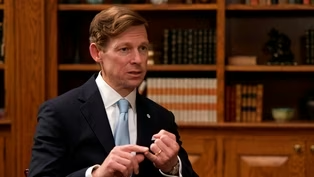
Lee H. Roberts on UNC-CH’s School of Civic Life & Leadership
Video has Closed Captions
Clip: 11/11/2024 | 35s | Chancellor Lee Roberts discusses UNC-Chapel Hill’s new School of Civic Life and Leadership. (35s)
Providing Support for PBS.org
Learn Moreabout PBS online sponsorship
- News and Public Affairs

Top journalists deliver compelling original analysis of the hour's headlines.

- News and Public Affairs

FRONTLINE is investigative journalism that questions, explains and changes our world.












Support for PBS provided by:
Focus On is a local public television program presented by PBS NC