
Legal Aid for Rural Kentucky
Clip: Season 2 Episode 19 | 4m 4sVideo has Closed Captions
UK Legal Clinic is expanding its reach to provide legal services to more rural populations
University of Kentucky Legal Clinic is expanding its reach to provide legal services to more rural populations. Originally Aired 6/27/23
Problems playing video? | Closed Captioning Feedback
Problems playing video? | Closed Captioning Feedback
Kentucky Edition is a local public television program presented by KET
Legal Aid for Rural Kentucky
Clip: Season 2 Episode 19 | 4m 4sVideo has Closed Captions
University of Kentucky Legal Clinic is expanding its reach to provide legal services to more rural populations. Originally Aired 6/27/23
Problems playing video? | Closed Captioning Feedback
How to Watch Kentucky Edition
Kentucky Edition is available to stream on pbs.org and the free PBS App, available on iPhone, Apple TV, Android TV, Android smartphones, Amazon Fire TV, Amazon Fire Tablet, Roku, Samsung Smart TV, and Vizio.
Providing Support for PBS.org
Learn Moreabout PBS online sponsorshipFor those living in rural areas of Kentucky, access to certain resources like legal aid can be really hard to come by.
The University of Kentucky Legal Clinic wants to change that.
It's expanding its reach to provide legal services to more rural populations.
The clinic's director said it's a move that not only benefits low income clients, but the law students as well.
So Kentucky JAY David Rosenberg, College of Law Legal Clinic is basically a legal class.
So the students that are participating in the program are licensed by the Supreme Court of Kentucky to practice under a limited scope agreement.
And so once they're enrolled in the class, they are taking on real life cases.
By the time I got to my third year, the legal clinic was like a shining beacon.
You go before you get out into the real world.
You want real experience, you know, real time in court with real clients.
Each student, on average is doing at least four cases, sometimes five, sometimes six.
So on average were somewhere around 50 cases or so each semester.
Where student attorneys with only limited licenses.
But we can we can meet some of the need that is out there.
We can kind of fill the gap.
But we take a little bit of everything.
The great thing is that we have freedom to pick and choose what we want to take based on what the community needs, based on what student interest is.
So that it's been everything from consumer work, divorce, wills, estates, work, living wills, pieces, expungements name changes.
The cases that I handled were criminal expungements you know, sort of getting rid of old criminal convictions from somebody's record.
I did some will drafting in estate planning for a few clients.
I also handled you name change cases and those were kind of particularly a point of pride that we try to reach out and meet our clients wherever they are.
When we're thinking about who underrepresented clients are.
Unfortunately, that number and who that is continues to grow.
I think over the last few years and legal services, the need and the requests really coming from not just folks at the far end of the spectrum, people who are on disability, people who are not currently working, people who are experiencing homelessness, but really seeing that expand up through low income and into what we would otherwise have classified as middle income folks.
I think the legal clinic, if it does anything, it highlights just how much unmet legal need there is for regular folks all across Kentucky.
I don't think a single one of us came out of our experience without being very acutely aware of that.
The hope is that by giving students not only that knowledge, but giving them the practical experience to do something about it, that once they graduate, that they're interested in it and excited about doing that kind of work and whether that's becoming it, becoming their post-graduate job or whether that's doing pro-bono or just participating in volunteering in some way in community around the state.
That's our hope, right?
Is that exposure and access equals action.
I've accepted a position with the Department of Public Advocacy, so the State Public Defender agency and I'll be working in Pikeville for that.
I'm tremendously excited.
When I was graduating and thinking, you know, I knew I wanted to work in the EPA and very passionate about their work, but wanted to find a place that was both close to home and close to family, close to, you know, a community that I have deep connections with and really love.
It's really also been wonderful to see that a number of our students that are coming from sort of the far flung spots outside of the central part of the state are really, really excited to do work in their hometowns, right in their home regions to give back.
And I think that's such a beautiful thing that we can provide and do.
And I think we can just continue to work with partners around the state to expand on that.
He says there are currently serving about 20 counties, but that they will continue to expand that number.
Video has Closed Captions
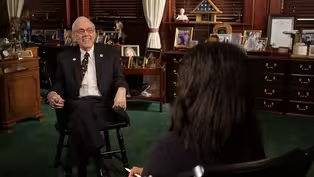
Clip: S2 Ep19 | 49m 14s | Renee Shaw sits down with Paul Patton, the 59th Governor of Kentucky who served 1995-2003. (49m 14s)
Video has Closed Captions
Clip: S2 Ep19 | 2m 59s | CANE Kitchen has been working to improve physical and mental health through food. (2m 59s)
Video has Closed Captions
Clip: S2 Ep19 | 7m 35s | Gov. Paul Patton talks about his affair and the state of the Democratic Party in Kentucky. (7m 35s)
Providing Support for PBS.org
Learn Moreabout PBS online sponsorship
- News and Public Affairs

Top journalists deliver compelling original analysis of the hour's headlines.

- News and Public Affairs

FRONTLINE is investigative journalism that questions, explains and changes our world.












Support for PBS provided by:
Kentucky Edition is a local public television program presented by KET