Keystone Edition
Legendary Coach Mark Duda
1/19/2026 | 55m 59sVideo has Closed Captions
A celebration of the inspiring life and career of Lackawanna College football Coach Mark Duda.
Mark Duda helped produce more than 450 NCAA Division I athletes, and more than 25 players who went on to sign NFL contracts. After his recent Parkinson's diagnosis, Duda retired at the end of the 2025 season. His work on and off the field has encouraged countless young men to become the best versions of themselves at home, in the classroom and out in the community.
Problems playing video? | Closed Captioning Feedback
Problems playing video? | Closed Captioning Feedback
Keystone Edition is a local public television program presented by WVIA
Keystone Edition
Legendary Coach Mark Duda
1/19/2026 | 55m 59sVideo has Closed Captions
Mark Duda helped produce more than 450 NCAA Division I athletes, and more than 25 players who went on to sign NFL contracts. After his recent Parkinson's diagnosis, Duda retired at the end of the 2025 season. His work on and off the field has encouraged countless young men to become the best versions of themselves at home, in the classroom and out in the community.
Problems playing video? | Closed Captioning Feedback
How to Watch Keystone Edition
Keystone Edition is available to stream on pbs.org and the free PBS App, available on iPhone, Apple TV, Android TV, Android smartphones, Amazon Fire TV, Amazon Fire Tablet, Roku, Samsung Smart TV, and Vizio.
Providing Support for PBS.org
Learn Moreabout PBS online sponsorship- [Announcer] From your Public Media Studios, WVIA presents Keystone Edition, a News and Public Affairs program that goes beyond the headlines to address issues in Northeastern and Central Pennsylvania.
This is Keystone Edition.
And now moderator, Julie Sidoni.
(upbeat music) - Think of all that has happened in the last 32 years.
That's the amount of time football players who come to Lackawanna College in Scranton have been taught by, and in many cases, mentored by one man, coach Mark Duda, whose hire began the football program there all those years ago.
That alone, of course, is something to celebrate, but coach Duda's influence might be even greater off of the football field.
You're about to hear from representatives from the college, from family members and people who know him well, and also from players themselves, past and present.
But first, we're gonna hear from coach Mark Duda himself as he embarks on a new path in life.
We are so happy to have you with us here, coach.
- It's great to be here, thanks so much, Julie.
- Now, for viewers who might be unfamiliar with your story, we've put together a little piece.
This was done by our great team here of WVIA News with some help from filmmaker Al Monelli.
(upbeat music) - I've had coaches that tried to be like him.
- Let's go, let's go.
- But there's nobody like coach Duda, - He's a gifted leader.
- Good job (indistinct).
- He's a gifted talker.
- Great effort thus far, hey, training captain.
- He's a storyteller.
- If you look at his face, right, you've missed tag completely.
- We were in a weight room when he was in eighth or ninth grade, and he said to me once he just, "coach, I'm gonna play pro football."
He was not the biggest guy on the team.
He is using his level of intelligence to take it to another level.
- Great sense of humor, he is a funny guy.
- If he says something, you don't have to ask him to repeat it twice.
You usually hear him the first time.
- Here we go, he we go.
- There's such a high standard here.
And, you know, seeing all the great things that he's done.
You want to keep those.
You wanna live up to those standards.
- He loves to teach lessons, life lessons.
He does it to me, "you have two choices, Jill, you got two."
Okay, he does it to our past presidents, everybody.
(upbeat music) - We actually met at Lackawanna, we met here.
He had been working here for approximately a year and a half, and I was coaching and we just sort of hit it off.
I mean, we talked, he called me and the rest is history.
30 something years later.
- He's a proud Northeastern Pennsylvania guy.
- Let me tell you this, Mark does not have any hobbies except for family and football.
(upbeat music) - You know, it's great, we're one big family.
- Your parents are invited to if they wanna come.
(players cheering) - He's a teddy bear at home, he's a soft, caring person.
So I don't think everybody sees that, but I see that every day.
- He's always gonna be that guy that you can just always rely on just to simply talk to.
- He's humble and he stays humble, and he knows who he is, where he comes from, and that shines through, you know, with everybody that he touches, so.
(whistles blows) (upbeat music) - Thank you coach for building a legendary career and shaping us all along the way.
You've taught us discipline, teamwork, and just the right amount of fear to keep us running.
We miss the yelling, the wisdom and the passion.
Enjoy your retirement, you truly earned it.
- Coach Duda, I want to get on here and say congratulations for all your success and being a great coach for many years.
You put Lackawanna on the map and you changed many lives during the process, including my own.
Without you, there would've been no D1 or NFL.
I just wanna say thanks coach for everything.
I appreciate you.
- Hey, coach Duda, I just wanna congratulate you on coaching and being successful and leading men for many, many, many years, and we're forever grateful and forever thankful for you taking us in and treating us all like one of your own.
Love you, and congratulations, you earned it.
- Coach Duda congratulations.
Couldn't be more grateful to have played for you and see what you've done for so many players and helping 'em throughout their career.
Unbelievable coach.
And I wouldn't be here as a coach without having you kind of teach me the way and show me the path to being a great leader and coaching young men.
So thank you for everything, congratulations.
- Coach, congrats man.
Retirement's here, I can't thank you, you know, more than enough for all the opportunities you've given me there, all the times used to bust my marbles about, you know, I'm a local kid and I'm lazy, x, y, z. But like I said, we appreciate everything you've done for us, you've humbled me, you turned me into a kid, into a man.
I can't thank you more than enough.
I hope you're your retirement.
- Hey, what's up coach Duda, it's your boy Rex here.
And I just wanted to make this video to say that I appreciate you for everything.
You played a huge role in my life and in my career, and I just wanna appreciate you for bringing me along and making me a part of the Lack family.
- Coach Duda, O.J Anderson here, voice from the past.
Congratulations on many wins and your continuation of producing guys to go to Division one and Pro football.
Enjoy your retirement, - Coach Duda, Scott Houseman here.
I just wanna say congratulations and wanting to thank you for everything you've done in my career and the man you've made me today, how much you've helped me.
- Hey, coach Duda, Martinez here.
Words can't fully express how grateful I am for everything you've ever done for us.
Not only myself, for all the other players you've been involved with.
You took me in when I was in my lowest, you let me stay in the dorm, you won't tell anybody about that.
You showed me how to be a coach.
You showed me how to be a mentor, and I transition that into a career.
- And by the way, we'd like to thank Lackawanna College for those player sound bites.
Using them has been, it's really great to hear it's straight from the players.
So are you ready to hear a lot about yourself this hour?
- I'm really sure, you know, you're usually not the focus, the team is usually the focus.
It should be, but I guess a little bit different.
- Well, let's start right in the beginning from where you grew up and how you got so interested in football to begin with.
- Well, I grew up in Plymouth, Pennsylvania, a small town right here, 10,000 people mostly when I was younger, a coal mining town.
And then everybody got into textiles after that.
So the town was very small.
There was a football team.
We had the Shawnee Indians football team, which was a, when I was 10 years old, one of the five most vivid members of my entire life was making the team as a 10-year-old and just like rolling down the field.
So happy that I made the football team.
I knew I loved it and not just a game, but I loved everything around it.
I loved weight training.
My father bought me weights every year so I could lift them.
I loved running, I loved all that stuff that was involved in football.
And I loved being able to like, know so many people.
You know, you're in your town.
It's Plymouth, Pennsylvania, there's 30 guys there, like 30 kids.
I stay in touch with those guys today.
John Dombroski, here it is somewhere in Georgia.
He'll hear this, you know, I've been his friend since we were five years old and, you know, he was a football player on that team.
So it really did begin to make me more social.
And as Jill Murray and of course Dr.
Murray and of course, Ray and Colonel Volk, wherever you are, I'm very social.
I like the talk, I really do like it a lot.
And so that kind of helped me kind of come outta my shell if I ever had one.
- So you were drawn to team sports right away?
- Very much so.
- What about football in particular?
You just like, and what was your position?
Are you hitting people?
What is it about it that you just went right toward?
- I was always an offensive defensive lineman ever since I think the physical part of it, I do love there's no question.
And running into people and running over people, I really enjoyed immensely, I really did.
And some of that is just the physical nature of it.
I have an older brother, Steve, who's in the audience who played three years before me.
He played at Valley West and he played at Villanova.
And he is a big kid.
Like when my brother was in sixth grade, he was like 5'10, 165 in sixth grade, right.
So I had a big brother, like I had a big brother, right.
So we would wrestle and we would fight and do all those things.
And the physical part sort of became really easy, right.
It became really easy.
Like there was no fear of any confrontation.
There was no fear of any game because you had a big brother who was this big strong guy that you always would wrestle around with.
So he kind of set the tone for me to have nothing but like love for the game.
- You played at Wyoming Valley West eventually?
- Yes.
- When you were a player, were you thinking, oh man, I wanna coach, I could do this?
- You know, I wanted to play as long as I could and I always wanted to coach as long as I could.
And so when I got to play at 10 years old, I wanted to play as long as I could play.
I got to play until I was 29 and I wish it was 39, it was one of those kind of things.
So I loved every bit of it, but I think I wanted to coach.
I couldn't see myself leaving the game completely.
Like I couldn't see myself like playing my last snap in the League and then never being on a field again.
It just frightened me.
It made me feel like I would miss too much of my life.
So I tried to get into it as quickly as I could and fortunately I got into the Lackawanna College for sure.
- You never considered any other career?
- No, no.
- Right from the start?
- No.
- No.
- No.
- Asked and answered.
- No.
- So after your time at Wyoming Valley West, then what?
- Well, the University of Maryland loved it there.
Coach Jerry Claiborne was a fantastic leader, great coach, a southern gentleman from Paducah, Kentucky, no-nonsense guy who believed in hard work and little else.
He just believed in players working as hard as they possibly could.
He was a no-nonsense guy.
I'll tell you one story, which I'm allowed to tell, I guess I'm allowed to tell.
- You're telling it now?
- Sure, my freshman year, I go to college and I didn't want to go to college, I just wanna play football in college.
Right, so, but I knew to go to play football, I had to go to college.
So I went to college and I went to my first semester and I failed miserably.
I failed courses, I should have never failed.
And I came into Coach Claiborne's office, which was imposing, like he was 180 pounds, but he was like nine feet tall when you looked at him.
He was just one of those guys.
And he said, you'll be the best athlete who works at Leslie Fay.
And so my dad goes, what are you doing?
So I came back the next semester, made a dean's list and continued on away education.
Never had an issue again, but it was one of those wake up calls, well, you can't do this unless you do that.
And that taught me a valuable lesson.
I think we've learned all the time.
- If we hear a lot about your perseverance, actually, particularly when you were a young athlete and saying, this is what I'm doing.
This is where I'm going.
How much pushback did you get on that?
- You know, it was funny, you know, my father, God bless his soul, we'd sit and watch games and Steve will tell you, my brother, and I said, I'm gonna play in the NFL, that's where I'm gonna play.
And he'd go, that'd be nice and stuff, you know, like he was, that was nice to me, but, and then when I was 15 I said, you know, dad, I'm gonna play in NFL.
And then when I was 20, I said, dad, I'm gonna play in the NFL.
When I was 21, I played in NFL.
Like for me, it was something I always wanted to do more than anything else.
And he was, and they were always my mom, my dad, my brother were always super receptive to it.
They never dismissed it like they just let me live it.
And it turned out to be the case.
- Were you that talented, that hard of a worker both?
- I think I'm the second most talented Duda son, the first talented ones up in that crowd up there.
He was the most athletically talented of the two of us.
I was dogged, I was, they said it once I am doggedly determined in the things that I do.
I have a lot of determination in what I do.
And so I think that I just sort of outworked a whole bunch of people that were more talented and I'll take it, you know, that's the way it went.
- You're drafted by the St.
Louis Cardinals in the fourth round.
We've watched the draft, we've all seen the draft, we've seen that moment when the name is called.
What was that moment for you?
- I was in my room the night before the draft.
Everybody goes out and so we all went out.
I came back and you're waiting for the phone to ring.
Now, back then, it wasn't like it is now where didn't have a camera on you and so forth back then.
And so I was waiting for the phone to ring and I knew when the phone ring, I was gonna get up.
I was getting my car and I was gonna go, you know, back to Plymouth to see everybody.
So I think it was like four o'clock in the afternoon thereabouts.
And a guy calls and says, you know, we've just taken you like the 92nd pick or something like that in the fourth round to St.
Louis now.
I was trying to figure out where St.
Louis was for a second.
It took me a little time, geography wasn't like my thing.
So I was figuring, well, St.
Louis and so I figured out where it was and every team had talked to me and every team had worked me out.
And St.
Louis didn't even seem really mildly interested in me, but there was a coach there named Floyd Peters, who was a legendary defensive line coach who liked what he saw and he recruited me there.
- What being in the NFL is something that so few people can speak to or speak about.
I mean, kind of briefly encapsulate your time in the NFL.
Was it everything you wanted it to be?
- It was more than I could ever imagine.
The best story I have, well, there's a lot of stories you have, you can't say, but the good story is this.
And so we're playing my first game ever, we play in Superdome.
- Wow.
- And so I played in Superdome before we played Tulane there a long time ago at Maryland, but I played in a Superdome.
And so you got a picture this now somebody who's a little older than a crowd can picture this.
So I line up and I look up and Kenny Stabler's the quarterback for the Saints.
Now, myself and my brother used to watch him all the time.
We watched them all the time, we loved them, right.
And then I looked up above him, right.
And Earl Campbell was playing running back for the Saints.
And Earl Campbell is like a legendary figure, like if you, everybody in Texas, like built statues about Earl Campbell.
So I'm sitting there and I'm playing against these guys.
I didn't know whether to sack him or get his autograph.
(audience laughing) Like I didn't know, I was like, oh my, this kid is Stabler, man, - You might to sack, I'm guessing.
- I wanna sack him, so, and we played the game, the game was over and I see Earl Campbell, we shake hands coming off and I said, "Earl, how long are you gonna do this?"
"Oh, a few more years."
He's like 38 years old and he was still playing.
He was so good, so that kind of gave me the realization that those guys were playing football when I was in junior high school.
And so you realize how good you can get playing the game.
So I was like 13 when Earl Campbell got in the League.
And so that is just something you'll never forget the rest of it.
- What was the transition then between your playing years and when you got to Lackawanna College?
- It kind of interesting, so we play, you know, you play as long as you can and there's two ways it happened to you.
You retire 'cause you get hurt, which I did, or you just get, you just can't just do it mentally anymore.
So I could do it mentally, but physically I couldn't do it anymore.
So I came out and I didn't really know what to do, right.
So, 'cause I never had a season in my life where I didn't play or since I was 10.
And so I was 10 and then I was like 30.
And so I didn't know exactly what to do.
So I started at East Stroudsburg and coached there a little bit.
I coached with Coach Mickey Gorham and some of you guys know Coach Gorham, who's a tremendous football coach at Myers High School.
Just a legendary coach.
And I just vowed that I would learn from all of them.
Like I would try to learn from all of 'em as much as I possibly could.
And then there's this little ad in the paper and where's Ray, where's Mr.
Angeli, he's there.
So there's an ad in the paper, a Lackawanna, and it had to be like, it looked like there was selling like dumplings.
There was this little ad and it was like two sentences, Lackawanna College to start a football program.
Like it was really, and I was like, that's like, well that's pretty close to Dallas, Pennsylvania I could, so I go up and I interview and true story I interview, I don't get the job, but the guy who gets the job, Wally Chambers goes to Frank Sano in Clarks Summit Lincoln Mercury for a car.
And Frank Sano's son is Greg Sano one of my best friends in the world.
And so Frank, like lamb based stuff, he goes, I cannot believe you hire Mark.
And he is like all over him.
And he is like, geez, you know, I didn't know.
So they came back and they hired me as the defensive coordinator in my first year at Lackawanna College.
And then Coach Chambers left.
And then I took the job as the Head Football Coach from that point forward.
That's how that kind of worked.
- I've heard a soundbite it was Dr.
Jill Murray having the audience here.
She has credited you with saving Lackawanna College.
Those are big words there, what do you, what is your reaction to that?
- Well, I know there's a tall guy that's sitting right next to her right now named Ray Angeli who kind of saved Lackawanna College also.
You know, it's rewarding to know that our kids could come get an education at the school and they could help financially make the thing keep going to now as strong as it is today.
And so I do take really pride in that, that those guys really helped out.
But also we helped them as well and they got great careers out of as well.
So it was kind of like a help both groups.
But you're right, it was a tenuous time at best.
But I think everybody was brave and everybody forward and these guys did a great job and that's how we got where we were.
- Can you explain a little bit more about the PSAC?
I understand that's something that you have been working toward that is now happening.
Can you explain to people what that is and why that's such an accomplishment?
- Sure, well, you know, it's a Division two program now.
Lackawanna is now like branched out into four year programs.
When we first got to Lackawanna, there were two year programs only.
And so the associate degree bearing programs, now it's become a four-year school, which is fantastic for everybody involved, the city and everybody who plays football, who doesn't play football.
But from a football standpoint, it kind of legitimizes the program.
Right now you're playing against teams that have played for like 80 years and you're playing in the Commonwealth.
So you're playing Bloomsburg and Stroudsburg and all those schools that have been playing football against each other for so many years and you legitimize the athletic program, right?
So Erik Larson, who's our Athletic Director now, has you know, has the duty the job wherever he is, Erik and of kind of making all that go.
But it's fantastic opportunity, then it never happens.
Two year schools don't become four year schools and two year schools certainly don't join the PSAC.
But if the football program has any indication of that, I think we were good enough and we were exposed enough to say, you know what, I think we're gonna give these guys an opportunity.
So I think it's huge for the community, it's huge for everyone and I think it's gonna really move the college forward in a great way.
- I should say that Pennsylvania State Athletic Conference is PSAC, what we're referring to PSAC, is this, I see your wife, you're a lovely wife, you know her, huh?
We see her in the audience.
And I just, I want to take just a little bit of a moment to ask you, you're listening to him kind of go through very quickly all of the ways that he came through this, through his personal athletic story and into Lackawanna Colleges.
What's your perspective from that time?
- Wow, well, I've been at the college for over 30 years.
I was even there before Mark arrived, so I did a lot of that background before football started.
It's just grown tremendously and I've seen him grow with the program also.
So it's just been an adventure.
30 years of a great adventure, I have to say.
- As an aside, when we started the football program, and Denise will tell you, she was one of the people who went to get equipment from Ulster that we had to, we've got equipment from another school that had closed their football program.
Denise was one of the people who went to get the equipment.
Like that's how far back it goes.
And to say this, you know, like I have her up there so I'm embarrassed the hell out of her.
That's what I'm gonna do, that's what people like me do.
- What else is new?
(audience laughing) - You know, like I wouldn't have stayed at Lackawanna all this time without her, and I'm not really sure anybody keeps me as grounded or could possibly keep me as grounded as she can.
And so that is something because as all of our leaders know, I can sometimes get a little bit on the edge and so she keeps me off the edge.
But it's amazing how we kind of grew together through the program, it was fantastic.
- One more question before I let you go, Denise.
We're about to get into the part of this where we're talking about the impact on the players and I've heard many of the players mention Mrs.
Duda as part of the thanks.
What was your role in helping these young men grow?
- You know what I think, I think just being there for them, listening to them, making them feel maybe that we're a family away from their family.
You hear them, they'll still call, text me, mama Duda, mama Duda.
That's, you know, you hear that or it's just Mrs.
Duda, but I wouldn't have it any other way.
I've enjoyed that.
It made me feel like I've had over a thousand sons.
You know, it's just.
- In a way you have?
- They, I think sometimes they've impacted me just as much as I have impacted them.
- Well, thank you, thank you very much.
Alright, we have another story to show now, again, from the WVIA News team and Al Monelli.
(upbeat music) - What's really interesting is when a student or previous student reaches back to us, they always talk about the times and the impact he had on them.
They never talk about the games.
- Mark had a tendency to find kids that needed help.
- A lot of our students come from very diverse backgrounds.
They might not have that father figure, that support.
They see that in Mark.
- And now you start to see the players that he had that are playing Pros and doing things.
I think there are things that become more important.
- He changed the trajectory of their life path.
(upbeat music) (indistinct) - His name is Jaquan Brisker.
He left here, went to Penn State, and now he is a starting safety for Chicago Bears.
He's always asking us, when are you coming to the game?
When are you coming to a game?
He got a sideline passes, we saw the game, he came immediately over to us and said to Bear social media, get our picture.
- He had conditioning programs, which would start at 5:30, 6 o'clock in the morning.
And he set it up the way it would be if you were playing at a bigger school.
After playing at Lackawanna, I got recruited by Syracuse University So when I got there, it wasn't a shock when they said, hey, during the season you have lifting at 5:30 or six o'clock twice a week.
(upbeat music) (whistle blowing) - Those are true stories, right?
He is in that dorm with a whistle.
- Yeah, he definitely comes through at like 5:30 sharp, five o'clock and he's blowing that whistle from first floor to third floor.
- I do remember hearing the whistle that early in the morning, - He's committed to, I'm gonna get you outta bed at 6:00 AM 'cause we gotta go practice, right.
I'm here too.
And so they respond to that.
- Coach Duda has meant a lot to me.
He's a very big figure to me.
I look up to him, he's more than a coach.
He says it all the time, I don't have just one kid, I have 150 kids, you know.
- Here we go, crank it up.
- Here we go.
(players clapping) - One, two, three, he's gotta find out.
- What he's gotten kids to do beyond what they thought they were capable of.
I think that's the most important thing.
- There you go, football up.
(whistle blows) (upbeat music) - Hey coach, how are you doing?
It's your boy LeMarcus Newman, aka Texas, aka one of the fastest runners to ever come outta Lackawanna Junior College.
You are not only a great coach, but also father figure and a mentor for so many different athletes across this nation.
Coach, I greatly appreciate you for giving me the opportunity to play ball at Lackawanna Junior College, I had the opportunity to play professional ball, not only play professional ball, but get an opportunity to work in the National Football League and work under President Obama, coach.
I greatly appreciate you and if it wasn't for you, I wouldn't have those opportunities, coach.
- Hey, coach D, happy retirement man.
Thank you for everything that you've done for me personally from a young child all the way into my adult years.
Everything that you instilled in us is definitely, you know, I'm glad to be a part of your journey as you were mine.
Now in my young career in coaching, I'm just looking forward to, you know, being as great as you are.
You know, you definitely set the standard, so thank you for everything that you've done for me personally and Black life, Savage life.
- What's up coach Duda, it's Nick Flores just checking in, wanting to let you know how much I appreciate everything you've done for me, right.
You gave me an opportunity and I'm forever indebted and forever grateful for everything that you've ever done, man, you changed my life and I wouldn't be where I'm today without your help.
- Hey, coach, it's Chris Yanik class of '99 coming to you from Brunswick, Georgia, home of the one time Golden Isles Bowl.
Just wanna say congratulations on retirement and I'm praying for you that the treatments work well for you.
- Hey coach, it's Kevin Walker here.
I wanted to take a time out real quick, intended time out to say congratulations on your retirement, well deserved.
We're talking 30 years of coaching at the same spot.
You just don't hear about that in this day and age coach.
But as being one of your first players to come through the program at Lackawanna, being the first player to receive a D1 scholarship and seeing how this program has grown since then, it speaks volumes to you as a coach, to you as a man.
I'm a proud alumni, as you can see.
I'm rocking the gear as I always do, following you guys.
Unfortunately, I can't be there this weekend.
I've really tried to be there, but I want to just reach out to you guys, to you personally, coach and say thank you for doing everything that you've done.
- Now, he mentioned this weekend, I assume there was a celebration for you at Lackawanna College.
- Yeah, there was an alumni weekend and a lot of guys came in from like all over the place.
Todd means came in from Las Vegas and different, the guys are spread all around the country, so it was really nice to see them.
Whenever we get a chance to see 'em, we take advantage of it.
- This is as good a time as any is, I want you to name drop.
Let's name drop who you got in the NFL.
Who's the doctors, who's the lawyers?
What have you done?
Tell us all about it.
- It's crazy, I mean, I think the start, how they start is more amazing than even how they finished.
Like where they came from originally.
Bryant McKinnie is a guy that people know.
Our dorm is named after him.
He played for 13 years in the League.
Well, he was in the band when he was a junior, didn't play football, played football when he was a senior.
Played for us for two years, played for Miami, won the Outland, then he went to the League and won the Super Bowl.
One of the better, probably one of the top five or six offensive line who ever lived.
And he was a 17-year-old kid who wanted to go home in the first week.
And so there are these tipping points in people's lives that you really have to understand so, so urgent.
And if you do the right things with them and take advantage, things go well for him.
So he's a prime example of that.
The Pro guys, we all know about the Pro guys, right.
Because they're on TV and stuff and you know, Mark (indistinct) is on TV and all those guys are alumni, the guy from the Giants are, he's their right tackle.
Pretty interesting stories from London.
Okay, no, we're not very creative at Lackawanna.
So I call him what, London.
Okay, so his name is, was calling him London.
Well, London comes here, he's from New Jersey.
He goes from London to New Jersey, plays football for one year, goes to Lackawanna, plays for two years, goes to Texas A&M, he's still in the League.
He's like been in the League for like 11 years.
11 years, okay.
So a guy who played football for basically one year in high school, right.
And two years at Lackawanna is playing in the League for like 11 years.
Completely, completely different story.
And so those people all have a place with us.
But to me, I know this sounds trite, but it's not, to me, teachers and all those kind of people that we bring up are vitally important and maybe even more profound because they come from an environment sometimes where nobody gave a chance to do that, right.
So education is just an opportunity, right, it's a chance.
And so if football can keep you here, right, then education could take you where you wanna go.
So sometimes you need that carrot, you need that, that something you really, really love to do to help your education.
So I see all these guys doing this stuff.
G Wade's out there, a guy named Shaun Galloway's out there in California.
He owns an ice cream company for the love of God.
Like I don't know how he does that, but he's out in San Diego and like he had no offers come out of high school.
He had no place to go really.
And came to Lackawanna College, got a college degree and now his life is different.
So education is what you make.
It's for certainly, but I think sometimes you need like an entree into it.
You need something to kind of get you into it.
- If so many of these young men credit you with getting to where they eventually got to, the big question is why, how, how were you able to do that?
- I think I love 'em enough to make their life difficult enough so their life turns out not difficult, right.
I love 'em enough so that you get punished at Lackawanna when you don't do what you're supposed to do.
You run stadium steps, you do all those things, right.
Care about 'em enough and they start caring about themselves.
And once that happens, everything changes.
Their lives change.
Like, you know, that look on a kid's face when he realize he can actually do it for the first time he can do it.
Your children, when your children walk for the first time and they realize they can do it.
Well, these guys are kind of the same way.
They realize they can do college work and then all of a sudden everything changes, their attitude changes, their life changes.
And I think that's really, really important.
So for that person who's teaching history, he's as important to us as the first round draft choice.
Absolutely is important to us.
And they all know it.
They all know it.
That changes everything, right?
- So you're able to see in real time what these young men look like when they first come to you and what happens one year, two year, five years later?
- It's fascinating, and myself and Denise, you know, we sit home and of course we talk about them.
Talk about 'em all the time and how they change and how they develop.
And at the end of it, like they become your best friend at the end, but sometimes you have to be hard and you have to be disciplined with them because they just need that.
- Your daughter Taylor, right?
I understand kind of grew up on the sideline there.
What is, I mean, she's not here.
I believe she lives in Florida, correct?
- She lives in Florida.
She has been at many games.
What we decided a long time ago was that if we could, we'd have Denise at every game that was ever played.
As soon as my daughter got old enough that she would be at every game we ever played and to our presidents, to their credit, they allowed us to do that, right?
They allowed us to go to Bowl games and do all those things.
She thought a 320-pound offensive tackle was a normal looking guy, right?
When she thought Brian McKinney was just like a regular guy, right?
She thought that, she thinks like a 225-pound linebacker hits somebody.
She doesn't even wince.
She's been at hundreds of games, hundreds of games.
And then she went to West Virginia, long and behold, and guess where she worked?
I'll give you a guess., the football office, right.
So she worked in the football office and we had four players there from Lackawanna at the same time as she went there.
And so Taylor has been involved in football our entire life.
But you know what's nice about it, and I'll say this to everybody here.
Everybody who's a father, how nice it is to be able to include your daughter and wife at work.
How nice is that, what an advantage that is.
And I'll be honest with you, that is the single most important reason that I stayed.
And people say, why did you stay, why did you stay?
Because I can include my wife Denise, and my daughter Taylor.
That's why I stayed because I could have a family and I could coach football at the same time.
And we know in many situations that coaches don't have families or they don't have families they could see very often.
So I've had advantage.
So I thank you all for having that happen.
That was very important for me.
- You had to have had other offers.
- Yes, yes.
- You wanna elaborate?
- No.
(audience laughing) Hey, sometimes I was, sometimes you get the offer and you'd be like, damn, where's Colonel Volk?
Where's Colonel Volk, he's there, yeah.
Sometimes you get an offer and you go to the Colonel and you say, Colonel Volk, I'm gonna go to Oklahoma, you know, and don't go to Oklahoma, like stay here, you know.
And so yeah, you do get offers along the way and it's very flattering.
But when I got out of high school, I went to Maryland like we talked about.
Then I went to Phoenix, like we talked about, I'm sorry, St.
Louis.
Then I went to Phoenix like we talked about.
I travel all over the country.
I did not wanna travel all over the country again.
And you know, coaching is a three or four year stint and you travel and you know, the thing I learned a long time ago, your family has to travel too.
And so now Denise has to have a different job and Taylor has to be in a new school.
And to me it just was not worth it.
And I could get more done here and I'll say it to the day I die, maybe we'll put it on a tombstone, I'm not really sure.
I think we have done more here for these kids than anybody could have did at any level.
And to me that's really, really rewarding, more than anything else.
- Had you gone to Oklahoma, maybe the impact wouldn't have been there.
- It wouldn't have been there, yep.
You coach eight great looking kids who could really play the game, right.
And then they go to League or wherever and you coach eight more, Lackawanna, you coach 130, sometimes 140 yo, sometimes 140.
Ask my brother back there, the big fella.
He ran the dorm, right?
And sometimes there was like a lot of kids there.
And so I think you get to influence more kids.
And I really think that for me in my life, if I look back on it, I will 100% say it did the right thing, no question.
- Before we get into our last bit of conversation here, we have one more video to show you.
And this one we think is kind of interesting coach, because it's not you being the coach.
You're a little bit in a vulnerable position at Rock Steady Boxing.
- Sure, absolutely.
- We're gonna talk about your Parkinson's battle here, but this introductory video.
(upbeat music) (vehicle door slams) (upbeat music) - Hey guys.
How are you?
(upbeat music) - All of our phones went off 'cause we have a group chat, it said meeting at the Feeder.
And coach Duda said, listen, he didn't have a lot to say, but you know, he told us about Parkinson's and he told us about how he's retiring.
And he said that I was able to do the two things I love in life.
I was able to play football and coach football.
- The entire team gather in a line and went through and gave him a hug because it just shows how much we care for him and how much he impacts us that we want to just be there for him.
(upbeat music continues) - You know what, it was probably one of the most difficult times in our life, I have to be honest.
(upbeat music) He always says to me, I've had two jobs careers in my life.
One was playing football that was taken away from me for injury.
The second was coaching.
And in many words, it's taken away from him again, it's always about the other person, whether it's his family, whether it's his players, whether it's the college even, the team, he always puts everybody else first.
So now I'm trying to convince him that this is about you and taking care of yourself.
(upbeat music continues) - Boxing any form of physical activity is beneficial for people with Parkinson's.
- What makes boxing unique is it's usually a skill that they don't already know.
So now you're using your brain to learn skills that you didn't previously know.
But we usually always start out with get to know your question.
They get to know your question is to encourage socialization, but also to practice using a loud voice because Parkinson's affects people's voice value, makes it lower.
- Parkinson's it's actually the fastest growing neurodegenerative condition affects over a million Americans.
- Mark is doing great.
Mark really enjoys being around the other people.
- I don't think anybody should be ashamed of having neurological disease.
I can't be the best person in the class.
I just want to be the best me in the class.
- If there's anybody who could weather the storm, have the attitude and just being positive, I think it's coach Duda.
- I don't see Mark ever using it as an excuse.
It just makes him work harder to overcome something.
And since I've known him, we've been married over 30 years, that's all I ever see him do.
He challenges put in front of him and he does his best to bust through it.
- I cannot say how proud I am of knowing him, how proud it's been to be able to touch his life and be part of his life.
I think that's important.
- He's gonna be a mentor, he's gonna be a mentor to new coaches.
He's gonna continue to be a mentor to our football team, but to other students as well.
And so we're excited that he's not leaving and that's like, that gives me joy and pleasure and peace.
You know, I can't imagine this place without any piece of Mark Duda because he's been so important to us.
(upbeat music) - Coach Duda, thank you for your strength, leadership and heart, both on and off the field.
You taught us more than football.
You taught us how to fight with courage and to live with purpose.
We stand with you on your battle and to celebrate your incredible legacy.
- Coach Duda, congratulations on your upcoming retirement.
You have done an excellent job coaching so many men across this country.
May God bless you and your family as you enter into a new phase of your life.
You're in my prayers.
- What's up coach, well, it's Jamison aka Agent 47.
Congratulations brother on retirement.
I remember my first visit, like it was yesterday.
The very first two people I saw were Big Baby and Monterey and I didn't think I'd be able to play at that level, but you gave me a shot.
So I appreciate you, appreciate all that you and Mr.
Duda have done for me and I wish you best of luck man in retirement and hopefully you can stay busy.
- Coach Duda man, my guy.
I just wanna say, you know, I appreciate everything you've done for me and my family gave us another chance at life, man.
You know, we thought the door was closed on football, you know, becoming Division one football players.
You know, you open up the door, you opened up your door with open arms for us, gave us a second chance.
You made us better football players and better men.
We can never repay you back and thank you enough.
- I watched those sound bites over and over so many people saying the same thing from all corners of the nation.
And I wanna go to the audience one more time.
We have representative from Lackawanna College here, Brian Costanzo.
Brian, what's it like for you to sit here and see real time all of the people, not even all, a small portion of the people he has helped in his career?
- All right it's great to see some of the old players on the video.
If you don't think that coach knows all their names, it might just be their nicknames, but he does know every one of their names that have walked through the halls of Lackawanna College.
His impact has been countless and there's so many ways, you know, obviously football is one everybody knows about.
He changed the way Lackawanna College looked at athletics.
He put Lackawanna College on the map nationally, you know, created the football program there was a national competitor every year.
And it probably affected all of our other athletic programs, but there's so many other ways that he impacted the college.
And we talked about financial stability before.
Mark doesn't talk about this a lot, but one, he was one of my first bosses at the college 24 years ago.
And we were doing some fine admissions work back in the day.
He was the Director of Admissions 15, 20 years ago.
And it was hard work.
And not only are you recruiting your students, but you're bringing in other students that are gonna make a difference.
You know, it was a different time at Lackawanna College and you know, he talks about the 120, 130, 140, football players sometimes.
And that was real because he understood the impact of how those students were gonna affect the college and also was willing to take on the responsibility to coach those kids and keep them there and make them successful because it was important to the institution and make us successful in where we are today.
- Thank you for being here and thank you for your comments tonight.
We should talk about Parkinson's disease.
The reason for your retirement.
I imagine you're not just hanging it up for no reason.
- No, I would never do that.
- I don't think so.
- If I had my way, I would probably coach till I died on the 40 yard line.
I just love this so much, but I don't love it enough to cheat the players that I coach.
So when we started talking about, this is a few years ago, like a few years ago, some strange things started to happen.
Like I'd go for walks with Denise and I really couldn't like, walk as fast as she was walking.
It was just the most bizarre thing.
And then I would, I wake up in the morning, it'd be super like so stiff that I couldn't really even really.
And I thought, what's going on?
And then finally a year or so down the road, my thumb started moving without wanting it to move.
So I knew I had to go find out what this was.
I had a friend of mine who played in the League with me and he said, oh, you have to go see a doctor.
You really have to go do that.
And sure enough, I got the diagnosis that I had Parkinson's disease and I knew nothing about Parkinson's disease.
I knew nothing about it whatsoever, but I knew that, you know, I needed help along the way and I just didn't want to be somebody who sat at the desk as the head coach and wasn't truly a head coach.
Like if you can't, if you're not actively involved with the players, you're cheating the players.
Now my players have been cheated a lot before they ever met me, right.
And some of have been lied to before they ever met me.
And the last thing I was gonna do was ever lie to them.
And so what we tried to do was, myself and Denise we were quiet and stuff about things.
We tried to go through those seasons, even two seasons ago and get through the seasons to work as hard as we possibly could, hoping that maybe it would improve.
We get better but it didn't, and it sort of got worse and worse and worse to the point where I knew I couldn't do the job like I should have done the job.
And so that would've been taking everything we did, whatever we talked about in this hour and just, and what, and just lied the same people who we've been not lying to for 32 years, is that what we're gonna do?
So I wasn't gonna do that.
So coming out with it was very difficult.
Not as difficult as having Parkinson's, not as difficult as my classmates have to live every single day.
They have, it's difficult.
Like, so for me it it's a journey like all are, and I'm gonna do everything I can and make it as long as a journey as I can.
But I don't want sympathy.
I just want people to understand that I would never stop coaching Lackawanna until I absolutely couldn't because some people coach for a living and for some people it's their life.
And for me it's my life.
All right, so I'm gonna figure out how to get around that.
I'm gonna go around the country next year and watch all the guys who play.
I'm gonna go to Phoenix and I'm gonna go to all over the place and watch our guys play.
'cause I really want to see 'em play and I wanna do all those kind of things.
And I want to help our athletic department as much as I possibly can, but from a physical standpoint, like I can't, I can no longer, it's hard to admit this, I can no longer wake up at 5:30 and coach 'em and train them and then go and then come home at eight o'clock at night and do it again, I just don't have that capability.
And my wife, who is my like, not only confidant, but my conscious very often, she'll be the first one to tell me when I can't do something.
Like she'll tell me, Mark, you really shouldn't do this.
And so then I had to go talk to coach Dr.
Murray of course, and talk to my team, which was very difficult.
But I would rather be a poster boy for somebody with Parkinson's who's trying to make it better than somebody who's trying to hide it.
If that makes any sense to you.
- Do your doctors think that your time in football contributed to the Parkinson's diagnosis?
- Yes, they do, I've both of them.
They do, they've determined that was the case.
Because remember football was different.
In the 1980s and the 1970s, you hit in practice every single day and you had true tour days and these guys are laughing back there.
Where's my brother?
Yeah, two days, Steven, right.
And so you were in full gear twice a day and you hit full contact twice a day and your training camps were six weeks long.
Okay, so there is no Parkinson's in my family.
None in any part of my family.
The only person in my family has Parkinson's me.
And so there is football induced Parkinson's and that's what I have.
And that's, you know, it came on slowly.
This is the thing that kind of like is devious about it like.
- How did you say a year, it took you a year?
- Like a couple years, like the first year.
Like you dismiss things we all do, right?
And so you'll, like you ever see that test they give you where you like when the breathalyzer test you take when you walk, when you're drunk.
They never said that when you walk like?
- No, I've never seen that.
- Well, you should try that.
Hey, some of you have seen it?
- Nope.
(audience laughing) - 'Cause Mr.
Costanzo has seen that.
And so when you walk like, and you walk foot to foot and you lose your balance and you fall, well as a player, I could have done that with my eyes closed backwards.
- Sure.
- Right?
And then I tried it in the Doctor's office and basically fell.
And I thought there was, like what's going on here, Doc?
How's that gonna be?
And so like, all these things start happening progressively over a couple of years.
And finally I just couldn't ignore them anymore and you have to do something.
And so then you go and you go to one doctor and then you go to another doctor and with the hopes of a being diagnosed and figuring out what to do next, medication, so forth.
And then also with the hopes of the NFL, you know, helping financially, because you know, when you, like in any business, when you're injured on the job, then hopefully they're gonna do the right thing by you and make sure that you're compensated for being hurt on a job.
And all these things are going through your head.
Meanwhile, everyone, you don't wanna retire.
I know this is the most bizarre thing, but you don't wanna retire.
You want to coach every game you possibly can.
You know how hard it is.
And my wife told me this too, she's so much smarter than me.
See, every year you are there.
Sooner or later you're gonna have to tell those freshmen you're not coming back, sooner or later.
Right, well, I wanted to be much later, right?
As late as it could possibly be.
And so you feel like you left them and it really does bother me to this day, but hopefully being around 'em, like Dr.
Murray said, being around them, at least I could be around 'em enough to make them feel like, hey, I haven't abandoned you.
I just can't do it in the same capacity.
I hope that's the case.
- Is boxing helping you?
- It is, markedly, it's helping me enormously like movement skills.
Like I do it every day, like I do something physically every day.
So there's never a day where I don't exercise every single day because all the Doctors tell me that is the thing that is gonna slow the progression down.
And so I'll be damned if I sit on my couch and lament my life instead of get out there and go, I'm gonna exercise.
And so I do it all the time, it's crazy.
- I'm gonna go to one more person in the audience right now, my colleague Sarah Hofius Hall from WVIA News.
It was largely her reporting that brought this topic to life.
And I know the two of you have spent some time together.
So Sarah, I just wanted you to have a chance to speak and say some of the, what you have experienced working with Mark through the years.
- Well, you know, I keep thinking back to, you know, so many players have mentioned this.
You've mentioned it to me getting up early in the morning and you would be in that residence hall with your whistle waking those young men up.
And what you said to me was that when they realize someone cares about them enough to be up that early blowing his whistle, then they start caring about themselves.
And I think your story has just resonated with so many people, you know, after I published the story about you retiring, I heard from so many current players, former players, even people with Parkinson's who were just so inspired by it.
- You know, it's appreciated, I mean, I think, I don't know.
I just think it's like you need to give 'em a chance.
And sometimes they need to give themself one too, right?
Because sometimes our kids don't give themself a chance, right, they feel like for some reason they're not worthy for some reason.
So I think they are worthy, but they have to earn it, right?
And so I said, why do you work at six o'clock in the morning 'cause it's harder than six o'clock at night.
Right, it's harder, I want it to be harder.
I want it to be extremely hard every single day.
So when they go to Oklahoma, they go someplace special, it's not hard, right.
It's not hard.
- We do.
- And so I think in our situation, that's what we try to do.
And academically, and there are some teachers, I see docs here, all these guys are here, hi.
Like, what makes those people special is that they take students who have not had enough education by the time they're a certain age, and they're willing to go back and work with them to make 'em special.
So there's special people for doing that.
And I say it to 'em all the time, I says, you know, like everybody, I always talk about guidance counselors.
Remember when you're a kid, you had a guidance counselor, and he would always write four letters for the top four people that were gonna go to Harvard anyway.
Where's the guy's counselor writing it for the last 20 people who just wanna try to go to college?
Like, where's that guy?
That's my guy, right, that's my guy.
So I wanna be that guy, right?
I wanted to be the guy who helped the kid who, oh, you know, he missed too many days of school or, you know, like or he got hurt when he was a senior, you know, and he didn't get the film he needed.
I wanna be that guy.
Our teachers are those people.
Our professor are those people.
And so when you see those work with somebody and somebody goes from being like Jaquan Brisker, you guys have Brisker, God love you.
So Brisker comes, you know, and he wasn't really a student when he got there, you know I mean, the son of a gun, didn't miss a class, didn't miss a lift, went to Penn State, graduated, we went to his graduation.
Now he's with the Bears and everybody loves that and all go Bears or whatever.
But the bottom line is he graduated from Penn State.
Who the hell thought he was gonna graduate from Penn State?
And he did easily.
So maybe these guys did a great job, just maybe, and maybe he bought in as well.
So I think that that's our institution, in my view.
That's who we are, right.
And if we always keep that empathy, I said this when I spoke to the group, if we always are empathetic with our students, not sympathetic, empathetic with our students, I think that the dividends will be enormous for them and certainly for us too, I believe that.
- Just one question left here, coach, which is knowing what you know now, anything you'd do differently?
- Probably win the ones I lost.
- You'd win more, you'd win more.
- No, I don't think I'd do anything differently.
I think that the only thing and once again, I allude to my wife all the time.
When I first got at the Lackawanna, I had just sort of gotten outta the League and I went from there and for a year or so, and I just got there, when I got there, I was absolutely a bull in the china shop, okay?
There was no question that the rules were kind of bothered me a little bit, right.
Like if it didn't make sense to me, it bothered me a little bit I would go, but I had great mentors, right, I had Jay Manion, right, And President Angeli and President Volk and President, I had great mentors who would calm me down.
But, you know, I would rather be calm down than have to be sped up, right?
I'd rather somebody say, hey Mark, you gotta sit down than to sit there and just like, oh my God, the sky is falling.
So I think that their leadership was fantastic for me at that time in my life because it was quite a transition going from, you know, St.
Louis and Phoenix where they basically carry your bag to the airport, drop, fly you to the game, take your bag, pack it, bring you back, put you on the plane again, and basically chauffer to your house, then go into Lackawanna or I gotta tell you, no, those things existed.
(audience laughing) All right, so we did everything ourselves.
So I think that was the biggest change I had to make.
And once I understood how much these people cared about the students that we had, that everything was fine with me.
I just had to realize they did, that's all.
- Coach Mark Duda, you have been an amazing guest.
We thank you for the enormous, tremendous impact you have had on this region, and we wish you all the best in the future.
- Thank you, those for having me.
And hey, thanks for coming.
- That is all the time we have here.
(audience applauding) That is all the time we have for this episode of Keystone Edition.
I'm Julie Sidoni, thank you sincerely for joining us and for all of us here at WVIA, we'll see you next time.
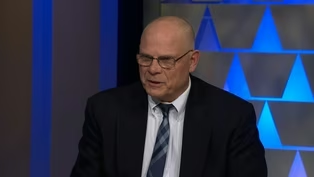
From Coal Country to the NFL: Mark Duda’s Football Journey
Video has Closed Captions
Mark Duda reflects on his journey from small-town football to the NFL. (15m 48s)
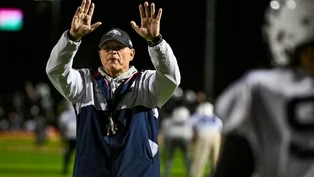
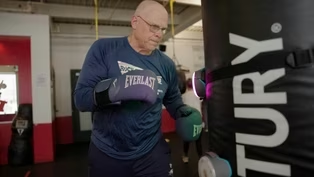
Mark Duda on Parkinson’s, Football, and Knowing When to Step Away
Video has Closed Captions
Mark Duda reflects on Parkinson’s, retirement, and integrity in leadership. (14m 59s)
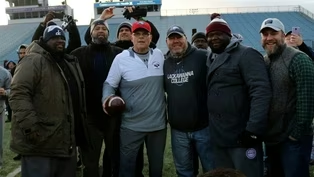
Why Mark Duda Chose Impact Over Fame
Video has Closed Captions
Mark Duda on leadership, discipline, and choosing impact over fame. (7m 50s)
Providing Support for PBS.org
Learn Moreabout PBS online sponsorship
- News and Public Affairs

Top journalists deliver compelling original analysis of the hour's headlines.

- News and Public Affairs

FRONTLINE is investigative journalism that questions, explains and changes our world.












Support for PBS provided by:
Keystone Edition is a local public television program presented by WVIA