
Legislative Maps, Reaction to Texas Abortion Ban, and More
9/30/2021 | 26m 46sVideo has Closed Captions
Legislative Maps, Reaction to the Texas Abortion Ban, and Chicago Bears
Host Hannah Meisel (NPR Illinois) and guests Jerry Nowicki ( Capitol News Illinois) and Kent Redfield (UIS) discuss the Governor signing for the new legislative maps, two house bills that were filed in reaction to the Texas abortion ban-- Protecting Heartbeats Act and the Texas Act, and the Chicago Bears leaving Soldier Field for a horse race track in the suburbs.
Problems playing video? | Closed Captioning Feedback
Problems playing video? | Closed Captioning Feedback
CapitolView is a local public television program presented by WSIU
CapitolView is a production of WSIU Public Broadcasting.
Legislative Maps, Reaction to Texas Abortion Ban, and More
9/30/2021 | 26m 46sVideo has Closed Captions
Host Hannah Meisel (NPR Illinois) and guests Jerry Nowicki ( Capitol News Illinois) and Kent Redfield (UIS) discuss the Governor signing for the new legislative maps, two house bills that were filed in reaction to the Texas abortion ban-- Protecting Heartbeats Act and the Texas Act, and the Chicago Bears leaving Soldier Field for a horse race track in the suburbs.
Problems playing video? | Closed Captioning Feedback
How to Watch CapitolView
CapitolView is available to stream on pbs.org and the free PBS App, available on iPhone, Apple TV, Android TV, Android smartphones, Amazon Fire TV, Amazon Fire Tablet, Roku, Samsung Smart TV, and Vizio.
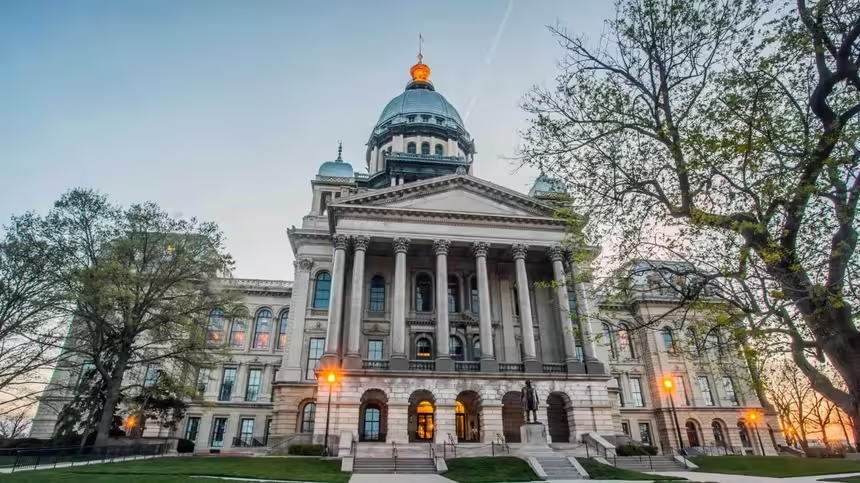
CapitolView
CapitolView is a weekly discussion of politics and government inside the Capitol, and around the state, with the Statehouse press corps. CapitolView is a production of WSIU Public Broadcasting.Providing Support for PBS.org
Learn Moreabout PBS online sponsorship(upbeat dramatic music) - Welcome to "Capitol View," where we discuss the latest in state government and politics.
I'm Hannah Meisel with NPR Illinois.
Joining us this week is Kent Redfield, Professor Emeritus of Political Science at the University of Illinois Springfield.
Thanks for being here, Kent.
- Good to be here.
- And also here is Jerry Nowicki of Capitol News Illinois.
Glad you're here, Jerry.
- Glad to be here.
Thank you, Hannah.
- The governor, since we filmed last week, the governor signed new legislative maps.
As viewers might recall, lawmakers, Democrats specifically, pushed for passing legislative maps last spring, despite the fact that the regular census data that they would usually rely on was delayed by COVID.
Republicans and community advocacy groups sued and when the census data finally did come out in August, it was pretty obvious to everyone that the maps that they had passed in May were unconstitutional.
And so they went back for round two and the governor signed for round two, which adds of course more ammunition to those who say the governor broke his campaign promise, which is true.
He promised to not sign, promised to veto maps that were drawn by legislators or staff, and he walked that back once he became governor.
But Jerry, he ended up signing the maps as expected.
And of course we now have kind of around three, we are preparing later this month to go into veto session and lawmakers, Democrats, of course, who control the legislature will pass new congressional maps.
So what are we looking at there?
- Yeah, well, with the state maps, I think there's still some ongoing lawsuits that we'll have to monitor as they go along.
The lawsuits generally don't prove too effective in stopping the maps from taking effect, but you never know with this year what the difference is with the census delay and all of that.
The final maps essentially being drawn after the deadline.
We'll see how that works.
In terms of the congressional maps, it's really kind of interesting.
The gerrymandering is sort of a subject for Democrats nationwide, like, oh, look what gerrymandering has done to the maps.
These states that are somewhat 50/50 blue or red have much more red representation.
Well, Illinois becomes even more important for the Democrats nationwide if they want to maintain that really razor thin majority in the house, be able to come close to some of the things they're trying to pass now.
So it's sort of, I don't know, just sort of a contradiction really, depending on which state that Democrats really want to focus on gerrymandering, except when you have control like in Illinois.
- Yeah, and in fact, congressional Democrats have been pushing this anti-gerrymandering legislation on that level saying, and they're of course focusing on states that are controlled by Republicans that have, you know, there's been this kind of nationwide push, I think it's called Project Red Map or something like that, that's been percolating for more than a decade and they've been fairly successful in what they want to do.
But Kent, when it comes down to it, Democrats are looking to states like Illinois and New York to make sure that Democrats in the U.S. House still can maintain their, you know, thin margin, especially in a midterm election coming up.
And that's gonna be a really tall order.
- Well, nationally of course.
In Illinois, what the census showed was more population growth than expected in Northeastern Illinois and with a few notable exceptions, less population growth or even depopulation in downstate Illinois.
And that creates an opportunity for the Democrats.
And while initially the thought was, you know, they'll try to, well losing a congressional seat, we'll try to make that a Republican and hold on to the one Democratic seat downstate, which is the district where Cheri Bustos was, you know, she's not running, but that was her district.
Quad cities, Rockford, that kind of part of downstate.
And now they're at least entertaining the possibility of crafting a district that is the Quad City, Rockford, and rolling it over into part of what is Adam Kinzinger's district and then getting a central Illinois Metro east district from Bloomington all the way down to Madison, St. Clair, that would be Democratic.
And then having the five Republicans that are currently in Congress essentially run against themselves for what would be two seats.
And so, that's quite a trick if you can, you know, be plus one in terms of eliminating the Republic, the seat that's eliminated being a Republican and then gain another democratic seat downstate in addition to what you already have, that would be quite the coup.
And I don't know, you know, until we see a little harder data and how aggressive the Democrats are, it's hard to say, but, and that's one of the reasons you're getting people like Congressman Rodney Davis from the 13th, is still being pretty coy about, you know, is he gonna run for reelection?
If he does, where is he gonna go?
Is he gonna be running for governor?
So you're putting a lot of pressure on the Republican incumbents, the same thing with Adam Kinzinger if his district disappears largely because it's absorbed both to, you know, into Bustos's district, but also goes north because they need more bodies, they need to spread out the bodies.
So I guess that's more the Democrats coming down into it sort of picture.
So there's a lot of intrigue there.
It's gonna be a very interesting set of maps.
Generally the only thing that gets your traction when you go to the federal court is one man, one vote or things having to do with racial disparities in terms of the Voting Rights Act.
And so you still can get suits on the state map about Hispanic representation and you're more likely to get the same thing on the congressional maps, but that would be a Northeastern Illinois thing.
It wouldn't be a downstate thing.
This is, you know, if it's just a political gerrymander, the courts have not wanted to engage.
And this could be as dramatic an increase from the democratic perspectives as what they pulled off, you know, two years ago or 10 years ago, which was to make that Republican seat disappear and they had to increase their numbers over what was left.
That was done in the suburbs rather than downstate.
- Right, so right now we have 18 congressional seats and with our population loss, or, you know, we were one of three states to have net population defined, but in general, other states also lost seats because they just didn't grow as fast as some other fast growing regions of the country.
We're gonna have 17.
So are you saying then that, you know, our current breakdown is 13 Democrats, five Republicans, are you saying that it could be not just 17 or 14-three, but it could be, or, it could be 15-two?
- That would be their hope would be to end up picking up a seat within the remaining districts, increasing their numbers within the remaining districts while the district we're losing is a Republican.
So I think that comes out, might come out 14-four, no, 14-three, I think.
- Three.
- Yeah, 14-three.
You have to, I'm sorry about my lack of math.
It's making the one disappear and then being plus one with what you've already got.
So they would pick up one, but the Republicans actually would lose, essentially lose two.
- Yeah, 15-two I think would be too hard from a- - Yeah, oh no, I have to, I think 14-three is what we're, is what they're talking about, where the assumption was, well, it'll be, you know, they'll lose that one seat and it'll be 13 to, (laughs) to four.
I guess.
I can't- - Right.
(laughs) - We should never, I should never do math, particularly without writing it on a blackboard.
But the idea is, they thought they would just be able to make sure that the loss of a seat was a Republican.
Now they're wondering if we can make the seat that goes away a Republican and then flip one of the remaining Republican seats to the Democrats without, conceptually that's what we're talking about, without getting hopelessly lost in the math.
I apologize.
- It's my fault.
I set the tone with that, but Jerry, just real quick, you had mentioned earlier that the litigation in decades past has not been all that successful with the exception, as Kent mentioned, of suits that focus on one man, one vote and especially focusing on Latino voting rights.
MALDEF, the Mexican American Legal Defense Education Fund, they're the group who has successfully sued in the past and they're also the group that is suing now, along with Republicans.
A federal judge has already kind of indicated that the Republican's argument is not that convincing, but we'll see where MALDEF's goes.
But we expect more litigation after the congressional maps are passed, right?
- Yeah.
I would think so.
The interesting thing about the case with the Republicans is they're kind of asking a federal judge to invoke the state constitution, to kick it to a bipartisan commission, which would end up being a 50-50 shot at either Republicans or Democrats drawing the maps.
It's just hard to envision a judge doing that.
The MALDEF argument is that you've lost, you've diminished Latino voter representation while they're the fastest growing population in the state.
Seeing more maps in the congressional district or more lawsuits regarding the congressional district maps, I think that that's a possibility, certainly.
I can't predict how a court will respond of course, but the other thing I will say is, I took journalism classes at ISU just so I had to take one fewer math course.
So I'm right in the same boat with you guys.
- I took a class at the University of Illinois called It's a Mathematical World.
So we'll leave it at that.
But yeah, I also want to mention that the maps that were passed in, I guess it was late August when the House and Senate went back in for one day, they actually decreased, not just Latino districts, but also districts that would be typically represented by Black folks and, you know, there's a lot of consternation about how both of those groups and other minority and community advocacy groups, like those who represent Orthodox Jews, for example, say, wait a minute, this is even worse than what was passed in the spring.
So it'll be really interesting to see what more litigation comes out of the congressional maps and what happens with the existing litigation.
But I'd like to move on.
Speaking of, you know, in the spring, it was so interesting to watch the remap process play out because both parties wanted to stay away from what it meant on a partisan level until the very last debate.
And then you saw, finally, the most partisan statements come out about what the world, what Illinois would look like under even more democratic rule and then Democrats countered, well, what would the Illinois look like if we allowed Republicans to draw the maps?
Well, it's been interesting to watch the House, especially, House Democrats become much more liberal under new House Speaker, Chris Welch, after the exit of former House Speaker Mike Madigan.
And I feel like a couple of good examples here are these two, pair of trolling-ish bills that were filed by house Democrats in reaction to that Texas abortion ban that went into effect in early September, without the U.S. Supreme Court's intervention.
Now this week, representative Margaret Croke, a freshmen from Chicago, filed a bill called the Protecting Heartbeats Act, which is yet another kind of troll on the Texas Heartbeat bill, the banned abortions at six or after six weeks, excuse me, which is, you know, actually well before viability but it's another, it's a take on, you know, if I'm an Illinois citizen, I'm able to sue for at least $10,000 against a gun manufacturer, importer, or dealer who's gun is responsible for bodily injury or death.
And that's just like the Texas bill, law, in which, you know, if I am in Texas, I can sue maybe my neighbor for getting an abortion or being an abortion provider after six weeks or even someone who, quote unquote, "aids and abets that abortion."
And then before this, earlier in September, Representative Kelly Cassidy, who has done other abortion rights bills before, most notably their Reproductive Health Act in 2019, she filed the so-called Texas Act, which is the the expanding abortion access in Illinois, a bill that would also allow for citizens to sue for $10,000 at least if they, against someone who commit sexual assault or abuse or even gets someone pregnant, even if that the act is born of consensual sex.
So Jerry, these two, they're not necessarily filed to go anywhere, but they do attract a lot of attention.
And what does it say then about the politics of Illinois Democrats, especially in the House going forward?
- Yeah, it's hard to say.
It's just kind of interesting that, you know, they're trying to paint a picture of if this is the world Texas wants to create, this is the type of thing that follows.
Why shouldn't people have recourse in these types of situations?
And Kelly Cassidy is always very outspoken in her beliefs, whatever they are.
And this is the type of situation where she's just like, Texas can rule the headlines, whatever, with this type of thing.
there is a counterweight to this type of thinking and this is what we're going to do.
This is the statement we're going to make.
I don't know, you spoke to her, I think you'll have more insights how serious she is about it going anywhere.
I think you quoted her as saying something like this is a hold buy beer type bill.
And.
- That's right.
She said this is like a hold my beer (indistinct) to this, but she is serious about at least getting a hearing and co-sponsors have already signed onto the bill.
- Right.
And then Margaret Croke's bill I think is kind of an interesting one.
It's sort of a philosophical question as to whether gun manufacturer's should be liable, and I think Kent had some thoughts on that when we were speaking before the recording here.
- Yeah, Kent, I mean, again, probably not gonna go anywhere.
And you also had some thoughts about the constitutionality of this, but, you know, after that, I'd love for you to just weigh in on the partisan, you know, the very far left turn that we've kind of seen over the last, I don't know, 10 months.
- Yeah, well, there are fewer Democrats from, you know, from marginal competitive seats.
Their seats have gotten more and more secure.
And that means that, you know, Speaker Madigan was always conscious of trying to not put things out there that could cause dilemmas for their members and get them making votes that might be, you know, make some people happy and some people mad in their district.
And there certainly is that, there's less concern about that the more secure the Democrats are in their majority.
One of the reasons we have time to work on this sort of stuff is that, given all of the massive legislation in broad areas, education, criminal justice, social equity, all of those bills that were passed last January into this spring, there's not a lot on the progressive agenda left to enact.
I mean, it pretty much all got put into law.
Now these take two different, they're two different issues here.
The one involving reproductive rights and sexual assault is essentially taking a criminal statute and deputizing citizens to go out and enforce what's always been a criminal statute.
And, you know, in terms of things like sexual assault, and that's a really bad public policy idea.
It's bad in Texas, it's bad here.
It does point out how ridiculous, you know, what the world will look like if everything was done through this kind of civil, deputize everybody approach.
The gun bill is more difficult in the sense that it's up against a very clear precedent, the Heller decision, that says, you know, a basic right to bear arms, individual.
And why it worked in Texas, even though Roe vs. Wade is still in effect, is that you had a district court, federal district judge, at the court level, trial level, and then an appellate panel that were not willing to say, "Whoa, this is in violation of Roe and we need a temporary restraining order until the court figures this, you know, the Supreme Court weighs in on this."
They refused to do that, and in fact, put in procedural roadblocks to get it up to the Supreme Court very quickly.
And when the Supreme Court refused to enjoin it, then the law is now gonna be effect until, at least until they make a decision about Roe and possibly in the Mississippi case.
I don't know that you would expect a court in, the courts in the district Illinois is in to act so irresponsibly in terms of upholding something that clearly violated a long-standing federal constitutional precedent and stuff.
But it is, as Jerry said, it's still, you know, the primary thing is here's attention to my issue.
Here's, you know, we can talk about guns and, you know, without, and so there's a heavy PR element to this and some of that is clearly just kind of standing up for Illinois and the new progressive Illinois and showing we're not Texas.
So I guess the hold my beer is as good at characterization is ending in terms of part of what's going on.
- Yeah.
Jerry, we have about three minutes left and I do want to get to this issue of the Chicago Bears organization saying we're leaving Soldier Field, we're entering a purchase agreement in race course, which is the long time horse race track for thoroughbred racing up in the Chicago suburbs.
And downstate viewers might roll their eyes, but really, it's an economic development issue.
And it's also, when it comes to paying for stadiums, it's a taxpayer issue too.
So Jerry, the Bears already have Soldier Field.
They're on the hook for using it for several more years.
And the Bears got $690 million in taxpayer funds when it wanted a bigger stadium several years back.
So, I mean, what is, what might happen here with taxpayer funds and I think we could ask Kent about the time that the House, the clock was stopped in 1989 to build a new Comiskey Park to stop the Sox from leaving for Florida.
- Yeah, so Sox Park, hopefully in October, will be hosting the World Series, so that investment will return.
But no, you know, there's already some pushback among Democrats for even considering putting any money toward a new stadium in Arlington Heights at Arlington Park.
It's gonna, I mean, it's just crazy to think that in Illinois's sort of fiscal climate right now that that'd be a consideration, but they've got all that money to land the spaceship in the shell of Soldier Field not too long ago.
So I think there'd be a penalty for breaking the lease if they did.
The lease is with the Chicago Park District, I believe.
And I really don't know, I don't know if they're just planning, maybe a practice facility in Arlington Heights.
I don't know if it's for sure they're gonna move there.
It's just a weird, weird sort of situation.
- And Kent, we have less than a minute left.
A quick yes or no.
Do you think that there'd be any entertainment of taxpayer funds to go through?
- No, absolutely.
That that's off the table.
But if you're gonna host a Super Bowl, you need a dome stadium.
And this is economics and this is the NFL.
They want people, their teams, to play in big dome stadiums.
And the Bears organization would like the idea of having lots of parking, easy access.
So what if they have to tear up most of the roads around Arlington Park?
So I suspect they're gonna move, but we shall see.
- Well, call me crazy.
I think you should suffer for your team.
Below zero temperatures, grass field, open air.
That's just me.
Well, we are out of time for this week's edition of "Capitol View."
I'd like to thank my guests, Jerry Nowicki, Kent Redfield.
I'm Hannah Meisel and we'll catch you again next week.
(upbeat dramatic music)

- News and Public Affairs

Top journalists deliver compelling original analysis of the hour's headlines.

- News and Public Affairs

FRONTLINE is investigative journalism that questions, explains and changes our world.












Support for PBS provided by:
CapitolView is a local public television program presented by WSIU
CapitolView is a production of WSIU Public Broadcasting.