
Legislative Session Week 4
Season 5 Episode 24 | 26m 54sVideo has Closed Captions
The legislature tackles tough issues. Utah congressmen impact impeachment proceedings.
Halfway through the legislative session, lawmakers tackle controversial issues. The US Utah congressmen play an important role in impeachment proceedings.
Problems playing video? | Closed Captioning Feedback
Problems playing video? | Closed Captioning Feedback
The Hinckley Report is a local public television program presented by PBS Utah
Funding for The Hinckley Report is made possible in part by Cleone Peterson Eccles Endowment Fund, AARP Utah, and Merit Medical.
Legislative Session Week 4
Season 5 Episode 24 | 26m 54sVideo has Closed Captions
Halfway through the legislative session, lawmakers tackle controversial issues. The US Utah congressmen play an important role in impeachment proceedings.
Problems playing video? | Closed Captioning Feedback
How to Watch The Hinckley Report
The Hinckley Report is available to stream on pbs.org and the free PBS App, available on iPhone, Apple TV, Android TV, Android smartphones, Amazon Fire TV, Amazon Fire Tablet, Roku, Samsung Smart TV, and Vizio.
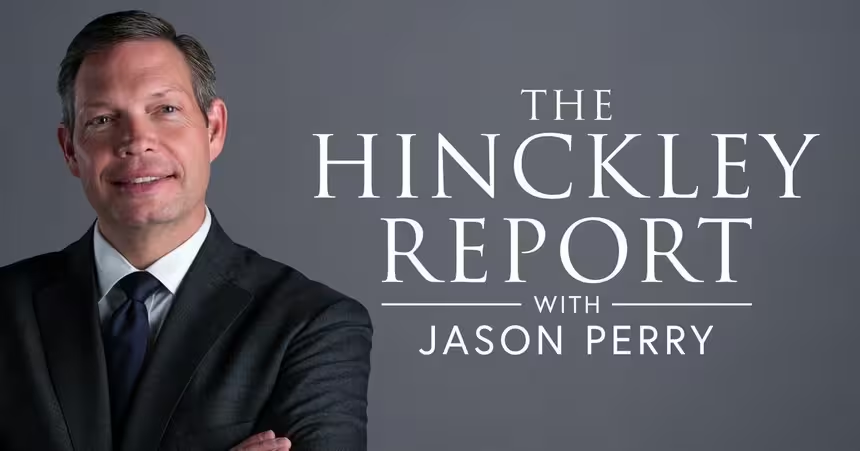
The Hinckley Report
Hosted by Jason Perry, each week’s guests feature Utah’s top journalists, lawmakers and policy experts.Providing Support for PBS.org
Learn Moreabout PBS online sponsorship♪♪♪ male announcer: Funding for "The Hinckley Report" is made possible in part by the Cleone Peterson Eccles Endowment Fund.
Tonight on "The Hinckley Report" Utah's legislature reaches the halfway mark as committees prioritize budget requests and tackle numerous controversial issues.
The number of new Covid-19 cases continues to decrease as a state ramps up vaccine efforts and the U.S. senate hears evidence and prepares to vote in a divisive impeachment trial of former President Trump.
♪♪♪ ♪♪♪ Jason Perry: Good evening and welcome to "The Hinckley Report."
I'm Jason Perry, director of the Hinckley Institute of Politics, covering the week, we have Jasen Lee, journalist with The Deseret News and cohost of Voices of Reason podcast; Maura Carabello, president of the Exhoro Group; and Matt Canham, managing editor of the Salt Lake Tribune.
So glad to be with you all today, particularly to talk about the legislative session.
We officially hit the halfway mark.
We're over it not that we count those days, but there's a lot going on right now.
And Matt, I want to start with what just happened at the end of the week, okay, because all the committees, the meeting they've been hearing all the request for funding that are going into the state, but this is the week when they start prioritizing those items and then they present it to really the committee that controls all the money: the Executive Appropriations Committee.
Talk about a couple of those proposals that are coming forward and a little bit about that process.
Matt Canham: So this is, you know, we start the session by collecting a wishlist.
Everyone comes out to the legislature, especially in a year like this one where we have some money.
So now it's the committee presents its list and we start getting serious.
The governor, we have a new governor who has his own proposals.
And so now we're gonna start figuring out where legislative leaders are going to put their stamp.
There's some money-- we talked a little bit before the show about double tracking on front runner, which is a proposal the governor came up with before the session something that it's expensive, I believe it's $350 million.
But this is a year, where we have enough cash where you can actually do something like that and it would have a huge impact.
Maura Carabello: To continue the conversation of process.
Some things to watch for next week: the new budget comes out, the new indication of actual money that will be close to the money we have to spend.
So that'll go back to the subcommittees.
They may give another set of recommendations, but really the secret here is the executive appropriations process and we're going to see funding of projects that we probably haven't heard discussed very much in committee here.
So the power of the Executive Committee is really something to watch and the final budget numbers will be out next week.
Jason Perry: The consensus we'll know exactly what they have to spend which is interesting.
I want to get into at least one of these points that Matt just talked about too.
A lot of money funneling into clean air initiatives.
This double tracking a frontrunner for example.
Jasen, talk about that because there are 22 bills right now all sides of the aisle trying to get to cleaner air in the state of Utah.
Jasen Lee: Environment has always been a really key issue in Utah, particularly for instance, I cover business.
Business always want to do something to improve quality of life and when they try to recruit businesses to come to Utah one of the key factors they mention is businesses think about the problem we have with our clean air, our environment, and if we can put some real hefty money into addressing these issues, I think it goes a long way to improving our economic stability in the years moving forward.
I also think that education is one of these things that is they've talked about putting a lot of money in there for teachers because education is so important again in getting our young people to stay where they can be best ready for employment.
Those are the kinds of things that are gonna be important this year and it will be interesting to see how much money actually is appropriated for those kinds of programs.
Matt: Thinking about business is one of the air quality bills that I think is most interesting is the idea of adding more electric charging stations around our state.
I think there's $6 million they're asking for.
We'll see if they get that much but if you're thinking about the future and you're recruiting businesses and you're thinking about a green economy we're going to have more electric cars.
You have to be able to charge it up in a vast state like ours and the only way that's gonna happen is if the state invests.
And this is a year where they actually can do that.
Maura: And it is you-- Jason as you said, it's a really big deal that we're seeing so much invest potential investment in the area of air quality, particularly from the Republicans in the legislature.
So I want to applaud that this has become a bipartisan issue and that we're also seeing investment.
The one thing I think as citizens pay attention to this to solve air quality, it's twofold, one in investment and infrastructure and program, but two we have to change our behavior, and that's often part of what we miss, right?
We're watching the legislature and thinking, oh, it's solved.
No, we're a big part of the air quality problem as individuals.
Jason Perry: Absolutely right and-- Jasen: We've probably had some help in this because Covid has made many of us work from home like myself and we don't have as many cars on the road and generally speaking our cars are the biggest influence that we have the biggest impact negatively speaking on our environment and if we can do something about moderating that then we can also go a long way towards addressing our long term environmental issues.
Jason Perry: There's two parts to this issue that Maura was talking about, Matt, I think it's interesting too because it is both sides of the aisle that are proposing these bills but also as you alluded to the business community is all in on this not just for their own businesses, but for the recruitment side, for the retention side, which is something that's developed recently.
Matt: Yeah, and I think, you know, there's a reality that the world's changing.
I mean, GM said I believe by 2035, they're not going to sell gasoline powered cars.
The world's changing, we have to get ready and I do think we have a track record in this state of looking ahead, of trying to plan for these kind of major changes.
And so I think this is what we're seeing here.
We're also-- there's a lot of bills on air quality monitors.
We're getting the information to the people about where we can make improvements.
I think those things make a lot of sense.
We'll see what happens, I say, one other thing with the budget is we might see a little bit of a slow process of seeing those priorities because there's still an eternal or at least a not public conversation yet about how big a tax cut are we going to have and that looms over everything.
Until you know how big the tax cut is you don't know how much other cash you have.
Jason Perry: Yeah, what's so interesting about that, Maura, is that we keep hearing about this tax cut.
I'm not gonna ask you details, we don't know details, but we do know this is on the agenda.
Maura: Right and it's being repeated and repeated by legislative leadership, and it's definitely on the agenda, but you're right we have very few details about this.
And again I'll repeat this next week becomes critical because we switch a little to executive appropriations.
We switch a little bit to big decision making by a small group of people, and we'll see a different set of dialogue coming up in the latter half as also it speeds up.
And a reminder we've talked about this before but what an unusual session this is.
You know, if you go up there the halls are rather empty, you're going with appointments only, and to the good of public policy the conversations and the deals that are made in the hallways, which are usually dismissed as inside baseball actually serve the public really well.
Being able to call 15 disparate people at one time as the speaker and say, "Are you in consensus?
Are you in consensus?"
is really important and there's a physicality to that that is completely missing and as they moved into quick sifting of bills, and as they make decisions more and more from an executive point of view, it's going to be a challenge I think.
Jason Perry: I want to talk about cars for just a second just to start talking about bills.
An article that ran in the Tribune here just today that-- so it's interesting a lot of us we have to register our cars every year and the tax commission they thought maybe they'd save $500,000 sending a postcard telling us they're not gonna send us a postcard telling us it's time to register.
It turns out about one in four people instead of Utah didn't remember.
Matt: Yes, I mean the hard part is how often do you look at your license plate and see the little month tag?
I don't even know what month I'm supposed to register my car.
It's been the same month for years like I don't even know what it is.
I wait for the postcard and apparently, Jason and I and a lot of other Utahns have been doing the same thing and even House Speaker Brad Wilson forgot, didn't register his truck.
This is funny, it shows how much influence a government can have by a simple act of sending a piece of mail.
Jason Perry: Jasen, talk about that cause I know-- Jasen: I was one of those people who got the card that I was late.
I had forgotten--I was a month behind already.
So then I had to go get a temporary.
You know, what's really fun is you get used to certain things.
I'm not sure what caused them to think that $500,000 in the grand scheme of billion-- many billion dollar budget was worth doing but it probably is one of the less popular decisions they've ever made and I will be so glad to be getting that postcard next year, because I will do the right thing as I'm supposed to.
But I'm like man I had forgotten what month it was in I think it's December.
And I got it in late January.
So I'm like well I'm already late to get that form thing and then put it in a window.
It's a big thing.
I'll be glad to get that postcard again.
Jason Perry: Maura, it was kinda funny the sponsor of the bill actually took a picture of the speaker of the house is his truck that had expired and said here's the reason for.
Maura: Yeah, I too will own that I need to be baby sat on this issue.
Jason Perry: So, it's interesting, let's talk about a couple other bills that have come forward here.
That one's resolved, we'll start getting our reminders again, funded by the legislature, but I just have to say because it's come up finally, Matt, Space Force.
'Cause we have talked about Space Force, it's back.
I don't--no one can say it without kind of a little smile.
Matt: So there's-- the Biden Administration has signed a raft of executive orders overturning a ton of President Trump's decisions but not Space Force.
Space Force might be here to stay and Utah is going to be one of the first states it looks like to recognize Space Force.
And I believe there are members at Hill Air Force Base, who are now inductees into Space Force.
And I think I find it to be funny.
I'm sure there are serious issues that Space Force can actually help us with.
But it's one of those things that is now going to be part of our federal bureaucracy.
Jason Perry: It is, it's gonna be permanent there as you just mentioned and Maura, former general Burton, who oversaw our National Guard for a long time as one sponsoring this thing saying this helps us get federal money to Hill Air Force Base from the state of Utah.
Maura: I am sure it does.
I was hoping you'd pass over this.
I have a hard time for some reason not chuckling whenever we talk about Space Force.
I'm sure the underlying issues and and our competition globally on these issues are very important but the optics on it right now maybe need to be readjusted.
Matt: The hard part is, I mean, it's because it's part of our military and when we think of our military we think of confronting an adversary.
So when you think of Space Force you think of confronting an adversary and then the question is whose the adversary in space?
Maura: I've seen the late night movies.
Jason Perry: We've seen this one.
Matt: But there are probably lots of serious issues about, you know, how we interact in space, the amount of satellites, the defense mechanisms we can and probably are already using in space, but it is just it's just humorous.
Jasen: One of the things I want to mention though is the Air Force has already been tasked they been, you know, not necessarily formerly they've been Space Force and in fact, they will be the conduit when they grow this bureaucracy.
I don't know that the money they spend on creating an entirely new bureaucracy, a new department is necessarily the best way to spend this money because you can just add to the appropriations given to the Air Force already and just have it be kind of a subset of what they do.
And so I'm a little surprised and to me it seems like a bit of folly, considering all the major issues our country has to deal with right now and certainly in our state as well.
That we are going to put so much effort and so much emphasis on creating what many of us chuckle at when we first hear and I think a lot of people in the country are wondering why are we doing this when there are so many other issues that we could be tackling?
Jason Perry: Mm hmm, let's get to a much more serious issue that we talked about on our show last week.
Maura, let's go to these women in sports.
There was this bill that we've talked about here, where it was making transgender athletes would not be able to play on the team for which they identify but big development in the committee yesterday morning on that bill.
Maura: Right, so in the committee they actually took out collegiate athletes and and kept it focused and I'm just going to correct him at it's not transgender athletes, its transgender girls.
So it's even more targeted than that and I think that there are a number of things that are very troubling with this.
We have very credible institutions like but not limited to the Olympic Committee, the National and International Olympic Committee, the NCAA, their advocacy groups.
This is a challenging and complex issue and it does not lack for policy.
There are many serious minded groups who have laid down the policy on this.
I think second concerningly whenever a bill shows up in committee with a strong note from legislative attorneys that say this is likely to have litigation attached to it.
It means that it's already an area that has established policy.
I don't think the legislature is the right entity to be discussing this issue and I think that it's certainly leading to a lawsuit which leaves us to believe that once again, it's a message bill.
It's targeted and it's targeted at high school children.
And I think that this is not the place to have this conversation on legislature.
We have neither the aptitude nor the expertise nor the need to have this piece of legislation.
So perpetuating a message bill that's focused on high school girls, I think is unconscionable, but more importantly, the legislature in areas that we have settled statute, in areas that we have policies that come from very thoughtfully considered agencies.
I would suggest that the representatives go petition that agency, have a dialogue.
There's a lot of conversations to be had in the area of transgender athletes, but have those with expertise.
Don't once again as a legislature take it upon yourself, particularly to send messages.
Jason Perry: It's interesting, Matt, when the collegiate sports was stripped out of this bill yesterday, there have been some arguments that maybe made the lawsuit even stronger since its targeted just at high school students.
Matt: Just at high school trans girls and I think that it's, you know, it will lead to lawsuits and it won't really tell us it's not just in Utah.
This isn't a Utah issue.
This is a Republican issue spread throughout our country.
This is something that Congress is talking about.
This is something that conservative media is talking about.
And I find it surprising this would be the issue that comes up in this time of our, you know, country, but it does happen.
Things catch people's attention that they do feel that there's something to debate.
And kinda like what-- said in the last story.
This isn't near the top of the list of issues we need to deal with.
To my understanding there is not a trans girl participating in a high school sport that we can point to and say this is the one we're talking about.
At committee there were a couple girls who testified that they participated against the trans girl in a cross state competition, but that's the only example that I've heard.
This isn't a common occurrence.
Jasen: It would seem to be blatantly discriminatory isn't it because we are targeting specifically women?
I'm surprised that constitutionally this would hold muster because you can't just choose one segment of the population to focus your law on and you know this.
I don't know how this is going to progress.
I'm really surprised as Matt mentioned that this is one of those issues that has been taken up particularly by the conservative side that they think is actually going to get somewhere.
Jason Perry: For just a moment keeping on the theme of sports, the house, okay, the change for Dixie State University, Maura-- Maura: This has been a tough issue.
It's it's an issue of sort of a conversation of social equity.
One thing I think that's interesting I'm gonna dive right into racism on this because one of the things we've found from behavioral scientists as we talk about whether it's use of force or whether we talk about affordable housing issues or whether we talk about the names of our universities.
Social behavioral scientists have found that the one thing we are most reactive to talking about is if there's any indication that we might be biased or racist.
And so I think that's the underlying of this is is are we feeling accused and indicted personally about our feelings?
But the reality is I thought that have come through in that yeah, those are the underpinnings of some of this language and the social consciousness that we are feeling right now in the United States.
I'm glad to see it's hit the shores of Utah.
I recognize how hard this conversation is for those who were born and raised in Utah.
I think it's an incredibly compelling argument that students are saying gosh I don't know if I want to graduate from a university and claim that that's the name on it.
So I think that the legislature has done a good job to work through it.
I was a little suspicious whether they would be able to it and what they've done let's kick off a process to find a name that everyone can can wrap around but it is time in the United States to continue to have these conversations about our biasness or the language that we use or what symbols.
Symbols are enormously powerful as is language and it's time to continue that conversation.
Jason Perry: There's also to this to this point, Matt, there is a bill dealing with Native American symbols in public education particular, encouraging the groups to come together and to eliminate those over time.
Matt: Right and I think that this is exactly the offshoot of the same thing that Maura was talking about.
We are taking a long overdue look at the language we use, at the symbols we use, and think about what it means to a broader group of people.
And that is a healthy process for any country to go through.
It's a healthy process for any city or university to go through.
And you know, people are gonna have different viewpoints.
People are gonna have different-- they're gonna be sentimental about certain things and I think that one thing that's been nice is there has seemed to have been generally an adult conversation about this at all levels, at the University level, school level, we saw with Bountiful High as well.
Like well some people will probably say this progress is ridiculously slow, the conversations been healthy.
Jasen: You know when I was in the MLK Human Rights Commission a few years ago, we took up the topic of Negro Bill in New Moab in Grant County, and I remember thinking I cannot believe as an African American person, I even called Washington D.C to figure out what the heck is going on to find out that there were seven other monuments around the nation with using that particular descriptor.
And I was so relieved when finally that was changed here in Utah.
And I was always surprised at the fight that we had to, you know, wage in order to make this happen.
Similarly with Dixie State.
This is Utah, it's not even the south.
I have no idea where that came from.
And as a person who I have lineage in Mississippi and they don't have it there.
It has always been surprising but as you guys have just described finally in the 21st Century, we are advancing in our thinking.
We are being more sensitive and to believe those vestiges of racism and discrimination.
The names like Dixie State to have the names of mascots after Native Americans.
It is to me a sign of progress and I'm glad to see you it.
I'm just sorry it took so long.
Jason Perry: Before we leave the legislature, one interesting bill with a high profile advocate this week.
There are a lot of treatment centers in the state of Utah, where people from all around the country come for various needs to get some help.
Matt, there have been a few stories on this, right?
And we had a big visitor to talk about this this week.
Matt: Yes, Paris Hilton, celebrity, so she was a resident in Provo Canyon School in the 1990s and she says she was abused there and she documented that in a film that she released this year and she came out here for a rally and she came right here to testify at the legislature about a bill from Senator Mike McKell, which so far has had no opposition, which would put restraints on or put limitations on the use of drugs on teens to make sure that they are compliant, to lock them in seclusion rooms, to hold them in restraints, to put them in stress positions.
I mean, we wouldn't let this happen to inmates in our state prison and yet this state has allowed this to happen to teens in treatment centers.
It is-- it's unbelievable that it's taking this long to have this conversation and when we've had it the treatment centers are in favor of this.
Everybody's in favor-- Maura: I'm gonna start where Matt left off with it's taken so long.
So this is substantive bill.
I'm glad it's not seeing opposition.
Credit is due to Paris Hilton bringing her celebrity to this and ensuring that it get passed and I really appreciate those who have influence using their influence.
I do wanna take a moment though to talk about the twitterpation.
The legislative session about having a celebrity up there.
And I love the word "twitterpation" has twitter in it because the social media that I saw, these starry eyed legislators loving Paris Hilton and talking about how well she did which again credit is due there.
What I hope to see in the next couple of weeks is more stories from legislators about everyday Americans or everyday Utahns who are showing up these-- at committees, who actually have something more to lose because they live in the communities in which they're speaking of.
There are some amazing testimonies that go on from Utahns during the session.
And while I appreciate us shining a bright light when Paris Hilton speaks, I would also suggest that this bill has been around for a number of years.
There have been a number of advocates that have been working on this who are articulate and emotional and they're Utahns and I would encourage our legislature to make them celebrities in addition to taking the selfie when someone comes into town.
Jason Perry: That's good.
That's good let's jump to the federal level for just a moment.
I know there's so many things on the table.
There is an impeachment proceeding going on in Washington D.C.
But Jasen, I wanna get it coming from you 'cause this is my observation.
Utah's been part of this.
We've had both legislator and both of our Senators Mike Lee, Mitt Romney have been part of the evidence and even our own Governor Spencer Cox.
It's just so interesting to see this national proceeding with Utah faces, talk about that.
Jasen: You know what's interesting to me as if the diverging ideas they have.
You know with Mike Lee and Senator Romney having different points of view and then Governor Cox, even before he was governor, you know, kind of diving into this and now since he's been elected continuing that dialogue.
I guess I'm proud of our state for having, you know, strong feelings about this.
Do I-- you know whether or not you know you disagree or not with whichever lawmaker we're talking about.
We know now that we have influence and that if we can continue to use it in a positive fashion, we become a bigger player on the national stage.
So I'm very grateful for that but I'll be honest with you it's kind of a lot of theater involved in this whole process as I've been watching in the news and on television.
And I'll be interested to see how it actually turns out because there's still a lot of partisanship involved in this and depending upon which side of the aisle you are on and to see at least this discussion being had in a serious way tells us that we can at least have adult conversations about it.
Whether or not we agree on the outcome that'll be a different story.
Jason Perry: Matt, I want to talk about the Mike Lee part for a moment.
You know when when it came to the first the constitutional question, whether or not you could hold the preceding for a former president, Mitt Romney is one of the six Republicans that voted yes we can proceed.
And they are proceeding, but there's some interesting things with Mike Lee on this one.
Phone calls from President Trump while it's going on, like maybe mistaken phone calls.
What happened right there and why is Mike Lee staying even now connected to that Trump administration?
Matt: He grew increasingly tight with the Trump administration as that term went on and on January 6th when rioters were storming the Capitol and they had not yet we evacuated the Senate, Mike Lee got a phone call from the president and it was a mistake.
The president was trying to reach Senator Tuberville, new senator from Alabama, and just accidentally called Mike Lee.
Our senator gave Senator Tuberville the phone and sat there and watch and the Senator told reporters about it including a reporter of the Salt Lake Tribune, and we-- multiple reporters published it.
That became evidence.
There was a story that said that the senator overheard the content of that conversation and that's what Senator Lee is disagreeing with but not that it happened.
It's a weird case.
The senators also now working with Trump's attorneys on this, you know, Mike Lee has already said what he thinks about this.
He thinks it's an unconstitutional trial.
He said how he would vote.
So I guess you know at the end of the day the idea of him talking to the lawyer doesn't mean a whole lot, but it's an interesting case.
Jason Perry: We've got about 20 seconds, give us the final say.
Maura: So let's talk about the political maneuvers we should be watching.
Right now we have the spectrum of elected Republicans in Utah that are showing us the fight for the Republican Party, right?
Spencer Cox, who was a Trump--a lightweight Trump supporter is now saying we got to look at this guy.
Lee seems to be doubling down on MAGA Nation, and we're going to use Utah as a litmus test for this.
Jason Perry: Thank you for these comments.
So insightful today, appreciate it.
And thank you for watching "The Hinckley Report."
This show is also available as a podcast on PBSUtah.org/HinckleyReport or wherever you get your podcasts.
Thank you for being with us and we'll see you next week.

- News and Public Affairs

Top journalists deliver compelling original analysis of the hour's headlines.

- News and Public Affairs

FRONTLINE is investigative journalism that questions, explains and changes our world.












Support for PBS provided by:
The Hinckley Report is a local public television program presented by PBS Utah
Funding for The Hinckley Report is made possible in part by Cleone Peterson Eccles Endowment Fund, AARP Utah, and Merit Medical.