
Legislative Session Week 6, Changing COVID-19 Policies
Season 5 Episode 26 | 27m 15sVideo has Closed Captions
Lawmakers debate top priorities in the legislative session. Utah adjusts COVID response.
In the final push towards the end of the legislative session, lawmakers consider a major tax cut and negotiate their top priorities. Policy makers plan for the future as the COVID-19 vaccine rollout ramps up and cases continue to decline.
Problems playing video? | Closed Captioning Feedback
Problems playing video? | Closed Captioning Feedback
The Hinckley Report is a local public television program presented by PBS Utah
Funding for The Hinckley Report is made possible in part by Cleone Peterson Eccles Endowment Fund, AARP Utah, and Merit Medical.
Legislative Session Week 6, Changing COVID-19 Policies
Season 5 Episode 26 | 27m 15sVideo has Closed Captions
In the final push towards the end of the legislative session, lawmakers consider a major tax cut and negotiate their top priorities. Policy makers plan for the future as the COVID-19 vaccine rollout ramps up and cases continue to decline.
Problems playing video? | Closed Captioning Feedback
How to Watch The Hinckley Report
The Hinckley Report is available to stream on pbs.org and the free PBS App, available on iPhone, Apple TV, Android TV, Android smartphones, Amazon Fire TV, Amazon Fire Tablet, Roku, Samsung Smart TV, and Vizio.
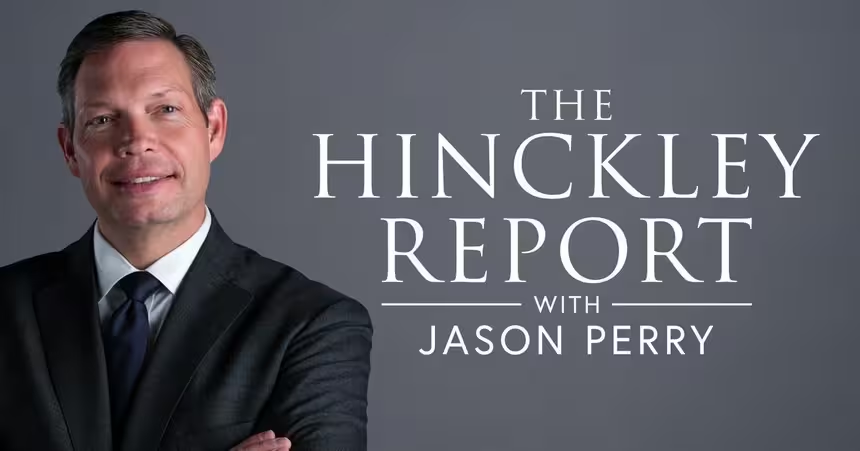
The Hinckley Report
Hosted by Jason Perry, each week’s guests feature Utah’s top journalists, lawmakers and policy experts.Providing Support for PBS.org
Learn Moreabout PBS online sponsorship♪♪♪ male announcer: Funding for "The Hinckley Report" is made possible in part by the Cleone Peterson Eccles Endowment Fund.
Jason Perry: Tonight on "The Hinckley Report" in the final push towards the end of the legislative session lawmakers consider major tax cuts and negotiate their top priorities; citizens and advocates weigh in on controversial issues making headlines; and policymakers plan for the future as the vaccine rollout ramps up and Covid-19 cases continue to decline.
♪♪♪ ♪♪♪ Jason: Good evening and welcome to "The Hinckley Report" I'm Jason Perry, director of the Hinckley Institute of Politics.
Covering the week, we have Michelle Quist, political commentator with the Salt Lake Tribune; Morgan Lyon Cotti, associate director of the Hinckley Institute of Politics; and Doug Wilks, editor of The Deseret News.
I'm so glad to be with you all today.
There is so much happening in our legislature and around the country.
I want to get right into legislation 'cause this has been an interesting week.
I want to get to this topic where we saw a lot of bills and it's dealing with the political process itself: the ballots, how people get to run for office.
And so Doug, because we talk about this every year it turns out, the remnants of a Senate Bill 54, which gave the opportunity for candidates to get on the ballot through convention or through signature gathering.
It's in the crosshairs yet again.
Doug Wilks: Well, I think what we learned is that politicians really want to control the outcomes of elections.
We see it with gerrymandering.
We see it with trying to put people in place who have the loudest voice.
That's not necessary surprising.
It's not necessarily unethical, but in this case you have a conflict between politicians that want to control and a public that wants a choice.
And so as they try to unravel SB 54, if they try to limit the choice, it's gonna be challenged again.
And they said they'll do a signature drive if this bill passes.
Jason: Wow, that's so interesting.
So, Morgan, that's true.
So the count my vote proponents the people that try to get this on the ballot the first time, they've already vowed, if you change it we're coming back.
Morgan Lyon Cotti: Yeah, we saw them come out almost immediately and say we're geared up.
We can come and get these signatures if we need to.
And one of the interesting things about this is that Senator Dan McCay is saying hey, most of these people that are getting signatures, In fact, the vast majority are also qualifying through the convention, but that's not necessarily what we heard from Count My Vote.
They didn't say we want everybody to go the signature route.
They just wanted to provide those options, provide that other path to the ballot that might open it up to candidates or at least to give that extra choice to voters in the process.
Jason: So Michelle, what does this mean?
I mean, you've been so close as political candidate when it comes to getting on this ballot.
Talk about the implications, particularly as it impacts the Republican Party.
Michelle Quist: You know can I just say this this entire conversation is ridiculous.
SB 54 has pulled the party apart over and over and over again and here we are once again discussing the same issue.
Six--five years ago, Count My Vote said, you know, we're gonna run a referendum if you don't have a threshold of 70%.
You know, so they they passed SB 54, we told them that it would mean money would be used to buy signatures.
We already told them.
So the idea that this is now oh, this is such a surprise that so much money is being spent.
You know, that-- it's just it's a ruse for, like Doug said, you know controlling the elections.
SB 54 is-- signature path is what Utahns want.
The legislature just needs to leave it alone.
Jason: Michelle, what do you make of the fact that several of these legislators pushing forward on this bill are the very people that held pass this in the beginning.
Michelle: It's beyond comprehension.
I don't understand.
I honestly just do not understand, you know, this whole-- I can't believe this is how it's worked out.
We told them this was how it's gonna work out.
Utahns like the signature path.
And again, a referendum is gonna end up with no conventions and no party system at all.
And right now the party system allows those who can't afford to go get signatures to at least get first or second place at convention.
You know, we don't want that taken away and that's what's gonna end up happening.
Jason: So, Doug, before we leave it, this bill does give options to the parties.
There are various ways for a candidate to get there.
It's just really essentially kind of taking care of that signature thing, which so many Republicans are worried about.
Doug: Well, I agree with what Michelle said there is if you fight like this and you both are in two different corners then you often get a result that is not good.
Yet conventions could go away.
The whole caucus system could go away.
So you have a week left in this session.
Find a compromise to this.
You know we've talked about it enough you know the different slices of this.
You have a Republican Party nationally and locally that is trying to find its footing.
So do something that you can strengthen parties without taking away the freedom of choice for the voter.
Morgan: And bringing up Count My Vote over and over-- Oh, sorry, Michelle, go ahead.
Michelle: I was just saying a compromise to what problem?
There is no problem that we didn't know would already exist.
I think they should just keep it status quo.
I think this bill should go away.
Morgan: Yeah, it feels like this recurring self inflicted wound that the Republican Party just keeps bringing up year after year in the state.
It doesn't seem like it's in line with voters priorities and people are really wondering, you know, why aren't we just letting Count My Vote and SB 54 be the law of the land?
Jason: Well, a couple of those things will dovetail from whoever gets on the ballot and Doug take a second to help us understand ranked-choice voting 'cause we talked about it.
That's been a little bit of experimentation in Utah.
There's a bill now that's going to open that option up more broadly.
Doug: I'm certainly not an expert in ranked-choice voting, but basically it's you go to a ballot and you'd take your first choice, second choice, third choice, fourth choice, and then when you come out of that and you can see who the top candidates are, Vineyard, and some other cities have experimented with this.
It kind of worked pretty well down there.
I think the goal is you don't want to eliminate debate.
You want candidates to be able to debate and have issues.
The question is can you legitimately select through this method.
I think it's worth studying.
I think it's worth looking at but that's basically the process.
Jason: It's a good process.
Michelle, talk about this because the Republicans worked on this even in their convention, right?
They decided they would try some of this just a little bit experimentation.
Where do you see people falling on this and how do candidates feel about it?
Michelle: I like ranked-choice voting.
I think it's easy for voters to use.
They rank first, second, third.
It has been shown to take bias out of, you know, against females or against minorities because people, you know, may be reticent to put somebody in the first spot but oh, yeah, I really like for a second and then you know that puts the candidate, you know, in the real order of where the voters like.
There's a little disconnect between this bill because it, you know, it forces counties, you know, I think it says county clerks can't decide and that, you know, a little opposite of our, you know, small government rule, but I don't think, you know, one clerk should be able to stop this process that the county wants to use it.
And I think it's a good-- it's been a good experiment.
It's been a successful.
I like this.
I like this bill.
Jason: Okay, one more thing on these elections interesting.
So, Morgan, a bill that looks like it's not gonna go anywhere, has died, even getting involved in whether or not you can use a nickname for your name on a ballot.
This is interesting.
It was really fun conversation which we saw in legislature.
Morgan: It seemed to be just targeted at Frugal Dougall being on the ballot last November and it was interesting that one of the components was you were gonna have to try to prove that you had been called this nickname.
And apparently legislators were joking am I gonna have to go back and find a high school yearbook where someone wrote this nickname.
And a lot of times when something is really targeted so much so that it just seems like it's at one person, it's not gonna go anywhere and it doesn't look like this one will.
Jason: That's an interesting one, Doug, too because it's kinda like if you could prove this is what you go by everyone knows you as maybe that's how John Dougall was able to get Frugal Dougall on the ballot.
Doug: Well, I mean, it's one thing to be called Dugger Douglas, right?
You know and my mother could make that choice if I ever run for anything but we've come-- we went through four years of Donald Trump where he gave a nick name to everyone.
And so you have that kind of hangover now coming into something like this and just play it straight.
It was-- it's just it's not worth the time to talk about in my opinion in the legislature.
Jason: It was fun though for some legislators to identify what their nicknames were in high school.
So we had that.
So Michelle, one more thing, there's one more bill trying to get to that-- to this issue that some saw as Democrats affiliating as Republicans to vote in the election.
So we're talking about in this last and our primary in particular.
One more bill, this is House Bill 197 which was changing when you can officially state your party affiliation.
Before March 31st of the election year if you want to vote in the primary.
Them trying to corral people just the procession for some of kinda gaming the system.
Michelle: Yeah, I think we-- I think the Utah Legislature should be passing bills that increase voter participation not decrease it.
I understand the concern from this last election, where, you know, you had Democrats, who had been longtime Democrats switching parties in order to vote.
In the GOP primary and it is unconstitutional to force the GOP primary to open up to members that aren't, you know, to people that aren't Republicans to vote in the Republican primary.
But I just think it's not the best look for legislature to be limiting voting.
I think we should always be trying to increase voter participation in any way we can.
Jason: A couple other bills I wanna get to, Morgan, one was interesting this week a big conversation on the kinda the effects of a 2000 initiative, where people voted on English being the official language of government.
And a lot has happened in the last 20 years and we have some legislators saying it's time for us maybe to address that.
Maybe open up the ability for governments to start communicating with people in other languages, their own languages.
Morgan: Yeah, this English only law that we have in Utah is interesting because it seems to not be in line with this image that we have that Utahns are really proud of that we are pro immigration, that we are a friendly place for refugees to come, and this is something that's interesting about our conservative Republican state.
We're not necessarily in line with some of those others-- other counterparts nationwide, but especially this is important with the pandemic.
We saw that certain communities, especially maybe that speak a different language were really hard hit by this pandemic.
And the state being able to be allowed even to publish things in different languages to communicate with our citizens residents in different languages can have life saving effects in these cases.
Jason: Doug, that certainly seem to be the argument from those putting this forward is there are times our state has changed so much.
We have so many people speaking so many language, which we prize, which we like, but sometimes government is not able to communicate with them.
Sometimes the things that very much are matter of health and safety.
Doug: Well, I agree, I mean, both of those points, the image, the populace speaks many, many languages, has been all over the world.
We were very proud of the governor when he said look, you know, we want the refugees here.
We can help.
We know how to help.
And with the health crisis you needed to get into the Latino communities.
You needed to get the message out about public safety.
So I agree with everything you said Morgan.
I think it needs to be there.
Jason: Okay, one more thing interesting.
Michelle, I'm just kinda curious about this.
We have like three major bills on billboards.
It seems like billboards are in their sights.
Two week right there, but it's so interesting how they're going after municipalities and some of their desires get billboards out of their communities and also a competing bill tryin' to say regardless of what's happening in your local community if you want to put up a digital Billboard you can.
Michelle: Billboards is always all about the money, you know, and you can follow the money on this issue.
There's a big lobby, you know, and you also have public citizens who are affected by where the billboards are, and what they look like, and what they are, you know, making their city look like.
And then cities want to get involved too and then you've got the lobby coming back in.
Billboards will come up every two years and we just have to suffer through it I guess.
Jason: Okay, we'll see what happens there.
There are several bills dealing with targeted tax cuts, Morgan, for members of military, for personal exemptions for families.
Why is our legislature really kinda gettin' to this point where its targeted instead of what they were kinda hopeful it'd be more broadbased.
Morgan: Yeah, we've seen major pushes for major tax reform at the state and federal level over the last several years.
And what I find really interesting about these bills is that normally these are things that would be part of a much bigger bill package, but the legislators really taking this targeted approach and we're finding that they're having a lot of success.
These bills are going through pretty easily with not a ton of public pushback and because, you know, they are really positive things.
They're really targeted at communities where it makes sense to people's brains.
Yeah, they should get that tax cut.
Jason: A lot of this is connected.
Oh, go ahead, Michelle.
Michelle: I was just going to say that that's the point, especially with this child tax credit.
I'm giving the legislature no credit running this bill.
It should pass.
It should've passed three years ago, four years ago, when the federal tax changes went into effect.
And the state, you know, other than every other state, you know, made the change so the tax credit would be, you know, still be a state benefit and Utah didn't.
And they didn't the next year and the next during the next year.
So this-- especially the, you know, the the family tax credit, the child tax credit.
That should go into effect.
It should've gotten into years ago.
And I'm giving them no credit, but I'm glad they're doing it.
Morgan: Well and perhaps it didn't go into effect several years ago because it was part of one of these bigger bills, where they're saying hey, we need this child tax credit and also these 14 other things that are part of this bill.
Doug: You've got to have more than a billion dollars that they're tryin' to figure out what to do with.
They've cut out $100 million.
How can we help so you have veterans and military families and you have seniors and you're tryin' to give them an income tax break.
They don't wanna do it across the board income tax break for all Utah citizens.
And they're trying to kind of anticipate okay, the projection looks good for getting on top of Covid-19, but we'd better be a little conservative.
And Utah did it right.
Last legislative session they had all these things to do.
They held off on it.
And now they were able to kind of address where we are at this moment.
Jason: So there are these very targeted tax cuts on the elderly as you mentioned, on people who are receiving social security that is an interesting one but all this rolls up into the overall tax structure of the state of Utah, which I think is important to talk about for a second, Michelle, too, because we're about to see from our legislature, maybe one of the biggest investments in this state of Utah's history in transportation and infrastructure.
Michelle: Yeah, and there's still this tax reform, you know, in the background that needs to be addressed sooner or later.
You know, whether we tax services, you know, the grocery tax that was hugely unpopular that they appropriately didn't pass.
And now we have this, you know, the infrastructure needs in the state and the question on bonding.
Its a continuous issue.
I'm glad the legislature's taking time to study it out.
And I think they should, you know, keep doing that and be careful in how they go forward.
Jason: One more thing, Doug, I think this is an interesting bill-- its Representative Carol Spackman- Moss, who every year runs a bill on distracted driving.
It's almost always exactly the same bill.
Has kind of got held again to this year, but the idea here is that you can be cited by law enforcement, if you're holding a phone while driving.
This issue just keeps coming up.
It keeps getting pushed down in our legislature for enforceability reasons and other kinds of things, but why do you think this one is not really getting through so far?
Doug: That's actually a mystery to me.
I mean, there's plenty of many other states that have done this.
Whether you're holding a sandwich or a phone you're not as able to respond to something on the road and a phone certainly has taken your attention.
You have technological solutions that aren't very expensive.
So it just seems like in the interest of safety, you're wearing a seatbelt, you know, you've got to have a car that, you know, meets an emissions standard.
Why not take a phone out of your hand?
It's not a right to have to hold the phone when you're driving.
Jason: So interesting this one keeps coming.
Yeah, go ahead, Michelle.
Michelle: I think it's not going through because they all use phones.
They recognize that that's gonna really curtail their behavior and their, you know, perhaps a little concerned about that.
Doug: It just doesn't have to, I mean, it's just doesn't have to curtail their behavior.
Morgan: And we see this every time we have an added safety measure and certainly we saw that last year and this year's with masks.
That people don't like the government telling them what to do and there is huge fights over helmets and seatbelts and all these things.
They're just part of our lives.
Jason: So speaking of telling people what they should be doing, lets talk about schools for a minute 'cause we brought it on our program.
Michelle, you've talked about this very issue on our program before.
Senator Todd Weiler has introduced a bill telling school districts for the entire state of Utah, you must provide a four day in person option.
Not saying they can't still do some remote but you must have four days.
Talk about the development of that bill because we still have one district in the state that has not been willing to do that.
Michelle: Which is Salt Lake and I guess, the teachers were, you know, were up there picketing on Wednesday.
I didn't know that.
My kids were, you know, at home online school Wednesday, because for some reason Wednesdays are still at home online for all of them.
Even the ones who are in four days, the elementary school kids.
I don't think there's any reason right now for junior high and high school kids to be home for four days.
I recognize that, you know, that school boards are making these decisions.
I think they, you know, I think incentives from the state are appropriate.
And I think it's also appropriate for the state to be worried about kids that are, you know, in school for two days when when everyone else in the state is in school for four or five.
Jason: It's interesting to this point, Morgan, because not just as this conversation happening locally.
We even had our own Senator Mitt Romney just this very week, saying, maybe we should not even give pandemic aid to places where kids are not in school.
Morgan: As I was thinking about this this morning.
So I was not a physics major so I may get this wrong, but that whole idea of the immovable object and the unstoppable force is sort of what it comes down to with some of these school districts, who really don't want to go back to in person learning and the state governments and then federal leaders as well who are really pushing this.
That we're even-- this was even part of why President Joe Biden ran on getting kids back into school.
The logistics of how you actually do that especially when you have a school district like Salt Lake, who isn't going back and I think a lot of people feel that they haven't heard the communication of why they're exactly they're not going back or what the plans are to go back.
And they're looking at some of the surrounding districts like Granite District, who has figured out how to go back, has figured out how to do a mask policy, and testing in the schools, and are wondering what's happening and why can't you, know, why aren't we finding these better solutions or the quicker solutions?
Doug: I mean, I would say, you know, things are a lot different a year ago, right?
We're a year into this really looks.
End of February, March, March 11th when Rudy Gobert, you know, was tested positive and the world changed.
The science says that it's better outcomes for a child to be in school.
We're losing kids.
The science says that Covid is not as big of a threat that you can manage with proper procedures.
The science says a mask can help.
If you're very concerned double masking, they're looking at maybe that will help.
Can you protect the teachers?
Yes, you can with vaccination.
So if you're looking at science you don't have to shut down business.
You can make conditions so that business can stay open.
You don't have to shut down school.
You can make conditions so that kids can be in school.
So if you follow it that way then you have a much greater chance of getting kids in school.
Having a bill say you have to do this, that's born out of frustration, because you see all this science and and then people are still not reacting.
That immovable force is difficult.
Michelle: It's like divorced parents who are fighting over who controlled where the kids go and when they go.
You know, it's all about this fight over control and they lose sight of what are the best interest of the kids.
You know this bill installed right now because of funding or increase testing.
I think if we find that funding and were able to increase, you know, the testing for kids that are in junior high and high school.
I don't see any reason why they shouldn't be there and I think Salt Lake District and any other districts should be accountable for having your kids in school.
Jason: Let's talk about some of the Covid kind of things are happening this week because a lot are happening, Doug.
So the governor just yesterday came out changing some of the parameters for people who are able to get the vaccine.
Doug: Yeah, so if you have a preexisting condition and there's a list of those conditions and you're over 16 or 18 then you can begin to get the vaccination.
And I heard today that there are spaces available to go do that.
Another very important thing happened in Utah today, which the Church of Jesus Christ of Latter Day Saints gave $20 million to UNICEF to a program to try and make sure that other countries, where they don't have the advantage of the United States or the United Kingdom that they can get vaccinations in there.
So you have a lot of momentum right now toward vaccinations.
And the governor what did he say?
That he wants to be in a parade in July without his mask waving to the masses.
Jason: Yes, he wants to make the response to the virus go viral.
With all that go ahead, Morgan.
Morgan: Antiviral, hopefully.
Well, in a poll-- one of the things that's really encouraging in a poll that we did with The Deseret News at Hinkley Institute, the numbers have shifted dramatically.
People are much more willing to get this vaccine.
And Jason correct me if I'm wrong, but I think just 12% of people said I don't want this vaccine.
And the other really encouraging thing I'm seeing is that or that we're all seeing is as that Utahns above the age of 70, I think about over 70% of them have received at least that first vaccine.
So the fact that these people are figuring out how to make the appointment, figuring out how to show up, how to get that shot in their arm is really encouraging for hopefully what the rest of our younger citizens and residents will be doing.
Jason: Michelle, let's talk about these points that both Doug and Morgan just made because the numbers are very interesting.
In 2000-- In September of 2020, this was our poll that we did with you, Doug, and we asked if people would be willing to take the vaccine.
This was before we had it.
People were anticipating that it would come.
25% of the register voters in the state of Utah said, they would not get the vaccine and another 21% were unsure.
And this has changed dramatically as Morgan just mentioned in the poll that we just did with the vaccines out.
12% of Utahns now said never and only 3% of Utahns are not sure.
That's a big change.
Michelle: It is, I think people are more comfortable.
They can see others, you know, have received it and have been fine.
I love that Utah made the change.
You don't have to prove, you know, your underlying medical condition.
So we don't have, you know, that the women in the other state who pretended to be old grannies so that they can, you know, go and get this shot.
I love that they included 16 and 17 year old kids, you know, who have underlying conditions.
I think Utahns want to you know be protected against this and they want to get back to new normal.
I don't know if normal is ever possible, but they want to get back to life.
And I think that, you know, people are just comfortable with the fact that there aren't many risks to this vaccine.
Morgan: Now, one thing that I hope that people are very careful about though is this honor system to, you know, getting the vaccine.
We're seeing issues in other states, where I mean, the women dressing up as old ladies is sort of a funny one but other young healthy people showing up to get shots in places where it was really directed at those communities of color that have been disproportionately impacted.
So I hope that in our state we're cognizant of that and making sure that those communities that have been so effective-- affected aren't shut out of getting these vaccines.
Jason: One more issue on this, Doug, because we all are so careful to wear masks.
I know you are very careful about wearing your mask, but also as we start getting more and more people vaccinating.
There's already coming up again to our own governor as recently as yesterday about whether or not we will lift the mask mandate sooner than later.
Doug: It's a really good question.
I mean look at the flu numbers this year.
The flu numbers are way way down.
So lives were saved with the flu because people wore a mask.
You know, Asian countries have a culture of wearing a mask because there's these different health risks.
So I've had conversations in my house are we comfortable wearing a mask?
Do you have to be as diligent likely not.
The numbers have already come down but there is some wisdom in protecting yourself just as we try to wash our hands, is a mask the same thing?
It'll be interesting to think about.
Morgan: And protecting others too I mean, what a wonderful problem that primary children's hospital is having right now that those nurses and doctors are probably pretty bored 'cause there's no babies or little children there that are sick with RSP.
Jason: Do you think this-- go ahead, Michelle, last 10 seconds.
Michelle: I don't need the government to tell me to do something that's good for me or my family.
We'll be wearing masks for a while, at least probably through the end of the year.
And it's not a big deal.
It's just a mask.
Jason: Okay, excellent.
Thank you so much for your insights today.
Lots interesting bills coming forward and lots of implication.
So thank you for your insights.
And thank you for watching "The Hinckley Report."
This show is also available as a podcast on PBSUtah.Org/HinckleyReport or wherever you get your podcasts.
Tonight, we'd like to say a special farewell to our stage manager Kate Cook, who has been with PBS Utah since 2005.
We'll miss her dearly as she heads out on a new adventure.
Thanks so much for all that you've done for PBS Utah and for "The Hinckley Report."
And thank you all for being with us tonight.
We'll see you next week.
♪♪♪

- News and Public Affairs

Top journalists deliver compelling original analysis of the hour's headlines.

- News and Public Affairs

FRONTLINE is investigative journalism that questions, explains and changes our world.












Support for PBS provided by:
The Hinckley Report is a local public television program presented by PBS Utah
Funding for The Hinckley Report is made possible in part by Cleone Peterson Eccles Endowment Fund, AARP Utah, and Merit Medical.