
Legistlative Maps & Attempts to Repeal the Parental Notice
10/22/2021 | 26m 46sVideo has Closed Captions
Discussion on legislative maps & attempts to repeal the Parental Notice of Abortion Act.
Host Hannah Meisel (NPR Illinois) and guests Dave McKinney (WBEZ) and Charlie Wheeler (UIS) discuss legislative maps and attempts to repeal the Parental Notice of Abortion Act.
Problems playing video? | Closed Captioning Feedback
Problems playing video? | Closed Captioning Feedback
CapitolView is a local public television program presented by WSIU
CapitolView is a production of WSIU Public Broadcasting.
Legistlative Maps & Attempts to Repeal the Parental Notice
10/22/2021 | 26m 46sVideo has Closed Captions
Host Hannah Meisel (NPR Illinois) and guests Dave McKinney (WBEZ) and Charlie Wheeler (UIS) discuss legislative maps and attempts to repeal the Parental Notice of Abortion Act.
Problems playing video? | Closed Captioning Feedback
How to Watch CapitolView
CapitolView is available to stream on pbs.org and the free PBS App, available on iPhone, Apple TV, Android TV, Android smartphones, Amazon Fire TV, Amazon Fire Tablet, Roku, Samsung Smart TV, and Vizio.
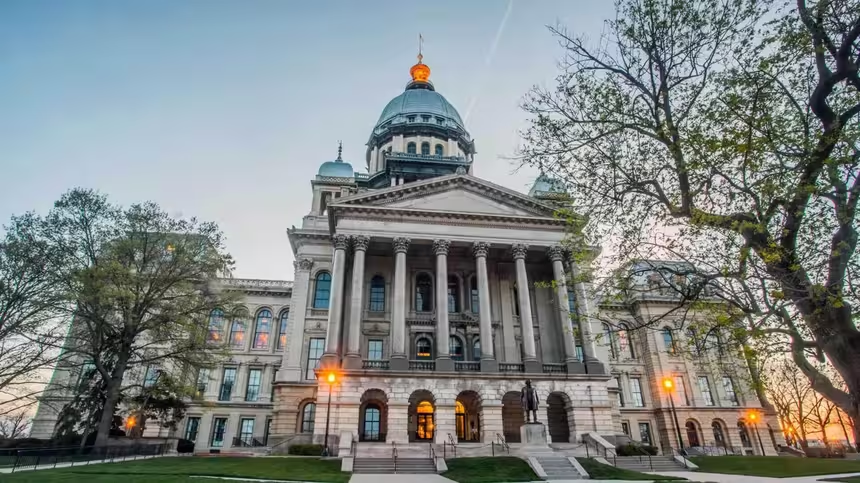
CapitolView
CapitolView is a weekly discussion of politics and government inside the Capitol, and around the state, with the Statehouse press corps. CapitolView is a production of WSIU Public Broadcasting.Providing Support for PBS.org
Learn Moreabout PBS online sponsorship(sweeping orchestral music) - Welcome to Capitol View, where we discuss the latest in Illinois state government and politics.
I'm Hannah Meisel with NPR, Illinois.
Joining us this week is Dave McKinney of Chicago public radio station WBEZ.
Thanks for being here, Dave.
- Hey, Hannah.
- And also here is Charlie Wheeler, Director Emeritus of the reporting program at the University of Illinois, Sprinkler, field, Springfield, hello.
Glad you're here, Charlie.
- Thanks.
I always enjoy being here with you guys.
- Well, another busy week in the world of map-making.
Of course, we are in the middle of a decennial redistricting process, always messy, always very political.
But this week we saw a ruling that could signal what's to come for the rest of the process.
At the same time, Democrats are trying to shore up what is gonna happen with the congressional maps, which will have, you know, an effect on what happens in Washington DC, or at least congressional Democrats are hoping so.
So, let's get to the opinion.
A three judge panel ruled that yes, the Democrats' first set of maps for the state legislature that they passed in May, before the official census data came out, that was delayed because of COVID, were indeed unconstitutional.
But the ruling didn't go as far as Republican Ted wanted, of course, the GOP wanted the court to force the appointment of a bipartisan panel to take over in the map-making process.
Charlie, was that ever a realistic goal?
- You mean the likelihood that the court would agree with the Republicans?
- Yes.
- No.
I thought it was, to use the football analogy, it was like a Hail Mary pass, right at the end of the game and you just throw it down the field and hope for the best, because the court made it pretty clear that the constitution says there has to be a map effective by a certain date, and if not, then it goes to the commission.
Well, there was a map effective, and the court, in its opinion, explained, here's what it needs to be effective.
It means it has to be passed by both chambers and signed by the governor.
The map under question, the one that was approved in the spring, that's what happened to it.
But they also agreed with the Republicans that it's really out of whack because of the population, because the Democrats used basically estimates rather than waiting for the actual census figures.
And they pointed out that the numbers that the Democrats used were really off base by much further than has been allowed in federal cases involving redistricting around the country.
They pointed out to one case where the variance was as great as 19.3% of the population, and the high court threw it out.
And in this particular case, the differences were as high as just about 30% in house districts.
And so the court says the maximum, I'm reading from the opinion here, the maximum deviations in the June redistricting plan exceed any limit tolerated by any case law.
And so they said, all right, so the spring map is unconstitutional, but they did not do what the Republicans wanted and say, so we're gonna send it to the redistricting commission.
And instead they said, we will allow you, the plaintiffs, who are challenging these maps, the Republican party, and then also the MALDEF, the Mexican American Legal Defense and Education Fund, which was challenging on behalf of Hispanics, we will allow you guys to draw your maps and submit them to us.
That would remedy the faults that you see with what the Democrats did when they came back and re-did it over the summer.
And then we will give the Democrats a chance to respond to what you do.
So the bottom line in all of this is I expect we're gonna see what happens, as matter of fact, actually 40 years ago in the redistricting that ultimately led to Michael Madigan being elected house speaker.
The Democrats will look at the Republican map, they'll make some tweaks, they'll take some of the Republican incumbents who are now put into the same district, they'll split them up, they'll each have their own district, and then they will add districts, add probably one or two more Hispanic districts and possibly, and make sure that the black district down in the Metro East area has enough of a black population to guarantee that a black person will be, will be elected there.
Now, you can't guarantee it, but to give the black voters in that area the opportunity to choose someone observed, of their desire.
- Right, and you know, the court in the opinion, it gave Democrats kind of a pass.
It said, you know, we're in very extreme circumstances, normally the census data would have come out in the spring as it usually does, but it was delayed.
And so it, you know, the fact that Democrats chose to go ahead without census data, even though it was for a clearly political purpose, the purpose isn't illegal.
So, you know, we're gonna stay out of that, and you know, they said it's clear, you know, Democrats deserve another Biden, luckily they already did considering the condensed timeline.
But Dave, you know, in that opinion too, there were some signs, and some signs that Republicans are at least taking, you know, if they can't have the big, wanted to have this bipartisan panel to give them a 50/50 shot at control, they're still reading the tea leaves to see the can, admonitions the court gave Democrats and the chance that they'll get to submit their own suggested maps.
And they're saying, well, you know, this is a sign that we could win, but Dave, I mean, how much could they possibly get out of a, you know, an adjusted map that the court has to oversee, especially considering in the past, these adjusted maps, the adjustments have not actually been that big.
- Well, I'm like Charlie.
I think I'm pretty skeptical that the courts are gonna look at this and toss out what the Democrats have done here.
I mean, they opened the door by inviting the Republicans to submit a map, but they, you know, it wasn't certain that the court was gonna impose any sort of requirements or take over the map making process.
I mean, I, the opinion, at least on a few occasions, seemed to kind of show deference to the fact that this is a legislative, you know, function, that it's not really up to the courts to decide how these maps should look.
I mean, there's precedent of coursework where courts wade into, you know, these gerrymander cases, but, you know, for every time a court might want to go into, you know, look at a democratic map in a state like Illinois, you know, that also means that a map that Republicans draw in a state like Texas could wind up being undone by the same, you know, ultimate decision.
So I think they tread very carefully.
I mean, it is interesting in this case, you know, we talk about a three judge panel.
Two of those judges come from Indiana.
One is from Illinois, and two of them are Republican appointees, one from George W. Bush, the other from Trump.
And so, you know, I think Republicans thought with that development that they stood at least a decent chance, but, you know, the fact that the commission was sort of thrown out the window here, that, to my way of thinking, really kind of took the air out of what Republicans hoped to accomplish here.
And that was maybe getting a map that would enable them to kind of pick away at it a little bit at the suburban dominance the Democrats have shown in the last several election cycles.
The suburbs are really where most of Illinois statewide elections now are won or lost.
And, you know, while Republicans have a hold mostly on downstate rural areas, they just have not been able to make any significant inroads in the suburbs, and of course, in the cities.
So, you know, I think for Republicans, it's, you know, they might've got some encouraging language sprinkled about that opinion here and there about how, you know, that there needs to be more public input accept, you know, considered and things like that.
At the end of the day, they don't really have anything, you know, that they did, you know, they don't have anything more now than they did at the beginning of this process.
- Yeah, no, that's a good point.
And, you know, the, the super majority that this legislative map would draw for the Democrats would, you know, it would blow the current super majorities out of the water, it seems.
And it will be really interesting to see if the map is, you know, upheld or, you know, for the most part upheld and if there are adjustments, what that will mean for the democratic caucus moving forward, whether we'll see more, you know, in-fighting between kind of the old guard Democrats and this wave of progressive, certainly the governor, you know, out to be a progressive, the house that he's necessarily labeled himself as such, but definitely his legistry would demonstrate that.
But, you know, it's interesting, we've also seen this week, a new, I guess, last week really, over the weekend, a new lawsuit, you know, kind of late to the game, but the NAACP of east St. Louis and, you know, a couple other groups that advocate for black voting rights throughout the state have filed another lawsuit, this time focused on east St. Louis.
You know, a group that had been focused on the city of Chicago also had threatened legal action and had asked for the department of justice to review the maps in the process too.
But, you know, Charlie, considering the history here of how in Illinois, MALDEF, as you mentioned before, the Mexican American Legal Defense Education Fund has been the only, you know, party that's ever been able to convince the courts of, you know, to adjust the maps.
Do you think that that lawsuit or the DOJ review has any likelihood of success?
- I think what'll happen is, it was alluded to earlier that the Democrats will make a response, they'll come in and they'll tweak the lines, maybe put a few more black voters into representative Greenwood, I believe as a representative down there into her district, and then it'll be okay.
Because that's what happened, again, going back 40 years, which in my mind was the, kind of the initiation of all of these disputes over redistricting.
The Democrats, in essence, settled with the plaintiffs in the Maldives.
They settled out of court and they said, okay, here are the, here are the your way we'll adjust the districts, we'll create this Hispanic Senate district on the Northwest side, Humboldt park area.
And the Maldive people signed off and that was the end of it.
And by the same token, they also made the tweaks.
So the bottom line is, yeah, they're gonna adjust lines.
They're gonna adjust the line to be able to say, well, yes, we've responded to your complaints, and here's what we did specifically.
We created this district here with Hispanic population.
We took these Republicans that we'd all clumped together, we now gave each of them their very own district.
And so it's okay, and the judges will say, yep, that's fine.
And that'll be it, and the map that was approved this summer is the one that we're gonna use for the next decade.
- Well, we will see what happens in the next couple of weeks with the situation on the legislative backs, but Democrats are also rounding the corner, trying to bring it home with the congressional maps, which likely we'll see pass before the end of next week.
So, Dave, you know, after the initial set of maps were revealed last, late last week Friday morning, some Democrats not so happy about it, especially Murray Newman, who is in the third congressional district, which has traditionally, you know, stretched into the city, but also captured a lot of the Southwest suburbs of Chicago.
What's going on there?
- Well, that's probably the most interesting kind of subplot to all of this that's playing out.
I mean, Newman, you know, within an hour or so of the democratic map going online and becoming public, Newman was out with a pretty blistering response that this was, you know, not something she was at all happy with.
I mean, you know, that sentiment of hers had sort of been communicated through some of the caucus staff people that I had been talking to, and you probably as well.
So I mean, you know, she's not happy and it's, you know, she probably legitimately feels that like, you know, she's just coming out of her first election, and it was a very tight election, and she needs to, you know, have the, she needs to be shored up a little bit, perhaps.
And instead what happened was this district goes from basically Midway Airport, or a little bit actually north east of Midway Airport over almost to Bridgeport, goes all the way out to LaSalle, Peru.
And I mean, you get every sort of flavor of the demographic ice cream cone in that, in that district, you know, pretty much.
Rural, suburban, urban, and, you know, it's a mostly white district, but the thing that's significant about it as well is that that district also would be where Adam Kinzinger, the Republican who has really, you know, created a national profile for himself, he's been crowded into that district as well.
And Kinzinger, right after the map, the proposed map was released, came out with his own statement, and it was, you know, clear as mud about what his intentions are, about whether he intends to seek reelection to Congress, where a lot of people are kind of thinking, you know, he's got a very difficult primary, one that he may not be able to win given his anti-Trump sentiment, you know, does he do that?
Does he go for a statewide run, US Senate perhaps, Tammy Duckworth or even governor, or does he go try to be part of some sort of presidential ticket somehow?
And so he's got all these options ahead of him.
Throw in the, you know, a cable news talking head, that might be another option for him.
But either way, we have two kind of interesting figures crowded in at the same district there, that one is a big toss up, and probably one that we'll get a second look as the mapmakers try to do this.
I mean, the big, big, big part of this map that's so important on a national scale is that, you know, Democrats are facing really, really tough headwinds going into this mid, this next election cycle, the midterms, because, you know, pretty much all of the generic polls show Republicans are, you know, favor to perhaps take back the house, possibly even the Senate.
And so they're scrambling, the Democrats are, to shore up the seats that they have, and in as many democratic friendly states as they can.
I mean, Nancy Pelosi now has an eight seat majority in the House of Representatives, and, you know, given the growth in states like Texas and Florida in the Sunbelt where Republicans are controlling the process, you know, they, through redistricting there, through population gains, they could wipe away that majority.
And so that's what makes states like Illinois, New York, Maryland, the states that Democrats, they control every branch of government, that's where it comes into play.
And, you know, this map that was put into, you know, circulation last week, you know, it was initially kind of billed as one that could give Democrats, potentially, a three seat net gain.
If you were to, you know, right now the spread is 13 Democrats, 5 Republicans in our 18 seat delegation, well, we're losing a seat because our population dropped, but there was some talk about, you know, maybe a 14 to 3 spread.
Now, the part about that is that, you know, you, nothing is certain in these midterm elections and it's conceivable, you know, 14 to 3, that would be the way the presidential, the 2020 presidential election looked in these congressional districts.
But if you go back to the governor's race, you see that the sixth district, the 14th district in the Western and Northwestern Chicago suburbs, where Sean Casten and Lauren Underwood are at, those two districts are uncomfortably close.
And in fact, Republicans won those districts by a couple of percentage points.
So, you know, this might not be as much of a slam dunk for Democrats as some would hope.
So I think what we see coming out, you know, perhaps this week, is a map that kind of cements a little bit more these partisan gains that Democrats want to wring out of the map.
- Right, and you know, another thing that folks had been longing for was whether or not Democrats would add a second congressional district for majority Latino voting age population.
And the proposed map that came out last week did not do that.
And from what I understand, you know, despite the kind of years long effort from, I guess, the Chuy Garcia progressive wing of the party, that, you know, the folks who went all in on the census, you know, get folks to be counted for the census, you know, they really wanted that second district, but, you know, from what I understand, D triple C, the, you know, congressional Democrats, they don't actually, you know, they don't think that would be workable.
Dave, you heard anything about what might happen there?
- Well, I mean, I think it's, you know, yeah.
The population growth in Illinois has been among Latinos and Hispanics.
I mean, so naturally they want more representation and they should be entitled to it.
But the reality is that in the fourth congressional district now, which is where Chuy Garcia runs, it's kind of called this earmuff district because it kind of extends in a C-like way from up in Logan square in the Northwest side, all the way down to the Southwest side near midway airport.
It, right now that is a heavily, heavily, heavily Latino district, 65% according to the demographics that, you know, rack up that the Democrats put out here.
But if you look at the way these other surrounding congressional districts are shaped, you know, are shaped right now.
I mean, you don't have, you don't have more than, you know, 24, 25% voting age Hispanic population in any of those districts.
So really only way that they could perhaps get the second district is to really, really radically undo Garcia's district.
Take some of that, take some of those Latino voters and crowd them into a neighboring district that, you know, is like I said, 24%, 25% Latino voting age, and maybe get up to that point.
But, you know, Chuy Garcia has got a good deal going now.
I mean, he's in a safe district and it's, you know, arguable on how badly does he want to give up safe political turf in order to kind of add another voice for Latinos?
I don't, I think the jury is out on that.
- Sure.
Well, with about five minutes left in the program, I think we should move on to maps, to a couple other legislations that we might see in the second week of veto session.
Charlie, Democrats are, looks like they're moving forward trying to repeal the parental notification act, parental notification of abortion act, which is this decades old law that says if you are 17 or under, you, a parent or guardian has to be notified before you get an abortion, otherwise you would have to appeal to a court and navigate that process alone, which is, you know, difficult as adult and, you know, even more difficult as a teenager.
So Charlie, how do you think that this would, this will go through no problem, or do you think that the more conservative, you know, wing of the Democrats, especially in the Illinois Senate Democratic caucus might seek to block it or not be comfortable with it?
- I don't know if it's gonna get through next week.
Ultimately it'll happen, I believe.
And I think what happened in Texas, where the Texas legislature basically made everybody a vigilante who can collect big money if you turn somebody in for cooperating with an abortion, I think that's galvanized the pro-choice people here.
And the question is, will they be able to get enough votes to make it effective immediately, which would require extraordinary majorities, or are they gonna wait and do it after January 1st when they can do it with a simple majority, and maybe some of the Democrats who are in less progressive districts and more conservative districts will be able to lay off it, because after January, you only need 60 in the house, 30 in the Senate.
So I think that that's, that's unsure at this time, as I say, ultimately, it's gonna happen.
Whether it happens next week or happens in January or February remains to be seen.
- Right, and this is the last kind of abortion restriction law on Illinois' books because in the last several years we've seen Democrats try to undo those, you know, in the future, in the likelihood that Roe V Wade gets overturned, which, you know, we will see this coming fall, winter, see if the court will indeed do that.
But Dave, one more piece of legislation I wanted to talk about before we go.
The healthcare rite of conduct, another kind of abortion related law that's been on Illinois' books for decades.
This one has historically allowed doctors and other healthcare professionals to not have to, you know, perform abortions if it violates their religious beliefs or anything like that.
But in pandemic days, we have seen a kind of creative reuse by folks like teachers who don't want to comply with either vaccine mandates or even testing mandates.
So Dave, in the minute we have left, how likely do you think it will be that Democrats will be able to be, you know, adjust the law so it doesn't, can't be used for COVID, but also, you know, navigate so progressives who want it totally knocked down won't be unhappy?
- Well, I think, you know, it's a priority of governor Pritzker's, so I think that there's a high likelihood that there'll be some effort made to do this, but, you know, he's running headlong into the Catholic conference of Illinois, the FOP and, you know, conservative Republican groups, none of whom want to see changes made to this.
So it's a bit of an uphill struggle, but I do think that, you know, it's another one of those cases where they, they will probably try to go for the simple majorities to get this thing done, as opposed to the super majorities, which would give an immediate effective date.
And I think that, you know, Pritzker is seeing that this is a little leak in the dam on COVID, and so that's the priority.
He wants to make sure that this is something that gets plugged quickly.
- And I think the way you do it is you just amend the, what was it?
1978, was it when the law originally passed?
It was in the mid seventies.
And you say that this is not apply in cases involving COVID-19.
You know, the legal language to say that, then that would totally wipe out all this, what I believe is this misguided effort to use a law for something which was never intended or never dreamed of at the time it was first enacted.
- Well, we will see what happens next week.
I'd like to thank our guests, Charlie Wheeler, Dave McKinney, and we will see you next time on Capitol View.
(sweeping orchestral music) (gentle music)

- News and Public Affairs

Top journalists deliver compelling original analysis of the hour's headlines.

- News and Public Affairs

FRONTLINE is investigative journalism that questions, explains and changes our world.












Support for PBS provided by:
CapitolView is a local public television program presented by WSIU
CapitolView is a production of WSIU Public Broadcasting.