Charlotte Cooks
Lemon Posset | Charlotte Cooks
Season 8 Episode 3 | 24m 35sVideo has Closed Captions
Chef Pamela introduces us to lemon posset, what it is and how to make it.
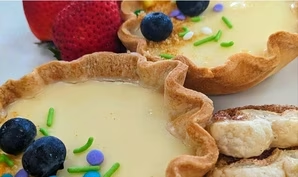
Do you know what lemon posset is? Chef Pamela Roberts does and in this episode she will introduce it to you and how to make this dessert that goes as far back as Shakespeare's time.
Problems playing video? | Closed Captioning Feedback
Problems playing video? | Closed Captioning Feedback
Charlotte Cooks is a local public television program presented by PBS Charlotte
Charlotte Cooks
Lemon Posset | Charlotte Cooks
Season 8 Episode 3 | 24m 35sVideo has Closed Captions
Do you know what lemon posset is? Chef Pamela Roberts does and in this episode she will introduce it to you and how to make this dessert that goes as far back as Shakespeare's time.
Problems playing video? | Closed Captioning Feedback
How to Watch Charlotte Cooks
Charlotte Cooks is available to stream on pbs.org and the free PBS App, available on iPhone, Apple TV, Android TV, Android smartphones, Amazon Fire TV, Amazon Fire Tablet, Roku, Samsung Smart TV, and Vizio.
Providing Support for PBS.org
Learn Moreabout PBS online sponsorship(lively music) - [Narrator] This is a production of PBS Charlotte.
(lively music fades) - [Narrator] The following episode of "Charlotte Cooks" is brought to you by Central Piedmont Community College and viewers like you.
Thank you.
(upbeat music) - Hello there.
And I am so glad you are joining me on "Charlotte Cooks" today.
You're in for a treat.
You're going to learn one of the easiest desserts you have ever made, and people are gonna think, "Whoa," what a gourmet you are when they taste this.
And you're gonna wanna either keep the secret all to yourself, or you're gonna wanna share it, and people will think you're absolutely brilliant.
What we're making today is called a lemon posset.
And posset is a dish that actually established itself first in medieval England.
And when it was first developed, it was developed out of curdled milk and ale, and it was served warm.
And if you can imagine drinking curdled milk and ale as a medicinal thing, it was sort of, like, repulsive.
But hopefully, as things went on, they were able to improve the flavor and the appearance of this.
And so it actually became very, very popular in so much so that Shakespeare actually refers to posset in "The Merry Wives of Windsor."
And it's really kind of fun to see all these things going back so far in ages, and yet they're still around today, just the same way that we make them back then.
But we're not gonna use curdled milk today, and we're not going to use ale.
What we are going to use is heavy cream, lemon juice, and sugar.
That's all that's in this.
So let's show you how this gets done.
So first thing you're gonna do, you wanna make sure that you have a pot that is big enough so that when this boils, it's not gonna boil over the side of the pot and all over your range.
And I'm gonna show you why it's important to have this because when milk and dairy products go into a pot and they get heated when they boil, if you had any experience with this at all, one thing that it does is the volume increases, and it just goes up and up and up and up and up and up and up.
And so we wanna make sure that we're gonna be paying attention to this.
So you also have to have a big pot so that when it comes up, it's not gonna go over the sides.
So we're going to use three cups of cream.
We're going to use a cup and just a little bit more of sugar, and we're gonna bring that to a boil.
We're gonna stir it.
Now the one beautiful thing about this dessert is that it has no eggs, it has no flour.
It's just cream and sugar, and lemon juice.
So unless someone is averse to eating dairy products, this will fit into a whole lot of diet profiles.
Obviously, not keto, but if you've got a vegan, you could do this if they eat dairy.
If you've got someone who doesn't do eggs, someone who doesn't do flour, well this is the perfect dish for them.
This posset that I'm making here is gonna be the very basic posset, cream, sugar, and lemon juice.
Now you can take this into another realm and add other flavors to it, and really start developing it.
What I'm gonna do is show you how to infuse some flavors into the cream before we add our citrus juice.
So I wanna keep stirring this.
I wanna keep my eyes on this.
I don't wanna walk away, I don't wanna ignore it.
But I do also wanna get ready for making the infused flavor in the next posset.
So I wanna look at this, and every time I see a bubble on there, I'm gonna stir it, okay?
So keep that in mind.
You're gonna stir these things.
So over here, I'm gonna take three more cups of cream.
And right now I've only got two cups in here, so I'm gonna add it up to three.
See, on these mason jars, they always have these beautiful measures on the side of the cup so that you can always tell without having to pull out your measuring cups.
So just heavy cream.
And I see some bubbles on the side, so I'm gonna give this a stir.
When you see the bubbles start forming, this is when you really, really, really can't ignore it.
You really can't.
Number one, milk scorches, cream scorches, dairy scorches on the bottom of the pot really, really easy.
So when you're choosing the pot, you wanna use a stainless steel pot, and you wanna use something with a nice heavy bottom on it, okay?
Not a thin-bottomed pot, 'cause you'll just end up with scorched cream like crazy and you won't enjoy posset, and you'll say, "What a bad recipe."
But it's really a very good recipe.
So now we are really getting close to it coming to a boil.
Okay, so we're gonna let that work.
I'm gonna take my next cream and I'm gonna put it in this other pot.
Pour it right on in there.
I love the way cream looks.
It looks like velvet.
It's so neat.
And now I'm gonna turn that heat on, put it on medium.
And then I'm going to infuse this with some orange zest.
I'm gonna put a little bit of this orange zest in here because we're gonna make an orange posset.
Hello?
Okay.
(Pamela laughs) All right, this is demanding my attention.
Come take a look.
It is boiling and boiling and boiling.
You wanna adjust your heat a little bit.
And now we are in the business of making posset.
When it starts rising up, you're gonna see it coming up, up, up, up, up, up, up the sides of your pan.
Don't freak out, just stir it.
You're saying, "It's still rising while I'm stirring it."
Turn your heat down just a little bit until you can control it, okay?
Now I'm gonna do this two-handed here.
So I got my orange zest on this side, and this I just need to stir, I just need to keep my eyes on it.
If I could separate my eyes and look at two different things at once, I would.
But I just need to stir this orange zest into here.
And this one I'm going to flavor with orange and lavender.
When this comes to boil, you're gonna boil it for a minimum five minutes.
You can go up to 10 minutes.
One thing you wanna look for is a little bit of thickening, but we don't want it to get down to a paste or any kinda like a really thick thing because lemon juice is gonna coagulate the milk and make it nice and thick like we want.
Okay, so our lavender buds, our lavender buds usually come dried, and they're really, really nice.
When you get lavender buds, you wanna make sure you're buying food-grade lavender.
And so they're very, very strong and so you don't need very many.
Some people will leave the lavender buds in their posset or in their puddings, and you can, but it's kind of like biting into a piece of soap when you actually get one, and it's not very pleasant.
I would take 'em and strain them out.
And I'm gonna show you how to do that later.
So I'm just gonna use about a teaspoon of lavender buds, and that's gonna be more than enough to infuse.
You wanna make sure you're using a heatproof spatula and that you are touching the bottom.
We're not just stirring the top.
You wanna make sure you're touching the bottom so that nothing is gonna stick down there so it scorches.
I'm gonna turn the heat down on this one 'cause I want to really pay attention to this one over here right now.
All right, it is getting very close to being done.
And the way I can tell is the bubbles have changed ever so slightly.
They're beginning to look thicker.
When I stir it, I see the bubbles all throughout the liquid, not just on the top.
It is one of the components that happens when you start boiling cream and sugar together.
Melted sugar has a whole wonderful characteristic all on its own.
All right, so I think that this one is going to be ready for the next step.
So now we're gonna add our lemon juice.
I just turned off the heat, and I should actually take it completely off the heat, 'cause this burner is still hot and I don't necessarily want it to stay getting hot.
This is what the mixture looks like before I add the lemon juice.
This is squeezed from fresh lemons.
Please use fresh lemons for this.
You need those active enzymes.
Bottled lemon juice goes through a heat process, and those enzymes are not necessarily active.
You have lemon taste, it still has acid in it, but fresh lemons have something else, all right?
So we're just gonna take this and pour this in.
You're gonna start seeing an immediate change.
The color's gonna turn nice and bright.
Remember, the handles on your pot are hot, guys.
The colors are nice and bright.
It turns into a nice pale, creamy yellow color.
So you wanna let this sit just for a few minutes, and you're mostly just starting to let this cool down because if you're choosing to use a nice crystal goblet to put your posset in, you don't wanna put it in hot because that would crack your crystal.
And so all you wanna do is just make sure that this just gets cooled down a little bit.
Makes it a little bit easier to handle.
But the real magic happens when it cools down.
And I'll show you what happens there.
So I've got my orange posset sitting here, and it is simmering and I am watching it, and I'm gonna show you what to do with this after this is finished simmering.
But before I do that, I'm gonna show you what we're gonna do with this posset.
We're going to take a pitcher.
Now it's important to get a pitcher that has a pouring spout on it because what we're gonna be doing is we're gonna be pouring it into our dishes.
We are going to be using some little dishes like this today.
So you can choose to actually make a little pie crust.
And they have these pie crusts you can buy already made.
You can make your own pie crust if you want to, but you wanna go ahead and bake it off if you choose to do this in a little pie.
Or you can use little cups, which is what we're gonna use today.
And you can also use all these beautiful ready-made filo cups.
And all of this is really great alternatives to be able to use for serving up your posset.
And then we're gonna show you how you're gonna decorate it up.
And I've got some fun ideas for you to use for decorations.
Now we're gonna pour this into this pitcher.
Look at how pretty that color is.
Isn't that nice?
Now if you wanted to be real fastidious, you can get a spatula in there and get every last drop, 'cause sometimes that last drop is enough for another portion.
Look at how much.
There's about another half a cup coming outta there.
This is the easy part.
It's easy to pour.
We are ready just to go ahead and put it in whatever we're going to serve it in.
So I'm gonna add a couple to these little pie crusts.
And remember, the pie crust have to be made, already baked off.
When I'm doing this, I like to leave my pie crust in the little pie tins until I'm ready to serve it, simply because it's going to be easier to handle them and move 'em around without breaking the pie crust.
And now, on these little filo cups, you can buy these in the grocery store year-round and they're really marvelous to have on hand to make quick little desserts.
You can always take this and mix some little bit of lemon juice and some cream cheese, pop it in there, add a couple blueberries, and we're gonna talk about decorating and adding flavors to these things in just a moment.
And so here we are with these baby possets.
These are nice little bite-sized possets.
And as you can see, I've got some berries on the plate.
So I'm probably gonna end up decorating these with some berries.
And now we can use these little cups, and you can see that this one recipe will make several versions.
If you wanted to do several portions, you can.
All right, we gotta fill these up.
Use this up.
Orange posset is simmering away over there.
Here I tell you not to ignore it, and I'm paying all my attention to the lemon posset.
All right, that's all I can put in here.
These are all full.
And so what we do with this now is we take this and this goes into the refrigerator to cool down.
And this is almost ready to strain.
It smells so good.
Let me move this over to this other burner here.
So here's the secret to making the posset coagulate.
What happens with the posset and coagulation?
If you ever just try to take lemon juice and add it to milk, you're gonna find it gets to be nice curdled mess.
And so the reason that we simmer the cream and the sugar together is that it changes the structure of the dairy molecule so that when you add the acid to it and the lemon juice, instead of that milk curdling, it's gonna absorb that lemon juice to become more custard-like.
It's all about science.
So our orange posset is now ready to strain because we don't want that orange zest in there.
We don't wanna keep that lavender in there.
If you wanted that, what happens is it gives you a little bit of a texture in your custard, and sometimes I just really like a plain, smooth custard.
But if you want that little bit of texture, you don't have to strain it.
So this is how we're gonna strain it.
We're gonna take a bowl, and we are going to use a really fine wire mesh strainer.
You don't have to get one this fancy.
If you just got a little round one, you can buy at the store, that's fine.
We're gonna go ahead and strain this.
One of the secrets to get everything outta the strainer is just to go ahead and take your spatula or a ladle or something and just rub everything through.
So you can see it come through the screen, and all that's gonna be left in the screen is the orange zest and the lavender buds.
And since we don't necessarily want that in our little posset, we're just gonna leave that behind and see there's just nothing really left in there.
So now this is where we're gonna add our citrus juice.
This is gonna be orange and lemon.
Now lemon is the one that has the stronger acid in it.
And so we're gonna go ahead and pour some of the lemon juice in.
And then for our flavors, we're also gonna be adding some orange juice, okay?
So what we've done is we've just reduced the amount of lemon juice just a little bit because that lemon juice is what's gonna give us a lot of that coagulation.
And if you remember, oranges aren't nearly as tart and acidic as lemons are.
And so they don't quite have that level of acid.
So we wanna always have the lemon juice with the acid and then the orange for the flavor.
It's still gonna turn out to be that beautiful cream color.
And it's just gonna thicken up.
And because we've ran it through the sieve already, it's already cooling down enough to where we're ready to pour it into the pitcher and into our little dishes.
And here we've got these containers that we are gonna be using.
Once again, these little cups, you're gonna find with posset the little cups are probably gonna be your favorites 'cause they're, number one, easy.
You can make this a couple days ahead of time.
When your dinner party comes, all we're going to do now is just take this and decorate it, and serve it.
And because this is orange and lavender, we can garnish this with some beautiful fresh lavender and some little orange slices.
If you wanted to drink this warm, you certainly could, but it's just so much better cool as a custard.
All right, so next I'm gonna show you how to make a nice little palmier cookie.
They're so simple, just like the posset.
It's not difficult.
Only a few ingredients.
All you need is a piece of puff pastry and some cinnamon sugar, and an oven, okay?
So what we're gonna do with this, if we wanted to make our cookies larger, it depends on the size that you cut your puff pastry.
These cookies here were made with a half of one of these.
And for our little possets, I'm gonna make some tiny cookies because I want them to fit inside of that little cup.
And if you wanna remember how big those cups are, they're just tiny.
And so if we put this cookie on top, well, sure, you can do that, but there's not a whole lot of room for more garnishes.
And so what I wanna do is actually make that cookie just a little bit smaller.
I love these cookies, by the way.
I make 'em on this size all the time, even bigger, you know, they're really wonderful.
So all we're gonna do is we cut our puff pastry, and we're gonna take cinnamon sugar and we're gonna cover this pastry with cinnamon sugar.
Now you don't have to put any butter on it.
All right, we're just gonna cover this up just like this.
I'm only gonna do half of this.
You get quite a few cookies outta one of these, and they don't take very long in the oven.
You wanna have your oven preheated to 400 degrees.
400 degrees for puff pastry, 'cause what makes puff pastry rise and puff is the melting of the butter that's in it.
And if you have the temperature in your oven too low, your butter will just melt out and you won't get any rise or you get very little rise out of it.
So you need to have it at 400, sometimes 425.
I think 400 is really a good temperature.
So fold this to the center, and then you're going to fold this other part to the center.
Try and get as close to you can to the middle.
Might have to fudge it just a little bit.
So right now we've got things folded to the middle.
I'm sure you guys have done folded things like this before, so it's not a challenge.
Then we're gonna fold it in half like this, okay?
Fold it in half like this, kinda like a book fold, okay?
I'm gonna go ahead and do it on the other one.
Now you're not gonna mash these together, you're just gonna hold it, get it so it goes like this.
Once again, fold it to the half, and then we're gonna fold it to the half line that runs down the middle.
It's imaginary, of course.
All right.
And then fold it in half again.
So now we've got these little bitty folded doughs.
And all we're going to do with these is we're going to slice them, we're gonna place them on a parchment-lined cookie sheet, and we're gonna bake them in the oven.
You don't wanna cut these too wide, you just wanna cut them into little pieces like this, okay?
Maybe about finger width wide, maybe a little less than finger width.
And the one thing you wanna do, you wanna cut straight down.
You don't wanna saw it back and forth, going all the way down.
You wanna cut it and saw it in the bottom so it makes sure you get all the way through.
What happens if you saw this on the way down is you're mashing the dough layers together, and they're not gonna be able to separate as nicely as they could.
They'll still separate and fluff, but not as nicely as they could.
Okay, here we go, parchment-lined, nothing else on it.
And now you gotta stand these little guys up like little soldiers and stand 'em all in the same direction, different directions.
But you wanna give them room because they are going to expand quite a bit.
As you can see, when they start out like this and they end up like this, they do expand quite a bit.
It's gonna look like you don't have a whole lot on the sheet pan, but that's okay because it's better to be undercrowded than overcrowded on these because once they start unfolding and they run into each other, they start looking a little funny, and sometimes they will unfold on you all the way.
And that's okay because you just keep those in the kitchen and use those for kitchen snacks, and it's cook street.
Now the neat thing about this is that instead of just using plain old cinnamon sugar, you can also add things like cardamom or ginger or other warm dried spices, nutmeg, that kind of thing to make them really, really, really exotic and really good.
Into the oven they go.
So this is what they look like when they're done.
Aren't they cute?
So we're gonna use these on our possets today.
Let me show you how we are going to decorate.
We can use some graham cracker crumbs, we can use some berries.
When we do our orange and lavender possets, we can put a little orange on there.
We can have some little mint leaves if we wanted.
Okay, so what we're going to do here is we are going to take our berries, we're going to carefully put them on the edge.
When you cluster things on your dishes, you always wanna cluster things in groups of three and not even numbers.
And that's just because it's so much pleasing to the eye to see groups of three than it does to see even numbers.
So whenever you're doing something like this, just go in groups of three, and then we're gonna take a little bit of our graham cracker crumb, put a little bit of graham cracker crumb on here just for a little bit of crunch.
And these are just plain old graham crackers that have been crunched up.
You can buy graham cracker crumbs and use those.
You can take graham cracker sleeves and crunch those up with a rolling pin till they get nice and fine.
And then, once we get this done, I really like cinnamon and lemon and blueberry together.
So I'm gonna just touch this with a little bit of cinnamon sugar.
I really don't want the cinnamon sugar to be like outstanding, but just a little hint when you taste this will be marvelous, darling.
Just marvelous.
So now I've got some other sprinkles over here, and I can put some of these beautiful sprinkles that you would use on candy dishes or, you know, anytime you're using things in the bake shop.
I love to go to the stores, especially during the holidays, and buy fun little sprinkles because they come in all different kinds of shapes and sizes and they just look really, really nice on some of your desserts.
Just put some on each one, gives it a nice little crunch.
And then we're gonna add some of these other sprinkles to it as well, just so that we have some color that makes it look good.
All right, so I'm gonna use a little spoon for this and just put a couple little green sprinkles in here just to make 'em look nice.
All right.
And then for your little tiny cookies, grab a little tiny cookie and pop it in there.
And there's one more decor we're gonna put on here.
Just a little, tiny cookie.
And then for the last thing, I'm going to take some whipped cream and I'm gonna put a little tiny star of whipped cream on each side.
And there we go.
That's how we can decorate these beautiful possets, and those are ready to serve.
Let me show you how we're gonna do the filo doughs.
Here's the orange and lavender.
We've got some beautiful garnishes on the plate, with some fresh lavender and some nice orange sections.
And you could take these orange sections, just cut your orange pieces down into little bitty pieces, and it makes a nice little bite on the plate when you're eating.
So I'm gonna add a little bit of this to here.
Put it down here by the thumb.
Add a little bit of this.
I'm not gonna put any lavender on the plate simply because I have it on the serving plate.
And the reason I'm not gonna add any lavender to it is because, once again, if you bite into it, it's just not that pleasant.
So here, I'm gonna put a little bit of sprinkle here, a little bit of sprinkle here, some more goodies just to make it look pretty.
And I'm gonna use some of these goodies over here just to make it look pretty.
And you can be wide open with this stuff, guys, anything that you want.
And so here we are.
We're gonna go put these over here, add a little cookie because we love the little cookies.
You stay right there.
And guys, I'm gonna show you these possets.
Here we have from medieval England to the Gulf Coast of the United States.
This is a recipe that you find all over the Gulf Coast.
This is why we included it in our Bringing People to the Table series this season.
You guys are not gonna believe how good these taste.
Then your friends and your family are gonna go, "Wow, when did you become gourmet?"
And you, like I said earlier, you can choose to save this recipe for yourself and have it be your secret weapon, or you can actually share it and have your friends think you are a marvelous genius.
Thank you for watching this episode of "Charlotte Cooks."
I do hope you go home and you make posset for yourself.
Let me know.
Send me pictures of your posset.
I'd love to see what you make, and I wanna know your opinion of it too.
So coming up on the next "Charlotte Cooks," what's really in Brunswick stew.
We have someone coming up here that's gonna be making Brunswick stew.
We are featuring Chef Yvette Kerns, from the Petite Chef Charlotte.
She is a premier personal chef here in Charlotte, and she's bringing you her secret recipe for Brunswick stew and cornbread, and I think she might even have a surprise or two.
If you have any questions, I'd be happy to answer them.
Send me an email at pamela.roberts@cpcc.edu.
You can watch this show and past episodes on PBS Charlotte Passport or subscribe to our YouTube channel.
Thank you for watching this episode of "Charlotte Cooks," and I will catch you next time.
(upbeat music) (lively music) - [Narrator] A production of PBS Charlotte.
(lively music fades)
Preview: S8 Ep3 | 57s | Chef Pamela introduces us to lemon posset: what it is and how to make it. (57s)
Providing Support for PBS.org
Learn Moreabout PBS online sponsorship

- Food
Christopher Kimball’s Milk Street Television
Transform home cooking with the editors of Christopher Kimball’s Milk Street Magazine.







Support for PBS provided by:
Charlotte Cooks is a local public television program presented by PBS Charlotte