
Lessons from the locker room help shape a company culture
Season 4 Episode 1 | 26m 49sVideo has Closed Captions
Mike Renna, President/CEO of SJI, discusses clean energy & lessons from NFL locker rooms.
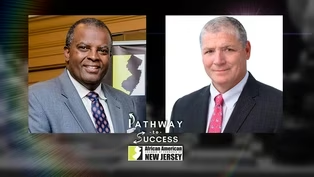
John E. Harmon, Sr., Founder, Pres. & CEO of the African American Chamber of Commerce speaks with Michael J. Renna, Pres/CEO of SJI about SJI's innovative clean energy initiatives and how the NFL locker room helped shape his ideas on inclusivity and diversity. Produced by the AACCNJ, Pathway to Success highlights the African American business community.
Problems playing video? | Closed Captioning Feedback
Problems playing video? | Closed Captioning Feedback
Pathway to Success is a local public television program presented by NJ PBS
Lessons from the locker room help shape a company culture
Season 4 Episode 1 | 26m 49sVideo has Closed Captions
John E. Harmon, Sr., Founder, Pres. & CEO of the African American Chamber of Commerce speaks with Michael J. Renna, Pres/CEO of SJI about SJI's innovative clean energy initiatives and how the NFL locker room helped shape his ideas on inclusivity and diversity. Produced by the AACCNJ, Pathway to Success highlights the African American business community.
Problems playing video? | Closed Captioning Feedback
How to Watch Pathway to Success
Pathway to Success is available to stream on pbs.org and the free PBS App, available on iPhone, Apple TV, Android TV, Android smartphones, Amazon Fire TV, Amazon Fire Tablet, Roku, Samsung Smart TV, and Vizio.
Providing Support for PBS.org
Learn Moreabout PBS online sponsorship[upbeat jazz music] announcer: Support for th is program was provided by: Horizon Blue Cross Blue Shield of New Jersey... PSE&G, proud sponsors of "Pathway to Success"... ♪ ♪ JCP&L and the African American Chamber of Commerce of New Jersey, working together to build a stronger community for all, Investors Bank, banking in your best interest, Berkeley College, ed ucation drives opportunity.
Be inspired.
NJM Insurance Group, the New Jersey Economic Development Authority.
♪ ♪ - Hello, and welcome to "Pathway to Success."
I'm John Harmon, founder, president, and CEO of the African American Chamber of Commerce of New Jersey.
We're delighted to bring you our fourth season, and we have a very special guest today, someone who's done significant things here in our great state, Michael Renna.
He is president and CEO of South Jersey Industries.
You know, the utilities sector is a vital component of everyone's lives.
Michael, welcome to "Pathway to Success."
- Thanks, John.
It's really an honor to be here.
- So let's just start.
Let's get to know you just a tad.
Where are you from?
Big family, small family?
- Great.
So I'm born and raised in New Jersey.
My folks are from New Jersey.
Grew up in the Princeton area, West Windsor, so Central Jersey.
I know that's a big argument around the state, whether there is a Central Jersey.
There is.
- [laughs] - Came from a football family.
And my father graduated from Rutgers, played at Rutgers.
My brother graduated from Princeton, played at Princeton.
Great role models growing up with my mother and father and maintain a real close relationship with my brother.
As far as my current family, just celebrated my tenth anniversary with my wife, Christina, who was actually the president of the South Jersey Chamber of Commerce.
And you know her very well.
Got three children, two of which have recently graduated from college.
Again, third-generation football players.
They played in college.
They're now gainfully employed, which is terrific.
My daughter is a sophomore at the University of Delaware and has fully solidified herself as the favorite in the family, given that she is the only girl, she is the youngest, and she is going to her father's alma mater.
Spent 1 year with-- 1 1/2 years with M&T Bank and then came back down to New Jersey and started my career with SJI.
- But you also did a little time in the NFL.
- I did.
I had the privilege, honestly, of being on the 1991 Eagles' team.
I was a defensive end.
For those of you that remember that team, it was arguably one of the best defenses in NFL history.
Three members of the defensive line starred in the Pro Bowl: Reggie White, Clyde Simmons, Jerome Brown.
Mike Pitts, Mike Golic were a part of that team.
Seth Joyner, Eric Allen.
It was just-- it was pretty incredible locker room.
- As a professional athlete, it takes a certain mindset, a certain preparation.
How has those skills transfer to being a CEO of a major company here in our state?
- There's all these kind of foundational things that happen as a result of playing football: The hard work, the tenacity, the grit, these things that are required of you to be able to--you know, continue to grow as an athlete and compete as an athlete-- all the work that goes into the off-season.
But I think equally important for me were the experiences and the relationships I developed, right?
I...
I've often mentioned that one of the most prolific... - Mm-hmm.
- Learning experiences from a inclusivity perspective is honestly the locker room, right?
Because you are around people from every walk of life and you really come together a team.
So as a young man, at 20-some years old, to kind of have that experience and be around people that came from places very different than where I grew up was really something that I think has really carried over into my leadership style.
and the culture we're trying to build at SJI.
- The mission of SJI, can you kind of speak to that for us?
- SJI is a energy infrastructure company.
We operate two utilities in New Jersey, South Jersey Gas Company, which serves the seven southernmost counties in New Jersey, and then Elizabethtown Gas, which serves the New York suburbs and the northwestern part of the state that runs from kind of the Water Gap down into Mercer County along the Delaware River.
Our mission is to deliver energy, critical energy, for the homes and businesses of New Jersey, but also for the region, right?
We have some non-utility businesses that are making critical investments in decarbonization, which... for us, it's not just delivering energy.
It's delivering the clean energy.
It's delivering solutions for the future.
- You know, we have this war going on between Russia and Ukraine.
The cost of energy has been fluctuating.
How does that impact your business model?
- You know, I think what's really impacted our business model is the shift in energy priorities both domestically, but I think also now you're seeing it in Europe.
So it's gonna tie in to kind of how we've had to change as a company, right?
You've got an energy master plan here in New Jersey, which is pushing us towards decarbonization by 2050, and then you've got a situation in Europe right now where there's scarcity of supply.
We as a gas utility are always very mindful of not only, you know, the service that we provide, but the affordability of our product.
What's going on in Europe is absolutely having a direct impact on domestic energy costs.
- How are you driving your talent within the organization to be more innovative and leveraging other technologies to get--to strike that balance?
- That's a great question, and I think one of the things I constantly remind our teams... Is just how innovative we are at SJI.
We are one of the first gas utilities in the country to decouple.
- So could you explain decoupling, what that means, so our viewers can understand and appreciate what that's all about?
- So decoupling is actually the true decoupling of our profitability from customer usage.
Historically, utilities, charge based on usage, throughput, right, how much gas we delivered to customers.
Our profit was embedded in usage.
Now we've stripped that away, so that as customers use less, right, our profitability is not impacted, so it allows us to make investments in marketing, in high-efficiency appliances, and in other means, insulation and other things to make homes more energy-efficient.
So we've accelerated the replacement of our more vintage leak-prone pipe and, again, the benefit to the environment there is significant reduction in fugitive methane leaks, right, that result from your older pipe.
A lot of our infrastructure was 60, 70, 80 years old, was made with cast iron and bare steel.
We've replaced all that with high-density plastic.
One of the first companies in the country to put in one of these accelerator replacement programs and now operate one of the most modern, efficient, safe systems in the country.
And then, you know, last-- outside of our utilities, we are on the forefront of decarbonizing the gas stream, and that is ultimately blending geological natural gas with organic natural gas or green hydrogen to bring down the carbon intensity of the natural gas.
And, again, you know, SJI is a market leader on that front.
- You know, we're gonna break here shortly, but wanted to talk a little bit about core values.
- At SJI, we embarked on a mission to... To sort of consolidate all of these different aspects of a company, right?
Our culture, our vision, our strategy, our mission, our values, all of that came together in what we call "One SJI."
Core to all of that are our values because they are what... they're foundational, and for us, it's safety, service, community, and inclusion.
It's in our DNA.
- Now, I think as a consumer to hear those core values articulated-- that was great to hear.
So we'll take a break here at this time on "Pathway to Success."
I'll be back in a moment.
announcer: The African American Chamber of Commerce of New Jersey is your pathway to success.
We encourage you to visit our website at www.aaccnj.com or call us at 609-571-1620.
We are your strategic partner for success.
- Welcome back to "Pathway to Success."
You know, we're kicking off this season four with energy.
I realize that South Jersey Industries has made a significant investment towards clean energy.
Can you elaborate on why that was important?
- We're an infrastructure company, right?
We make money on the infrastructure that delivers energy, and we are agnostic as to the molecular content of that energy, so we set out to not just support the goals of the state, and the goals of the region, and the governor's energy master plan, but to really accelerate that transition.
And we knew that our infrastructure could be a critical part of that transition, right?
It would--it was capable of delivering the clean energy in the future, so what we're doing now outside of our utility and our non-utility businesses is we're leading the way with respect to decarbonized gas, renewable natural gas, gas that comes from waste, whether it's food waste, landfill waste, wastewater treatment facilities, and in our case, from dairy farms.
And we've assembled a portfolio of over 40 dairy farms.
Well, we're taking the manure... - Uh-huh.
- And we're producing a clean low-carbon organic gas, and that will be blended into either an interstate pipeline or a utility pipeline to bring down the carbon intensity of geological natural gas.
RNG is a rapidly growing segment in our space, and as I said, you know, right now we have assembled an industry-leading portfolio.
We'll have over 40 farms online by 2024.
And at that point in time, we'll be one of the largest, if not the largest, producers of dairy renewable natural gas in the entire country.
- A true recycling continuum, if you will.
So speak to the Sentury Pump Station.
What is its function?
- The Sentury Pump Station is designed to... ensure reliability to customers in southern New Jersey.
If you think about southern New Jersey, South Jersey Gas is challenged by the fact that all of our gas lines run west to east and then north to south, right?
So we can't--because of how much of our territory is covered by the Pinelands, we can't run infrastructure through the Pinelands.
So in order to be able to get to Cape May or, you know, Ocean City, right, we have to go across the state and then down-- down the Parkway essentially, you know, and outside of the-- outside of the Pinelands.
So the new Sentury Pump Station is designed to maintain the pressures needed on very cold days or if, for some reason, there's an interruption on one of the interstate pipelines, to make sure that we have adequate pressures to be able to move that gas, again, west to east and then north to south.
- Governor Murphy has made offshore wind a priority of his economic agenda.
So could you speak to why that's a part of your portfolio and how does that relate to the over 700,000 customers of SJI?
- The role we're playing in offshore wind-- we're partnering with Atlantic Shores on a pilot project that will take the intermittent electricity from their Offshore Wind project and produce green hydrogen that'll be directly injected into the South Jersey Gas system to bring down, again, the carbon intensity of the natural gas.
Currently, we're actually developing a very small-scale true pilot project, green hydrogen project, at the new Sentury Pump Station.
We have solar--a solar facility on that property that's going to create, again, intermittent electricity that we'll then use to produce small quantities of green hydrogen that will be directly injected into the Pump Station.
- You know, a few years ago, you all made an acquisition of Elizabethtown Gas.
Why did that happen, and how are things going today?
- Well, Elizabethtown Gas is obviously an essential utility in New Jersey.
We thought that there were a tremendous amount of synergies.
There was a complementary culture at Elizabethtown Gas, one which would afford us the ability to blend the cultures and take what was a little bit more of an entrepreneurial culture.
They operated with military-like precision, right?
They do a lot of modeling, do a lot of forecasting.
They had this very disciplined culture.
You blend that together with an entrepreneurial culture and you take the best of both.
And it was an opportunity for us to strengthen our utilities in-- you know, really across the state.
We put in a accelerated infrastructure program in at Elizabethtown, where they didn't have one previously.
So we're now replacing all that vintage, more vulnerable infrastructure up at Elizabethtown as well.
And we've almost doubled our customer growth rate.
Again, making investments in infrastructure is what we do, and it's where we earn money.
- But you also have embarked on another merger.
- The board unanimously approved our merger with IIF.
IIF is a infrastructure investment fund.
So we are effectively taking SJI private.
- Mm-hmm.
- The real exciting part for SJI with this is that we're gonna stay headquartered in New Jersey.
We're gonna retain local management, local-- you know, the leadership team is going to stay in place.
We now have access to-- direct access to capital.
It's gonna fund all these investments I talked about, in terms of the dairy farms and the green hydrogen, as well as all the things-- exciting things we're doing in our utility, so we are really excited about it.
- That sounds fascinating.
Are there other models like that across the country?
- There are other cases out there.
This is going to be something that you're going to see a lot of utilities consider, especially electric utilities that may want to divest of their gas properties and take that cash, and then plow it back into their electric utilities and their renewable electric investments.
- You know, innovation is the key to transformation.
So let's pivot a little bit, get a little more into supplier diversity and its importance to SJI.
- Supplier diversity is a very important part of our entire DE&I strategy.
We're very proud of our record.
It's a really unique opportunity for us to, again, I think, advance and develop the communities that we are honored and fortunate to serve.
Both South Jersey Gas and Elizabethtown Gas have a number of very diverse communities that we're actively involved in, both from a philanthropic perspective, but also, again, from a supplier diversity perspective.
- When you afford a Black business an opportunity to be a prime, or second, or third tier, they in turn are gonna take those opportunities to hire or reinvest back into some of these challenged communities, which ultimately produces a win for our state and makes our state more competitive, so when I hear from leaders like yourself and you express your commitment to this, it underscores the significance of our mission and our partnership, so that's great to hear.
Let's talk a little bit about homeowners and renters and some of the strategies that you all have deployed to reduce their energy costs or work with them in a way that makes them feel, you know, you appreciate their business.
- The first is, we do have a lot of community based programs.
The late 2017-2018 time period where Atlantic City was really in a tough spot, South Jersey Gas Company, along with Stockton, right, we relocated our headquarters to Atlantic City, made investments at a time when everyone else seemed to be leaving the city, and we are deeply embedded in that community and involved in a number of local neighborhood associations, really looking to bring folks from that community in particular into the South Jersey Gas family and provide them with a career.
So that's one way we do it.
I think the other one, it goes all the way back to what we were talking about earlier with--in fact, with decoupling, right?
One of the other advantages of separating our profit from our throughput is that it allowed us, in the simplest of terms, we now make the same amount of money on a customer irrespective of how much gas they burn.
So it opened up the door for us to serve a lot of underserved communities, where, perhaps in the past, they didn't burn enough gas for us to justify the running of the line there.
Now they do because it doesn't matter whether or not it's a McMansion or it's, you know, a smaller bungalow down at the southern shore, we make the same amount of money, which allows us to then extend pipe into these communities that, at one point in time, were unreachable.
And we brought with that very low-cost, affordable form of energy, far cheaper for them, far more economically beneficial for them to heat their homes and power their appliances with natural gas than it was either electric, or heating oil, or propane.
- I appreciate that response.
The relationship with Mark Cuban and the AI Bootcamp Atlantic City, how did that come to fruition?
- They approached us, and they approached us during the pandemic.
They were looking for corporate sponsors of their program.
It's a great program, right.
It's a STEM program in these underserved communities, in this case in particular, in the Atlantic City and surrounding communities.
- And then I started thinking about what the boot camp could really mean for students in Atlantic City.
We're talking about giving opportunity to let underserved students understand new career path that they can go to, giving them a new avenue of seeing different things.
It's gonna expand their horizons and their view.
They're gonna take that back to their friends.
They're gonna take that back to their families.
We're gonna be able to provide them other support along the way, and before you know it, we're gonna have a lot of kids who used to live in Atlantic City working for South Jersey Industries.
- It was a great success.
They came back again this year.
I'd like to think we have a monopoly on it now because, you know, it's been a great relationship, and it's-- one thing it's done for us is it's built a pipeline to future employees.
- I think those investments will pay great dividends down the road, and I encourage you to continue to do those.
What's the future, next five years for SJI?
- The future is very bright for SJI.
Within five years, I do believe we'll be leading the way as far as renewable natural gas and green hydrogen.
We'll be transforming our utility, delivering the cleaner energy of the future, and what I really see is that five years from now, South Jersey Industries will be recognized as a leading innovator in the clean energy space in New Jersey and in the greater region.
- My last question: The African American Chamber of Commerce of New Jersey, its significance with SJI.
- I think it's the synergy there with our mission, and our culture, and our emphasis on DE&I.
You know, it's important for all of us as leaders to make sure that there's equal opportunity in all of our communities, and that comes from equal access to, whether it's affordable energy, or whether it's contracts, or whether it's capital.
That's the important work that the Chamber is doing.
It's really focusing on making sure that that playing field is level and that those opportunities exist, and that is so consistent with our vision, and our approach, and the culture at SJI.
- Well, Mr. Michael Renna, president and CEO of South Jersey Industries, just want to thank you for being our guest today on "Pathway to Success."
Until the next time, on your pathway to success, this is John Harmon, founder, president, and CEO of the African American Chamber of Commerce of New Jersey.
Thank you for tuning in.
[upbeat jazz music] Our fourth season.
You know, as I reflect back on the initial vision of "Pathway to Success," I felt it would work, but you never know, so you do a lot of testing.
You do a lot of researching and thinking it through.
You know, we have 1.2 million Blacks in New Jersey.
We have systemic poverty and challenges within the Black demographic of the state.
So it only made sense to showcase Black businesses representing a diverse swath of industries and showing their level of success, their commitment, their investment to their personal enterprises-- similarly, to showcase New Jersey's major corporations, telecommunications, health, manufacturing, construction, hearing from those leaders and their commitment to help Black people in New Jersey get in a better place.
The end goal is to make our state more competitive and leveraging the pathway to success to communicate with our viewers throughout our streaming footprint with NJ PBS and the talent behind the camera, all of which come together to produce an excellent product for you to get a full appreciation of what Black people can do when afforded the opportunity to do it.
That's what "Pathway to Success" is all about, and now in our fourth season, you know, a Gold Telly Award winner, that's something to be very proud of, but we're not resting on our laurels.
Every day, we seek to be better.
We seek to produce the best product possible.
We seek to showcase Black people in the best light possible.
Thank you for tuning in, and we encourage you to continue to tune in.
Thank you.
Have a great day.
[upbeat jazz music] announcer: Support for th is program was provided by: Horizon Blue Cross Blue Shield of New Jersey, PSE&G, JCP&L, Investors Bank, Berkeley College, NJM Insurance Group, the New Jersey Economic Development Authority.
♪ ♪
Lessons from the locker room help shape a company culture
Video has Closed Captions
Preview: S4 Ep1 | 32s | Mike Renna, President/CEO of SJI, discusses clean energy & lessons from NFL locker rooms. (32s)
Providing Support for PBS.org
Learn Moreabout PBS online sponsorship
- News and Public Affairs

Top journalists deliver compelling original analysis of the hour's headlines.

- News and Public Affairs

FRONTLINE is investigative journalism that questions, explains and changes our world.












Support for PBS provided by:
Pathway to Success is a local public television program presented by NJ PBS