
Lewis College/Birwood Wall
Season 49 Episode 42 | 26m 46sVideo has Closed Captions
Lewis College/Birwood Wall | Episode 4942
Michigan’s only historically Black college and university is re-opening with a new focus and mission. I’ll talk with the man who is restoring the legacy of the Lewis College of Business. Plus, a closer look at the history behind a longtime symbol of racism in Detroit: The Birwood Wall. And, a performance by Marygrove dance students. Episode 4942
Problems playing video? | Closed Captioning Feedback
Problems playing video? | Closed Captioning Feedback
American Black Journal is a local public television program presented by Detroit PBS
Lewis College/Birwood Wall
Season 49 Episode 42 | 26m 46sVideo has Closed Captions
Michigan’s only historically Black college and university is re-opening with a new focus and mission. I’ll talk with the man who is restoring the legacy of the Lewis College of Business. Plus, a closer look at the history behind a longtime symbol of racism in Detroit: The Birwood Wall. And, a performance by Marygrove dance students. Episode 4942
Problems playing video? | Closed Captioning Feedback
How to Watch American Black Journal
American Black Journal is available to stream on pbs.org and the free PBS App, available on iPhone, Apple TV, Android TV, Android smartphones, Amazon Fire TV, Amazon Fire Tablet, Roku, Samsung Smart TV, and Vizio.
Providing Support for PBS.org
Learn Moreabout PBS online sponsorshipComing up on "American Black Journal," Michigan's only historically Black college and university is reopening with a new focus and a new mission.
I'm gonna talk with a man who is restoring the legacy of the Lewis College of Business.
Plus, we'll take a closer look at the history behind a longtime symbol of racism in Detroit, the Birwood Wall, and a performance by Marygrove Dance students.
Stay where you are.
"American Black Journal" is about to start right now.
ANNOUNCER: From Delta faucets to Behr paint, Masco corporation is proud to deliver products that enhance the way consumers all over the world experience and enjoy their living spaces.
Masco, serving Michigan communities since 1929.
ANNOUNCER: Support also provided by the Cynthia and Edsel Ford Fund for Journalism at Detroit Public TV.
ANNOUNCER: The DTE Foundation proudly supports 50 years of "American Black Journal" in covering African-American history, culture and politics.
The DTE Foundation and "American Black Journal," partners in presenting African-American perspectives about our communities and in our world.
ANNOUNCER: Also brought to you by AAA, Nissan Foundation, Inpact at Home, UAW, Solidarity Forever, and viewers like you.
Thank you.
(upbeat music) Welcome to "American Black Journal."
I'm Stephen Henderson.
Michigan's only historically Black college and university is getting new life after being closed since 2013.
The former Lewis College of Business here in Detroit is expected to reopen next year, thanks to a partnership between Pensole Design Academy of Portland, Oregon and Detroit's College for Creative Studies.
Pensole's founder, Dr. D'Wayne Edwards, is leading the project, which, if it's approved by the state, will makr the first time an HBCU has ever reopened.
It will also be the first HBCU with a focus on design.
The school will be named Pensole Lewis College of Business and Design.
I spoke with Dr. Edwards about his vision for this historic Detroit institution.
Dr. D'Wayne Edwards, welcome to "American Black Journal."
Well, thank you very much.
It's an honor to be here.
Yeah, so first of all, congratulations on this really interesting idea, and the ability to pull this off, which I think a lot of people are still marveling at.
I wanna start here.
Tell me why now is the right time, and this is the right way, I suppose, to reintroduce the idea of Lewis College of Business.
Well, sir, it's not really a now.
It's been brewing decades, and I would say, decades for me, being over three now, that I've been in this industry and been in the footwear industry and when I started three decades ago, I was only the second African-American in the entire footwear industry.
And over the years, those numbers slowly, slowly, slowly increased, and it wasn't until I left the industry in 2011, to really focus in on the problem of how do we better educate Black students to the opportunities of what could be possible on the design side of career aspirations?
And then that number doubled.
Once I was able to leave, it doubled, because there was this, an individual academy that was focused specifically on it.
And you know, as we look at our current HBCUs, which are amazing institutions, one of the areas of development, an opportunity is on the design side.
As you know, they are extremely strong on the legal side, and the business side, and the engineering side, but one area that has been really underdeveloped is on the physical design side.
And last year, after, obviously, as unfortunate events of George Floyd happened last year, you started to hear about all these amazing contributions being made to support Black communities by major corporations, and a lot of those dollars did go to historically Black colleges and universities, but when it came to the design dollars, some of those design dollars, they were coming to me, because I was really the only learning institution that really trained and developed Black talent from a design perspective.
And the request came in as, hey, can you help us work with HBCUs?
Hey, can you help us find more Black talent?
And it was really through a casual conversation I was having with an alumni here in Detroit and he was the first one in October to tell me that Detroit had, at one time, had a historically Black college and university.
And so, that was really my first time being made aware that there was an HBCU here, and I immediately jumped online and my team jumped online and started googling and trying to find everything we could learn about it, and we were blessed to get in contact with the family, and speaking with the family, understanding what the history was, and why did it close, and how for, close to a decade, they'd been trying to resurrect the college.
But with no real success, and so, I was like, hey, you know what?
I can figure this out, and if I could figure it out, would you wanna work with us and they said yes.
And so, about 11 months later, we got it figured out.
So there are lots of, as you point out, schools of business here in Detroit and Metro Detroit and the state of Michigan.
Why not attach this effort to one of those, and what's the importance, in your mind, of saying, no, you know what?
We're gonna do this as a HBCU and as the only HBCU in Detroit?
You know, it needs a singular focus.
It's great, the schools here are amazing, some of the best in the nation, but none of them focus specifically on people of color, and that was what we did for the last 11 years with our academy.
Even though we're an inclusive academy, just like HBCUs are, we became the go-to destination if there was a Black kid anywhere around the world who wanted to get into our industry, they came to us.
And it was that singular focus that's been missing for all these decades, is because yes, other design schools and colleges around the country, they have design programs that are also inclusive, but when you look at the national average, only 9% of African-Americans actually go to design schools and universities in the United States.
And half of them drop out, and so, what ends up happening, these different product companies, and I'm not talking just footwear, I'm talking any company that makes a product, they only have about 1% of a graduating class to choose from nationwide every single year.
And even though these universities, these colleges and universities speak to diversity and they have diversity inclusion people who try to make an effort, it just wasn't making it fast enough and it wasn't making it hard enough, and it took, you know, it takes someone to slowly focus in on it.
And that was really, you know, besides, we weren't able to be educated as free slaves, in the 1800s, one of the reasons why HBCUs were created in the first place.
Yeah.
So I wanna talk a little about the financing for all of this.
Yep.
That's an issue both on the university side, the college side, for HBCUs, lots of them really struggling to keep things above water, to keep things going, but I also wanna talk about it on the student side.
Absolutely.
The cost, what's the approach here to make sure that this is a going concern that stays going, but also, is a place where African-American kids, who often don't have the same means as other kids, are gonna be able to access it?
So I'm that kid.
So growing up in Englewood, California, I'm the youngest of six kids raised by a single parent.
College wasn't in my future, and so, I was not able to attend college.
One of the biggest two primary reasons is a lack of awareness of where I should go, and two, no money to actually attend.
And so, once I got into the industry and I started to understand how the corporate world works and understanding the relationship between corporations and colleges, it's this really weird standoff, where the industry wants the colleges to create more career-focused, relevant degrees, but then the colleges wants the companies to give them the money to create these things.
So there's this standoff so nothing really ever happens.
Me understanding that and never being an educator, I decided to hey, let me, I know exactly what the industry wants so I took it upon myself to create my own version of what I thought that the education side should be providing, and I made the companies pay for it.
So I did it for my, I did it on my own dime the first few years just so I can have proof of concept so the companies can understand no, this is not a fly by night opportunity I'm providing.
I'm actually providing something that is long-standing, so when our students started getting jobs at these companies, then it started to click to them hey, you're an actual resource for us to help better diversify our talent pool.
And so, there comes the business model.
The business model was teach kids the way they will work and have the companies partner with us to pay for their education.
Hmm.
And so, we're carrying, we've done that for over 11 years now, and as we transition into Pensole Lewis College of Business and Design, we'll do the exact same model, where our corporations will cover the tuition and the housing for all of our students that participate in the college.
That part is mission critical, because as you said, you know, HBCUs, the students have trouble paying the bill, the schools have trouble making sure they stay relevant, up to date with the latest demands of the industry, where we have that really nice balance of being able to waive the fees so that's not a hindrance.
We just need a kid that's passionate and hungry.
So I wanna go back to something you said earlier, and I just wanna make sure we emphasize that point.
You said that when you started in the industry, you were the only African-American designer.
Only one, man.
That is remarkable, first of all, I mean, just overall, but it's also remarkable because you're not an old man.
No.
(laughs) We're not talking about something that happened in the 1950s or '60s.
Tell me about the industry when you started and why it was as white as it was.
1989 is when I started, so a little over 32 years ago.
You know, it's, and I was number two, by the way, the first was Wilson Smith III.
It was just never important.
I mean, the industry, the footwear industry, sportswear industry, in general, is dominated from a white male perspective.
Even women are struggling to make waves.
They've made a lot more strides than we have, but it's just always been, that's the way it's always been, but also, the other thing, the way it's always been is they've always had Black athletes be the face of these organizations, and so, I've always challenged every company I worked with with being hypocritical.
You're putting a Black face out in front of the world, for people to believe that your products are for them, but yet, there are not people in the background designing, developing, marketing, promoting the products.
And because they didn't have to do it, and because they didn't personally see the reason why it would be a good thing, because they're not of color and they don't know the struggle, they don't know the lack of opportunities that we have, there was no real reason for them to do it if it was working, right?
Most companies don't fix things that's working, and so, it just needed some very direct attention.
I mean, even with what Beyonce has done with her career, where Vogue magazine said, we want you on my cover, and she's like, yes, if a Black photographer shoots me.
First time ever there's a Black photographer on the cover of Vogue.
Same with Serena Williams when she tells Nike, hey, I want people who look like me designing my products, and there wasn't, and then she made sure that that happened.
We have to be more directive in asking for what we want, and in some cases, we might have to demand it.
And how is that going in the shoe industry now?
Obviously, it looks different than when you started, but how different is it?
It's different in the sense of there's about 180, 85 Black footwear designers, but that's 32 years later.
And when you look at women, there's less than 20.
Wow.
In the entire industry.
Now, I got a wife and daughters.
You know we like shoes, right?
And so, for just that small of a number of Black women to be in this industry is a travesty.
Yeah.
And that was the part that also attracted me to Violet T. Lewis' story of her entrepreneurial spirit and just hey, all right, I don't see it, so I'm gonna figure out how to make it happen, where she created this school as a secretary school because she was the only one working in these offices.
And so, it's not until we take control of our future and design the one that we wanna see is when things start to happen.
But we still have an awful long way to go.
I mean, 180 is unacceptable.
It's unacceptable considering the billions of dollars corporations spend with Black faces in the front representing them and then, those Black dollars also supporting that organization in return.
We don't have, we're slowly getting to $100 million invested.
Target did that single-handedly.
So Target single-handedly did that, and that was one of the reasons why we really wanted to work with them, because they put their money where their mouth is, same with the Gilbert Family Foundation.
You know, it's not about the dollars.
It's actually, it really mattered.
It really mattered to them, and that's why they're putting forth the effort, the energy, and that's why we're working together.
We turn now to another part of Detroit's history.
The Birwood Wall served as a symbol of racism when it was built eight decades ago, and it still exists today.
Bridge Detroit teamed up with NBC News to dive into the history of the wall that segregated the Detroit neighborhood and to talk with people who lived near it.
One Detroit senior producer, Bill Kubota, gives us a closer look at the legacy of the Birwood Wall.
ERIN: If you see it today, you happen upon it, you just assume it's there for decorative purposes.
BILL: A cinder block wall with a few different names, the Wailing Wall, the Birwood Wall, the Eight Mile Wall is just south of Eight Mile Road, built by a real estate developer to separate people by race 80 years ago.
I thought about it a lot.
BILL: Torre May's been here 20 years.
Just makes you angry.
BILL: One Detroit partner Bridge Detroit teamed up with NBC News to tell the wall's story which caught former Detroiter Johnnie Smith's eye.
She's with her children, visiting from California.
Actually, there was a writeup about the Eight Mile Wall and I thought it'd be a very interesting to have the kids come and see how Detroit was segregated not many years ago.
Detroit was growing really, really rapidly.
Erin Einhorn and Olivia Lewis spent six months investigating the legacy of the wall.
How did you get onto this story in the first place?
Yeah, actually, it was last summer, the height of the protests, George Floyd had been killed and then there were all these other viral videos, and we were really struck by how differently people were viewing these events, like completely different lenses.
Specifically, white folks were viewing it very differently from Black folks.
We were just kinda talking about, well, why is it?
And it's actually pretty obvious why that is.
Here, in one of the most diverse countries in the world, most Americans live in a segregated neighborhood.
BILL: In 1941, the developer had to keep his houses separate from an adjacent Black neighborhood to get a government loan.
Up went a wall between Birwood and Mendota Street.
It's the embodiment of redlining, lending money, but leaving out African-Americans.
If you lived in that house- More recently, Elizabeth Warren made a campaign stop here and Gerald Van Dusen wrote a book about it.
Do you think most Detroiters about this wall?
Most people living on Mendota and Birwood don't know about the origins of the wall.
That's what I found quite stunning.
People were so used to when they moved in, having this concrete backing, they assumed it was a lot like the kind of barriers you see maybe behind stores, you know, running maybe east and west on Eight Mile.
I knew about the wall.
My mom had told me about the wall when I was younger, 'cause she grew up in a neighborhood close by.
My family also has ties to the neighborhood.
My father grew up half a mile south of the wall.
Some of people we interviewed for the story were my father's elementary school classmates.
And this was actually, for me, a pretty revealing discovery.
I think all of the white folks we interviewed, none of them knew that the wall was there when they were kids growing up.
There's been stories done about this wall before, but yours had some new information that probably was a revelation to a lot of people in Detroit.
You know, I think one of the things that is really interesting about our story and what makes it a little bit different is that there is this ongoing story about one family.
BILL: The Crews family came from Alabama in 1918 to the area near Eight Mile Road.
It was Greenfield Township back then.
They settled here in a tar paper shack.
And we talk about a family who comes to Detroit, sets up their own neighborhood, essentially, and is fighting for housing rights and access to housing early on, and to see that play that out over decades, I think, is really important.
When we were getting started on this project, we were trying to figure out, well, okay, who built the wall?
And we talked to experts but nobody seemed to know, and this was surprising, because the wall's, as you said, gotten a lot of attention in recent years, but missing from that narrative has been who built the thing?
BILL: A dive into the archives revealed the developer, a prominent Detroiter from a prominent family, even today.
ERIN: James T. McMillan and his two sons were the people who built the wall.
James T. McMillan's grandfather was James McMillan, who represented Michigan in the United States Senate around the turn of the 20th century.
It's important to know who was behind things, just so that we can back and see how history played out.
I think that people want to know not only who was responsible but to hold people accountable and see how can we move forward, and how have we moved forward?
And so, I don't think it's necessarily always a standpoint of blame, but how can we learn from this and do better in the future?
During the war, Detroit attracted more factory workers, causing a massive housing shortage.
As the Birwood Wall went up, so, too, the Sojourner Truth Federal Housing Project, meant for African-American war production workers on the Northeast side.
Trouble was, white people showed up when they tried to move in.
That particular incident, the riot, maybe even that is lost to history for a lot of people of Detroit.
Pretty much.
Pretty much lost, as well.
It still stands, and I went over there one day fairly recently, and I was talking to the current manager of the public housing unit.
They had no idea of the history of that structure and what had taken place during the war years.
Gerald Van Dusen wrote a book about the Sojourner Truth Riot, too, a riot instigated, in part, by a priest at a nearby Polish Catholic Church.
And the arrests were primarily of Blacks, even though whites were doing just as much of the pushing and pulling and rock throwing and the like.
BILL: As the country united against the Germans and Japanese, in Detroit, the arsenal of democracy, the fight was on to keep society segregated.
And the rules simply said this.
That if you're gonna put up housing, public housing, if the neighborhood is predominantly Black, then the housing will be exclusively Black.
If it's predominantly white, it'll be exclusively white.
If it's a mixed neighborhood, well, theoretically, it could be mixed, but never was it mixed.
It was gonna be one or the other, and typically, it was, in a mixed neighborhood, it was white.
BILL: Sojourner Truth became a rallying cry, a conflict over housing and race heard nationally.
GERALD: The Birwood Wall incident, the Sojourner Truth incident, and then the hate strikes at the Packard Plant and other factory plants really precipitated the race riot of 1943, the biggest riot of the war.
You know, I was driving recently down a broad boulevard that had a grassy median down the middle right near the border of Detroit and Grosse Pointe, and thinking, like, oh, I understand why this was here.
A lot of those broad boulevards with grassy medians were built for the same exact reason this wall was built.
We have all these legacies in all these different places and we may not even know they're there.
That is gonna do it for us this week.
As always, thanks for watching.
You can find out more about our guests at americanblackjournal.org.
And you can always connect with us on Facebook and on Twitter.
We're gonna leave you now with students from the Institute of Dance at Marygrove, performing to the sounds of Motown.
Enjoy, and we'll see you next time.
(jazzy music) ♪ I never met a girl who makes me feel ♪ ♪ The way that you do ♪ ♪ All right ♪ ♪ Whenever I'm asked who make my dreams real ♪ ♪ I say that you do ♪ ♪ You're outta sight ♪ ♪ So fee, fi, fo fum ♪ ♪ Look out, baby ♪ ♪ 'Cause here I come ♪ ♪ And I'm bringing you a love that's true ♪ ♪ So get ready, get ready ♪ ♪ I'm gonna try to make you love me, too ♪ ♪ So get ready, get ready ♪ ♪ 'Cause here I come ♪ ♪ Get ready, 'cause here I come now ♪ ♪ I'm on my way ♪ ♪ Get ready, 'cause here I come ♪ ♪ Come on, y'all ♪ ♪ Get ready, get ready ♪ ♪ Get ready, ready, ready, ready, ready ♪ ♪ 'Cause here ♪ ♪ We ♪ ♪ Come ♪ (bright jazzy music) ♪ Calling out around the world ♪ Are you ready for a brand new beat ♪ ♪ Summer's here and the time is right ♪ ♪ For dancing in the street ♪ ♪ Dancing in Chicago ♪ Dancing in the street ♪ ♪ Down in New Orleans ♪ Dancing in the street ♪ ♪ In New York City ♪ Dancing in the street ♪ ♪ All we need is music ♪ ♪ Sweet music ♪ Sweet music ♪ ♪ There'll be music everywhere ♪ ♪ Everywhere ♪ ♪ Swinging and swaying ♪ ♪ And records playing ♪ ♪ Dancing in the street ♪ (rhythmic clapping) ♪ Oh, it doesn't matter what you wear ♪ ♪ Just as long as you are there ♪ ♪ You are there ♪ So come on ♪ ♪ Everybody, grab a girl ♪ ♪ Everywhere around the world ♪ GROUP: Whoo!
(upbeat music) Come on.
Whoo!
Come on.
All right!
WOMAN: Yeah, come on, come on.
(bright jazzy music) ♪ Oh, oh, oh, oh ♪ ♪ It doesn't matter ♪ ANNOUNCER: From Delta faucets to Behr paint, Masco corporation is proud to deliver products that enhance the way consumers all over the world experience and enjoy their living spaces.
Masco, serving Michigan communities since 1929.
ANNOUNCER: Support also provided by the Cynthia and Edsel Ford Fund for Journalism at Detroit Public TV.
ANNOUNCER: The DTE Foundation proudly supports 50 years of "American Black Journal" in covering African-American history, culture and politics.
The DTE Foundation and "American Black Journal," partners in presenting African-American perspectives about our communities and in our world.
ANNOUNCER: Also brought to you by AAA, Nissan Foundation, Inpact at Home, UAW, Solidarity Forever, and viewers like you.
Thank you.
(light twinkling music)
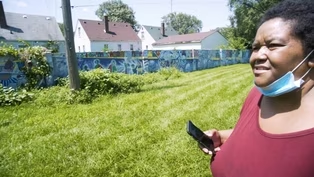
Video has Closed Captions
Clip: S49 Ep42 | 7m 7s | Birwood Wall | Episode 4942/Segment 2 (7m 7s)
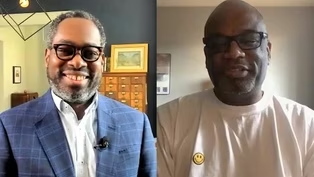
Video has Closed Captions
Clip: S49 Ep42 | 13m 5s | Lewis College | Episode 4942/Segment 1 (13m 5s)
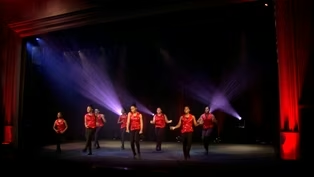
The Sounds of Motown - Institute of Dance at Marygrove
Video has Closed Captions
Clip: S49 Ep42 | 2m 15s | The Sounds of Motown - Institute of Dance at Marygrove | Episode 4942/Segment 3 (2m 15s)
Providing Support for PBS.org
Learn Moreabout PBS online sponsorship
- News and Public Affairs

Top journalists deliver compelling original analysis of the hour's headlines.

- News and Public Affairs

FRONTLINE is investigative journalism that questions, explains and changes our world.












Support for PBS provided by:
American Black Journal is a local public television program presented by Detroit PBS