
Lexington Council OKs Ballot Measures Proposed by Civic Assembly
Clip: Season 4 Episode 416 | 3m 24sVideo has Closed Captions
Three proposals brought forth by CivicLex project approved by city council for November ballot.
The Lexington-Fayette Urban County Council has approved three local referendums to be placed on the November ballot. The proposals came from 30 Lexington residents that made up a civic assembly. The group was organized by CivicLex, a non-profit focused on civic health and education, and the project has been years in the making.
Problems playing video? | Closed Captioning Feedback
Problems playing video? | Closed Captioning Feedback
Kentucky Edition is a local public television program presented by KET
Lexington Council OKs Ballot Measures Proposed by Civic Assembly
Clip: Season 4 Episode 416 | 3m 24sVideo has Closed Captions
The Lexington-Fayette Urban County Council has approved three local referendums to be placed on the November ballot. The proposals came from 30 Lexington residents that made up a civic assembly. The group was organized by CivicLex, a non-profit focused on civic health and education, and the project has been years in the making.
Problems playing video? | Closed Captioning Feedback
Where to Watch Kentucky Edition
Kentucky Edition is available to stream on pbs.org and the PBS app.
Providing Support for PBS.org
Learn Moreabout PBS online sponsorshipThe Lexington.
Fayette Urban County Council has approved three local referendums to be placed on the November ballot.
The proposals came from 30 Lexington residents that made up a civic assembly.
The group was organized by Civic Lex, a nonprofit focused on civic health and education, and the project has been years in the making.
Our Clayton Dalton has more on those proposals and the Assembly to form them.
So we've actually been planning or we did plan the Civic Assembly for almost three years.
It was a long project for us.
And really the big thing that happened was kind of the convergence of, our local council approached us about wanting to do a charter review and asking us if we would be interested in conducting that.
And at the same time, in kind of the broader field, nationally and internationally, civic assemblies have been getting a lot more popular as a tool to kind of get people engaged in local government and solve, like, thorny issues.
And so there was a lot of interest in us doing an assembly in general.
We did a process called like a civic lottery, to randomly and demographically select, our, our panel is what we called it.
So we had 50% men and 50% women.
We had people of every age of different education levels, political registration, council districts.
The group in the room mirrored Lexington as a whole really, really closely.
We had two topics and three recommendations because the Assembly kind of came up with their own kind of bonus.
Third recommendation.
But our first topic was the compensation of council members.
And the assembly, is recommending increasing the compensation of council members to $59,987, which is, the average annual wage in Lexington.
So they want council members to be paid like the average Lexington resident.
There is a few reasons for that.
One was about, paying council enough that they can treat it like a full time job.
They think it's an important office and it deserves people's full attention.
They also talked a lot about reducing barriers for who can run for council, making sure that, you know, people can make the kind of average and hopefully a living wage.
So the second, potential charter amendment is about having public attendance records for council members and public expectations for accountability.
And the Assembly is recommending that there is a mandatory charter review that's conducted by the city every eight years with a randomly and kind of demographically representative group of people.
It kind of underpins the rest of it, right?
If the charter is continuing to be reviewed.
All of these other topics have the potential to be changed.
And then for the recommendations themselves, we presented those to council.
And council had to vote whether or not to place them on the ballot, and they voted.
All three were approved to go on the ballot.
Two of them were unanimous and one of them had two no votes.
But I think the general logic of council was the Lexington residents put a lot of work into this process, and they wanted to put it up to the community.
So they voted to put it on the ballot to let the community decide whether they support them personally or not.
Although the Civic Assembly's recommendations were internally approved by a supermajority vote, none were unanimous.
Civic Lex is currently working on a minority report summarizing those dissenting opinions and justifications.
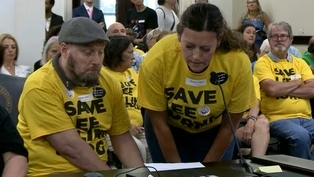
Beshear Announces Short‑Term Fix to Keep Lee Clinic Operating
Video has Closed Captions
Clip: S4 Ep416 | 4m 43s | Beshear announces plan to temporarily fund clinic serving adults with disabilities. (4m 43s)

Kentucky Researchers Helping Mussels Make a Comeback
Video has Closed Captions
Clip: S4 Ep416 | 3m 54s | Kentucky researchers working to save freshwater mussels as numbers decline. (3m 54s)
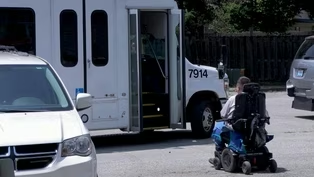
Lee Specialty Clinic Patient Hopes Care Continues
Video has Closed Captions
Clip: S4 Ep416 | 2m 59s | Patient of Lee Specialty Clinic hope to return to clinic after funding announcement. (2m 59s)
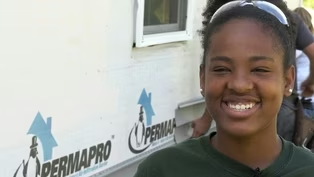
Teens Spending Summer as 'Kentucky Changers'
Video has Closed Captions
Clip: S4 Ep416 | 3m 36s | Teens using tools and teamwork to make a change in Kentucky communities. (3m 36s)
Providing Support for PBS.org
Learn Moreabout PBS online sponsorship New Episode
- News and Public Affairs

Top journalists deliver compelling original analysis of the hour's headlines.

- News and Public Affairs

FRONTLINE is investigative journalism that questions, explains and changes our world.

 New Episode
 New Episode
 New Episode
 New Episode
 New Episode


 New Episode
Support for PBS provided by:
Kentucky Edition is a local public television program presented by KET