
Lidia's a Pot, a Pan, and a Bowl - Lidia Bastianich
Season 9 Episode 1 | 9m 38sVideo has Closed Captions
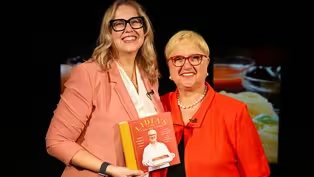
Lidia Bastianich talks with J.T. Ellison about her book LIDIA'S A POT, A PAN, AND A BOWL.
Lidia Bastianich – the Italian-American chef, beloved public television personality, and cookbook author – shares her culinary expertise in "Lidia's a Pot, a Pan, and a Bowl." Lidia invites us on a delightful journey through the heart and soul of Italian cuisine, celebrating the simple yet soul-satisfying joys of cooking in everyday pots, pans, and bowls.
Problems playing video? | Closed Captioning Feedback
Problems playing video? | Closed Captioning Feedback
A Word on Words is a local public television program presented by WNPT
Lidia's a Pot, a Pan, and a Bowl - Lidia Bastianich
Season 9 Episode 1 | 9m 38sVideo has Closed Captions
Lidia Bastianich – the Italian-American chef, beloved public television personality, and cookbook author – shares her culinary expertise in "Lidia's a Pot, a Pan, and a Bowl." Lidia invites us on a delightful journey through the heart and soul of Italian cuisine, celebrating the simple yet soul-satisfying joys of cooking in everyday pots, pans, and bowls.
Problems playing video? | Closed Captioning Feedback
How to Watch A Word on Words
A Word on Words is available to stream on pbs.org and the free PBS App, available on iPhone, Apple TV, Android TV, Android smartphones, Amazon Fire TV, Amazon Fire Tablet, Roku, Samsung Smart TV, and Vizio.
Buy Now
Providing Support for PBS.org
Learn Moreabout PBS online sponsorship(bells ringing lightly) (gentle music begins) - Hi, I'm Lidia Bastianich, and my book is "Lidia's a Pot, a Pan, and a Bowl."
- A good cookbook tells a story.
What's the story of this cookbook?
- This is like you can do this.
It is simple.
You don't have to worry about cleaning thereafter, and you can get a great meal.
So it's sort of an empowerment with simplicity and out at the end a delicious meal.
My grandmother had one pot, maximum two.
She didn't have 10 pots on the...
I said, well, that's what I'm gonna focus on.
And then the pandemic came, and people really got cooking.
I says, okay, this is it.
I'm gonna, you know, focus on this one pot, one bowl, just one, so you don't have to wash or clean thereafter.
But foods can be cooked deliciously, just like my grandmother, whether you braise it all together, whether you put it all in the oven, the vegetables, the potatoes, the proteins, and all of that.
So those are the kind of recipes that are straightforward, simple, and usually one pot.
(gentle music continues) - [J.T.]
And there's something different about the American food culture and the Italian food culture.
Do you see that?
- There's the Italian American food culture, and then of course, Italy, it's regionality.
Each region has its own flavors, and they're different from each other because the Italian American cuisine is a cuisine of adaptation.
The immigrants, when the first came, they didn't have all the ingredients, and they made do with what they found and what they remembered as the recipes.
It happens to be a delicious cuisine.
The Italian American cuisine is a good cuisine.
But when you go to Italy, you really see the regionality of Italian cuisine.
(gentle music) I come from the part of Italy that was given to Communist Yugoslavia after World War II.
Italy lost the war, and hence things really changed radically, you know, as far as language, as far as religion, as far as, and food was scarce.
So I was brought kind of in a situation where grandma provided the food, grandma and grandpa, for the whole family, not just our family.
So she had the animals, and she took care of it, and chicken and ducks and geese, and we had rabbit, and we had goats, and we have pigs, you know.
I mean, milk the goats every morning, made the ricotta fresh with grandma.
Then the pigs, whatever.
November was the slaughter; made the sausages and this.
So all of these things, that was a base.
You know, I was collecting, my formative years, I guess, you know, all these flavors and all of that, not knowing that I will go back to that library of flavors on as my career.
But that's when I took away from that all this tasting.
I mean, you know, you made the ricotta in the morning, just milked the goat, and it was still warm.
You know, she would drizzle a little bit of honey on it.
I still remember that taste.
And you know, whenever, still to this day when, you know, I want ricotta, I'm looking for that taste.
Years later, I realized that cooking was the thing that would bring me back, what I was missing, you know, the flavors and all that.
So I started cooking and trying to bring out the flavors that I remember from grandma, and those made me feel comfortable, made me feel good.
And I got into a whole career, my whole life dedicated to this sort of nurturing flavors that connect with things that you love, people that you love.
And it's a great feeling to be able to give that gift.
I at least I feel very, very honored to be able to cook and nurture people in that way.
(gentle music) There are the chefs that are innovative and in a sense they invent things, and, you know, they show what they can do.
I feel more as a chef that it's a conduit of a culture.
I go to Italy to the source.
I get the recipes there.
I don't invent these recipes.
They really have a place in the Italian culture.
They have a regionality, they have a seasonality, and I try to capture all of that.
The one thing that I try to do is to make it uncomplicated, make it straightforward, and see how simple it could really be.
And my success, you know, I measure personally my success when I get those emails.
"Oh, I did that.
I had a meal for all your recipe.
"And we did it; we love it; my kids get involved."
I love that because, you know, you communicated, I communicated to these people, and I kind of gave them the confidence to go and cook.
(gentle music continues) I wanted to transmit the real cuisine, the cuisine that I had in my memory.
And that's when I went after it evermore.
And I think that's when I was recognized, especially on in my career, when I opened Felidia.
And then, you know, the journalists, Julia Child, they all came to visit to see what this woman was cooking.
I was cooking regional Italian food.
- Speaking of Julia Child, that's a perfect segue.
You have got to tell us that story.
- Oh well, okay.
So we had opened my first restaurant in '71, and we had two restaurants.
We sold those, 10 years of me kind of working all my kinks out, shall we say, and then we opened Felidia in '81, and that was in Manhattan.
And of course, you know, who is this woman, this young woman, this woman chef, and what kind of Italian cooking is she doing?
I began to cook regional, like polenta, like risotto.
Those were not things that were cooked in most of the Italian American restaurants.
And yeah, Julia Child and James Beard walked in one night, thick; they had called.
I mean, you know, they're both big, towering figures.
- Right.
- And she wanted the risotto; she wanted to learn, to eat the risotto first.
She loved it.
She says, "Lydia, you're gonna teach me this."
And we became friends.
She came over the house.
We cooked the risotto.
And then she ultimately asked me, she says, "Lydia, would you be on my show?
"And could we do risotto on the show?"
And so we did.
I did two episodes in her "Master Chefs" series, I think she had.
The producer said, "Lydia, you're pretty good.
"How 'bout a show of your own?"
And she says, "Absolutely, you do to Italian cuisine "what I did to French, you know, bring it to the fore."
And you know, I felt I had a raison d'etre, and now I had to do something, had to.
You know, Julia told me, "Do for the Italian cuisine," and I really held that in my mind.
And so, on television, I always felt I wanted to do the real Italian cuisine.
I wanted my native cuisine and bring it to my adoptive family, which was America.
So, you know, I wanted to connect the two.
(gentle music) - [J.T.]
And you do a show every year, the annual "Lidia"... - "Lidia Celebrates America."
And for me, it was a way of, because of thanking America, of seeing things in America that maybe, you know, was missed by a lot of the Americans, and being, you know, being here.
So as an immigrant, as an outsider, you really see and appreciate things.
And I do it all with food, you know.
That's what's nice about it because how do you get into somebody's life, you know, and they different kinds of works and whatever?
With food, you know, we cook.
I said, you know, wanna learn your food, and we cook together; we eat together.
You know what else intrigued me very much?
Not only the cooking, but the way of eating.
I interviewed this family, and they were from Bhutan.
They eat on the floor, said I just loved that.
And they eat with their hands.
And I thought it was... You know, I felt so included, so inclusive when they bring it.
This is their very special place because, you know, family meal is very special.
So these shows that I do, I really, I go permeate America my way.
(light Italian music) - What are the absolute must-haves in the kitchen?
- Well, you're talking about oil and garlic and onion.
Tomatoes, no.
Either fresh in the summer or the plum tomatoes.
The Summer Sun are tomatoes.
Canned, they're perfectly fine.
And of course, the fresh herbs, seasonal vegetables, and so on, you know; it's endless.
Be seasonal, have those simple condiments, and don't elaborate.
Garlic always, onion now and then.
- I think there's only one thing left to say.
- What's that?
- Tutti a tavolo a mangiare.
- Brava.
Brava.
- (laughs) Grazie mille.
- Prego, prego.
Thank you very much, grazie.
- It's been wonderful to have you.
- My pleasure.
Thank you, thank you.
Great questions.
- And thank you for watching "A Word on Words."
I'm J.T.
Ellison.
Keep reading.
(bells ringing lightly) (light Italian music) What is your favorite meal?
- [Lidia] Oh, I don't have one.
Like it's asking, "What's your favorite child?"
(light Italian music)
Lidia's a Pot, a Pan, and a Bowl - Lidia Bastianich | Short
Video has Closed Captions
Clip: S9 Ep1 | 2m 30s | Lidia Bastianich talks with J.T. Ellison about her book LIDIA'S A POT, A PAN, AND A BOWL. (2m 30s)
Providing Support for PBS.org
Learn Moreabout PBS online sponsorship












Support for PBS provided by:
A Word on Words is a local public television program presented by WNPT