Jay's Chicago
Life Stories
Season 2022 Episode 3 | 22m 19sVideo has Closed Captions
Mysterious antique negatives. A surprising family tradition. Chicago’s storytelling champ.
Jay explores a mystery: who is that little girl in dozens of century-old negatives found in a Chicago attic? Then, a handmade “onesie” becomes a treasured symbol of family love as it is shared by dozens of babies across generations of a single family (cuteness warning!). And he meets the undocumented immigrant who became Chicago’s winningest storyteller.
Problems playing video? | Closed Captioning Feedback
Problems playing video? | Closed Captioning Feedback
Jay's Chicago is a local public television program presented by WTTW
Jay's Chicago
Life Stories
Season 2022 Episode 3 | 22m 19sVideo has Closed Captions
Jay explores a mystery: who is that little girl in dozens of century-old negatives found in a Chicago attic? Then, a handmade “onesie” becomes a treasured symbol of family love as it is shared by dozens of babies across generations of a single family (cuteness warning!). And he meets the undocumented immigrant who became Chicago’s winningest storyteller.
Problems playing video? | Closed Captioning Feedback
How to Watch Jay's Chicago
Jay's Chicago is available to stream on pbs.org and the free PBS App, available on iPhone, Apple TV, Android TV, Android smartphones, Amazon Fire TV, Amazon Fire Tablet, Roku, Samsung Smart TV, and Vizio.
Providing Support for PBS.org
Learn Moreabout PBS online sponsorship(bright music) - Everyone has a story.
It's a cliche because it's true.
I listen to people's stories for a living, and I've found that most people are willing, even eager to tell their stories, if offered an attentive and appreciative set of ears.
And the listener always has something to learn from the joys and challenges of another person's life.
In the next half hour, five life stories.
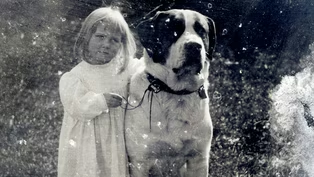
There's the winningest competitive storyteller in Chicago, old glass negatives found in a Chicago attic offer clues to the surprising life story of this little girl.
A Chicago artist wants to leave parts of his story behind and light up the world with color.
And without a doubt, the single cutest story to ever appear on this program.
Stick around.
That's right now on "Jay's Chicago."
(upbeat music) Hi, I'm Jay Shefsky.
This first story comes with a lesson.
You never know what might be hidden up in the attic.
It's about a remarkable find that turned up in a Chicago home just days before the house was torn down.
- [Jay] When Jimmy Neuter was a kid, he spent a lot of time with his grandfather, an iron worker who built Chicago skyscrapers.
Jimmy says this photo taken nine stories up, says a lot about him.
- He was a bad-ass I mean, he was just meat and potatoes.
He worked hard for his life.
And I learned a lot from him.
(hammer clanging) - [Jay] Jimmy says he learned a love of history and about the beauty of things made by hand.
Jimmy Nuter does architectural salvage.
Sometimes he finds what you'd expect in an old house, and he's got a warehouse full of pre-1930 gems, but he also has to be open to the unexpected things a house might offer up.
A few months ago, Jimmy was working in a house on the north side of Chicago and it held a big surprise.
- From the outside, I mean, you'd drive right by and think nothing of it.
- [Jay] And even inside there wasn't much of interest, but sometimes he says, you just get a feeling.
- There's something here, beyond what you're seeing.
There's something here.
I just, it's a weird thing to say.
I just don't know how to explain it.
- [Jay] He climbed into the unfinished attic, nothing but insulation.
All he found were some old business cards and letters, he was about ready to leave.
- [Jimmy] Just at that point, I stumbled on the first glass plate.
- [Jay] We're glass plate negatives, dozens of them, the kind common in photography until the early 20th century.
- The very, very first image that I held up and was able to blow off.
I saw this big giant dog.
I don't know if it was a Burmese Mountain Dog or a St. Bernard.
Now, that's a strange picture.
I'd put that one off to the side.
And then I saw a really beautiful portrait of a woman.
- [Jay] There were more than 75 altogether and he brought them back to his warehouse.
- And then the next picture I saw was a family in the living room and a bunch of portraits in the background, really sophisticated paintings.
- [Jay] But these were all negative images.
He wanted a better look.
He brought the plates home where there was an amazingly coincidental resource.
Jimmy's partner, Kari McCluskey is an artist who works at the Art Institute of Chicago and specializes in glass plate negatives.
- They were over a hundred years old.
It was amazing.
They're so tough.
If this would have been film, it never would have survived.
- [Jay] And when they started scanning what they saw took their breath away.
- [Kari] There were so many of them, all of family and not in a studio, in their home and in their backyard.
And then we realized that was the same house that he found them in.
It was just like - it just kept unfolding.
- [Jay] There were many pictures of a woman and her daughter often with the big dog.
There were scenes of men gathering and then some shots of other people posing sometimes in front of a white cloth or newspaper.
But who was this family?
And why did they have this kind of camera, usually used in a studio for more formal portraits.
There were clues in the papers Jimmy found in that attic.
- One of the names that kept coming back up was a Hermann Schultz.
And so I just arbitrarily punched Hermann in Google.
Found out that there was a Hermann Schultz who happened to be a famous portrait painter.
- [Jay] That would explain all the paintings in the living room and the people posing.
He must have used them as a reference for portraits.
There is just one photo of someone who appears to be the dad and then a posed shot of the same man.
Jimmy found out that Hermann Schultz was from Norway.
- He came to America around 1892 and was commissioned by Carter Harrison, the mayor of Chicago, to paint his portrait for the World's Fair.
- [Jay] A Norwegian-American museum has a collection of his paintings.
One of which is a portrait of his wife and dog visible in this photograph taken in their living room.
Hermann's wife was Hedvig, and they had one daughter Sigrid, born in 1893.
When Jimmy Googled them, the bombshell discovery came late at night.
- Kari was in bed by then and I quietly said, "Kari, I think I just found something really cool."
- [Jay] It turns out that this little girl with the big dog, grew up to be a groundbreaking foreign correspondent for the Chicago Tribune.
- She was a very, very big deal.
- [Jay] Ron Grossman is a longtime Chicago Tribune reporter and it's unofficial historian.
He says, "Sigrid Schultz held positions unheard of for a woman in her time."
- She was appointed just after World War One as a correspondent for the Tribune stationed in Berlin, rose to be the chief of that bureau.
And eventually chief of all the bureaus in central Europe.
- [Jay] During the thirties, Sigrid Schultz became a key voice from inside Germany, reporting on what was already occurring there.
- [Ron] Some of her material she feared would not get past the censors.
So she wrote it under a fake byline, John Dickson, and usually went to a nearby foreign country to file the material.
- [Jay] The Schultz family had left that house and Chicago many years earlier in 1901 when Sigrid was eight.
She grew up in Germany and France.
The house had at least nine more owners before it was torn down in 2018.
None of them apparently ever thought to look very carefully in the attic.
(upbeat music) - Family traditions are part of the glue that keeps the family together and strong.
This next story shows that sometimes love can be conveyed by something as simple as a baby's onesie.
- Okay, let's put this on.
When Zachary was born, we were so excited to meet him.
And I was so excited to put the sunsuit on him.
Okay, we'll put it down over here.
- [Jay] Zachary Pingoy is wearing a garment that may hold the world record for hand-me-downs.
It's a kind of onesie that's called a sunsuit in the Philippines, and Zachary is the 60th baby in this family to wear it.
- The sunsuit has been our family for three generations.
My lola, which is Filipino for grandma, I call her lola.
She put this on her first baby, my aunt Bernadette.
And they took a picture.
- [Jay] That was 1945.
Mary Grace Pingoy's grandparents went on to have 12 children And each one wore the sunsuit.
One of those babies was Mary Grace's mother, Margie.
- It was made by my aunt, the eldest sister.
who is a nun.
She must've just thought, "I'd give a nice gift to my sister because she's having her first baby."
And she didn't realize how important this sunsuit was three generations now.
- [Jay] When those 12 babies grew up and had their own kids, they continued the tradition, 28 more times.
- 1,2,3, I'm gonna come in.
- [Jay] Mary Grace and her husband have five kids.
She and the others in her generation have so far put 25 babies into that original sunsuit.
Though these days it's only worn for the photos and then stored safely away.
- Every time somebody says I'm pregnant, or we make sure that he or she will have that sunsuit ready when the baby comes (laughs).
- [Jay] Now, there was a time that the sunsuit went missing for a while, but no baby is left out of this album.
Even if the sunsuit is added by Photoshop or worn a little later than usual.
- [Mary] They had to stretch the sunsuit to fit her.
(both laugh) - [Jay] Now, you might say that the sunsuit is only a hand-me-down.
Yet for the members of this large family spread around the world.
It's become a powerful symbol of family unity and love, and especially the matriarchs love for them all.
- And then just come a little bit forward on that side.
Very good.
Again?
- [Jay] Today, Mary Grace Pingoy is a professional photographer.
Inspired, she says by her grandmother who filled her own home with family photos.
And Mary Grace says the power of this sunsuit tradition is not just that the babies wear it.
It's also the photos.
- I think pictures speak to children.
And when you're growing up to see all the babies wearing the sunsuit, it just, you feel like, a sense of belonging when you see your family heritage and that we're connected through the years.
In this world today, there's something we all just need to know is that, we're loved and we're precious.
And that's what my lola taught me - to be that to everyone and to show them that.
- Over here, Hi Zack, hi Zack.
(upbeat music) - Next up the story of a Chicago artist, determined to put parts of his past behind him and light up the world with color.
♪ If you've got a story to tell ♪ ♪ I guess all you need is a studio ♪ ♪ If you've got a product to sell ♪ ♪ Just make sure the business is booming now ♪ - Colors is my thing, you know, and I like a lot of color.
'Cause I want it to like light up a room.
My name is Edo, artist, entrepreneur, just a creative in general, you know.
Looking to take over the world.
(laughing) - [Jay] Edo puts that color into everything he does from paintings to apparel, to design, to digital art.
- [Edo] But then once it attracts the eye, I want them to see what I'm actually trying to say.
(train tracks clanging) - [Jay] Like a lot of young creatives Edo has his hands in a lot of things.
He and a partner run a little shop called Project Escape in this container mall in Bronzeville.
- [Edo] It consists of three brands, which is Tru Lies, Fake Decent, and Infinite Inception, which is my brand, so.
- [Jay] And who makes all this stuff?
- [Edo] We do, I specialize in the graphic portion of it and my business partner, he specializes in the print portion of it.
- [Jay] Edo was born, Edward Santana White.
- It was very interesting childhood, (laughs) to say the least.
My mom was a heroin addict.
She was addicted to heroin.
So she knew that she had to give us up.
My dad currently right now to this day is still addicted to heroin.
I was in 12 different foster homes within a two-year span, but eventually, you know, my mom got clean and she gets us back and stuff like that, but I was still angry and afraid of everything, you know.
But it was only so many times I could use that as like, why I'm acting the way that I'm acting toward people.
I'm acting this way because I've been through that.
It's like, okay, but like everybody goes through things, you know?
So I just wanted to take all that hurt and all that pain and put it as a something productive.
And art was that thing for me.
- [Jay] It started for Edo with clothing, like screen printed shirts, hoodies and jackets.
Then one of a kind items decorated by hand, pants, sneakers, hats, boots.
- [Edo] And they come with custom tags, custom shoe laces, all created by me.
(energetic music) - [Jay] Then came digital art.
Like these portraits he created on his laptop for a 2017 show in New York.
He calls this style Infinite Inception.
And he says it's become his identity.
- Like when you see some type of art like this, you always think, whoa, that's definitely Edo's work.
Organized chaos is what they say.
'Cause it's like, it's super detailed, but then, It's kind of like all over the place.
- [Jay] And now paint.
- [Edo] Painting was like really, you know, each stroke was like an emotion.
So if it's pain that I'm feeling, you'll see it in the art.
If it's happiness that I'm feeling, you'll see it.
That's like wizardry: to wake up every day of your life and create what you see.
Come on man, it's freedom, you know what I'm saying, like?
That's freedom man, that's next level, and I get to do that everyday of my life.
I don't take art for granted at all because it saved me, you know.
(upbeat music) - Now you might not think of storytelling as a competitive sport, but all over the country people tell true stories live on stage.
They're called story slams.
And an audience panel selects a winner that goes on to compete in a grand slam.
Meet the winningest storyteller in Chicago.
- And let it go for Nestor Gomez everybody.
(audience cheering) - [Jay] This was the first time Nestor Gomez told a story in front of an audience, and he almost didn't make it to the stage.
- I was freaking out, I almost chickened out like three times.
If it wasn't because of my wife, I would have chickened out.
I was 15 years old when my family moved from Guatemala to Uptown, Chicago.
- [Jay] He was worried about his accent and whether an American audience could relate to an undocumented immigrant, but he gave it a shot and it changed his life.
- On my first day in Chicago, I met some Mexican kids who over to show me around the neighborhood.
- [Jay] That first story was about how an innocent phrase in Guatemalan Spanish means something very different, and quite crude, in Mexican Spanish.
(audience laughing and clapping) Apparently the audience could identify with a story about a boy's embarrassing misunderstanding with a girl and Nestor came in first that night.
- I started to cry-- - [Jay] And he's won 36 story slams since then, a record in Chicago.
- What makes Nestor such a compelling storyteller is that he tells stories that have to do with sort of everyday struggles of him navigating through life.
But I think what makes him extra special is when you put that against the backdrop of his own story.
- It's 1980, I'm about 10 years old living in Guatemala with my siblings and my parents, but we are very poor.
My family, we used to make little worry dolls that we used to take to the airport to sell to the white people that came to the airport - for tourists.
- [Jay] Nestor's parents came to Chicago first to find work and left Nestor and his siblings with grandparents.
- But the civil war got so bad that my mother realized that it wasn't safe for us to be in Guatemala anymore.
So she decided that she was gonna bring us to the United States instead.
- [Jay] Their father came back to get them and Nestor remembers running behind the coyote, or immigrant smuggler, to get them across the border.
- I feared that we were going to be separated from our father.
I feared that we were going to get lost, and I feared that we're going to get caught and wouldn't be able to see our mother or be reunited with our mother.
- [Jay] That was 1985.
Nestor Gomez became a US citizen in 2018.
For the last 10 years, he's worked as a quality control inspector for a Chicago manufacturer.
And now in addition to his stories of everyday life, he's made it his mission to educate Americans about immigration, and to offer comfort to young immigrants.
- When I was in high school, I didn't see anybody talking about immigration.
They were nobody that will come to the school and tell us about how the immigration processes is, and how we should feel about it, or we shouldn't be ashamed of it.
So please welcome Esperanza.
(audience cheering) - [Jay] Nestor Gomez, also produces a show called "Around The World in 80 Minutes."
- [Nestor] And it's a show where we bring immigrants, descendants of immigrants and all likes of immigrants to share immigration related stories.
- [Jay] Nestor has told more than 100 stories so far, and he continues to bring humor to many of his stories, like encountering his baby for the first time.
- He was a really good looking baby.
He kinda looked like me, I was like, "This a cute baby."
- [Jay] But he also takes on other deeply serious topics like, alcoholism, domestic abuse and his own sexual abuse as a child.
- Now I loved my uncle, and when he asked me to pull down my pants lay down on the grass face down so he could get on top of me, I let him.
That's the way life is, you know, some days life is very funny.
Some days it's not.
That's the way that the stories come on as well.
So I got married and I immediately had two kids.
- Because he is so open and willing to share very personal things about his life.
He immediately connects with our audience of strangers, but people at the end of the night feel like, you know, they've made that connection.
(audience cheering) - Give it up for Nestor everybody.
(audience cheering) (upbeat music) - You can watch any of these stories again, along with 15 years worth of other stories on our website, wttw.com/jayschicago.
And while you're there, tell us what you thought of the show.
I'm Jay Shefsky.
Thanks for watching.
(lively music)

Lighting Up The World With Color
Video has Closed Captions
Clip: S2022 Ep3 | 3m 53s | Edo loves color. “Color is my thing,” he says. “I want it to light up a room.” (3m 53s)
Video has Closed Captions
Clip: S2022 Ep3 | 6m 43s | You never know what you might find in the attic. (6m 43s)

A Unusual Tradition of Love and Family Unity
Video has Closed Captions
Clip: S2022 Ep3 | 3m 50s | This is undoubtedly the cutest story to ever appear on the show. (3m 50s)

The Winningest Storyteller in Chicago
Video has Closed Captions
Clip: S2022 Ep3 | 4m 43s | Nestor Gomez is Chicago’s champion storyteller. He came here as an undocumented immigrant. (4m 43s)
Providing Support for PBS.org
Learn Moreabout PBS online sponsorship













Support for PBS provided by:
Jay's Chicago is a local public television program presented by WTTW