
Life’s most difficult decisions, celebrating Martin Luther King, Jr. Day at The Henry Ford
Season 10 Episode 29 | 26m 46sVideo has Closed Captions
A look at healthcare and legal planning for caregivers and The Henry Ford’s MLK Day programming.
One Detroit is continuing our coverage on caregiving with two reports about planning for the future with aging loved ones. We’ll examine the steps people should take to make sure family caregivers are aware of their healthcare wishes and more. Plus, we’ll hear what The Henry Ford in Dearborn is planning in recognition of Martin Luther King, Jr. Day.
Problems playing video? | Closed Captioning Feedback
Problems playing video? | Closed Captioning Feedback
One Detroit is a local public television program presented by Detroit PBS
Life’s most difficult decisions, celebrating Martin Luther King, Jr. Day at The Henry Ford
Season 10 Episode 29 | 26m 46sVideo has Closed Captions
One Detroit is continuing our coverage on caregiving with two reports about planning for the future with aging loved ones. We’ll examine the steps people should take to make sure family caregivers are aware of their healthcare wishes and more. Plus, we’ll hear what The Henry Ford in Dearborn is planning in recognition of Martin Luther King, Jr. Day.
Problems playing video? | Closed Captioning Feedback
How to Watch One Detroit
One Detroit is available to stream on pbs.org and the free PBS App, available on iPhone, Apple TV, Android TV, Android smartphones, Amazon Fire TV, Amazon Fire Tablet, Roku, Samsung Smart TV, and Vizio.
Providing Support for PBS.org
Learn Moreabout PBS online sponsorship- [Narrator] Coming up on "One Detroit," we're continuing our special coverage on caregiving with two reports about planning for the future with aging loved ones.
We'll examine the steps people should take to make sure family caregivers are aware of their healthcare wishes.
Plus, we'll look at the importance of having conversations in advance about legal and financial issues.
Also ahead, we'll hear what the Henry Ford and Dearborn is planning in recognition of Martin Luther King Jr.
Day.
It's all coming up next on "One Detroit."
- [Narrator] Across our Masco family of companies, our goal is to deliver better living possibilities and make positive changes in the neighborhoods where we live, work, and do business.
Masco.
A Michigan company since 1929.
- [Narrator] Support also provided by the Cynthia & Edsel Ford Fund for Journalism at Detroit PBS.
- [Narrator] The DTE Foundation is a proud sponsor of Detroit PBS.
Through our giving, we are committed to meeting the needs of the communities we serve statewide to help ensure a bright and thriving future for all.
Learn more at dtefoundation.com.
- [Narrator] Nissan Foundation, and viewers like you.
(upbeat electronic music) (upbeat electronic music continues) - [Narrator] "One Detroit" is continuing our special series of reports on caregiving with a look at the often-challenging choices that older adults and their caregivers must make as they plan for the future.
"One Detroit" contributor Marty Fischhoff sat down with a palliative care doctor and with Susan Major, a cancer patient who took important steps to make sure her loved ones knew her healthcare wishes.
(relaxed electronic music) - Susan Major was diagnosed with pancreatic cancer four years ago.
Recently, we sat down with her at the Ann Arbor home of her sister and caregiver, Marsha, to discuss some of the crucial healthcare decisions she has made and how she's ensured that her wishes are carried out.
Susan, how are you feeling today, and is it okay if we talk a little bit about your condition and the decisions you made about the kind of healthcare treatment that you desired?
- I feel good today.
I don't have any pain, I have enough energy to do pretty much what I wanna do.
- Tell me about when you first got the diagnosis.
- The diagnosis happened because I was actually on my massage table that I have, and I was on there and I felt something really funny here, and I thought, "Hmm, I wonder if that's a hernia," and so, I called my doctor and she said, "We'll just get a CT, I'll just order it right away," so she did, and yes, I had a small hernia, but she also found pancreatic cancer, and it turned out to be fourth-stage and inoperable, and most people... Like, if you don't do anything, die within three months, most people die within a year, I guess, and I'm on year four.
- [Marty] Susan took chemotherapy on and off for four years before deciding to stop because of the side effects.
- I've stopped chemo longer than the three months that I was supposed to be dead, so ain't dead yet, and I'm not afraid of dying, and so, I feel like I had the honor of being able to have enough time to do all of that and tell everybody I love them, and, you know, spend time with people and live how I wanted to live.
- [Marty] Susan speaks highly of the physician she had at Michigan Medicine, not only her oncologist, but also her palliative care doctor.
- This is silly, but I have trouble with words and I found a palliative care doctor early on as well, and I call her my paleontologist.
- [Marty] Dr.
Jane Chargot is Susan's palliative care specialist at Michigan Medicine.
In her role, she helps relieve the pain and other symptoms of patients, but she does much more.
- So we try to manage complex symptoms for patients who may be needing a little bit more specialization and a little bit more expertise.
The other thing that we help do for patients is we help with communication, because when people have complex diseases, they often have a lot of different doctors, a lot of different members of their medical team, and they might hear a bunch of different things that are very confusing, and maybe at times, seems at odds to each other, so we help sit down, really get to know the patients, really help them navigate through their journey, and then, also help them really understand what it is that they are hoping for from their medical care, and then, help communicate that back to their medical team so that the whole team that surrounds them is really keeping them, that patient, at their focus.
- [Marty] We ask Dr.
Chargot what conversations she wishes older adults and their family members would have before a health crisis occurs.
- So we often talk about a group of documents that are called advance care documents.
Within an advance directive, we help patients start to think about what kind of care that they want... Would want in their end of life, whether or not somebody would want to go to the ICU when they start to get really sick, whether or not they would want to have something like a feeding tube, or have dialysis, or even have intubation, the tube that goes down your throat and helps you breathe, these are things that some people really don't want and these are things that other people feel very strongly that they do want, but if we don't have these conversations or if we don't have documentation indicating what we would want when it comes down to that spouse, or that parent, or that child trying to make decisions for you, they may feel adrift.
As difficult as it is to think about your own end of life or your own illness progressing, that this is a gift to the people that you love more than it is a gift to yourself, because it really helps them navigate these really awful decisions that they have to make and helping lift a little bit of that burden from their shoulders.
- [Marty] Susan Major has had conversations about her wishes with her patient advocate, the person who could speak on her behalf if she is unable.
- All of that, I got done in the first three months 'cause I thought I was gonna die in three months, I really did, so we were... I was in a hurry to get all that done and put into place, and we did, thanks to Marsha, she did all of that, not to mention the research and everything else, and going to every chemo session with me.
- [Marty] Marsha said the entire family rallied around Susan to support her, but she took on the role of primary caretaker.
- I think that one underrated aspect of caregiving is helping your loved one through issues that you don't always associate with caregiving, for instance, when Susan was first diagnosed, I helped her with her medical insurance, I, to this day, get all of her medical insurance communications so she doesn't have to look at them, we set up her financial... You know, all of her financial records so that her bills were on automatic payment and that sort of thing, and that really reduces a huge amount of stress that she's going through.
- [Marty] Marsha, who's an attorney, has another valuable piece of advice for caregivers.
- Well, I think one thing that people should be aware of is that not only do you need those documents, but you have to have those documents in a place where they're readily available so that, for instance, there are packages that you can put on your refrigerator that have all of the important documents that tell all contact numbers, insurance information, all the medications you're on, so that if you have to call 911, the ambulance company has all that information.
- Yeah, I have an envelope on my refrigerator, "Do not resuscitate" on the outside of it, I have one in my purse and my car.
- [Marty] Finally, we asked Marsha what the secret is to her sister's remarkable upbeat attitude.
- I don't know what gives her the strength and the energy, but I wish I did.
She... What's been most amazing to me is she has just remained so emotionally stable during this, and I don't think anyone who's not going through this can begin to imagine what it's like to have this kind of prognosis, and it just is mind-blowing that she can, you know, live every day and enjoy every day.
- Everybody thought I'd live to 100 because, you know, I'm one of those organic, all-natural, homeopathic, aerobatic kind of people that never did any drugs and all of that stuff, and it was very, very conscious, so it became... It's a surprise, I don't have any cancer in my family, it just came out of the blue, so what kicked in for me is I have spent a lot of my life doing spiritual work and emotional healing work, and I've had teachers that have really taught me to accept what is, and to take one day at a time and live in the present, and there's never been a better time to do that than now, let me tell you.
(laughs) - [Marty] After Susan had made all the other necessary preparations, she had one last thing to take care of.
- I think my greatest concern, and it was a huge concern to me, is my dog.
I love my dog, she's the most wonderful friend I have, and I didn't know who could take care of her, but fortunately, my next-door neighbor, who's never had a dog in her entire life, volunteered to try and get to know the dog, and see how it was gonna work, she was really nervous that she wouldn't, you know, be able to do it, but my dog's very, very well-trained, so for the past four years, they have already established a relationship, she walks him every morning, just lets herself in, takes the dog, and I know my dog is going to be with a wonderful mother and that was a huge relief to me.
- That's great.
- [Narrator] Another sensitive but important conversation that should take place between caregivers and their loved ones involves financial and legal planning.
In this report, Marty Fischhoff discusses these crucial issues with an attorney, and visits a mother and daughter, Judy and Ericka Page, who are preparing for the future.
(relaxed electronic music) - We're at the home of Judy Page, she's 81 years old and lives in Northwest Detroit.
Recently, she and her daughter Ericka visited the Elder Law & Advocacy Center to prepare for Judy's future.
Why did you decide it was time to meet with the attorney and talk about your mom's future?
- Her older sister is a year... Almost a year older, they... Her and my cousins, her daughters, had sat down to talk about her final wishes probably about 10 years ago and had urged us to do the same, and just, you know, it's not an easy subject to breach, and so, just had put it off for a while, but I saw an email that invited, you know, the community to come and learn about estate planning, and wills, and trust, and the like, and I signed up, I figured it'd been time enough to put it off.
- Judy, what made you think it was the right time to do this?
- I wanted to leave my daughter the house, and it was time to proceed with the workings, because I had a stroke and I was not retaining everything that I wanted to retain.
- So you wanted to set down a plan for the family so they would know your wishes for the future?
- Correct.
- Ericka set up a meeting with Antonia Harbin, an attorney at the Elder Law Center, to address sometimes difficult issues.
Antonia first asked to speak to Judy by herself.
Were you surprised when the attorney asked you to leave the room?
- You know, I'm a little protective of her, so I was like, "Why do I have to leave?"
You know, because we do everything together.
Antonia was very warm and welcoming, so I was able to trust her and know that my mom was in good hands, and I wanted the attorney to understand that these are her wishes and not mine.
- [Marty] Ericka and her mom knew there were documents they needed to sign, but a will was not on their minds.
- Honestly, I hadn't thought about a will, you think that when you're wealthy, that's when you think about a will, but talking with Antonia, we realized that, yeah, it actually is important, it really is not... It's more about what happens with the assets that you do have, you know, after your demise, 'cause you're dealing with so much when you lose the loved one, so just one less thing to worry about and I'm glad we did it.
- [Marty] A recent survey by the University of Michigan Institute for Healthcare Policy and Innovation found that most Michiganders 50 years and older have not taken the necessary steps to prepare for their long-term needs.
Only 25% have designated a durable power of attorney for medical care, and only 24% have identified the people in their lives to serve as their caregivers.
Even among those age 65 and up, only 37% have assigned durable power of attorney.
The survey also found that 39% of those 65 and older said they had not talked with family, friends, healthcare providers or anyone else about their options and wishes for long-term care and caregiving.
That is the kind of planning for the future that Elder Law & Advocacy Center helps clients with, and they discuss the necessary paperwork to make sure those plans are carried out.
Antonia Harbin, Judy Page's attorney at the Center, explains.
- The Elder Law & Advocacy Center is a division of Neighborhood Legal Services Michigan, and we do a lot of different type of work there, we provide free legal services for those who are 60 and older who live in Wayne County and their caregivers, and we do all types of legal services, landlord tenant, probate, we do elder abuse prevention, we also do life planning and we help with kinship caregiving as well as other caregiving, those are just to name a few, and outside of that, I really wanted to tell you about our first Tuesday workshop, that's been going on for many years now, and it gives those who are 60 and older the opportunity to get their life planning documents done for free.
- The workshops are held by Zoom and by conference call.
If clients want to proceed, they fill out forms, and then, meet with an attorney one-on-one.
When would you say people should start thinking about these life planning documents?
- Well, really, 18 years of age or older, but, you know, that rarely happens just because people may not be prepared to have those conversations, but I would say those conversations should be more immediate because you never know if something will happen or kind of can happen, so just having them as soon as possible.
- [Marty] There are generally two primary documents that need to be executed.
The financial durable power of attorney gives a designated individual the authority to manage bank accounts, retirement funds, and other assets.
The durable power of attorney for healthcare specifies the kind of treatment a person wants if they are incapacitated and designates an individual to make decisions according to those stated wishes.
- With the life planning documents, we often say those documents are even more important than those after death because they control while you're living, they help you to continue your decision-making as you're living if something happens, you become incapacitated, unable to give your preferences, give your thoughts about certain things, then someone you've trusted can actually step into your shoes and make those decisions for you.
- [Marty] Antonia says dealing with older adults is something that gives her great satisfaction.
- Really being able to talk to older adults about, you know, what their situations are, they have so much wisdom, so I enjoy every moment, every time we get to meet, talk, it's just... It's a great joy for me.
- Completing the paperwork, knowing that her wishes will be carried out when the time comes brought peace to Judy and her daughter.
Now that all the paperwork is signed, sealed, and delivered, how does it make you feel knowing that that's all in place?
- It's comforting that it is all in place and I don't have to worry about it, and I was glad that it didn't really cost me anything because it was free of charge.
- A burden lifted, for sure, because like I said, it nagged me for quite a while to get it done, and it just... You know, sometimes, we make up things in our head like it's just gonna... You know, "I don't wanna breach this conversation, I don't..." You know what I mean?
But it's a burden lifted, but then, on the other hand, it also is kind of a nudge for me to get my own paperwork done, which is a whole 'nother story, now, I gotta have the conversation with my children.
- I, at first, was apprehensive, and I'm glad I did it and it was... All out of the way now, and I can relax.
- [Narrator] Let's turn now to the Martin Luther King Jr.
holiday on Monday, January 19th.
It's the day the nation recognizes Dr.
King's contributions to civil rights, social justice, and community service.
The Henry Ford and Dearborn has three days of activities planned to celebrate Dr.
King's legacy.
"One Detroit" contributor Stephen Henderson of American Black Journal got the details from the Henry Ford's vice president and chief marketing officer, Ellen Hill Zeringue.
(relaxed electronic music) - Let's talk first about this holiday and I guess what it means at the Henry Ford, I think when a lot of people think of them, okay, holiday, they think of the Wright Museum in Midtown Detroit, but it's just as important at a place like the Henry Ford, tell us why.
- Absolutely, first of all, we're thrilled to be able to once again commemorate the amazing legacy of Dr.
King, and when you think about Dr.
King, he was just an ordinary person who did extraordinary things, and that's what we do at the Henry Ford, we tell those stories of amazing innovators, and he aligns no different than the Rosa Parks bus that we have, or the Kennedy limousine that we have, or the other stories of innovators and amazing people who just did... Ordinary people who just did extraordinary things, and it's also an opportunity for us to really highlight one of our collecting categories, which is social transformation, and the impact that Dr.
King had on changing the trajectory of our country is very important from an innovation standpoint, a history standpoint, and that's what we do at the Henry Ford.
- Yeah, yeah, so what will that look like on the 17th through the 19th?
- We've got a wonderful program, three days of programming, which as you mentioned, will start on the 17th, on the 17th, we will start with... We're going to have a play called "The Beginnings of the Boycott," and the significance of this play is that it tells the background story of arranging and organizing the movement and the boycott surrounding when Mrs.
Parks refused to give up her seat, and on December 1st, 1955 when she was arrested, we know that that first boycott had 40,000... Over 40,000 blacks who decided not to ride the buses, but after that, there was so much more significant planning because that one day was great, but it didn't have the impact, the full impact, so "The Beginnings of the Boycott," which was written by one of my colleagues, X. Alexander Durden, really tells the story of... That background story of organizing, and also highlights that moment where they appointed Dr.
King to be the leader of that boycott in that movement.
Following that, we'll also have... On the 18th, we'll have musical performances, we'll have Ashley Baylor, who's a local soprano, we'll have Sean Bird, who's a pianist, so we'll have music happening, and also on the 18th, we will have Dr.
Jeanne Theoharris, and Dr.
Theoharris is a world-renowned best-selling author, New York Times best-selling author and she wrote the book "King of the North," that's her most recent book, and "The King of the North" really highlights the impact of Dr.
King and his advocacy in the North, when we think of Dr.
King, we think about the South, but really he was very instrumental in many movements in the North, and Dr.
Theoharris is a strong advocate for telling that story, so on the 18th, she'll sit down with our curator of black history, Amber Mitchell, and we'll have a conversation about her book, but also about the overall impact of Dr.
King in the North.
- What do you hope that people who visit the Museum, you know, over the three days, are able to kind of take away from not just Dr.
King and the holiday, but also this sense of place with regard to Dr.
King, you know, being here in Southeast Michigan?
- You know, Stephen, we're really fortunate that Henry Ford... That we're in a position where we can really celebrate this important moment and Dr.
King, and so, what I hope people get from being here is a renewed sense of inspiration.
This is a tough time for many in our country right now and it was a tough time then, and Dr.
King, the organizers, many other civil rights advocates fought against what was a very challenging environment in our country, and so, I hope that people will learn, I hope that they will be inspired, and I hope they will understand that it took the work of ordinary people, and these were young people, Stephen, these were not people in their 50s and 60s, these were people in their 30s, and in many instances, people in their teens, college students who just did what they could do in their own personal capacity to try to affect change, and I think what's really special about the days that are coming up for the King holiday is that on Monday, January 19th, the Museum will be free admission, so everybody can come, and on that day, we will have for the first time on display, the chair that Dr.
King was sitting in on the day that he heard Lyndon Johnson's speech, "We shall overcome," which was signaling the impending signing of the Voting Rights Act, so that chair will live on in the Jackson home, which you know is a recent acquisition that we've acquired here that will open this summer, but the opportunity to just sort of get a glimpse of that chair and understand the magnitude of that moment, all the work that Dr.
King and his advocates and civil rights partners were doing in that very moment, he heard the president of the United States signal to him, and we have that chair, and when I see that chair, I am reminded of not only the great works of Dr.
King, but again, what ordinary people can do to affect change in our country.
(relaxed electronic music) - [Narrator] That'll do it for this week's "One Detroit," thank you for watching.
Head to the "One Detroit" website for all the stories we're working on, follow us on social media, and sign up for our newsletter.
(relaxed electronic music) - [Narrator] This program is made possible in part by Ralph C. Wilson Jr.
Foundation, Michigan Health Endowment Fund, AARP Michigan, and by... - [Narrator] Across our Masco family of companies, our goal is to deliver better living possibilities and make positive changes in the neighborhoods where we live, work, and do business.
Masco.
A Michigan company since 1929.
- [Narrator] Support also provided by the Cynthia & Edsel Ford Fund for Journalism at Detroit PBS.
- [Narrator] The DTE Foundation is a proud sponsor of Detroit PBS.
Through our giving, we are committed to meeting the needs of the communities we serve statewide to help ensure a bright and thriving future for all.
Learn more at dtefoundation.com.
- [Narrator] Nissan Foundation and viewers like you.
(upbeat electronic music) (upbeat electronic music continues) (upbeat piano music)
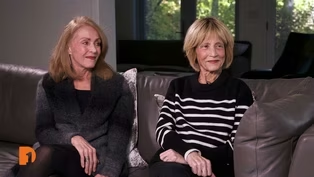
Caregiving: Healthcare planning for the future
Video has Closed Captions
Clip: S10 Ep29 | 9m 41s | When Susan Major was faced with a cancer diagnosis, she ensured her loved ones knew what she wanted. (9m 41s)
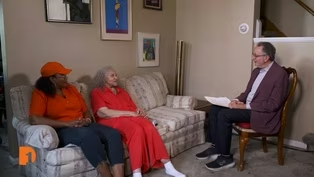
Caregiving: Legal planning for the future
Video has Closed Captions
Clip: S10 Ep29 | 7m 53s | Discussing caregiving and planning for the future with an attorney and a mother and daughter. (7m 53s)
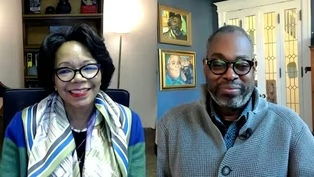
How The Henry Ford is celebrating the legacy of Dr. Martin Luther King, Jr. over the holiday weekend
Video has Closed Captions
Clip: S10 Ep29 | 6m 47s | Programming will include plays, musical performances, conversations and more. (6m 47s)
Providing Support for PBS.org
Learn Moreabout PBS online sponsorship
- News and Public Affairs

Top journalists deliver compelling original analysis of the hour's headlines.

- News and Public Affairs

FRONTLINE is investigative journalism that questions, explains and changes our world.












Support for PBS provided by:
One Detroit is a local public television program presented by Detroit PBS