
Linda & Carlos: A Chicano Love Story
Special | 55m 23sVideo has Closed Captions
The story of the remarkable journey of Chicano movement figures Linda and Carlos.
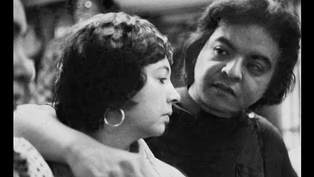
Linda & Carlos LeGerrette represent the legacy of the Chicano Movement of the late 1960s and 70s in San Diego. Beginning as students at Mesa and San Diego State, they were in the forefront of that movement, fighting successfully to increase Chicano student enrollment at the universities and colleges. This is the story of their remarkable journey.
Problems playing video? | Closed Captioning Feedback
Problems playing video? | Closed Captioning Feedback
Linda & Carlos: A Chicano Love Story is a local public television program presented by KPBS
Linda & Carlos: A Chicano Love Story
Special | 55m 23sVideo has Closed Captions
Linda & Carlos LeGerrette represent the legacy of the Chicano Movement of the late 1960s and 70s in San Diego. Beginning as students at Mesa and San Diego State, they were in the forefront of that movement, fighting successfully to increase Chicano student enrollment at the universities and colleges. This is the story of their remarkable journey.
Problems playing video? | Closed Captioning Feedback
How to Watch Linda & Carlos: A Chicano Love Story
Linda & Carlos: A Chicano Love Story is available to stream on pbs.org and the free PBS App, available on iPhone, Apple TV, Android TV, Android smartphones, Amazon Fire TV, Amazon Fire Tablet, Roku, Samsung Smart TV, and Vizio.
female: Hi, how are you?
female: Good, I'm doing well, thank you.
female: Hi, how are you?
female: I'm good.
How are you?
female: I'm doing well, thank you.
female: Nice to see you.
John: It's John Rice.
male: Wherever you like.
[crosstalk] [crosstalk] Eva Shultz: So today is a pretty special meeting because we have our--the founders of Cesar Chavez Clubs here today, Mr.
and Mrs.
LeGerrette, and-- Hiyab Misghina: So yeah, Ms.
Linda and Mr.
Carlos not only worked with Cesar Chavez but really helped and brought forth the movement that was going on that Cesar Chavez himself was working towards, the farm workers movement, and so they have a lot of experience with leadership and activism and they're the reason why we have this amazing organization and are able to exercise like Ten Values, leadership skills and just like everything in general that we need to be successful citizens in our community.
So, without further ado, they're going to--they're gonna talk to you guys and it's just gonna be amazing.
So can we please have a one, two, three clap for Mr.
and Mrs.
LeGerrette?
One, two, three.
Carlos LeGerrette: But you guys have built a great powerhouse of the Chavista Club here and I wanted to, you know, congratulate all of you.
There's a lot of things that are gonna happen this year, a lot of good things that you guys are gonna be coming up with.
♪♪♪ ♪♪♪ ♪♪♪ Linda LeGerrette: It was Carlos's idea, even though he always says it was our idea.
I thought he was a little nuts.
So it was his idea to put the Cesar Chavez Service Clubs together, because to me, a club was like more of a social thing.
It was a fun organization that you did.
I didn't conceive of what he really meant.
Linda: Years ago when Carlos and I co-founded the Chavez Clubs, it was the legacy of Cesar Chavez.
And it's like, how do you know what to do when you want to teach leadership development and it became very clear and very honest to us because those Ten Values that you guys are learning that are taped up on your window, those are the ten values that we live by, only we didn't know we were living by them.
We didn't know about those values.
Carlos: There's a lot of things that we had learned in the movement that definitely were beneficial for us in terms of our lives and what we were doing.
And my thought was that it would be great to have an organization that would be--that would teach those lessons that we learned and that we could also teach those lessons to the--to our kids.
Carlos: This is a photo, a picket line photo.
Do you recognize anybody in this photo?
Carlos: Right.
Yeah, this is a photo I took in City Heights, probably 1971.
And these three individuals, but we still see them today, of course, this is Linda.
♪♪♪ This is 1973.
And Cesar Chavez in the fields, talking with a group of workers.
♪♪♪ ♪♪♪ ♪♪♪ ♪♪♪ Carlos: There's a common thread that goes through a period of time stitched together by the activities of the movement, a whole tapestry of events in our lives that would stay with us forever and have a profound effect on--to what we do now.
Carlos: Ready, one, two, three.
♪♪♪ ♪♪♪ ♪♪♪ Linda: Carlos and I met Gracia 53 years ago on this campus.
Didn't look like this, but it was Mesa College and so it's extremely personal, and with great love and affection that I share with you my memories and lessons learned from her.
♪♪♪ Linda: She first got us involved in a social club, which was really cool for me, but I mean, it didn't take long for that social club and the people involved with that social club to then become political.
That changed the whole--my whole life.
Carlos: And had we not met Gracia, or she had not been, you know, our professor at Mesa College, you know, we could have been down a completely different path in our lives, you know.
We could have been doing other things, making money and all that stuff that we could have done, I think, rather easily.
She was very, very political, very, very progressive.
At that time, we were involved at Mesa College with a organization called Club Amigos, and the Club Amigos was a charitable organization, and that was nice, right, but it wasn't fulfilling.
Not when you compare that to what was going on in the streets here in San Diego.
And so we knew that we wanted to do something more political.
Gracia Molini, the--was our adviser to the Club Amigos.
And at the same time she was telling us, well, there's an organization in San Diego called San Diegans for La Buelga, you know, San Diego's for the strike.
For the strike in Delano, and she says you guys maybe ought to take a look at that.
So that's when we came up with the idea of putting together a Chicano or Mexican American youth group together for the campuses.
For example, when we started organizing car caravans to go to Delano with food and clothing and a few dollars, we used that issue to organize MAYA.
♪♪♪ [singing in Spanish] [singing in Spanish] [singing in Spanish] Linda: In those days at Mesa College, it was the farm worker movement and the involvement that we had was taking, you know, the food and the clothing, but it was also an awakening of who you are as a person and as a culture and how you're seen by other people.
So it was pretty clear, you know, back in those days, and it still is, it's a very racist community out there, you know.
Sometimes people don't talk about it, but it happens and people sort of stereotype you based on what your culture is, you know what I mean?
So we learned not only about our culture but to be proud of who we were as Mexicans, Mexican Americans in those days, Chicanos, frame of mind, you know.
It was--it was powerful.
It was really powerful to sort of be in charge and to be proud of who you are, and not to let other people define who they think you are.
That's a very great place to be in life.
[singing in Spanish] [singing in Spanish] [singing in Spanish] Carlos: At that time, there was a lot of stuff going on in the streets.
You had the civil rights movement.
You had the women's movement was just starting.
Vietnam.
Well, there's a lot of opportunities that took place at that time.
We began "La Verdad," the Chicano newspaper.
That is a great si se puede story.
You know, here are these individuals who didn't have any journalistic skills whatsoever.
We weren't writers, you know, we were just reporting what, you know, what was happening, you know, in education, in labor.
The paper also, was an avenue for the artists to have their artwork in the paper.
♪♪♪ ♪♪♪ ♪♪♪ ♪♪♪ ♪♪♪ Carlos: Chicano Park is a great, great, great si se puede story.
♪♪♪ ♪♪♪ ♪♪♪ ♪♪♪ ♪♪♪ ♪♪♪ ♪♪♪ ♪♪♪ ♪♪♪ ♪♪♪ Carlos: My great grandparents came into San Diego at the turn of the 1900s.
In the 1920s become founders of Our Lady Guadalupe Church, both illiterate.
But to have these individuals who had no money, no education, to become founders of the church of Our Lady Guadalupe Church.
I mean it tells me a whole lot about, I mean, their determination in terms of what they were doing in their life and then they would become like Guadalupanas in the church and forever serve, you know, the Barrio Logan or Logan Heights community.
Through their involvement they raised my mom and then, you know, my mom was involved with the church and she was the singer for all the funerals and all the weddings, you know, she was the one who always sang the Ave Maria.
And so those values were inherent in the background for me to get involved.
♪♪♪ As a youngster, I think beginning in middle school, you know, our family imploded with a divorce with my mom, so my mom was left, you know, with being a single mom with five kids, and I was the youngest of the five.
I don't think I was a very good son in terms of the trouble that I was getting involved with, and so, you know, it wasn't until I got out of middle school, got out of high school, after attending 13 schools, that I began to--that I woke up and I think that's probably when I met Linda.
Linda: I met Carlos before he met me and I met Carlos in my sister's 8th grade yearbook at school.
I was like a 9th or 10th grader and I was flipping through her book and I came across this photo.
It just jumped out at me.
I thought he was so cute, so I cut it out and she got so mad at me and I had it in my wallet for probably about a year before I met--before we actually met together.
Carlos: When I met Linda, you know, that was definitely a turning point in my life, being, you know, kind of aimlessly going through life versus beginning to set some goals, a wonderful feeling that there was some direction as to where I was going.
♪♪♪ ♪♪♪ Linda: I do believe in love at first sight.
In that initial attraction, it was a thunderbolt, you know, which is, whoa, it was, that's the one, you know?
My mom was born here in San Diego at Mercy Hospital.
My father was born in Krasnoyarsk, Siberia, Russia.
When they had me, I had a Mexican mother and a Russian father.
But I grew up actually Mexican because most everybody else in our family was Mexican.
My father loved the Mexican culture.
I think I was just born really positive and really happy.
I've just been like that my whole life.
I was full of pep in high school as well.
I mean, you know, not to brag, but like in my high school, you know, my high school annual, I got like Best Personality because just I enjoyed what I was doing and who I was hanging out with, you know?
I never considered myself political because of politics.
I sort of got into political issues because it was social at first.
You know, it was like just--it was like being involved in a campaign.
Like, I'm embarrassed to say, I don't mean anything bad to this guy, but like I was a Goldwater rah rah person when I was in high school because I went to kind of a conservative high school, and so a lot of my friends were kind of conservative.
So, Barry Goldwater was like the guy that we were all rallying for, you know, and I look back at that now and it's like, oh my God, I get so much crap from, you know, from some of my friends.
♪♪♪ ♪♪♪ Carlos: At that time, I think on the campus there were like 21,000 students at San Diego State.
And if you have 21,000 students, we would have, from the--of EOP, 150 come in each semester.
Those who came in under the EOP program came in under--it didn't make--they didn't look at grades.
They just looked at potential, right?
I'm proud to say that I was one of those individuals who, you know, came in as an EOP student, as Linda, and I would become the first EOP student to become the director of an EOP program.
♪♪♪ Linda: Okay, for all of you running for office, that's this table here, these three tables, and-- [indistinct] ♪♪♪ Linda: It became very clear and very honest to us because those values.
♪♪♪ male: Say "Si se puede," one, two three.
all: Si se puede!
Si se puede.
♪♪♪ male: Look at him.
He's from San Diego High.
[applause] [indistinct] ♪♪♪ female: You think it fits?
Yeah?
female: I feel like African Americans should always, always be able to vote because they're human beings like any other ethnicity in this world.
female: 1776, only white men who are older than 21 and who also owned land are allowed to vote.
1790, only white men are allowed to become citizens and vote.
220 years ago, 1856, all states allow all white men to vote.
Linda: Okay, can I have a-- thank you very much.
Just like we were talking earlier, your voice matters.
You have to take a--you have to take a stand, and you have to be able--you have to understand that you have more power than you think you have, and voting is one of those ways to do it.
♪♪♪ ♪♪♪ Linda: In the classroom, it's a wonderful place to be when you watch a child, a student at Chavista grow from who they are at the beginning and then who they become.
male: In Birmingham, Alabama, 9--83 years ago.
Linda: I think the reason it's important for young students, Chavistas, to, you know, to carry out the values that we're teaching our kids, is to give them the confidence and the power to make change.
all: Si se puede!
Hiyab: Just Ms.
Linda and Mr.
Carlos, they had had so much faith in me since I was in 6th grade and ultimately, like, pushed me to become the person I am today, and they saw so much in me that I never saw, like the potential I had to be a leader.
I definitely never envisioned that and, because of them, I grew into this confident, well, hopefully confident and very driven person in this club, and so I owe a lot of that to them.
♪♪♪ ♪♪♪ Carlos: I mean this is where we won this--the grape strike is with the picketing of the stores internationally of those stores that carried the California grapes.
By 1970, and the growers signed a contract, but it would never ever happen without the support of the picketing and the boycotting that took place outside of the agricultural areas because the growers controlled the agricultural areas.
It was a different story when we got out there and started doing this in the cities, and they found out that we control the cities, and that's where they-- that's where we won and that's where they lost.
Linda: In Delano we took the clothing and the food.
We met with a lot of bunch of college kids.
We all slept in sleeping bags on the floor in Delano at the Filipino Hall, and so Cesar made a presentation, which was great, but the person that made the difference to me that day was a guy by the name of Reverend Jim Drake.
He was a tall white guy with glasses and he was like an assistant to Cesar Chavez and I was so mesmerized by his message.
His message was something like, I want you to think about this.
When you go back to your school and back to your communities, what's more important than continuing to do work to help farm workers help themselves?
Something like that.
And it just made a difference to me.
After that meeting in Delano, we were gonna volunteer for the farm workers for one summer.
We had just gotten married, I hadn't had a baby yet.
We were gonna volunteer for a summer and that summer turned into 13 years.
Carlos: That was a real turning point in our lives, right?
I mean, we were here in a beautiful home.
I'm making good money at San Diego State.
I was in discussion with Tom Hom, a real estate developer, in downtown San Diego on two or three parcels, which is now the Gas Lamp area, to purchase those parcels.
And so we were, I think we were only a couple weeks away of doing that.
And that was--so that was that--we could have gone on that fork in the road and made lots of money.
Linda: Making that decision to go from that comfort zone to go to work for room and board and $5 a week, it's so funny because a lot of people say, "God, that was a sacrifice you did that and--" It was not, we didn't see it that way.
We didn't see it that--we thought it was a wonderful opportunity to really go and do something that we really felt was important and wanted to do and, thank, God was able to do.
Carlos: This is one of my favorite photos, and I've mentioned to a lot of people that the photos I like the most, the ones I've taken, are generally the ones that are taken over the shoulder of Caesar, and so these are lechugueros.
They're lettuce workers in salinas.
This is 1975.
They're the toughest of the tough when it comes to the farm workers.
They're very, very militant, and Caesar loved them because of their--because they were so well organized.
In 1973, probably is when I've got to know Caesar.
And you know, going up to the farm worker headquarters I became with Cesar like his go-- like a go-to guy, administratively, right there.
The first meeting when I understood Cesar in terms of thinking out of the box we had a meeting and he asked me to-- that we needed a purchasing department in La Paz because we had, say, 20 different departments who were ordering office supplies and all of them were ordering separately.
So we never--he says we can never get a discount because we're not putting it all together and so they're charging us a lot of money for one delivery when, if we put them all together, we can probably save 30% or 40%.
And so I put together a sketch of what the department should be.
He liked that a lot and then he says "But," he says "you know what," he says, "I'm thinking that we should maybe think a little bigger."
And I said, "Well, what's that?"
He says, "Why don't we order a freight car of copy paper.
And then we could supply all of our offices throughout the state of California."
And that made a lot of sense to me and then it was like, wow, that's what Cesar was all about--was thinking out of the box and that was like thinking out of the box and so, you know, I take that as a great lesson from Cesar.
I like to think out of the box.
Carlos: Now these two, these two had a great relationship here.
That's my wife Linda, and of course, Caesar, and they-- Caesar called Linda "Lindita."
Linda: I loved and respected Cesar Chavez so much, while we were there, just as a--on a, you know, as a person.
He was funny.
He was a good dancer.
Well, he looked like a good dancer.
His wife, Helen, made him look like a good dancer.
He loved music.
Cesar Chavez inspired me to believe in myself and to know that I can make a difference in the world.
And it was through that experience that I was able to feel so accomplished in having success stories about the things that we were involved with, social justice and economic justice.
Carlos: In this photo, this is a historic photo because this is Cesar Chavez's first visit to San Diego during the--this is right during the tomato strike, I think that was in 1971, here in the South County, the Edgar Gia strike.
Everybody knows and loves Cesar Chavez.
But without the millions of people who boycotted grapes and those farm workers who lost their homes and their families and their cars, to build a movement-- when you see a person who is about 60 years old, and who was striking, you know, that means a lot.
Because this person knows that, you know, he is at that age where jobs aren't that easy to come by.
And then when you see these persons and you talk to them, And you've seen the sacrifice that they've made, and then also the eyes of people can tell an awful lot.
And you can see, you know, the years and years and years of injustices, of the humiliations, and so on, that they've suffered.
Carlos: The farm worker's the most powerless, right?
But making the most powerful statement being on the picket line.
I mean that, you know, that was, I mean, I saw my great-grandparents, when I saw them.
When President Obama, when he dedicated the farm worker headquarters as a national park, I think it was, so here you have the most powerful man in the world dedicating this soil in La Paz that the most powerless individuals used to use.
♪♪♪ ♪♪♪ ♪♪♪ Linda: We were there when the rose was in full bloom and what we learned there and what we learned we could accomplish there, what the relationships that we developed there, the good experiences, the bad experience, they really kind of helped form the decisions that I make today in my life, personal and political.
We didn't leave the farm worker movement because we were done with it or whatever.
We left because we came home so I could die around family.
♪♪♪ ♪♪♪ The doctors in Delano, who I loved, said to me, "You need to go back home and get your things in order because we really feel like your time has come."
And so, you know, so we--that was hard to grapple with because we had a little 3-year-old girl.
narrator: Not long ago, Linda LeGerrette faced the decision of her life.
The choice she made then changed her attitude towards doctors and the role of patients.
Her story begins when she decided to undergo chemotherapy treatment for choriocarcinoma, a rare type of cancer.
Linda: I went through the 9 treatments of methotrexate, which is a period of--I can't remember now--3 or 4 months, something like that.
And then I was--I was cured for, what, about a year or so I guess, and then I--and during this year I kept going back on a monthly basis for tests and at one point my test came back that my blood count was showing that there was some recurrence of the choriocarcinoma.
narrator: She was admitted to a hospital for her second series of treatments, and the dosage was tripled.
For the first time, her body reacted strongly to the medicine.
Linda: Violent throwing up, the swelling of the midriff, the loss of the hair, you know.
You lose your hair.
narrator: One year after the second series of treatments, cancer cells reappeared, and her doctor told her that she would have to undergo more chemotherapy.
Linda: So I did go back to the hospital.
And I went back, reluctantly.
I went back thinking that-- knowing that I had to do something else because if chemotherapy didn't work the first time and if it didn't work the second time, what's to say that it's gonna work the third time?
Linda: Cesar Chavez actually introduced me to another way of dealing with health issues.
And so, that itself was kind of an eye-opener, right?
So, so I did this thing with nutrition and with the raw foods and no medicine for a while.
And, anyway, I didn't die like I was supposed to.
And so, to me, that was like a message.
It's like, you know, I was young, I had overcome this illness that was rare.
Linda: Looking back at when I was ill and whether or not that positive attitude helped me through that process, there's no--there's absolutely no other way to look at it.
So I do think that being positive around that illness and some good medical attention, really, it saved my life.
If it was my turn to die, I would have, no matter how positive I would, maybe I would have, but I don't--I wasn't ready, and I wasn't about to--I wasn't about to accept that, you know.
I felt like I had so much more to do--you know, mostly my daughter.
I had a little girl and I wanted--I wanted to see her grow up, you know, and do things, and, you know, I wanted to be a mom.
I wanted that.
Carlos: This photo was taken in 1975 at the headquarters of the Farm Workers Union La Paz, and this is Governor Jerry Brown on the left walking with Cesar Chavez.
I took this during a conversation that they had regarding strategy of winning the passage of the Agricultural Labor Relations Act.
♪♪♪ ♪♪♪ Carlos: I think that we definitely took the opportunities that came our way, whether it be working with the Farm Workers Union, working with Governor Jerry Brown or Sol Price, you know, they all of them had kind of their own--not their own message, but their own calling to us and so I think that we made the right choices.
Carlos: The mentors in my life and Linda's life, it would definitely be Sol Price and Caesar.
Two individuals, one poor, one fabulously economically rich.
But very, very much aligned in their values in terms of their belief in people and, organizationally, how things got done.
Linda: And so we had this relationship with Sol Price, who was a wonderful, progressive, wise businessman and an amazing philanthropist, and so one night in this house, in our bedroom upstairs, one night we were thinking, you know, we've never really taken those, except for real estate, those things that we learned working in the union and turning it into a money-making business for us, something that we enjoy doing.
When that opportunity became clear to us we said, "Yeah, let's do it."
So we did.
We started the Price Club delivery business which is now Costco delivery.
And then it became very successful, and we were able to make a really good living and saved a little money and that really, you know, and that was Sol Price.
I mean, he believed in us.
Caesar believed in us.
Sol believed in us, you know, and they both gave us an opportunity--opportunities.
♪♪♪ ♪♪♪ Carlos: And then the--this is the night before the march, the funeral march for Cesar Chavez.
Right after 12 o'clock, I noticed the Reverend Jesse Jackson.
He immediately left from where the family was and went up to the casket and was saying a prayer.
I think I was the only one who had a camera there that night that late.
There's no photos like this around.
Joel Castro: So I joined the Cesar Chavez Service Clubs when I was in the 4th grade.
So if I hadn't joined the Chavez Clubs, I don't--I mean, I probably would be a lot less, I don't know, ambitious, probably.
My long-term goal is to give back to my community in terms of, you know, affordable STEM education to communities who couldn't otherwise afford it, and a lot of that is kind of based in kind of the values that were taught to me as a chavista.
male: The challenges with the tax or the property tax, the goal is to spread the burden as wide as possible, so nobody has to pay too much, versus other kinds of taxes like that can actually impact-- Carlos: For the--our chavistas to be at the head of the table, they have to understand what's involved, not only in being there, but how to get there, and that's what--I think that's where we come in.
female: You said you were gonna--we were--you could work to build more homes, right?
But the people that didn't have a home, they would still have to pay, right?
And how would they get the money if they're living on the street?
male: Well, so most people are eligible for some level, so the question is, you know, if people are homeless, they have no money, how are they--they have to pay something in rent.
Linda: The message we give our kids is politicians help people who give public service, respect them, work with them, but the truth is they work for us.
female: Some people will say things about homeless people that like it was their choice to be homeless or they're just lazy.
How are you gonna--if we are gonna make this happen, we would need to convince them that it's a real issue that, like, is important and that it wasn't their choice and they're not lazy.
So how will you persuade them to?
male: Wow, that's a really good--that's a really good question, very sophisticated question.
Thank you.
Linda: Just because they're kids and they're adorable and stuff, they have something to say, and what they say is important.
Carlos: But a year ago they were working on the homeless, you know, they're working on climate change, so even though they can't vote, they are involved.
male: Can you guys, like, know if they're homeless or not?
Linda: Those kids are amazing.
They give me inspiration, honest to God.
It's--when you're--we're in a classroom--I mean, it is the reason to get up in the morning.
They're so--well, because they are who they are, I mean, you take a little kid, even if you had, if you're a parent, you know when you're raising a little kid, they're so inquisitive, and they're so creative, and they're just so, you just have to like help them, you know, stay that way, 'cause then they'll grow up and be old cynical people.
We don't want that.
[indistinct chatter] Linda: Right now, we have-- we've done more fundraising than we ever have.
I mean, after 20 years, we are like a, you know, we've gone from puberty now to adults and the clubs are successful, they are sustainable.
We have handed off the heavy workload to staff with a--with an operations manager who is amazing.
So, we get to be fundraisers and we get to be ambassadors, and then we still do a lot of work.
Carlos: But all of that didn't come easy.
You know, we go back and we're looking at when we didn't have any, you know, we had one volunteer who was leading the organization, going back, and that was me, going back to, you know, 2001, and it wasn't until 2008 when we started getting a few dollars to pay somebody, one person, some money.
And then to the point now where we have eight staff.
female: Miss Jane has been working with-- Linda: We have an amazing staff who make this happen.
They all have the same kind of passion for the mission of the clubs, and they all really respect and they all understand that the students are who they work for.
male: All right, the minutes, have you all perused the minutes?
Linda: We have a really diverse board.
Amazing, intelligent people who care about social issues, and they're not just yes people.
They give us great ideas.
They give us great direction.
They're really involved and really care and participate financially and with their intelligence and with their experiences of helping out the kids.
♪♪♪ ♪♪♪ female: We'd like to welcome everyone and I hope that everyone got to talk to each other a little bit.
Carlos: Each and every one of you that are here today, today you are making history.
So why do I say that?
Well, let's go back to when this man by the name of Cesar Chavez and his supporters said, "I'm gonna build, and I want to build a farm workers union to represent the interests of those individuals who work in the fields, who pick the fruits that we eat."
People looked at him.
"Hmm, no se puede.
It's never been done.
It can't be done."
Well, it got done.
And we made a--we made a vow, we made a promise that at some point, we were going to organize students so that they can represent their interests.
And that we would have an organization here in San Diego.
You know what people said?
"No se puede, it can't be done.
It's never been done."
Guess what?
Si se puede?
children: Si se puede.
Carlos: Se puede?
children: Si se puede.
♪♪♪ female: So when you bring a project to me, like I wanna save the animals from wildfires, okay, in San Diego?
Check.
Is it gonna benefit the community?
Check.
Does everybody get to participate, right?
So that's what we're trying to figure out, what do we have to consider before we decide to take on a project?
female: Any other ideas?
female: Well, for me, I would like to, before I graduate college, hopefully register more people to move.
Carlos: This is two meetings at the Congress, then an election has to take place to take that person's position.
♪♪♪ female: 1.6 billion people in the world who are homeless and we never know if we might be in their shoes one day, so I think we should really get involved in, like, helping the homeless.
female: So we can complete our common goal, and that's it.
Thank you.
[applause] Adrian Moret: I've enjoyed being in this congress and I like about it so far to be able to share my ideas about how we could make San Diego a better place in general.
Carlos: I see myself as being one of those chavistas, similar background.
I think of life's experiences and when you come up with an idea like that.
An organization where they could come together, it's kind of similar to the farm workers movement, you know, to establish the relationships amongst one another on different places-- working on issues, knowing that they can make a difference, provide a place in their lives that they could go to and to keep them away from the, like, the troubles that I was doing, where they could become confident within themselves so when they met with someone, whoever it is, that that person was no better than themselves, so that they would have a very-- a high standard within themselves of who they are, that nobody's better than they are, and that they have a lot to offer.
♪♪♪ Carlos: This is one of the most popular photos in--that we have for--from the farm worker documentation project and this is a photo of Cesar Chavez, and those are sons and daughters of volunteers who worked at the farm worker headquarters.
♪♪♪ ♪♪♪ ♪♪♪ ♪♪♪ ♪♪♪ ♪♪♪ ♪♪♪ ♪♪♪ female: That's a dangerous combination.
male: Well, I think it goes right-- Linda: We love to entertain.
We love--we love to be around people.
That's our talent.
Our talent is developing and keeping and loving the people that we've met over the years and entertaining them.
Carlos: Many of them that come here, we owe a lot to.
You know, they've been part of our lives.
And I think it's a way to, you know, express our gratitude to many of them.
[indistinct chatter] Carlos: Retirement is doing what you want to do, and in my head, in what I do on a daily basis, I've been retired, we've been retired, our whole lives because we've done exactly what we wanted to do.
We've never, ever, ever done anything in the movement to enrich ourselves, to take anything from anyone.
We did it, you know, the school of hard knocks, of great amount of learning, you know, taking that opportunity to learn, to give, to love.
[audience cheering] female: All the work that they have done and continue to do and continue to build for our next generation.
It's my pleasure and honor to present the 2019 Community Service and Commitment to Labor Award to Carlos and Linda LeGerrette.
[audience applauding] [audience applauding] [audience cheering] [applause] [applause] ♪♪♪ Carlos: I love to be around Linda.
I mean, she's funny, entertaining, and everything that I--anybody I think would want to have in a relationship.
Linda: I don't think I'd want to be in a relationship where I had to feel like it was hard work.
It's just having a really good, respectful, devoted love and friendship, because, you know, things change over the years in terms of your relationship.
So I didn't think it was hard work.
I still don't think it was hard work.
♪♪♪ ♪♪♪ ♪♪♪ ♪♪♪ ♪♪♪ ♪♪♪ ♪♪♪ ♪♪♪ ♪♪♪ ♪♪♪ ♪♪♪ ♪♪♪ ♪♪♪ ♪♪♪ ♪♪♪ ♪♪♪ ♪♪♪ ♪♪♪ ♪♪♪ ♪♪♪ ♪♪♪ ♪♪♪ ♪♪♪ ♪♪♪ ♪♪♪ announcer: Support for this program comes from the KPBS Explore Local Content Fund, supporting new ideas and programs for San Diego.
Video has Closed Captions
Coming 2/26 - the story of the remarkable journey of Chicano movement figures Linda and Carlos. (30s)
Providing Support for PBS.org
Learn Moreabout PBS online sponsorship












Support for PBS provided by:
Linda & Carlos: A Chicano Love Story is a local public television program presented by KPBS