State of the Arts
Little Girl Blue: The Nina Simone Musical
Clip: Season 42 Episode 4 | 4m 43sVideo has Closed Captions
Little Girl Blue: The Nina Simone Musical
We meet the Broadway veteran Laiona Michelle as she portrays the legendary singer Nina Simone in a musical she both wrote and stars in at the George Street Playhouse in New Brunswick, NJ.
Problems playing video? | Closed Captioning Feedback
Problems playing video? | Closed Captioning Feedback
State of the Arts is a local public television program presented by NJ PBS
State of the Arts
Little Girl Blue: The Nina Simone Musical
Clip: Season 42 Episode 4 | 4m 43sVideo has Closed Captions
We meet the Broadway veteran Laiona Michelle as she portrays the legendary singer Nina Simone in a musical she both wrote and stars in at the George Street Playhouse in New Brunswick, NJ.
Problems playing video? | Closed Captioning Feedback
How to Watch State of the Arts
State of the Arts is available to stream on pbs.org and the free PBS App, available on iPhone, Apple TV, Android TV, Android smartphones, Amazon Fire TV, Amazon Fire Tablet, Roku, Samsung Smart TV, and Vizio.
Providing Support for PBS.org
Learn Moreabout PBS online sponsorshipMichelle: [ Singing ] Black is the color of my true love's hair.
Janki: Laiona is just uber-talented and mind-boggling when you see her on stage.
She does embody Nina.
I mean, I think that sort of was her connection with the piece.
I think people told her, like, "You're very much like Nina Simone."
Narrator: Broadway actress Laiona Michelle has been fascinated by singer and Civil Rights icon Nina Simone for years.
Simone: [ Singing ] Ain't got no home.
Ain't got no shoes.
Ain't got no money.
Michelle: [ Talking ] I grew up listening to Nina's music.
My mother was the minister of music at our church, and I grew up in a choir in church, just like Nina.
So we're kindred spirits, really.
And I remember hearing -- the first song I heard was "I Loves You, Porgy."
And my mother would play that, and I'm like, "Who is this rich voice?"
Simone: [ Singing ] Yes, I loves you, Porgy.
Don't let him take me.
Narrator: Laiona has created a musical based on the great singer's life.
She's both writer and performer.
"Little Girl Blue: The Nina Simone Musical" premiered at the George Street Playhouse in New Brunswick.
It's a very personal take on the iconic singer's life.
Michelle: This piece is... it's scary.
It's thrilling.
It's a roller coaster of a ride.
[ Singing ] Oh, being that my father's dreams would some day take me home... [ Talking ] And I knew I wanted to deal with pieces of her life that may be surprising for people, that I found to be very surprising for me.
When I learned that she loved Bach -- her first love was Johann Sebastian Bach -- who knew?
So when I read that, I was like, "Wow."
So I knew that this was my way in, in telling her story.
It was her biggest disappointment, as well.
She wanted to be known as the first Black -- African-American -- concert pianist.
And she didn't get that, you know?
She did not get that.
And it was because of her skin color.
I don't need treatment!
I was born a child prodigy, darling.
I was born a genius.
And I also thought it was important that I dig a little deeper into her personal life and talk about her mental illness.
And Nina carried around the label, during her time, as being the "angry Black woman."
And so I wanted to, like, put -- quiet those voices down a bit and answer those questions inside of this show.
Why was she angry, you know?
Why was she so angry?
Narrator: The show has two acts, each set at a live concert, 10 years apart.
Michelle: We started in act one, in '68, right after Dr.
King's assassination.
So we're meeting Nina towards the earlier part of her career.
[ Singing ] It's a new dawn.
It's a new day.
It's a new life for me, yeah.
[ Talking ] And then in act two, we visit her in Switzerland, where she's liberated.
You know, she's removed from the U.S., and she has a fighting spirit that is more free.
In Switzerland, she was so accepted and looked at as being unique and special.
Fifer: One thing that Laiona really was able to capture was her viewpoint on Nina's story and then to enhance the storytelling with Nina Simone's songs, which she performed, but hearing them up against a narrative context in the story that made you hear the words in a really new way.
Michelle: "Little Girl Blue," which is the title of the show, "Little Girl Blue"... I feel like this show is for everybody, but I feel like, in particular, it's for that broken little girl, all those broken little girls out there who want something, and they see something, but they really can't reach it.
Yeah, and that was Nina.
[ Singing ] That all you can ever count on are the raindrops... ...that fall on little girl blue.
[ Music plays ] Narrator: Later on, a look back at the rich history of Black comic strips.
But first, an artist with a deep connection to the iconic French master Henri Matisse.
[ "Chord Left" playing ] Pickett: I'm Janet Taylor Pickett, mixed media artist, and I have this remarkable show at the Montclair Art Museum called Janet Taylor Pickett: The Matisse Series.
And that's profoundly exciting, because for me, it's allowing people to find out who I am as an artist and what my journey has been and also what my conversation has been with this artist called Henri Matisse.
[ Song continues ] I was particularly drawn to his color, and there was a painting called "The Red Studio" that's hanging at the Museum of Modern Art.
And when I first saw that work, I was amazed by it.
Here, this man used this profound red and carved in it with this white line that he allowed to come through which was the canvas, the raw canvas, and I was mesmerized by it.
So why Matisse?
It's because he's this multifaceted artist that worked with color, that worked with textile, that also followed his own voice, and he was also having this conversation with Picasso.
So, I thought I'd join in.
Why not?
[ Song continues ] Imlay: Her hand comes up right up the bottom of the dress, the hand of the artist.
So she's in communication with the master, Henri Matisse, and here is this Black woman coming in and saying, "This is my world, too," you know?
"Make room."
[ Song continues ] Her work is very decorative, and I say that in the way that Henri Matisse's work was decorative.
You know, a lot of people think the decorative makes it, you know, not high art, but she's able to use it in the way that he did.
[ Song continues ] Pickett: Beauty can be subversive, and by saying, "Subversive," I mean that you can tell a story that's difficult through beauty, and I love color.
I love pretty things.
Imlay: And it's wonderful on the back how you can see all the stitching.
Pickett: Right.
Many times when you look at artwork, you don't see the back of it, but I kind of like to give another surprise on the back, again, with using a repetitive pattern of the hands, and that's the fun of working like this.
You can add sort of visual surprises in the work.
It's most remarkable to come up to Bloomfield Avenue and see banners with my art and my name on it.
I grew up in Ann Arbor, Michigan.
I live in California now.
I live in a wonderful neighborhood in Pasadena, but to come here, it's to return home.
New Jersey and Montclair has been home for nearly 35 years.
So, I've been in California for about 5 years now, but this has been my artistic home.
Tingle: I actually came on opening day to see Janet's exhibit, and then I found out she was teaching the master class.
So, the work is incredible and inspiring.
So, I thought to get a chance to create with her would be amazing.
Pickett: So you're gonna have to turn this way.
Tingle: Yes.
Pickett: It's about inspiration.
It's about unleashing, tapping in to that inner creative person, that inner light.
[ "Eleggua" plays ] -Yeah.
-Woman: The pews are people.
Pickett: And then you add your groom.
Woman: Yeah.
An important part.
Pickett: That's the important part.
See, you're manifesting your groom.
This is her wedding dress, and she's manifesting her groom, and he will come.
[ Laughs ] Ellis-Williams: As a young Black woman, telling stories is important from a cultural perspective and a historical perspective, and, I mean, her work just captures me.
[ Song continues ] Pickett: There're certain visual motifs that I've used over and over again.
I'm using images from books, African images, African-American images, images from quilting, Matisse images of birds, myself as a little girl, my own daughter, family members.
So, I'm telling you this life story.
[ Song continues ] How I'm telling my story becomes a specific story, but it's also universal.
Imlay: She is using the dress form as a vessel to fill with all these stories and all these elements, pejorative symbols, everything from the melon to the cotton, all of these things that she has personal connection with.
Her father picked cotton as a little boy.
So, this -- this is personal.
It's in her DNA.
And because the dress has become her template, that's her power symbol now.
[ "Chord Left" plays ] Janet loves beauty, and that's how she tells her story.
Pickett: I was very much inspired by "The Blue Dress," done by Matisse, but I've taken my own riff on it.
I've put my own vocabulary in it.
I've used African design.
I've used images from African art.
I've used the mask.
So, I'm talking to you, the viewer, but I'm also talking to Matisse.
I'm saying to him, "Hey, here I am.
My life matters.
I'm a Black woman artist, and I'm talking to you, and you've been talking back to me, and it's all good."
[ Song continues ] [ Song ends ] [ Music plays ] Narrator: Later in the show, the work of a young artist who made the cover of The New Yorker, but next, the history of Black comics.
T'Challa: ...determines what happens... [ Music plays ] ...to the rest of the world.
With Marvel Comics' 2018 "Black Panther," a Black superhero has finally made it to the big screen, but the history of Blacks and comics is a long one.
Rider University professor Sheena Howard is an expert on the subject.
Howard: So, I actually went to graduate school and did my dissertation on the Boondocks comic strip.
So, I wrote 160 pages on a comic strip, so you can actually get a PhD and study something cool and awesome like comics or whatever it is that you're interested in.
When I was doing my dissertation, there was no book that kind of traced the lineage of Black comic strips and who were the main people to know in the industry.
And so, once I graduated from Howard, I wrote "Black Comics: Politics of Race and Representation."
Narrator: The book explores the ways Black comic book creators have grappled with gender, politics, and the Black experience from the early 20th century to the present.
It won the comic book world's most prestigious award, the Eisner.
Sheena Howard's most recent book, "The Encyclopedia of Black Comics," features Jason Le Von Richardson, a comic book creator in Philadelphia.
Richardson: I like that there's a book that's bringing to light what I jokingly call "the unicorns of the nerd culture," which is the beautiful Black nerds.
Johnson: I wasn't surprised by the number of people, people of color who were interested in comics and graphic novels because I am a person of color that's into comics and graphic novels, so I knew that, you know, we existed.
Narrator: Ariell was recently featured on the cover of Marvel's "Invincible Iron Man" comic book.
Her bookstore and coffee shop Amalgam in the Kensington section of Philadelphia is the first of its kind on the East Coast owned by a Black woman.
Howard: He headed the FBI and he did a lot of really bad things.
The first Black comic book was All-Negro Comics, which was based out of Philadelphia.
This was a time when Black people couldn't kind of publish their work in mainstream publications.
Black creators that were ground-breakers in the comics industry are people like Brumsic Brandon, who was doing comic strips in the '50s and '60s.
They were very witty, satirical, and smart.
[ Music plays ] There's Wilbert Holloway, who, in the 1920s, he was doing some of the early, early, early comics-work that was also socially relevant and kind of challenged the status quo.
Narrator: In his World War II comic "Strange Interlude," Uncle Sam welcomes white aliens while a Black man is in chains.
Howard: Early on in the print industry, Black people could only publish their comics in Black newspapers -- Chicago Defender, Pittsburgh Courier, because no mainstream outlets would pick them up.
You even think of people like Buck Brown who did cartoons for Playboy, and Hugh Hefner was actually very inclusive.
You know, he has all this background about sexism and abuse and all those sorts of things, but, racially, he was really inclusive.
And cartoonist Buck Brown -- he couldn't get his cartoons published anywhere else, so he actually went to Playboy in the '60s and got a lot of work.
Jason Richardson lives in Philadelphia and he created J1 Con, which is an anime comic convention, and he's featured in the "Encyclopedia of Black Comics" for his work, and he's also a comic book creator and writer.
Richardson: Well, I was always into comics, and my mother got me into comics at a young age.
She worked at the University of Penn bookstore.
Since I've been a fan growing up, I wanted to create my own.
I describe my art as a mix of American... and Japanese art styles and animations kind of mashed together.
I'm tired of Black heroes always being just the muscle or the comic relief in entertainment, so I decided to make ones who were, like, the smart guys or the cool main hero.
Narrator: After writing about comic book creators, Sheena is now writing her own comic book series called "Superb."
Howard: The two characters in "Superb," Kayla and Jonah, whose superhero names are Cosmosis and Amina -- We're going to have a superhero with Down Syndrome and a Black female lead.
Jonah and Kayla are a part of the Catalyst Prime universe, and they live in this community where the Earth has been hit by meteors, and they have been affected by fragments of meteors, and they become enhanced.
Johnson: What superpower would I like?
Um, I would like to be X-23-ish.
Storm is my favorite superhero, but I don't think I have the self-control to wield that much power.
Richardson: What is my superpower?
I don't know.
Just being nerdy and being proud of it and making people feel comfortable being nerdy.
There you go.
Let's go with that one.
Howard: My superpower, I believe, is to inspire people, whether they want to be writers, whether they're scared to take the next step in reaching their goals, or whether they just need inspiration in their everyday, daily lives to get through things -- the people who are like me but people who are also not like me.
[ Music plays ] [ Music plays ] Narrator: She was one of Forbes magazine's 30 under 30.
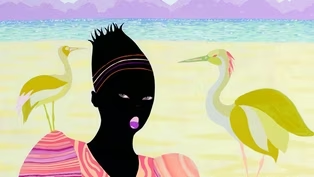
Last on the show, we meet artist Grace Lynne Haynes.
[ Music plays ] Haynes: One of my favorite speeches is Sojourner Truth, "Ain't I a Woman?," where she talks about how Black women are not seen as not only human beings but we're not seen as women.
[ Music plays ] The example of womanhood is white womanhood.
And the farther you are from that, oftentimes the less worthy of protection you are seen or the less womanly you are perceived to be.
And so that's something that I always wanted to emphasize in my work -- that not only am I Black, but I am woman, and I have the right to put my womanhood first and prioritize my womanhood.
[ Music plays ] My name is Grace Lynne Haynes, and I am a visual artist.
I consider art to be a spiritual practice.
I remember when I wasn't making art, it was like my senses weren't alive.
It's like I felt Christmas again.
[ Music plays ] Over the past year, things have really started to blow up, and I've had tons of press and amazing art collaborations and opportunities and experiences.
[ Music plays ] But there's also a stress as a young and emerging artist to produce work constantly and to also feel like you don't have time to really explore your creativity.
A lot of times, the industry sees what you're doing, and they like it, and they want you to keep doing that because that's what they like.
[ Music plays ] Being in graduate school with already a certain amount of success, there's this battle that goes on where it's like I can technically just keep doing what I'm doing and be fine, or I can really challenge and push myself.
And I choose to challenge and push myself.
[ Music plays ] I'm really interested in ideas of color, specifically challenging ideas in which we historically have seen the color black as associated with negative connotations, especially in Western religion.
[ Music plays ] I wanted to show that dark is feminine.
Dark is sublime.
It's ethereal.
It's mystical.
And I want to surround it with colors.
Dark and light can coexist together in one image, and the dark can be the central point and represent the figure.
[ Music plays ] I consider the women in my paintings to be the spirits of Black women.
They aren't representational paintings.
They are spirits.
It's an energy.
Black women -- we are seen as strong.
We are seen as resilient, and we definitely are, because we have to deal with racism and sexism.
However, we are also soft.
We are also passionate.
We are also nurturing.
I believe the strong Black woman archetype has been around in the country for years now, since enslaved Africans were put on the continent.
The goal was to de-masculinize the men, which causes the woman to have to take on a more traditionally masculine role.
When you're always perceived as strong, you're not seen as deserving of protection, which leaves a lot of stress for Black women, who feel like we have to carry the world on our shoulders.
[ Music plays ] There's a universal theme that connects the women in terms of the skin tone, but each painting has a distinct woman.
And I use a different set of eyes collaged in from magazines on each of the paintings, and I don't replicate that.
[ Scissors cutting ] Now in 2021, I'm specifically focusing on young Black girls, and I'm also focusing on collectives of Black girls and activities that bring Black girls together, such as dance, because oftentimes, Black children are adult-ified or overly sexualized at a very young age.
And so I really want to address this adolescent stage in the Black experience and show that in my work and show that it's a stage that deserves to be protected.
It's a stage that is very much there.
[ Music plays ] In my work, I strive to use different materials, different fabrics, different publications, and construct my own figure that is distinct to my imagination.
[ Music plays ] I am honoring the tradition of African-American collage-making, because, historically, oil painting has been associated with Western art.
And on top of that, oil paint is also very expensive.
And so, in the past, a lot of African-American artists didn't use oil paint because of the price, because of the type of facility it takes to do oil paint.
And so they found innovation in using collage materials.
That is what Black creativity is.
It's being able to work and make amazing art from a lack, and it's also being able to make your own new genres without any strict linear rules.
And I believe that collage and gouache really allow me to play around in that form of creativity.
[ Music plays ] For me, art is almost my escape, and it's also my reality.
I believe that sometimes fantasy and reality can come together.
And sometimes you kind of have to go outside the realm of reality to show people what could possibly exist and how they can shape their identity in a new way that society hasn't shown them yet.
For me, it's such a privilege to be able to show other young women of color, little girls of color, what they can make out of their life.
Sometimes you have to see it to believe it, and that's the power of representation.
[ Music plays ] [ Music plays ] Narrator: Find out more about these trailblazing Black women on our website... ...and leave a comment.
We love to hear from you.
Thanks for watching.
[ Music plays ]
Video has Closed Captions
Clip: S42 Ep4 | 6m 48s | We meet young art-star Grace Lynne Haynes (6m 48s)
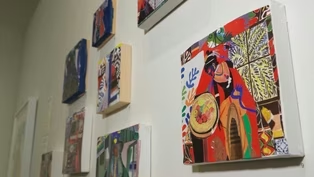
Janet Taylor Pickett: The Mattisse Series
Video has Closed Captions
Clip: S42 Ep4 | 6m 36s | Janet Picket Taylor is seen reflecting on her artistic conversation with Henri Mattisse (6m 36s)
Providing Support for PBS.org
Learn Moreabout PBS online sponsorship

- Arts and Music
The Best of the Joy of Painting with Bob Ross
A pop icon, Bob Ross offers soothing words of wisdom as he paints captivating landscapes.












Support for PBS provided by:
State of the Arts is a local public television program presented by NJ PBS