
Little Island
Season 2023 Episode 1 | 26m 46sVideo has Closed Captions
Explore New York City’s unique public park in this documentary.
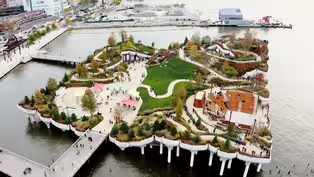
Explore NYC’s unique public park in this documentary and discover how the island came to be from founder Barry Diller, landscape architect Signe Nielsen and Park leadership.
Problems playing video? | Closed Captioning Feedback
Problems playing video? | Closed Captioning Feedback
ALL ARTS Docs is a local public television program presented by WLIW PBS
Little Island
Season 2023 Episode 1 | 26m 46sVideo has Closed Captions
Explore NYC’s unique public park in this documentary and discover how the island came to be from founder Barry Diller, landscape architect Signe Nielsen and Park leadership.
Problems playing video? | Closed Captioning Feedback
How to Watch ALL ARTS Docs
ALL ARTS Docs is available to stream on pbs.org and the free PBS App, available on iPhone, Apple TV, Android TV, Android smartphones, Amazon Fire TV, Amazon Fire Tablet, Roku, Samsung Smart TV, and Vizio.
Providing Support for PBS.org
Learn Moreabout PBS online sponsorship♪♪ ♪♪ Santini: Little Island is a public park.
It's public space, and our art has to exist in this unique environment.
Because there is no place on Little Island to hide, there's no place to block off an experience.
Everything is available to everyone.
By the time you actually are in the space itself, I think you're already primed to take in beauty, to take in whatever artistic experience you may happen upon.
Wiggins: Little Island's provided, I think, New Yorkers with opportunity to see in action how we can light a fire under the idea of community.
Santini: The space does something to you, physically and emotionally.
I think there's something about the design that helps you relax.
You take one walk across that bridge and get here and see people smiling and, you know, it just makes you happy.
Santini: I think the other thing we can promise is that you'll feel differently when you leave then when you arrived.
♪♪ Nielsen: Little Island is part of Hudson River Park and part of a sequence of piers along the West side.
This is one of the few piers that offers just an experience of an intense landscape.
Wiggins: The vision for the park was that everyone would feel like it was for them, that it should be beautiful, and that it would bring delight.
It is a gorgeous place and it invites you to come and rest, to relax, and to find some form of entertainment or some joy.
It invites you to connect through art and nature.
The island itself was really built with the idea that you can come here and discover things.
Diller: It serves multi-purposes.
Mostly, though, it just makes people happy.
♪♪ Santini: The way Little Island came together really was initially kickstarted by Madelyn Wils, who was the head of Hudson River Park at the time.
You know, Pier 54 had been in disrepair and then Hurricane Sandy occurred.
So they recognized that in order for the pier to be functional again, it needed a reimagining, if you will.
And they approached Mr. Diller with the idea of starting a capital campaign.
"We want to rebuild it, of course.
And would you like to rebuild it?"
And I thought, "No, not really."
And they sent me a maquette, you know, a rectangle of a park, a base of cement and a few trees planted on it.
And I said, "God, that doesn't really interest me very much."
After he reflected upon it for a little while, he came back and said, "I would like to do it, but I would like to completely reimagine what it might be and provide the sole funding for that."
I'm not that interested in just remaking or building up the pier that existed, but if we could use that space and not have it be a rectangle and be architecturally ambitious, at least I'd start thinking about it.
And that began what was a 10-year process of actually building the thing.
The design motif, sort of the big concept was this notion of a leaf floating in water.
The architect, Thomas Heatherwick, envisioned it more as a magic carpet.
I tend to think about it now, really, as a dried leaf floating on water because the edges kind of curl up.
And I think those reveal kind of the different ways that we think about this project.
But what that did for me as a landscape architect is create extraordinary topography.
Diller: We came up with the idea of these pots that hold up the pier, which we also thought wasn't buildable until we said, "Well, let's at least see if it's possible at some not truly astronomical cost."
And we found out that while very expensive, we could build it.
The pier structure is comprised of 132 of these pots.
The pots are supported on a pile, and the pots themselves are very, very heavy.
And so what the structural engineers had to do was calculate the amount of load that one of these, essentially, columns can take.
♪♪ Diller: The big worry was, how could you pound piles into the Hudson River when there's no hard depth?
It's all soft.
So you're piling them from 30 feet to 200 feet, and if they move even slightly because of the geometry of the pots that rested on top of them -- I mean, you move three inches, and the geometry is off.
So just doing that was trying.
Nielsen: The pots are about 400 square feet each.
They are all tied together with a 10-inch reinforced concrete slab.
So there is no soil in those pots.
All the soil is therefore on top of this concrete deck.
But we had to be extremely mindful of the load on the on the pots, which is why placing each tree relative to the capacity of the pile became a, frankly, a year-long back and forth.
♪♪ The wonderful work that Signe Nielsen did with the landscaping is that it's so varied.
I said one thing at the outset and all through I said, "It has to have color.
It has to have color that changes.
It has to have season.
It has to have variety."
♪♪ Nielsen: There are about 400 species of plants in the park.
There were, I think, at the end of the day, about 30,000 different plants installed.
And then the perennials and grasses, I went a bit crazy there.
♪♪ The trees, for the most part, are selected because of their tolerance to wind, and so they generally have fairly small leaves so that they present less mass to the wind, if you will.
The shrubs provide a lot of seasonal diversity are also used for slope retention.
And the pots create some extraordinary topography.
Those slopes, we had to manage by selecting certain kinds of plants that can really hold the soil.
We started in March of 2020, and then we we planted every single day until the beginning of January 2021.
It was almost 12 months of planting every day, but it was a great way to get through the pandemic, I just have to say.
♪♪ If this space exists and you have an opportunity to think about it in a completely different way, what would it mean to create a beautiful space that provides people with more connection to nature and more access to art?
And every conversation was sort of centered around that.
What can you create that is unique and distinctive and also very New York?
We obviously serve visitors from all over the world, but we consider ourselves a neighborhood park first.
It was really important to us to establish those relationships, cultivate those relationships, and create a sense of belonging.
Wiggins: Let's face the fact that there's a lot of gentrification on the West side of Manhattan, and it's a very wealthy neighborhood, and that is a barrier to entry if you don't live in this neighborhood.
So the question right away when you see us on Instagram is like, "Oh, that's a gorgeous place, but am I invited?"
And so our job is to make sure that everybody in New York City and everybody who comes to visit the park feels like it's for them, that they're welcome and that they were invited.
And you get to choose your own adventure here.
♪♪ Nielsen: One of the unique things about Little Island is that when you arrive, whether it's from the north or the south, there's nothing that tells you what to do or where to go.
And it's very much about the visitor determining their own preference.
Maybe they just want to go sit down in the playground and have a coffee.
Maybe they've heard that there's a great view from the southwest overlook over the harbor.
Diller: You can go up 75 feet to the top and look over the Statue of Liberty, or you can look to the city or you can look to New Jersey.
♪♪ Any way you look, you're going to see something that only probably you can see from this little vantage point.
Nielsen: The sort of choreography of the paths is one that enables you, as you make each turn to either see the river, see the internal part of the park, or see the city.
And that was extremely intentional.
I wanted people to be able to spread out and not feel crowded, so the boulder scrambles are just another way for people to take shortcuts, able-bodied people, I would say, and younger generally.
They are certainly an aspect of whimsy and also additional seating.
♪♪ The word "whimsy" has often been used to describe Little Island, but I have to say that attribution goes directly to Barry Diller, who, after a pause in the project fairly late in the design process, returned to us and said, "I've been thinking.
I would really like this park to be whimsical."
Diller: Wherever you walked, wherever you would turn, there would be some kind of surprise, either in the change of the landscaping, in objects that we would place for people's enjoyment or views that would happen, that in a sense, you'd just say, "Oh, I didn't know that was going to happen."
So it's filled with just wandering wonder.
Our desire was to have an island that looks like a New York City subway car.
So if you've ever been in a New York City subway car at the best of times, you'll hear, you know, many languages, you'll see all different kinds of people, and it serves a basic human need.
And the basic human need that we're trying to serve is joy.
♪♪ Santini: Part of our joy is having people be surprised and delighted and a sense of discovery.
You know, you came here for one purpose and then you found that there was something going on that extended your stay and engaged you in a way you didn't expect.
Hey!
When you enter and you come into what we call the playground, which is just an open plaza, it's where you can purchase food and beverage if you're interested.
There's plenty of seating, there's shade.
So it's a space for, you know, you can take a break, you can have a coffee, you can grab a sandwich, you can people-watch.
The experience of having some surprise and delight in your day can start in the playground.
In the playground, we feature pop-up performances.
So busker-style performances, things that, for instance, you might see on the subway or on a street corner.
We also feature our educational, creative breaks, dance classes, visual art classes, as well as some late night programing on the weekends, which include everything from Drag Bingo to trivia.
[ Beatboxing ] ♪♪ Little Island's programing is really about live performance.
You should expect when you come to the island to see circus, dance, a lot of music.
♪♪ These are the things that function well in a public space in which there are no doorways and which you really can't tell someone that they can't participate.
You know, everything is accessible and available to everyone here.
♪♪ And that if you come with your child, there's also something for them to do.
[ Keys dinging ] And if you've come with your grandparent, there's also something that interests them.
Three!
Whoa!
And we consider the entire thing to be programing.
♪♪ People are surprised so much of the programing is free, because the majority of our programing is free.
♪ Oh, whoa, whoa ♪ ♪ Oh-oh ♪ Kraus: One of our unique performance spaces is called The Glade.
It's a smaller stage with a beautiful, green, sloping lawn that seats about 200 audience members.
[ Singing in native language ] Audiences in this space, usually about half know that there was something happening or they're familiar with the artist or they're fans of the artist, and so they come specifically for that performance, and probably about the other half are folks that didn't even know maybe that we had programing in the park, and they wandered in that day and really got to experience and encounter something new.
[ Singing ] The Glade is a performance space as well as a space that we use for all of our education programing.
And it could be visual art, it could be dance, it could be music, and it's all designed for all ages.
We have everything here from comedy, open mic nights, all the way to trios, five-piece bands.
I would say this is a space, a real place for discovery.
♪♪ ♪♪ You can come on one day and see a young artist in the very early stages of their careers who's quite exceptional, and you feel like, you know, you've discovered the talent, and the next day you might come and see an organization that you know very well, that's an established company, and everything in between.
And it's a lovely place to sit on the lawn with a glass of wine and listen to some music.
♪♪ [ Cheers and applause ] Wiggins: As this neighborhood has been gentrified, Some groups of people like LGBTQ Black and Brown queer kids who utilized the piers were driven out.
That was a place where Black and Brown queer youth hung out in the '80s and the '90s and before.
I was one of those young people who hung out on the piers, so it's very significant that our partnership with The Door allows them to have this real estate back in their lives in a significant way.
Harrison: One of The Door's primary values is to provide a safe space for young people to be their authentic selves.
And that aligns with everything that Little Island is offering in their teen nights, so our young people can come here and be the person that they want to be, and it's safe and it's free, and it's just sheer joy to be here and see young people come alive.
And so on Friday nights, what you'll see, and I think it's highly significant, is you'll see that these young people are centered and celebrated just as we would celebrate any of the work that is presented by our artists in residence in our amphitheater.
Their artistic expression, their socialization, their safety is prioritized.
It's been this amazing opportunity for our young people to come and be artists on a gorgeous stage in a gorgeous space, And it's a safe space for all of our young people to really develop and grow professionally and personally.
Wiggins: Little Island's provided, I think, New Yorkers with an opportunity to see in action how we can put a spark, you know, light a fire under the idea of community.
Little Island is very conducive to performances, acoustically.
You're completely buffered from the large amphitheater.
The shape and the topography enables that to happen as opposed to a flat, rectangular pier.
Our amphitheater, our amp space seats about 700, and it's beautifully porous.
We have an overhead structure that supports all of our lighting and sound equipment, and I would say the things that we tend to program there are a bit larger in scale.
Originally the idea was, let's just do a kind of classic Greek amphitheater, stone, and make it rough and as if it had been here.
And then we thought, no, no, no.
That's making something up.
If we're going to do it, let's build a classic four-vom theater with all of its support structure, et cetera, that can do almost anything.
That evolved.
♪♪ ♪♪ ♪♪ We have a range of programing in that space.
It's the only space that requires tickets.
All of the rest of our programing is free, open, come and go as you please.
The Amph has ticketed events and it presents a range of disciplines from music to dance, theater... Woman: If they started... interlinking.
comedy, circus.
♪♪ Really, all of the programing is in service to reaching the broadest audience possible, so we pursue bringing a very broad mix of disciplines and a broad mix of artists in the hopes that over the course of the season, there is something for everyone.
♪ Yeah, yeah, yeah ♪ The entertainment that we have, the depth and breadth of that entertainment is to make sure that there is something for you when you come.
♪♪ And we want to make sure that everybody in New York, if they live on the West Side or if they live in Staten Island or live in the Bronx, they feel like they're invited to that thing.
So we have a community ticketing program, and that community ticketing program is done in partnership with the Department of Youth and Community Development, which is a city agency.
It means that we can reach all New Yorkers, no matter what age they are or what their demographic is.
Last year, we gave away about 40,000 free tickets, and our mission is to make sure that the park is inclusive.
What is a city if not the memory of someone surviving, sweet like bath water fresh off the stove top?
I have a definite affinity for The Amp, both as public space and performance space.
I think there's something about being able to sit quietly in a space and just stare at the Hudson River, you know, that really can take your shoulders down.
It is one of the most amazing places to watch the sunset.
And it's also a space that has a particular magic with performances, because in the summertime, when shows start at 8:00, you arrive before the sun sets, you watch the sunset during a performance, and over the course of the performance, the moon and the stars are out.
And there's something about that space and that span of time that I think fully realizes the desire for people to feel connected to nature and art simultaneously, because you literally, over the course of time, are watching nature change.
♪ Imagine all the people ♪ ♪ Living for today ♪ I can't help but affect you.
The artists talk about the way it affects them.
♪ There can only be ♪ ♪ One♪ It's an experience that really encapsulates the philosophy behind this space.
♪ Mama, they're telling me it's time, gotta grind ♪ ♪ If you ever want to see your boy shine, gotta climb ♪ ♪ Gotta elevate the mediocre lines, gotta rise ♪ ♪ Gotta levitate on everybody, trying to get mine ♪ They're all porous, you know?
There's no door that closes.
So the ability to wander in and discover something and then decide, I'm going to sit down and enjoy this for the next, it could be ten minutes, it could be an hour and a half, is incredibly unique.
When we are in rehearsals or when we are in a technical rehearsal process, that is all open to the public.
So people really, unlike other venues or certainly other parks, get to really have an insider's perspective about what it means to create work.
Woman: Alright.
Let's try this.
When we're doing a dress rehearsal, it's a public experience.
People may go to The Amph thinking, "I hear the sunset is beautiful here," have no idea that a rehearsal is going on.
That's just not a traditional experience.
You can't wander into a theater and watch their rehearsal.
These are very private processes, usually, but being in a public space makes that a completely different ballgame.
There's a participatory aspect when you experience art here.
♪♪ Wiggins: Little Island is committed to making sure that we have a fair and engaging workplace, and we're also committed to making sure that the seasonal jobs that we have are rewarding.
So Pathways to Employment is a suite of programs.
These programs put money into the hands of CUNY students.
Our usher program is our newest endeavor.
In that space, we hired 16 ushers this year in order to provide service to our patrons in the amphitheater.
They get cohort learning, so they learn about communication, leadership, financial capability and literacy, public art and public space.
A high-quality job needs to have a next step.
We're looking to find out if there's talent there that we can then promote within, and they have relationships now that will support them throughout their academic and professional careers.
♪♪ Santini: This space does something to you, physically and emotionally.
♪♪ I think there's something about the design that helps you relax.
You know, Mr. Diller talked so much about wanting it to be a space of respite and also a place that ignited your imagination.
Wiggins: Mr. Diller's decision to give a gift to the city of New York, to the world, actually, is a very special thing.
Nielsen: In addition to the extraordinary donation of building this park was also a donation to maintain it.
Santini: We have a 20-year lease with Hudson River Park.
The family has committed to ensuring that what was created is the thing that is consistently delivered to visitors, and that is just not something that you hear about every day.
Without that commitment from the donor, there is no way I would have designed a landscape as complex as this one.
♪♪ If we're going to take responsibility for the very great expense of building it, I think we have to take the responsibility for keeping it in at least the full spirit of the original, let's say, amount it cost to get it here.
Santini: The magnitude of that is not only unprecedented and inspiring, it's moving.
♪♪ Wiggins: Everybody needs a public space in order to realize the dream of America.
♪♪ It's not that we're saying that everyone has to build a Little Island.
What we're saying is that the design of the park, the location of the park, the intention of the park to make a change in the world that is good for everyone, those are the things that you can bring to scale.
Those are the things that you can franchise.
This is what we can do for each other if we care.
♪♪ ♪♪ Diller: I want them to smile.
I want them to be happy.
I want them to walk back out into the city and say, "Hmm, was different.
I like that."
♪♪
Video has Closed Captions
Preview: S2023 Ep1 | 30s | Explore New York City’s unique public park in this documentary. (30s)
Providing Support for PBS.org
Learn Moreabout PBS online sponsorship













Support for PBS provided by:
ALL ARTS Docs is a local public television program presented by WLIW PBS