
The Little Satellite That Could
Clip: Season 4 Episode 19 | 8m 25sVideo has Closed Captions
How Brown students hitched a ride on SpaceX’s Falcon 9 rocket.
Satellites are responsible for many modern conveniences—from advance weather forecasting to internet communications. But the orbits around Earth are getting crowded, creating a problem: space junk. In this segment, we meet a group of Brown University students who beat the odds to send a satellite called SBUDNIC to space. Their goal: test technology that reduces space junk.
Problems playing video? | Closed Captioning Feedback
Problems playing video? | Closed Captioning Feedback
Rhode Island PBS Weekly is a local public television program presented by Ocean State Media
The Little Satellite That Could
Clip: Season 4 Episode 19 | 8m 25sVideo has Closed Captions
Satellites are responsible for many modern conveniences—from advance weather forecasting to internet communications. But the orbits around Earth are getting crowded, creating a problem: space junk. In this segment, we meet a group of Brown University students who beat the odds to send a satellite called SBUDNIC to space. Their goal: test technology that reduces space junk.
Problems playing video? | Closed Captioning Feedback
How to Watch Rhode Island PBS Weekly
Rhode Island PBS Weekly is available to stream on pbs.org and the free PBS App, available on iPhone, Apple TV, Android TV, Android smartphones, Amazon Fire TV, Amazon Fire Tablet, Roku, Samsung Smart TV, and Vizio.
Providing Support for PBS.org
Learn Moreabout PBS online sponsorship- [Crew] Ignition and lift off.
- [Narrator] Last year this SpaceX rocket ship blasted into space, carrying some cargo from Rhode Island, a little satellite that could called Sputnik.
- So this is Sputnik.
This is a kind of like a prototype model, but this is the exact size and shape of Sputnik's chassis.
- [Narrator] Marco Cross was a graduate student at Brown University and lead engineer on the Sputnik satellite team.
- I feel like the entire development period was just kind of like a controlled panic attack.
Like it was just like, you know, like every day was just another rollercoaster.
- Is there anything new going on in space transportation?
- [Narrator] His professor was Rick Fleeter.
- You can't launch it from the ground 'cause you've got air and everything around.
You've gotta get it into space.
- [Narrator] A space engineer known for his pioneering work with small satellites.
- A friend of mine had a launch available because another satellite had canceled, but it was launching in less than a year and nobody builds a satellite in less than a year.
They normally take like 15 years.
Without knowing anything of course, I said sure, no problem.
And then I took it to my students.
- To be clear, something that never happens ever in space, like never like.
- So this is your golden ticket?
- Yeah, pretty much.
He offered it to us and of course we took it.
- [Narrator] A team of 40 students went to work on the project.
The clock was ticking and the budget was tight, forcing them to experiment with new materials.
- 3D printing in space is not new, but we used materials for the 3D printer that are something that you can buy on Amazon for 20 bucks.
Printed parts in space are typically done with specialist materials and machines that cost hundreds of thousands of dollars.
- [Narrator] Their thrifty solutions would be tested in the most extreme of conditions.
- There's radiation concerns.
There's physical degradation concerns, materials in space because there's virtually no pressure from the atmosphere.
Materials that we think of as solid almost boil off, just disappear.
- [Narrator] Plus these days satellites face another threat, space junk, dangerous debris which circles Earth at thousands of miles per hour.
- If you were to put a frozen pea into orbit and there was a satellite traveling, like something the size of a car, and the pea traveling the other direction, that pea hitting that satellite, it would be a catastrophic event for the satellite.
- Because the pea is moving... - So fast.
- [Narrator] Decades ago there was little worry about space junk because fewer satellites were in orbit.
That's not the case today.
- Imagine you had a hundred cars on the whole face of the entire earth, or a hundred airplanes.
Would you really be worried about them running into each other?
People are like, give me a break.
This is not ever gonna happen.
It's so unlikely.
And then it started to happen.
There was a a time when the windshield of the space shuttle was damaged from a what turned out to be a chip of paint.
And then NASA started having to move the space station around to avoid collisions.
So it's gone from kind of a science fiction like, you know, not credible at all to a, yeah, this is part of our reality nowadays.
- [Narrator] The ultimate concern is that space junk can multiply.
- Because if you have a single collision, it's gonna break both things into a million pieces.
So instead of having two objects in orbit, you have 2,000 objects in orbit.
- [Astronaut] Debris from the missile strike has caused a chain reaction.
- [Narrator] It's a problem featured in the movie "Gravity".
(astronaut yelling) Excessive amounts of debris could render entire orbits too dangerous to enter.
As more satellites are launched, it becomes an even greater threat.
- If a future does not include being out there among the stars and being a multi-planet species, I find that it's incredibly depressing.
- [Narrator] In 2019, Elon Musk's company, SpaceX, began launching a network of Starlink satellites to provide internet access across the globe.
- [Marco] SpaceX itself has deployed between three and 4,000 satellites alone in the last four years, five years.
They have plans to deploy another basically 30,000 satellites up in similar orbits.
- [Narrator] Adding to the congestion, old decommissioned satellites can stay in orbit for decades before falling to Earth and burning up in the atmosphere.
- In principle, you would have 10 times less space junk if everybody came down in three years instead of 30 years.
- [Narrator] That's exactly what Sputnik was designed to do, to bring down satellites faster with a low-cost mechanism called a drag sail.
- It looks like this.
That's kind of the packed version.
Keeping this restrained, these wings restrained, and then they pop free like that.
Both pop free like so.
This doesn't require power, this just works.
So the drag sail itself is designed to deploy from the back of Sputnik like a fan.
It catches atmosphere and basically slows Sputnik down.
So we've dramatically increased the speed with which Sputnik will fall out of orbit.
- [Narrator] The team spent a grueling year working.
Launch day was fast approaching.
- And we had to do exceptionally aggressive testing during that time.
In a couple instances we, they nearly failed.
Those were heart stopping events.
- [Narrator] In May of 2022, members of the team gathered on a Cape Canaveral Beach to watch the launch.
- [Marco] We saw the rocket go up.
(people cheering) I was proud.
I was really proud of my team.
(people cheering) - [Narrator] But then radio silence.
- We didn't hear from Sputnik ever.
That was devastating because part of our mission was to hear or to test radio communication from space where we just kind of were like, ah, Sputnik is lost.
- [Narrator] The silence went on for nearly a year, but in early March of 2023.
- [Marco] So like let's say, I want to see where Sputnik's at right now.
- [Narrator] They checked a government website that tracks satellites, and there it was.
- This is mission success right here.
This is drag sail's success.
- [Narrator] Sputnik was lower in orbit than other satellites on the launch.
- The only reasonable explanation was that Sputnik had successfully deployed its drag sail.
- [Narrator] The data shows that rather than staying in orbit for 25 years, Sputnik will stay up for about five.
- Hopefully we will see more satellites using similar technology to pull their mass out of orbit.
- To prevent themselves from becoming space junk.
- To prevent themselves from becoming space junk.
- [Narrator] Today, Marco Cross is a marine engineer in Rhode Island, but he still returns to Brown's workshop to mentor a new crop of space designers.
One group explores new spacesuit designs, another how magnetic fields could one day defend against radiation.
- At some point in the future, years from now, Sputnik will burn up in the atmosphere and that will be the, that will be the true end of the satellite mission.
- But the spirit of Sputnik lives on.
Scientists from countries like Australia and the Dominican Republic saw how Sputnik was developed for $15,000 rather than 15 million and saw an opportunity to start space programs of their own.
So who dominates most of the space world?
- It's mostly dominated by countries who can afford it.
That would be the U.S., Russia, China.
It's a small club.
Canada, the European Space Agency.
- And so you're seeing an opportunity for the club to get bigger.
- Yeah.
- Conceptually this makes sense for satellites of this size.
- [Narrator] As for Marco Cross, the experience was something he had been dreaming about since childhood.
- You hear about Cape Canaveral as a kid, or at least I did as a space nerd as a kid, is this is like the place, this is where it happened.
To be part of that lineage, to be part of that legacy, even in a small part, for me is that's a memory that I, yeah, I mean that I'll treasure forever.
Video has Closed Captions
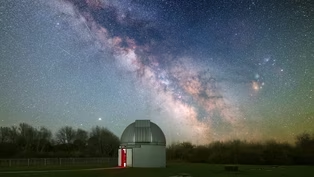
Clip: S4 Ep19 | 7m 35s | A form of pollution is taking away our connection to the night sky. (7m 35s)

My Take: Mushrooms, Mushrooms Everywhere
Video has Closed Captions
Clip: S4 Ep19 | 5m 38s | Mushroom farmer tells you everything you need to know about edible fungi. (5m 38s)
Providing Support for PBS.org
Learn Moreabout PBS online sponsorship
- News and Public Affairs

Top journalists deliver compelling original analysis of the hour's headlines.

- News and Public Affairs

FRONTLINE is investigative journalism that questions, explains and changes our world.












Support for PBS provided by:
Rhode Island PBS Weekly is a local public television program presented by Ocean State Media