
California Bell Peppers
Clip: 6/30/2023 | 6m 20sVideo has Closed Captions
Visit a bustling farm in California’s Central Valley as they harvest bell peppers.
Visit a bustling farm in California’s Central Valley as they harvest bell peppers. Live Oak Farms grows bell peppers in four different regions in California, allowing the family-owned farm to harvest bell peppers nine months out of the year.
Problems playing video? | Closed Captioning Feedback
Problems playing video? | Closed Captioning Feedback
America's Heartland is presented by your local public television station.
Funding for America’s Heartland is provided by US Soy, Sustainable Agriculture Research and Education, Rural Development Partners, and a Specialty Crop Grant from the California Department of Food and Agriculture.
California Bell Peppers
Clip: 6/30/2023 | 6m 20sVideo has Closed Captions
Visit a bustling farm in California’s Central Valley as they harvest bell peppers. Live Oak Farms grows bell peppers in four different regions in California, allowing the family-owned farm to harvest bell peppers nine months out of the year.
Problems playing video? | Closed Captioning Feedback
How to Watch America's Heartland
America's Heartland is available to stream on pbs.org and the free PBS App, available on iPhone, Apple TV, Android TV, Android smartphones, Amazon Fire TV, Amazon Fire Tablet, Roku, Samsung Smart TV, and Vizio.
Providing Support for PBS.org
Learn Moreabout PBS online sponsorship♪♪ Under the warm California sun, on more than 2,000 acres of land, rows and rows of green and red bell peppers have found the perfect place to grow and thrive.
[Briana Giampaoli] California, I mean, the climate is ideal for pepper growing.
Briana Giampaoli, her brother Dominic and their father, Bob, are the third and fourth generation of farmers who own Live Oak Farms in Le Grand, California.
[Dominic] I'm the farm manager for most of the vegetable crops, um, throughout many of the different regions for Live Oak Farms.
Bob's sister, Sandy, also works here running the main office, but it's out in these fields in California's Central Valley where Live Oak Farms first started, thanks to their ancestors who came from Italy in 1926 and planted their first tomato crop.
[Sandy] They, um, researched and I guess decided Le Grand was a good place to grow their tomatoes and they must have brought their seeds.
Later, they began growing almonds, jalapeños, corn, eggplant, and bell peppers.
The family soon learned how well peppers adapt to the California climate.
Eventually, they were able to make the most of regional temperature changes to grow peppers throughout the year.
[Dominic] So, we grow in many different regions, pretty much, um, so we extend our season and... and just different areas of California are better for our crops, um, just because of the weather patterns that go throughout California.
Here in Le Grand, they're able to grow peppers three months out of the year.
When it's too hot here, it's just right farther west in the coastal area of Gilroy.
In the Southern California regions of Coachella and Bakersfield, they can plant earlier because it gets hotter sooner.
Farming in four different regions allows the family to harvest peppers nine months out of the year.
[Dominic] As we continue to push the boundaries and extend our crops into different areas, um, make it a year-round process is the goal.
♪♪ Today is harvest day in the Gilroy fields, where crews work alongside a mechanized belt to hand-pick bell peppers.
[Dominic] They pretty much pick a basket of bell peppers, put it on the belt.
It gets shifted over to a tractor that's carrying six bins in a trailer behind it.
Workers carefully dump the peppers into the bin to make sure there's no bruising.
Red peppers are hand-packed in the field, while green ones are sent to the packing shed in Le Grand, where they're processed.
[Briana] Once it gets to the packing shed, they are washed, they are sorted.
So, wanting to take out all the defective peppers, the ones that aren't desirable to consumers or to our buyers.
Then, they go down a packing line, where the machinery inspects each pepper again for defects and shoots them to the appropriate box.
The boxes are stacked and sent to the cooler to await shipping trucks.
Those trucks deliver Live Oak Farm's produce throughout the U.S. and Canada.
[Briana] Look for it in grocery stores, at- You'll- I'm sure you're eating them at restaurants, which is really great, at least for me, you know, as a farmer, to know that we are helping feed America.
That's one reason the Giampaolis say they want to continue the family tradition of farming, despite the many challenges facing farmers in California.
[Bob] The biggest challenges, I think, are- at the top of the order, would be labor and... and regulations in... in California.
It just gets harder and harder.
All of their vegetables are hand-harvested.
So, as labor costs go up, production costs go up.
When they don't have enough workers, they fall behind and risk losing produce that sits unharvested in the field.
The other big problem they face is with California's ongoing drought.
[Dominic] We're going to soon have restrictions on pumping water.
Um, so, years when there is a drought, uh, or we don't have as much rain, the pumps are going to be limited to what we can grow.
So, we're going to have to do more with less acres.
[Briana] With lack of water, if we're not able to give tomatoes, bell peppers, the amount of water that is needed to grow, we're going to see differences in- whether it be fruit size or... or volume or, you know, all... all across the board.
Considering all of the challenges, Bob Giampaoli encouraged his kids to leave the farm for college and come back only if they're passionate about farming and dedicated to finding solutions to these big challenges.
[Bob] I'm...
I'm glad they're back.
And, you know, they're... you know, they're a big push of it now, 'cause it's not getting any easier, you know, in this day and age.
Briana and Dominic both say they can't imagine doing anything else.
[Briana] I've really asked myself that question, like, "What else would you do?"
And I can't find an answer, which makes me believe I'm exactly where I'm supposed to be.
I love growing the product.
I love working with my family.
[Dominic] It's something I knew from a young age.
You either like it or you don't.
Um, and I've always loved being out in the fields.
[Briana] It's a hard job.
It's not for everyone.
A lot of hours, a lot of, you know, sleepless nights.
This family says they're still driven by a passion for farming, for working with family and, ultimately, a desire to grow a quality product that would make their great grandparents proud.
Both generations hope to continue a family tradition that includes feeding the community and caring for their land.
[Dominic] To me, it's to maintain the goal that I think, you know, my great grandparents started, and it was to keep a family farming business going for generations to come and, um, to just keep growing and... and keep giving the next generation something to look forward to coming back home to.
♪♪ Here's a fun fact about bell peppers: Most people think bell peppers are a vegetable, but they're actually a fruit!
They're produced from a flowering plant and come from the same family as tomatoes and eggplants.
Green bell peppers are the most popular variety in the United States, but you'll also commonly find yellow, orange and red peppers.
The fruit changes color as it ripens on the vine.
So, a red bell pepper is actually a very ripe green bell pepper!
As the fruit ripens, the sugar content increases, making the red bell pepper the sweetest variety.
Video has Closed Captions
A mushroom farm near Monterey Bay grows unique varieties. (6m 2s)
Video has Closed Captions
Get ready for an all-new season of America’s Heartland premiering July 1! (30s)
Sustainable Agriculture in Pennsylvania
Video has Closed Captions
Meet the women who own a rural farm in Pennsylvania. (5m)
Wild Mushroom Galette – Farm to Fork with Sharon Profis
Video has Closed Captions
Discover how to prepare a Wild Mushroom Galette with chimichurri sauce. (5m 33s)
Providing Support for PBS.org
Learn Moreabout PBS online sponsorship
- Food
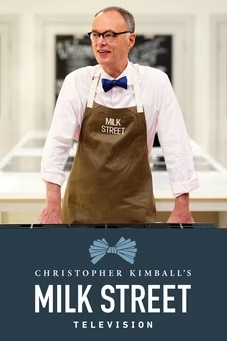
Christopher Kimball’s Milk Street Television
Transform home cooking with the editors of Christopher Kimball’s Milk Street Magazine.







Support for PBS provided by:
America's Heartland is presented by your local public television station.
Funding for America’s Heartland is provided by US Soy, Sustainable Agriculture Research and Education, Rural Development Partners, and a Specialty Crop Grant from the California Department of Food and Agriculture.