
Living Along the River
12/1/2022 | 21m 30sVideo has Closed Captions
Living Along the River
Illinois leaders are working to revitalize the state’s southernmost city by developing a Cairo Port District. We’ll explore those plans, and talk with city leaders in the river community of Quincy, about the challenges and benefits of Living Along the River.
Problems playing video? | Closed Captioning Feedback
Problems playing video? | Closed Captioning Feedback
InFocus is a local public television program presented by WSIU
Support provided by:

Living Along the River
12/1/2022 | 21m 30sVideo has Closed Captions
Illinois leaders are working to revitalize the state’s southernmost city by developing a Cairo Port District. We’ll explore those plans, and talk with city leaders in the river community of Quincy, about the challenges and benefits of Living Along the River.
Problems playing video? | Closed Captioning Feedback
How to Watch InFocus
InFocus is available to stream on pbs.org and the free PBS App, available on iPhone, Apple TV, Android TV, Android smartphones, Amazon Fire TV, Amazon Fire Tablet, Roku, Samsung Smart TV, and Vizio.
InFocus
Join our award-winning team of reporters as we explore the major issues effecting the region and beyond, and meet the people and organizations hoping to make an impact. The series is produced in partnership with Julie Staley of the Staley Family Foundation and sponsored locally.Providing Support for PBS.org
Learn Moreabout PBS online sponsorship(upbeat music) (camera beeping) (bright music) - Welcome to another episode of "InFocus."
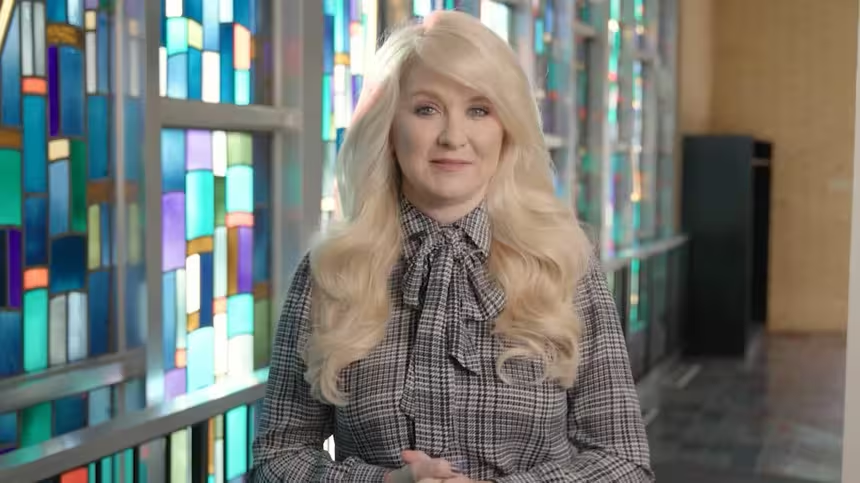
I'm Jennifer Fuller.
Throughout Illinois history, rivers have played a major part in economic impact, transportation, and even identity.
Whether it's the Mississippi River, the Ohio River, the Wabash, the Illinois, or many many others.
Illinoisans know all too well the benefits and the challenges of living along the river.
In one example, state and local leaders are trying to revitalize the economy of Illinois's southernmost community, Cairo, by building a new port district.
It could bring jobs and more transportation opportunities to the local economy.
WSIU's Benjy Jeffords has more.
- [Benjy] Illinois State and local leaders gathered in Cairo to give an update on the Alexander-Cairo Port Terminal Project, which in the last few years has been making steady progress in becoming reality.
Four years ago, Illinois lawmakers included a million dollars in the state budget to begin designs and obtained permits to get the project started.
In 2020 Governor J.B. Pritzker committed $40 million to the project as part of the Rebuild Illinois Capital Plan.
State Senator Dale Fowler has been a long time proponent.
- This place has always been one of my top priorities because of the economic development and the opportunity and the hope and the vision that lies here amongst this confluence.
These two mighty rivers, the Ohio and the Mississippi, that doesn't exist anywhere else in the entire nation.
We want to take advantage of that.
We're just taking advantage of the opportunity that we have to offer here in beautiful southern Illinois.
- [Benjy] State Comptroller Susana Mendoza has also been a supporter of the port.
- I've been coming to Cairo since before being elected your state comptroller in 2016, and ever since.
I'm gonna keep coming until this port is opened and attracting global business and providing jobs, and helping Cairo to thrive.
That's the vision!
And then I'm gonna keep coming back time and time again.
- [Benjy] Mendoza says projects like this is a prime example of how bipartisanship works.
- Illinois has a prime opportunity to become a leader in this space.
We have a strong competitive advantage over competing states and we need to keep that competitive advantage.
We can't let it float on by.
Every one of us up here, Democrat and Republican, southern and northern Illinois residents, are all 100% united on fighting for this port to become a reality.
Every official in Illinois from Governor Pritzker on down, has pledged their support to get this port built.
- [Benjy] She vowed to use the full power of her office to put this project at the front of the line for state resources.
- In my role as the state's Chief Financial and Accountability Officer, I have prioritized state payments related to the groundwork on this port authority project.
So far, I have paid out 11 vouchers totalling $1 million from the Department of Commerce and Economic Opportunity, and 43 vouchers totaling nearly 1.7 million from the Illinois Department of Transportation for architectural and design expenses related to the project.
- [Benjy] Cairo business owner Gabrielle Harris says the people of Cairo are being cautious because the town has seen a lot of changes over the years.
- I think that when you live in a town the size of Cairo and you have so many obstacles, from the housing crisis, it's been so many things that's happened in the last 20 years.
I think people are kind of just waiting to see until they see something tangible.
Right now it's people are more skeptical.
And once something does happen then, you know, I think people will get on board with it.
- [Benjy] Mendoza says the project is picking up momentum and the pandemic didn't slow it down because it was in the design phase.
- There is plenty more work to do.
And we must do everything to get this port moving along.
Now mind you, a lot of the work that's been done and all of the payments so far that have gone out have gone out for things that the public does not see.
It's the behind the scenes work, all of which has to happen before you'll see shovels in the ground.
- [Benjy] Fowler says it's still gonna be a while before the construction phase begins.
- There is a lot of permitting to be done with the Army Corps of Engineers, as the consultant mentioned earlier in the press conference.
So there's a lot of work to be done there.
So, you know, we just want keep it moving forward.
- [Benjy] Harris says Cairo needs something to look forward to.
- It's been over a decade.
It's been over a decade, over 10 years.
The designation was made quite some time ago.
But as far as the commitment I think within the last five or six years you've been seeing some commitment from the state.
So with that being said, I think people are starting to get a better feel for it, to understand it.
- [Benjy] To ease the public anxiety, Mendoza says there's work being done even if it's not always visible.
- We want to see shovels in the ground as soon as humanly possible.
But don't worry, this project is going to happen.
There are still behind the scene work that needs to be done.
The consultant work, the engineering work that is critical to making sure that this project runs smoothly.
But eventually we will see and we will be very happy to start celebrating actual shovels in the ground.
- [Benjy] Ely Consulting president, Todd Ely, says the project has gone through some major changes over the last few years.
- So the economic impact analysis study we had done by Northern Illinois University was done several years ago, and it was based on a design that we've replaced with a better, more robust design.
The old one was a 75 million capital investment.
The new one is between 250 and 300 million.
So substantially more.
So the numbers that I give you today are based on the old study.
- [Benjy] Once construction begins, advocates say it will bring in an abundance of jobs and stimulate the economy.
- During just the construction phase.
It'll be 675 construction jobs and spinoff jobs associated with that.
It'll be over $110 million in economic impact to the region.
$27 million of that is for actual payments to the construction workers that are there.
- [Benjy] Harris says this kind of impact will not only be good for his business, but for the whole town.
- With so much that can come from it, not only spinoff businesses, resources that can help the school district, the city itself needs quite a bit of resources.
So we're hoping that that's one of the things to come from it.
- [Benjy] With the rising cost of transportation, Fowler says businesses are looking for more economical ways to move their products which is growing more opportunities in the transportation industry.
- I know it's projected by the professionals in the industry, the maritime industry, that the container transportation opportunities are gonna triple from today's rates by 2030.
And that's the reason you're seeing these new vessels that are being manufactured that hold thousands of containers and operate on liquid natural gas and travel three to four times the speed of a normal vessel that you would see out here today.
So this is just where this industry is going and it's an economical farm.
- [Benjy] Mendoza says, a port project will bring a lot of changes and improvements to both Cairo and the region.
- You revitalize this area, it's not just about the port.
You're talking grocery stores, all kinds of commerce, right?
So there's so many other jobs that we're talking about and more importantly, services to the people of this area.
Why should someone in Cairo have to drive over that bridge to go get groceries, which by the way, with the increased price in gas, is monumentally more expensive for them.
- [Benjy] Mendoza says she's dedicated to helping Cairo return to prosperity.
- If Illinois as a whole can make a comeback, so can the city of Cairo.
And just like I never gave up on Illinois, I'm never going to give up on Cairo.
- [Benjy] For "InFocus" I'm Benjy Jeffords.
- We continue our look at living along the river here on "InFocus" with the mayor of Quincy.
Mike Troup, thanks for joining us today.
- Thank you for having me.
- You know, a lot of people may be familiar with Quincy as a river community.
It's a long been a very important stop along the Mississippi River, both for travel and for goods and services and things like that.
What are some of the benefits do you think for your community in living along the river?
- Well, you know, it's a agricultural region and so keeping a strong eye with the ag industry I think is one of the advantages.
The river offers a lot of transportation, not only for shipping bulky goods but also for other transportation, fun, recreational, you know, environment as well.
- Sure, but even as you have benefits of course with something, I don't wanna call it volatile, but perhaps unpredictable as the river, there have to be quite a lot of challenges as well, I assume.
- Yeah, anytime you have a body of water, and especially with a current like rivers, there's dangers, you know, that you have to warn your family and people when they're out and about with that.
But most people grow up in this region, you know, learning to swim and not necessarily in the river, but just having that basic safety and familiarity with how to deal with the water.
- Is there a certain identity that comes with Quincy because it's located along the river?
- You know, I think we do.
A lot of industry was started in Quincy because of its location as people were moving west.
We've got a strong German heritage.
Our architectural environment.
We've got virtually any style of buildings and residences throughout the community.
We've got some historical areas including our downtown area that has property owners keeping up the facilities to, you know, current standards, current uses, and the homes.
Quincy as an Illinois community has been recognized for the significant types of architecture available to view than virtually any other community in the state.
- I wonder how that identity, being along a river and having some of the benefits and challenges that you have, sets you apart from some of your landlocked neighbors that are just slightly further east, but not along the river?
- Yeah, I think some of that is because there was a lot of early river transportation and at one time Quincy was really the third largest town in Illinois because of river and train traffic that brought a lot of industry.
So business owners that set up operations built some very nice properties here in town.
They were strong merchants and some of the factories are still operating 150, 180 years later are still in the families operating in this region.
- Certainly that long in business requires you to evolve and to adapt to things.
But does that change?
And and how do you work together knowing that the river has its own ideas and its own life and its own movement?
- Yeah, I think in some cases the the river has lost some focus with some of those businesses as they have evolved.
But our ag industry, you know, we do a lot of corn and soybeans in this region and you can't feed the world without shipping product to them.
And the least expensive and best mode of transportation is barging those grains down to the port in New Orleans and then they get on ocean cargo vessels to go throughout the world.
- Certainly there are some who would have an idea of what a river community is like, and they base that on books and stories that perhaps they heard in childhood.
Quincy is tied of course to Hannibal, Missouri, which was the home of Mark Twain and the setting for some of his classic novels.
You are also in between, as you've said, the St. Louis region, Quad Cities, and other areas that are so closely tied to the river.
Do you try to move Quincy along with that identity or is that something that you're trying to maybe move away from?
- No, we're proud of our heritage and our history.
So we have no intentions of moving away.
We've had more presidents or presidential campaigns stopped in Quincy, you know, over our history.
You know, with the famous Lincoln-Douglas debates.
But we've had other presidents from Obama, President Clinton, President Trump, President Reagan.
There are some 7 to 10 different presidents that have made Quincy a stop at some point, either during the presidency or possibly in the election leading up to it, or even post term in office.
So, and we've got other support with the local areas we've helped.
Although we're on the river, we're on a bluff, so we have not had Quincy in general being negatively affected by flooding, but we help our neighbors when we do have a flood.
The 1993 flood was huge for this area and closed our bridges that crossed into Missouri.
So we had to find, actually route through St. Louis to get, 'cause a lot of our businesses work in the tri-state area, West Central Illinois, Northeast Missouri, and Southeast Iowa.
And with those bridges closed, it became, you know, several days trip instead of a 20 minute drive across the river.
So we adapt as needed and we're relieved when everything gets back to so-called normal.
- You mentioned transportation, and obviously that's a big part of any economy for a city in the Midwest.
Getting things both to and from your community.
How does transportation play a role?
Not just along the river, but over rail, over road, and through the air?
- Yeah, Quincy continues to expand.
So we now have four lane highway systems that go anywhere north, south, east, west.
You know, we can get anywhere in this country we can get to Canada, we can get to Mexico.
There's not a community we can't get by vehicle.
We have a regional airport based in Quincy.
We've got a commercial airline.
We've got a new commercial airline starting December 1st.
They will have several flights per day to Chicago O'Hare and additional several flights per day to St. Louis Lambert.
And so when you fly to either of those airports there's not a place in the world you can't get to.
So business travel, recreational travel, people can take the car, airplane.
We also have Amtrak service as two trains per day.
They go Quincy to Chicago Union Station.
And so it's very convenient.
- How do you market your community in a state like Illinois?
We talk to a lot of downstate leaders who say, "Well, Chicago is obviously the economic hub for the state, but we market our community a little bit differently, or we try to brand ourselves a little bit differently."
How does Quincy set itself apart?
- Well, I think part of it is our size.
Not everyone wants to go to a large community like Springfield, Peoria, or even Chicago at the super level size community.
So we're attracting different conventions, regional conventions to come use our convention center.
We're trying to build some additional hotels for housing so we can get those thousand to 1500 size groups to come in and have events in our community.
So we have, you know, the oldest art society in America was started in Quincy and still very active.
We have a symphony orchestra.
We've got a park band.
We've got all sorts of, with the high schools, we've got two high schools.
They have a full variety of musical talent that they've started in the elementary levels.
We've got college with John Wood Community College and Quincy University with not only a liberal arts full degrees but also graduate programs, in a variety from nursing to teaching education.
So we're a retail hub, a medical hub, a educational hub, and it's just nice there's something for anyone in a 7,500 mile radius that could benefit by a day or two in Quincy, or even to come and move and fill one of our open jobs.
- You mentioned tourism and I understand there are some plans underway to even continue the revitalization along the riverfront to allow cruise ships, riverboat cruises I should say for people who are unfamiliar, to come into Quincy and kind of build on that tourism.
How critical is tourism for your economy?
- You know, it all is an advantage.
It helps with people to come here, spend a night or two in a hotel, go to our restaurants, go shopping, visit some of the historical sites.
So it's all a benefit and Quincy loves to show itself off.
We have been working on a plan for the Quincy Riverfront development for several years.
Recently approved a full $50 to $60 million renovation to the Quincy Riverfront.
And one of those is what you mentioned that establishing a cruise dock for the river cruise ships there.
And what's interesting, those river cruises can typically have at least 300 passengers on a cruise.
And they're stopped, you know, for a full day.
Sometimes they're doing overnight at the dock.
But it would be welcome to get 300 visitors in, you know, 15, 20 times a year.
That'd be a real advantage and growth for the tourism and the businesses in the Quincy area.
- Like so many other communities along the river, I know that you have quite a few challenges and quite a few opportunities.
Mayor Troup, thanks so much for your time.
- Oh, you're welcome.
Thank you for calling.
- And thank you for joining us on "InFocus."
For all of us here, I'm Jennifer Fuller.
(bright music)

- News and Public Affairs

Top journalists deliver compelling original analysis of the hour's headlines.

- News and Public Affairs

FRONTLINE is investigative journalism that questions, explains and changes our world.












Support for PBS provided by:
InFocus is a local public television program presented by WSIU