Living St. Louis
July 6, 2026
Season 2026 Episode 13 | 28mVideo has Closed Captions
Jefferson Barracks Bicentennial, Welcome Neighbor Refugee Driving Program, Code Name: Hammer.
Jefferson Barracks National Cemetery celebrates its 200-year anniversary this month; Welcome Neighbor STL offers a driving program that helps refugee women gain independence; and the incredible story of Irven Hammerman, who, just a few years before his death, revealed he hadn't just served in WWII; he had been an assassin operating under the code name Hammer.
Problems playing video? | Closed Captioning Feedback
Problems playing video? | Closed Captioning Feedback
Living St. Louis is a local public television program presented by Nine PBS
Support for Living St. Louis is provided by the Betsy & Thomas Patterson Foundation.
Living St. Louis
July 6, 2026
Season 2026 Episode 13 | 28mVideo has Closed Captions
Jefferson Barracks National Cemetery celebrates its 200-year anniversary this month; Welcome Neighbor STL offers a driving program that helps refugee women gain independence; and the incredible story of Irven Hammerman, who, just a few years before his death, revealed he hadn't just served in WWII; he had been an assassin operating under the code name Hammer.
Problems playing video? | Closed Captioning Feedback
Where to Watch Living St. Louis
Living St. Louis is available to stream on pbs.org and the PBS app.
Providing Support for PBS.org
Learn Moreabout PBS online sponsorship250 years into America's story, you don't have to look far to see it still unfolding.
Here at Jefferson Barracks, history feels especially close.
For two centuries, this site has been a gateway for military service, men and women training to fight for the American dream.
But service doesn't always look like we'd expect it to, because America is still something people are shaping and navigating every day.
In this living St.
Louis, Jefferson Barracks is marking its own milestone, reflecting on 200 years of how this site connects past service to present memory.
The story of a World War II veteran whose role was far more secretive and far more complicated than most.
And we explore a different kind of courage happening today, as women new to this country take the wheel for the first time.
It's all next on Living St.
Louis.
♪♪ - As America celebrates its 250th anniversary, Jefferson Barracks is celebrating 200 years of military history.
We're here at the St.
Louis Area Showcase, learning about how the barracks is honoring local history as well as America 250.
♪♪ On June 6th, Jefferson Barracks welcomed many St.
Louis area historical groups to the park to share more about their organizations with the public.
Jeffrey Edison, a museum educator with St.
Louis County Parks, says it's one of the many ways Jefferson Barracks is celebrating throughout the year for its bicentennial.
Jeffrey Edison, St.
Louis County Parks, "Everything that we're kind of doing has its own 200th spin where we're doing historical tours that kind of showcase the entire history of Jefferson Barracks.
We're adding a few more programs, but it's also America 250.
So we're kind of throwing in some of those early years as well.
Built in 1826, Jefferson Barracks is the oldest operating military installation west of the Mississippi.
Fort Bell Fountain in Old Jamestown was actually the first fort west of the river.
But around 1820, the U.S.
government wanted a military facility closer to St.
Louis, which led to the founding of Jefferson Barracks.
They began looking and this land that we're on now was a donated tract of land by the community members here.
So the government accepted free land, and that's how we get Jefferson Barracks.
It was meant as kind of a training facility for the infantry here, but it was a school of the soldier practice where they were learning all those basic skills, and then it becomes something even bigger where you get the cavalry units here, and then shortly after, then you get the artillery units as well.
So it's a 1,700 acre worth of land here, but it has become so much more than just a basic training camp.
- The site was named after Thomas Jefferson, since he purchased the land west of the Mississippi while he was president.
And the facility had an active role in US history.
It was involved in every war since the Black Hawk War in the 1830s until the end of World War II.
We had over 200 Civil War generals come through Jefferson Barracks at any given point.
So think of Ulysses S. Grant, Robert E. Lee, Jefferson Davis, Tecumseh Sherman.
All of those like really gigantic names that we all learn about in grade school were all here at some point in Jefferson Barracks' lifetime.
As much of U.S.
history, though, Jefferson Barracks' is complicated.
Some of the early wars the barracks' military personnel participated in involved the removal and genocide of Native Americans.
And for decades, the hospitals and troops were segregated.
But hundreds of thousands of military personnel passed through these barracks and made their mark on U.S.
history, until the site was decommissioned in 1946.
The federal government kind of did a survey on what military bases that they really wanted to have after World War II.
So Jefferson Barracks was kind of on that early chopping block there.
But they realized that this space is kind of a strategic power, and so we see the Missouri National Guard move in later on where they're the Army and Air National Guard now.
So they occupy where Jefferson Barracks were.
So those brick buildings that you see on the north side of the cemetery, that's all still an active military base with the Missouri National Guard.
Jefferson Barracks is now divided into many parts, including the military base, walking trails and the National Cemetery, which started in 1827, just one year after Jefferson Barracks was established.
The federal government gave us the northern half of Jefferson Barracks as a way to keep a historical park.
They wanted to tell the military history of Jefferson Barracks, so they commissioned the north side of Jefferson Barracks as a historical park.
And then that blossoms into having all these trails.
We have three miles worth of trails now.
We connect to the Greenway system.
It's also full of military monuments and museums that operate out of repurposed spaces.
So the county parks, we operate two of our museums out of old powder magazines.
And so we have the oldest one that was built in 1851, then we have one that was built in 1857.
There's also the Missouri Civil War Museum, the POW and MIA Museum, and the Telephone Museum, which are run by other nonprofit groups.
Visitors this year will be able to experience the other celebrations marking the park's bicentennial, and the largest of those is in October and is in collaboration with the National Guard.
- So you can expect military vehicles will be there doing some historical lessons.
There might be some walking tours.
There's going to be bands.
They're going to have a lot of the men and women in formations.
And so it's going to be great.
This is kind of a groundbreaking history here.
Men and women who were at Joyce and Barracks have touched many lives.
They've served in different theaters of war.
So we just kind of want to showcase that there's 200 years of history here and it doesn't end just with one individual story.
- As Jefferson Barracks celebrates 200 years, it's impossible not to think of the thousands of lives that have been changed after passing through these gates and going on to serve our country.
This story is about one of those lives and the extraordinary turn it took right here.
I'd like to interview Irven Hammerman.
When were you born?
February 23, 1921.
And where?
St.
Louis.
Jewish hospital.
Where did you go to high school?
Soledan High.
Not a lot of people know about this.
I'm really not interested in most of it.
Nobody's going to know.
Your kids wanted this.
Yeah.
In 1994, Irven Hammerman reluctantly agreed to record an oral history of his life.
By all accounts, it was similar to that of many of his contemporaries.
He had served his country in World War II, was lucky enough to return home, and then worked hard to support his growing family.
But for years, Irven had kept the place where his story diverged from the lives of others a secret, even from those closest to him.
Let's start with what your dad was like.
What kind of guy was he?
He was always strict.
He was quiet.
He was was not the life of the party.
He didn't tell jokes.
You know, we'd go out and play ball in the back and things like that.
But he worked a lot.
You knew that he had served in the Army, correct?
We did.
He told us he was a medic.
That's the story he told everybody.
That was his cover when he was in the Army and doing what he did.
And what Irven did was so singular and so secret that before being discharged in 1945, he was sworn to a 35-year-long silence about his time in the military.
So my middle child, Zachary, was working at my father's advertising agency.
Somebody came and asked him, "Do you know what your grandpa did when he was in the war?
You've got to get him to tell you."
This chance encounter led the family to start asking questions.
And little by little, Irven began to share parts of his story.
And it was like pulling teeth.
He was somewhat ashamed of it.
You know, how do you go through life telling people you assassinated individuals, some of them civilians?
There were 14 missions.
He succeeded 10 of them and eliminated both the primary and secondary target.
Other than numbers like that, he wouldn't talk a lot of specifics.
He just didn't want to do it.
When Irven's family finally convinced him to record an oral history, decades of secrecy and shame prevented him from sharing much detail.
I think it was my sister that suggested that he start writing about it.
And he was able to tell the story that way a whole lot better.
Do you think it gave him any kind of relief?
I think it did.
I think both talking about it and again, writing about it was a was a catharsis.
On the one hand, he didn't want to tell anybody.
But on the other hand, it was difficult not being able to tell anybody.
Yeah.
Yeah.
That's a strange tension to live in.
Anybody that lived through World War Two or any any war has problems, things that they did, things that they saw, but a lot of them have the camaraderie of other people they served with who did the same thing and they can talk about it.
Nobody knew what he did.
Nobody did what he did.
My father's honorable discharge.
Oh, here's some pictures.
Harley Hammerman edited his father's written recollections into an autobiography, which is not only an account of many of Irven's missions behind enemy lines, but also provides context for why he was selected for special service.
Were you athletic?
Yeah, very athletic.
And what were your sports?
Mostly I was a gymnast.
When I went to Washington U, I used to get up at six in the morning, work out there for two hours before going to classes.
At Washington U, what were you studying?
Well, I was pre-med.
But in those days there were quotas in terms of how many Jewish people could get into the medical schools and he couldn't get in.
So, of course, that situation changed after the war.
It was tough.
Yeah.
So I switched to chemical engineering.
And then I went to American Foreign Foundry Company and they had a metallurgical chemical lab there.
Started out as a summer job, but I ended up staying there.
When the war broke out and they needed my work, I became chief chemist, even though I had not graduated at the time.
He had a permanent deferment.
He'd be on the streetcar or whatever, and here is this strong guy, and all around him are older people or whatever.
He felt like they were staring at him like, "What's wrong with this guy?"
Meanwhile, on the other side of the world in Japan, Irven's 21-year-old brother, Harley, was a bombardier navigator in the United States Army Air Corps.
And I felt bad because I felt I should be in the service too.
I thought I had something to contribute.
He asked permission to leave his job, even though they felt it was important, and he enlisted.
I received a very high score on the Army Intelligence Test, and as a result, they kept me at Jefferson Barracks for six weeks while they decided what position I would best be suited for.
During that period I operated the blood and urinalysis lab.
I guess they thought this was as close as they could get to what a chemist was trained to do.
Notice was taken of this unassuming, quiet young man, who was not only a skilled athlete, but also fluent in both French and German.
After training at both Camp Barclay and Camp Gordon Johnston, Irven was shipped overseas.
So all of these particular sets of skills that he had just naturally, the gymnastics, the languages, all of that, that really set him up for what was to come.
Also the fact that he was small, he was about 5'6", very unassuming, like he was not the life of the party.
He would melt into a crowd and that's what they were looking for.
I received orders that sent me to some place in Scotland for training with the British Commandos.
We went through a minimum of 12 hours of training, day and night.
Calisthenics, weight lifting, scaling cliffs.
We learned hand to hand combat and karate, the use of a knife in a close fight and in addition to many other things, we learned how to use a parachute.
After 12 weeks of grueling training, Irven was sent to London for a meeting with high-ranking officers, including General William Donovan, Commanding Officer of the OSS, and General Walter Biddell Smith, who was General Eisenhower's Chief of Staff.
My assignment was to be the elimination of certain German SS and Gestapo officers.
I was told that the men I would be eliminating were instrumental in the torture and elimination of the Jews in Europe.
He knew about the concentration camps and they knew he was Jewish and they said, "Hey, you'll be doing this to help those efforts."
And that did appeal to him.
So he agreed to do it.
- Almost a righteous.
- Right, exactly.
Yeah, a moral thing.
- His set of missions was given the code name HAMMER and were classified as G2 or Army Intelligence.
Irven's first assignment was to parachute behind enemy lines, pretend to be an injured German soldier, and eliminate the Gestapo agent in charge of that area.
- I'm sure this isn't the parachute.
There had to be a lot of parachutes, but this was one of them.
- His contact was a German nun who was part of the underground resistance.
- We became very close.
In fact, she wanted to marry me and come back to the United States.
And after war was over, I never saw her.
- When my mom and dad went back over there to visit, he tried to find her and he couldn't.
And then somehow found out that she had died during the war and had been killed during the war for what she was doing.
- While the war raged around him, Irven quietly hunted his targets, from battlefields to beer halls and even inside their own homes.
But once he was given a very different kind of mission, to help a prisoner escape from Buchenwald and take him to safety.
- I had been told not to ask him his name or occupation, why he had been put into a Nazi concentration camp.
And during the four days we were together, he never offered to tell me.
- Irven's assignments had often taken him to France.
So when the time approached for Operation Overlord, he volunteered to go in with the ships, figuring he could be useful since he already knew the lay of the land.
I came in on the second wave.
The second wave in Normandy.
He landed at Omaha Beach and the water was above their heads so they were sort of bobbing up and down to breathe.
Two other men who he was very close to, they were walking in and there were German shells all around him and he was up and they were down and one of the shells hit in the water and the two of them were killed by the concussion of the shells and he lived because he happened to be up.
Dear Mr.
and Mrs.
Hammerman, We were sorry to learn of the death of your sons, Lt.
Harley Hammerman and Private First Class Irven Hammerman, in the service of our country.
And we wish to extend to you... In June 1945, Irven's parents received a letter from the Red Cross stating incorrectly that both of their sons had died.
While Irven had survived his close call at Normandy and many others, Harley had perished on May 7, 1945.
After completing a bombing run on a Kamikaze airbase, his plane was rammed by a Japanese fighter, causing both to crash on a farmer's land on Hachiman Mountain.
A memorial to both crews now stands on that site.
A couple years ago, my son and his wife and my two grandsons went there, and it was very moving.
And it was actually moving for the people there, too, because when they got wind that the name was Hammerman, they sort of put two and two together, that one of them was related, and they had news media from the city and all kinds of people there, and it was on all the news shows.
And we said the mourner's kaddish for Harley Hammerman, which is the Jewish prayer for the dead.
So yeah, it's very meaningful.
- Three generations of Hammermans have worked hard to celebrate both Irven and Harley's bravery during the war.
When Irven's great-grandson, Calvino, was assigned a school video project that honored one of his heroes, he turned to his grandfather's book.
- There had always been like kind of an aura around him, but this was the first time I read the book cover to cover.
You know, we seek, or at least I think we seek in America, to honor our veterans.
We should give them, you know, the services they deserve.
But I think, in my opinion, the greatest way we can honor them is by telling their story.
- And of course, for veterans, the end of their service doesn't mean the end of their story.
- Then you come back after being processed and move in at home.
- My mother tells me I was very, very high strung and nervous.
Took me a while, a little while to calm down.
It was a different life.
It's so incredible to think of someone doing all of these things and then to be able, kind of, to go back to normal life.
I mean, your mind is a certain way, you're looking for certain things all the time and then you just come back and have a family and start a business.
Yeah, so it apparently wasn't that easy.
When I got back here, I went up to dinner with a young lady at the Chase Club.
A waiter came up behind me, put his arms on my shoulder, and I threw him over the table, which was very embarrassing.
And then that young lady never went out with me again.
Was it unconscious reaction?
Yes.
I felt nobody would ever marry me if they knew what I had done.
In 1948, Irven married Celine, and they spent the next 70 years together.
She was most likely the first and only confidant of his secret life for decades.
The couple had four children, and Irven went on to start several successful retail and advertising businesses.
But the echo of what he had done during the war followed him through all of these milestones, and the uneasiness he brought home with him never fully went away.
One day, this persistent hum of vigilance paid off.
- Long time down the line, he just felt somebody was following him.
He sort of got the jump on this guy, and he said, "What's going on here?"
And it turned out that he had eliminated this guy's father.
He had actually gone into their home, and his sister and his mother were there, eliminated the guy, and somehow this guy found out about it and traced him, and he never knew how, but he wanted some sort of revenge, and my father said, "Do you have a family?"
They looked in his wallet, and he had pictures of his wife and kids, you know.
I showed him a picture of my wife and kids, and I said, "At the time, I could have just as easily eliminated you, your mother, and your sisters, but I didn't."
I don't want to hurt you, and I hope you don't want to hurt me, and, you know, we should live our lives now, and he did.
The guy went away and never saw him again.
As Irveng continued to confront his past, he tried to locate his official records.
There was a fire in 1973 at this records center on Page, and they said, oh, all of his records were there, so none of them exist anymore, and he never believed that, and he would talk to various senators and representatives trying to get us, and they said, "That's not true.
Something as significant as your records, they exist somewhere, but you'll never ever get them."
In 2018, Irven Hammerman passed away at the age of 97.
He did not want to be remembered as a killer, an assassin, or even a war hero.
He says he just wanted to be known as somebody who led a good life and loved his family.
Did you all see him as a hero?
Yes, we definitely saw him as a hero.
But you know what?
He was always a hero to us.
For anyone making a big move, it can be stressful and overwhelming.
But for refugees, those who are forced to flee their home country due to war or persecution, beginning a new life in a foreign land begins with overcoming basic challenges that most of us take for granted.
In this next story, we explore a program that supports these new neighbors and their quest for independence.
Hi, my name is Zarina and I am from Afghanistan.
I lost everything the day the Taliban came.
Before the Taliban took over, Zarina worked as a teacher.
She speaks four languages and is learning her fifth, English.
Her children live in different parts of the world and she now calls St.
Louis home.
"I have a lot of wishes and I want to go back to my profession in the United States."
Unfortunately barriers to independence and success continue to exist for Afghan women like Zarina who have resettled in St.
Louis.
This region is dependent on cars, making many jobs, schools, grocery stores and doctors appointments difficult to reach without reliable transportation.
For immigrants and refugees who arrive without a driver's license or vehicle, simply getting from place to place can become a major challenge, leaving women feeling isolated and dependent on strangers.
We want to enable them to be independent.
Ann Whitman is the executive director of Welcome Neighbor STL, a local nonprofit that partners with refugees and immigrants as they start their new lives in St.
Louis.
The fear is takes a long time to get rid of when they first come.
They're afraid of everything.
They're afraid of people.
They're afraid of places.
They're afraid of our culture.
They don't want to get in trouble.
And so that takes a long time to get over that fear in order to then be brave enough to venture out into our society.
- This is a no U-turn, which means you can't turn around and make a big U in order to go back where you came.
- Welcome Neighbor STL has collaborated with Archway Refugee Connections.
They've created a pathway out of isolation for Afghan women through their driver education program.
The manuals luckily have been translated into Pashto and Dari.
And so if a woman is literate in her home language, then that's great for studying.
But of course, when they're driving, all of our signs, all of the directions, they're all in English.
And so we want to make sure that they are comfortable and safe.
Because during a driving test, you cannot have an interpreter.
And so you need to understand English to a comfortable degree.
Start turning this way.
Remember the hand over hand.
Yep.
Then hold it.
Now let go.
Let go of that wheel.
Don't fly.
Just keep your hands on the wheel.
When we got started with the first small grant from the Missouri Office of Refugee Administration, it was for Afghans and it could have been a man or a woman.
It was specific to Afghans.
But we chose to focus on the women because we knew some of the women were really excited about the opportunity to learn how to drive because they weren't allowed to drive in Afghanistan.
So we thought, let's give this a try.
And it takes longer because they've never driven a car.
So, at least the men had driven cars in Afghanistan, but the women had never been behind the wheel.
So, if there's a road and it has this sign, that means do not enter that way.
Some of these student drivers will use the freedom of a driver's license to get a job.
Immigration is one of the few sources of population growth in the St.
Louis region.
As refugee women gain access to jobs and careers, they help fill workforce gaps, support local companies, and contribute to the economic vitality of our region.
- Yeah, then hold that right there.
Now let go.
Yep, keep your hands on the wheel though.
Let it slide.
There you go.
- Rahanna has passed the driving permit program and is now learning the basics of driving from behind the wheel.
She is already employed.
Her and her husband work opposite shifts at a factory, so someone will always be home with their young children.
I work from 4 a.m.
to 5 p.m.
I work 10 hours a day.
My commute is very long.
Because I don't have a driver's license and I don't have a car, one of our fellow citizens comes to pick me up every day.
It's very difficult for me.
I depend on somebody else.
If that person wants to go, I'm able to go.
If that person is not going, then I'm not having anybody to take me or bring me back.
In the last year, 55 women have earned their driver's license.
They've been funded to train another 50 within the next 12 months.
For these women, learning to drive is more than passing a test.
It's about independence, freedom.
I want to be a teacher here.
I want to serve the people here.
You helped me in my hard situation, and I want to be a helpful person to the people here.
♪♪ And that's Living St.
Louis.
How did you and your family celebrate America's big birthday?
Let us know at Nine PBS.org/LSL.
We love hearing from you.
I'm Brooke Butler.
Thanks for joining us.
♪♪ - Living St.
Louis is funded in part by the Betsy and Thomas Patterson Foundation and the members of Nine PBS.
Video has Closed Captions
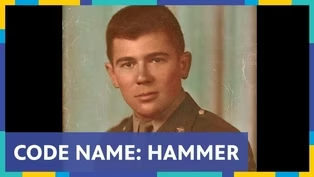
Clip: S2026 Ep13 | 13m 27s | A few years before his death, a St. Louis native revealed he had been an assassin in WWII. (13m 27s)
Jefferson Barracks Bicentennial
Video has Closed Captions
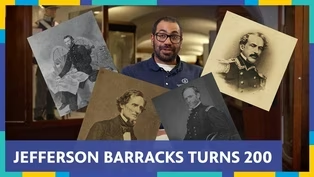
Clip: S2026 Ep13 | 5m 32s | Jefferson Barracks is celebrating 200 years of military history. (5m 32s)
Program Helps Refugee Women Learn to Drive
Video has Closed Captions
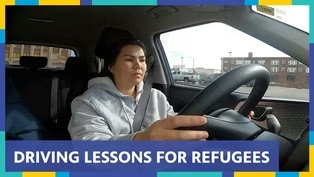
Clip: S2026 Ep13 | 5m 25s | A program that helps refugee women in St. Louis gain independence by learning to drive. (5m 25s)
Providing Support for PBS.org
Learn Moreabout PBS online sponsorship













Support for PBS provided by:
Living St. Louis is a local public television program presented by Nine PBS
Support for Living St. Louis is provided by the Betsy & Thomas Patterson Foundation.