
Living Well
Season 3 Episode 1 | 26m 46sVideo has Closed Captions
Meet the Movers and Makers creating and enriching safe, inclusive spaces for wellness.
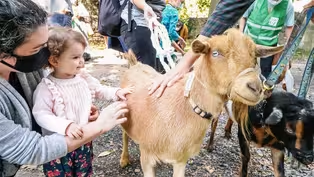
Meet the Movers and Makers creating & enriching safe, inclusive spaces for wellness in our region. The Philly Goat Project surprises city residents with fun ways to connect with nature, Spirits Up! fosters healing & mindfulness among communities of color, & Lancaster Farmacy harvests herbal remedies for mind, body, & soul. Plus, discover one woman’s journey to recovery through yoga.
Problems playing video? | Closed Captioning Feedback
Problems playing video? | Closed Captioning Feedback
Movers & Makers is a local public television program presented by WHYY
Living Well
Season 3 Episode 1 | 26m 46sVideo has Closed Captions
Meet the Movers and Makers creating & enriching safe, inclusive spaces for wellness in our region. The Philly Goat Project surprises city residents with fun ways to connect with nature, Spirits Up! fosters healing & mindfulness among communities of color, & Lancaster Farmacy harvests herbal remedies for mind, body, & soul. Plus, discover one woman’s journey to recovery through yoga.
Problems playing video? | Closed Captioning Feedback
How to Watch Movers & Makers
Movers & Makers is available to stream on pbs.org and the free PBS App, available on iPhone, Apple TV, Android TV, Android smartphones, Amazon Fire TV, Amazon Fire Tablet, Roku, Samsung Smart TV, and Vizio.
Providing Support for PBS.org
Learn Moreabout PBS online sponsorship- [Andrew] On this episode of Movers and Makers, fresh air and fun with the Philly Goat project, expanding the umbrella of wellness for communities of color, cultivating herbal remedies to heal body and soul, and one woman's journey to recovery through yoga.
(bright upbeat music) Welcome to the show, I'm your host Andrew Erace.
Tucked away in Germantown, Philadelphia, is the beautiful and expansive Awbury Arboretum.
Across these sprawling 55 acres, you can find open meadows, hundreds of plants species, free art exhibitions, community wellness classes, and even a working farm.
The city oasis was originally built as a summer escape for the Cope family, who, in 1916, converted its grounds into an Arboretum.
So that the quiet enjoyment of nature could be shared by all.
Our show today shares the stories of people and places, including here at Awbury, forging their own paths to mental, physical, and community wellbeing.
(bright upbeat music) (goat bleating) - [Karen] I love our community walks because we ask people to put their phones down and connect with the goat.
And we promise them that, if they pet the goat, and they are calm, the goat's gonna connect with them.
And I guarantee them that that goat will take a really nice selfie when they take their phone out at the end.
I started the Philly Goat Project in 2016 with my daughter Lily Sage at my side, because I really wanted to create a program that made a difference in our community.
And it seems really weird to use goats.
You can be the boss goat.
But the Philly Goat Project is about what we do with the goats.
That's what makes us different than a petting zoo or a farm or a school.
People meet us through these community engagement opportunities, and hear, "Oh, you do therapy too."
"Well, I have somebody in my life "who could really benefit from that."
Good job.
- [Jenna] We went to Mt.
Airy Day event, like a community festival, and the goats were there doing a Storybook Walk, and the boys loved them.
And I'm always on the lookout for new therapies for us to try.
We've done Aqua therapy and therapeutic drum lessons.
Who did you kiss?
- Ivy or Anthony?
- Ivy.
- Yes.
It's been huge for them working on their language and confidence building, getting to work with animals.
It also pushes them to do things that they're less comfortable with.
Jessie has some sensory aversions to lots of food textures.
So things he won't touch at home, he will touch in order to feed the goats.
And you'll give Jimmie a carrot or a pretzel and instead of feeding it to the goats, he often eats them (chuckles).
So he always get a snack when he comes to see the goats.
- [Karen] Animal-assisted therapy is one of my favorite things that we do whether it's a Rec therapist, Speech therapist, a Special Ed teacher.
How to incorporate their lesson plans with something that's fun.
What's more fun than a goat in a wagon?
You wanna try kiss again?
As compared to sitting in a classroom and doing a puzzle.
(chuckles) Ivy that was such a nice kiss Jimmie gave you.
We have a farm-based program where we just take care of the goats every day.
And we have teams of people who donate their time and take care of them in the morning, and take care of them in the evening, and put them to bed.
- I live very near to the Arboretum and I saw an announcement in the newsletter that the goat project was coming.
I was excited about that.
And then I heard about goat yoga.
I am not much of a yoga person, but who can refuse yoga with a goat?
And that same day I did my first community goat walk and my volunteer training.
And I've been here ever since.
- I discovered the goats with the tree-cycling.
The annual event where people bring their Christmas trees and the goats can eat them.
I said, all right, well, that's my Sunday set.
- [Cheryl] It's all about taking care of the goats, and also being part of an amazing community, and engaging the goats with Philadelphians.
(goats bleating) - [Ali] The walks are wonderful because we get to head out into the Arboretum, which is a beautiful space.
And we walk through the gardens and we run into people from the neighborhood, which is terrific.
We'll stop and let everybody have a minute with the goats.
What's really fun is when we walk out on the street and cars will stop (laughs).
Pull up beside us and say, "Are those goats?
They are goats (laughs).
- Goats.
- This is the letter T. And that means toilet.
So you can say to your goat, "Go potty, go potty."
- Miss Karen inspires just anybody walking by to come, and learn, and volunteer.
And this year with COVID, they weren't able to go to summer camp or anything.
And she invited us to come and learn about the goats and to help train the goats, and learn to take care of the goats, which was great.
Lots of space, lots of fresh air.
They were locked up in the house for around six months.
So they needed that therapy.
It gives a sense of leadership.
It makes people feel really good, to come and just grab a goat and walk a goat.
- Kelly, you're doing a great job.
- This is Anthony and this is Bebito.
- [Karen] All of our goats do have important names because after we talk about poop, and how you have four stomachs, and why they have rectangular pupils, and they can see behind them.
We can talk about why we honor the person that the goat is named after.
One of our goats is named Ray, he's my favorite.
He's named after Raymond Alexander, who's the first African American State Supreme Court judge in the State of Pennsylvania.
And he went to high school, right near Awbury Arboretum.
But we have other goats that are more world famous like Holiday.
She's named after Billie Holiday, who everyone thinks is from New York, but she was born in Philly.
- Hear ye, hear ye, the show's about to begin.
But first, we have some rules for everybody.
- One of the silliest things we've done is doing a play of the "Philly Goats Gruff."
It's fun, and what other chance do we have to do that these days?
- [Gabriel] I had no experience with any animals until here.
It was kind of sudden, because one day I'm on a game, the next I'm working with goats.
It's crazy how your life changes in a matter of seconds.
- [Karen] And we do other kinds of crazy and delightful things.
One of my favorite things is running around the city at 5:00, and 6:00, and 7:00 AM to film our annual calendar with really cool, professional photographers, who donate their time to us.
In all kinds of famous spots in Philadelphia that people think are Photoshop, but they're not because our goats are so well-trained.
- [Gabriel] These boats are very uplifting.
You will never leave here the same.
You may come here mad, but you will leave bright.
(upbeat music) - Already meditation is a radical act.
And yoga, and there's that idea of mindfulness is a radical act.
But then when you put it with the black community, and the black and indigenous community, where we live in a system that literally is built to disadvantage the neighborhoods that are all black and indigenous.
So when you have black people who are trying to be well in a space, and really push down the community heavy, it's radical.
Because there's so many black people living without even knowing that wellness is necessary in their daily life.
- [Instructor] Again, feel the air all around you.
- My name is Sudan Green, I am an artist and the founder of Spirits Up!
Spirits Up!
is a company that was started around the protests in Philadelphia for George Floyd.
I wanted to figure out a space, a place where people could go and be protesting, but not have like high-pitched sounds, yelling, screaming, being kind of like on the lookout and afraid all the time.
So we thought of Spirits Up!
and planned it in.
And like I hit everybody up that I could hit up.
And it became a company that is in search of more safe spaces that black and brown and indigenous people could heal in, can practice safely, can practice yoga, meditation.
(upbeat music) - [Adele] Yoga as a practice is meant to be a practice of liberation.
White supremacy tries to take our breath away.
So how radical and how empowering is it to hold space for black folks to breathe?
I have been in the yoga "world" for about 10 years now.
It took a while before I knew black people taught yoga.
I remember the first time I saw a yoga teacher, a black woman, on the cover of a yoga magazine.
I remember that moment of seeing like, oh there is space for me.
It's not just about representation, but it's about power.
And empowering folks when they step into a yoga space to know that they're welcome, that they're included here.
Close your eyes.
You're sitting on the ground.
Feel the ground underneath you.
- [Jiana] I think that how we can expand the umbrella of wellness, is to really provide opportunities for people to understand that wellness is not something that has to be bought.
It's not just the food that we're eating, it's not just exercise, it's not just our ability to be able to do a handstand in yoga.
It's really how we interact with ourselves, and interact with each other.
And champion ourselves and champion our families for a brighter future.
- [Students] Happy is in me.
- [Adele] Last one.
- [Aniya] Yoga makes me calm, happy and makes me feel good.
- [Shoffner] I had a lot of stress in me from the past couple of weeks.
So I thought if I do a yoga it would release all the stress.
- [Students] Powerful is in me.
- Mindful means to me, be calm and relax.
- [Adele] Turn all of that positive energy back to yourself.
- I'm usually bored in the house a lot.
So it gives me something to do.
- Wellness was like not a thing really growing up at all.
I mean, therapy was an idea, but usually when the problem was already there.
Not like as a, like, yo, therapy's even cool when we're going through life.
I didn't find this type of wellness, alternative wellness, until 2015.
Like when I first walked into a yoga class and like sat still, and he like rang the bell, and there was a shavasana.
And I felt so light and like bouncy afterwards.
It was just a whole different feeling.
Yoga and meditation are extremely impactful to me on a personal level because when I practice it, I noticeably go out to my day differently.
I'm walking differently and I'm feeling differently about certain things that are coming at me.
So that's why I wanted to start Spirits Up!
And it showed, like it showed that it resonated in so many other people that these certain things also help them and they're open to it helping them.
So that's like a super, simple when I like to describe it.
It just like, it makes me feel better when I sit there.
And then I need to also be consistent in it.
And I'm not as consistent.
But even just sitting down three days out of the week, it makes me of those days better than they could have been.
We need more representation and we need more black and indigenous faces everywhere.
But wellness is one of them.
(upbeat music) - [Elisabeth] Herbalism is an ancient tradition that cultures all over the world have always used.
Plants were a source of healing and medicine.
All of the medicines that we know today, probably have origins to a natural herb that was used in its place before.
I went to Hampshire College, and I studied Community Development and Art for Social Change.
I graduated, immersed myself in the non-profit sector.
I was involved in running youth programs, it was super passionate about what I was doing.
And at that time, I started to have some burnout going on in my personal life, but also in my health.
I had some different conditions come up that were really starting to debilitate me from doing the work that I wanted to do.
And I realized that I needed to sink myself into something that was gonna ground me and also be helpful for my own wellness.
And so when I started working with plants, I realized how important it was for me to use plants in my own healing and recovery process.
I'm now here today harvesting hibiscus.
This variety is called Thai Roselle.
And we love this one because, see these beautiful red calyces, it's off of the fruit that we get these wonderful red buds that if you peel, all you have to do is do an infusion with hot water, you can even do cold water.
Let it sit out like a sun tea and it'll make a beautiful red tea.
And the amazing thing about this, is it's loaded with vitamin C. We'll harvest them like this, and then we'll take them to our drying room.
And we'll dry them so then we can make tea from them all year long.
With herbs, you're able to preserve them by drying them.
I moved back to my hometown of Lancaster, Pennsylvania.
That year I met my partner, Casey Spacht, and told him, "I just feel Lancaster needs a herb farm.
"I just think it's such a wonderful resource.
"People need to know where to source their herbs from, "if they wanna use them.
"And also just do more education around herbalism."
Because I was so excited about it.
At that time he said, "I'm part of this non-profit farmer's co-op "and we don't have any herb farms.
"That would be a great thing to introduce."
So we decided to rent one acre, growing medicinal herbs that then we would prepare into different value added products.
That would be things like tea blends, tinctures, body oils, salves.
One thing led to another, and within the first year, we broke ground at what we call Lancaster Farmacy.
And we're here 11 years later doing it, but we have expanded in many different ways into what we are now offering.
This is a first year growth of echinacea that we started by seed in the greenhouse.
We transplanted it and we're getting a beautiful foliar growth on it this year.
And I'm gonna actually harvest this plant all the way down like this.
And look how ...
So in one season, this is what this plant has done, which is incredible.
The amazing thing about echinacea, is that the leaves, the flowers, and the roots of this plant are all considered medicinal.
Echinacea is really great at stimulating the immune system.
We blend that into our tea.
We also will tincture it.
So a tincture is an herbal extract and you can extract herbs in different solvents.
Today, I have grain alcohol.
Echinacea's most popular property is that it is an immunostimulant.
So if you have kind of that tingle in your throat when you're feeling like you're getting sick, that's the time when you wanna start using a tincture of echinacea.
And within three to four weeks, this liquid will have turned a very dark, beautiful, color brown And you will know that you have done all of the extraction you can with your solvent.
People who are having more of a interest in doing things preventatively turn to herbs, because herbs are what you can use before you're really sick.
The easiest way to approach it is by making tea.
And if you have fresh herbs or you have dried herbs, you steep your herbs in that hot water.
It will infuse them and you drink that.
And that's your medicine.
So that's one of the easiest ways to use herbs in a medicinal way.
- I'm standing here in the drying room, and this is where a lot of the action happens.
We do bulk harvest on our herbs, they come up here, and they rest on the racks behind me to dry.
We keep this room at about 90 degrees to keep everything nice and hot.
Once the herbs are finished drying, which takes about three weeks, we then take it over to the gargling table where we process everything down into that fine texture that we use for teas.
And then also in this room, we mix all of our teas, labeling, boxing, happens and it goes to wherever its going.
- [Elisabeth] We are a member farm of Lancaster Farm Fresh Cooperative, which is a co-op of over 200 farms in the Lancaster County area.
We're all certified organic farms.
We feel super grateful that there is a co-op and that they have the ability to pick up on our farms on a regular basis and within 24 hours, make sure our products get to customers in the Tri-state regions.
These are people who've gotten a weekly subscription of flowers from us.
So you can see each week you get a big, beautiful bouquet.
And it's amazing that we harvest it, and within 24 hours, it gets to the flower customer.
We have a Community Supported Herbal medicine share program, similar to the Community Supported Agriculture share program.
We just created a package of products that are all about supporting the immune system.
We make a product called Fire Cider, which is a tonic.
It's great at keeping colds at bay.
It's really neat when you think about what herbs are available at different times of the year, and realize that those herbs are growing for a reason.
We should use them every spring, summer, fall, and winter.
Our members, who subscribe, will get a package of our things.
The idea is that by the end of the year, everybody will have something that will create a home apothecary.
A place where they can go and be like, "Oh, this is the ailment I'm having.
"I could use this for that particular issue."
And that will carry you through for at least one, two, three years having products in your home that can be there for you.
(upbeat music) - Yoga really was always this mysterious practice for me.
I never really understood it.
And I just thought, why are those people sitting still?
(laughs) I mean, I was someone who liked to ride bikes.
I liked to dance.
I just did not get the whole yoga thing.
And it wasn't until I had breast cancer, and I was going through chemo, and I was really looking for outlets for me to relax.
It was like this breakthrough for me.
I cry.
This is just amazing.
I got it.
I figured it out why all these people were relaxing and closing their eyes (chuckles) When I was 12 years old, I found out through a friend, a girlfriend at ballet school actually, that my mom had breast cancer.
My mother was told not to tell her daughters that she had cancer.
I was 12, my sister was 10, and then she had a six-month old.
And I was mother's helper, I took care of my sisters while my mom went through some painful times.
I thought that she was gonna die really.
It was at 12, I mean, I didn't even know what cancer was really.
It's just I saw my mom in bed a lot.
But I didn't come to terms with it until later on of how it must have been to have three young children and deal with that.
I mean, she always put on a good face.
She was always trying to comfort us, even though she was in pain.
She's doing really well now.
She's a 40-year survivor and very active also in the breast cancer community.
She's on a dragon boat team.
She joins me in all of my yoga activities.
She's a yogi now.
So ever since my mom was diagnosed, I was high risk.
I was diagnosed with breast cancer six years ago.
I was getting mammograms since I was in my early thirties.
And started to become like a point where it's like, I'm fine, do I have to really go every six months.
I had a mammogram, and I was told to come back in a year.
And I forgot.
And it wasn't until National Breast Cancer Awareness Month.
And somebody had put on their Facebook page of two graham crackers with a jelly bean inside.
And it was like, "I just got my mammogram."
And I said, "I need to get, I think I missed, "I think I forgot to get my mammogram."
And so when I went back, they noticed calcifications and they asked me to get a biopsy.
And yeah, I had stage two invasive ductal carcinoma.
I was so used to just running around.
And I kind of think sometimes that I was running away from my diagnosis.
Like I couldn't stop.
I felt like if I stopped, the cancer was gonna creep all throughout my whole body.
- The rest of us are surrounding cast.
I had many sleepless nights I didn't tell her about 'cause I feared what might happen.
- I was just amazed at her at the time, like her strength, and like the joy she excuse no matter what the situation is.
I was there to hold her hand, but she was like, "Make me feel better about the whole situation."
After that was over, she started getting into teaching yoga.
- My health is better than ever today.
I think once death has been kind of on the table maybe, you kind of look at life a little differently.
From day one when the gym shut down, I think the day after I started teaching yoga via Zoom.
A friend of mine works at Awbury Arboretum in Germantown area, Philadelphia.
And she suggested that I teach yoga at their Arboretum.
- So when she told me she was coming to Awbury, I was like, "I'll be there."
And the first time we were on our mats, I just wanted to cry 'cause I was in the earth.
The sky was above me.
I could feel the warmth of the sun.
You could hear the birds.
You could hear the bees.
You saw the bugs.
- I didn't imagine I would ever take yoga lessons, but Megan has such a nice touch.
I enjoy the sensation, the feel, the calmness of it.
- And I've been in yoga classes where it's really serious and kind of competitive.
Her classes are not like that at all.
In fact, some people don't like it because of that.
They think it's supposed to be ... She keeps it down on the earth.
- You may lift your foot off of the floor.
Remember it's not a contest.
Some people think they're not skinny or they're not quiet enough or flexible.
I wanna be inclusive for everyone.
- She wants you to participate and be involved.
And then she also understands the health aspect of yoga.
- This pandemic is a game changer for anyone going through any type of diseases, cancer.
Having breast cancer right now, it's very isolating during this pandemic.
So being able to come out, even social distancing, but still being around one another within that community, is very gratifying.
And with her advocacy, and I'm also an advocate within the breast cancer community, we just click.
- I can't believe that Friday is your last treatment.
- Yes, Friday is my last treatment (grunting).
- You've had a rough road.
I believe that no one should really be alone through this disease.
- You see your spouse in your own special way and you don't necessarily see how they're seen by others.
I'm happy that I get a chance to be in her life and to see her in that way as well.
- Inhale, exhale, settle.
And then let's bring our palms together at our hearts and lets lower our left foot to the floor.
Nice.
- Whether it's taking a walk with the goats here at Awbury Arboretum, or taking a walk in your own neighborhood, getting outdoors has so many proven benefits both mentally and physically.
Wherever you are, we hope that you can get some fresh air and enjoy peace in your own surroundings.
I'm your host, Andrew Erace, and I'll see you next time on Movers and Makers.
(bright upbeat music)
Preview: S3 Ep1 | 30s | Meet the Movers and Makers creating and enriching safe, inclusive spaces for wellness. (30s)
Providing Support for PBS.org
Learn Moreabout PBS online sponsorship

- Arts and Music
The Best of the Joy of Painting with Bob Ross
A pop icon, Bob Ross offers soothing words of wisdom as he paints captivating landscapes.













Support for PBS provided by:
Movers & Makers is a local public television program presented by WHYY