Chicago Tonight: Latino Voices
Local Businesses, Consumers React to Trump's Tariff Plans
Clip: 3/6/2025 | 10m 58sVideo has Closed Captions
President Donald Trump is again pausing tariffs on some goods from Mexico and Canada.
President Donald Trump is again pausing tariffs on some goods from Mexico and Canada — this time after attempting to enact them on Tuesday. He's also moving forward with 20% tariffs on Chinese imports.
Problems playing video? | Closed Captioning Feedback
Problems playing video? | Closed Captioning Feedback
Chicago Tonight: Latino Voices is a local public television program presented by WTTW
Chicago Tonight: Latino Voices
Local Businesses, Consumers React to Trump's Tariff Plans
Clip: 3/6/2025 | 10m 58sVideo has Closed Captions
President Donald Trump is again pausing tariffs on some goods from Mexico and Canada — this time after attempting to enact them on Tuesday. He's also moving forward with 20% tariffs on Chinese imports.
Problems playing video? | Closed Captioning Feedback
How to Watch Chicago Tonight: Latino Voices
Chicago Tonight: Latino Voices is available to stream on pbs.org and the free PBS App, available on iPhone, Apple TV, Android TV, Android smartphones, Amazon Fire TV, Amazon Fire Tablet, Roku, Samsung Smart TV, and Vizio.
Providing Support for PBS.org
Learn Moreabout PBS online sponsorship>> Businesses and consumers are bracing for a trade war with America's biggest trading partners.
President Donald Trump is pausing.
25 1% taxes on many goods coming from a vehicle in Canada.
Again after just imposing them on Tuesday.
He's also moving forward with 20% tariffs on Chinese imports.
This the change comes after companies voiced their concerns about cost.
The stock market tumbled and the country's responded with their own Connor tariffs.
Joining us with more our Indiana 5 ago, economics professor at DePaul University man.
It gotta owner manager at a college Western Wear.
A family owned business and West Town.
And is Evan Hull teen vice president of the Illinois Farm Bureau.
Thank you all for joining us now.
This has been a hot topic.
There's so much to talk about.
So want to start with you in a new update today.
As we just heard, the Trump administration is delaying tariffs for one more month for make go and Canada goods but still plans to impose a rep Rakell tariffs starting April 2nd, can you tell us what that means?
>> Well, to be honest, there has been a lot of confusion, especially then implemented these policies, Senate and very way without previous announcement.
he changing the decision.
So the latest West said deadly but no debt cancellation know if types and that he's also planning to impose return to Tory at tight their country.
So that have create a lot of insert uncertainty.
And even though you said DeLay is not a consolation and they still carry the about what will happen after April.
Second, as you just mentioned, delay, not a cancellation and and this is the second change that Trump has announced in less than.
>> 24 hours.
The first update gave the car industry a one-month delay for those tariffs.
What are your thoughts on these constant back and forth changes its video, fortunate that this president making this decision?
really creating lot of uncertainty.
>> Across the unfortunately, you know, violates to some extent they free trade agreement that was initially signing 2020 and reaffirm.
But these president in it was a region it in 1994, the first trade agreement.
Then it was reaffirmed by the same precedent in 19 in 2020 and now he is using a special provision that he argues he's related to national security violate the is free trade agreement.
Now the latest he said the consolation on the applies for the products that in accordance with their late this agreement.
So it's not the flu constellation old times.
It's on a delay on the for those products that are because he's done with agreement 2020.
But you're saying bring some confusion.
Exactly.
And this on the covers around 30% of the products coming from Mexico on may be around 50% or so from Canada.
So it's still remains a lot of impact in the short term.
>> And Evan, I want to bring you in.
Are you concerned that Trump's trade policies will make things even more challenging for farmers like yourself?
>> Yeah, I think, you know, uncertainty is is the proper term here, right?
farmers face uncertainty every year with weather.
you know, we expect some of that.
you know, we want consistent trade agreements Mexico and Canada are number one.
And number 2 trade partners.
And so consistency and certainty in that really makes it easier for us because American farmers to navigate an already uncertain business kind right.
>> And what with that?
Consistency look like.
What are those chats among other farmers?
What does that look like?
>> Yeah, I you know, just honoring current trade agreements, we have looking to build out new trade agreements with new partners.
You know, the U.S. is is just built to be a great exporter and products.
But in all products, right in utilizing our ability to be a net exporter steers and our ability to be profitable.
So just continuing to build on the work that's already been done to build the USMCA and other trade agreements has really what we're looking forward to have that consistency.
>> Are you hoping that the administration provide some type of aid?
>> Well, I mean, you know, historically trade agreements tend to culture and farmers, the artist and so we hope we wouldn't be forgotten if if it gets to that point.
But as I said, we really want rain and we want markets.
We don't want a system.
right.
want to sell the products that we're so good at producing just continue to build on on the work that's been done to get to where we are with the Strait things.
>> And many.
What are your concerns about these tariffs as a small business Our concerns are really when it comes to the consumers.
I think that's one of the biggest impacts that I think throughout different different industries are definite The last thing we ever want to do is have to raise our prices due to the cost of products being more expensive to get over it across the border.
But unfortunately with the officer and that he is like things are as they navigating through.
This is it's going to take some time.
But where excited will wear anxious to see, guess where things are headed.
Have you seen some impacts in terms of customers coming in?
What does that look like?
How would you describe that to people?
Yeah, definitely.
I think people are a little bit more cautious with their with their spending.
They're definitely gonna figure out what's more important to them.
businesses like ours are a little bit more nations smaller that rely on these consumers to come are.
I definitely feel it because lot of people are just going to be more cautious about where they're going to spend their dollars just a year, but disappointed on these on the more more uncertain, more than anything, you know, where pretty resilient family.
We can definitely pushed to a bow.
It definitely cause some some kind of concern Guess is that he 53.
63 is a time.
So it's a family-run business.
It is.
It is.
Grandfather started by father and his brothers and sisters made its where now myself, their generation and my cousins hopefully take it to the next level.
Yes.
Now.
>> Now I want to mention in this congressional address Tuesday, Trump reminded us that this isn't the first time he's launched tariffs.
Let's take a listen.
>> The tariffs will go agricultural product coming into American our farmers starting on April 2nd.
>> It may be a little bit of an adjustment period.
We had that before.
When I made the deal with China, 50 billion dollars of purchases.
And I said just bear with me and they did.
Probably have to bear with me again.
And this will be even better.
>> Evan, do you think farmers can bear with him for a second time?
>> Well, you know, I I think the real question is is, is how You know, do we have to bear bear the brunt of of You know, uncertainty.
>> Can maybe be For a short time.
as I said earlier, it's just, you know, we spend so much time and effort as a country as an industry building out these trade relationships.
And, you know, I mean, 40% of our corn goes to Mexico.
We taking a lot of time and effort by a lot of people to get us to this point to have that export market.
And so, you know, we just really want and hope that the president will honor the terms of the USMCA stick to fair and level playing field when it comes to trade relations and for us as American farmers, the opportunity to sell our products that we're so good at producing in a global community.
There's a big partnership.
They're living in a somewhat used to work for the Department of Commerce and make Equal.
>> You know, the Trump administration is also saying that companies should just move manufacturing.
>> Out of other out of countries to America to avoid Perry paying the tariff.
How realistic for companies to do?
>> Well, video is to keep you are just giving them one month to adjust again, there a lot of uncertainty in that area.
But yeah, you know, I just wanted to highlight there a couple graphs that I wanted to show that highlights.
Also the magnitude of the sea impact.
And I don't know if they have it.
There.
The pointed out what Kevin mentioned that Mexico is the first trade partner with United States and followed by kind of that and China and there is significant rain between countries and that what is called the supply chain to fit.
That goes back to your question.
These producers have constantly trading back up for and put in order to generate the final up with mission in mind affecting so outrageous times with Justice wrote that supply change.
Like I didn't mention, it's taken time to build a partnership.
Exactly.
will create a lot of disruption and that supply chains as well.
It's not just about and we'll be a particular physical plant this about restructuring, then tiger supply change.
And that would take at least a couple of years and many your business or says much of his live there from a key goal.
>> You know, why not just buy American?
And, you know, when it comes to quality goods, I think we expect them to come from here in the U.S.
But also they do come from Mexico as well.
a lot of manufacturers.
>> To get products from Mexico.
And I think that there definitely in a we always just shops shop locally, support your small businesses and definitely whatever it takes to get this economy going.
>> appreciate.
Thank you all for your input very important to highlight the magnitude of but for domestic consumers, you know, a type dementia.
said tax and there are some estimates that indicate that families will be impacted in the ranch.
1002 up to a 2000 initially for family per year in extra cost and it could be significantly higher if we could see there they supply chain.
Your pick.
And then just average car industrial.
So it's going to significantly affected.
You could expect to pay around 3,000 and up to
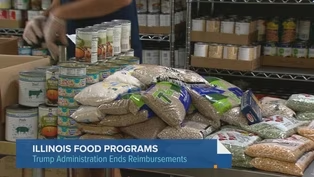
Trump Administration Ends Reimbursements for Illinois Food Programs
Video has Closed Captions
Clip: 3/6/2025 | 5m 33s | A local program aimed at improving food access is in jeopardy amid federal funding cuts. (5m 33s)
Providing Support for PBS.org
Learn Moreabout PBS online sponsorship
- News and Public Affairs

Top journalists deliver compelling original analysis of the hour's headlines.

- News and Public Affairs

FRONTLINE is investigative journalism that questions, explains and changes our world.












Support for PBS provided by:
Chicago Tonight: Latino Voices is a local public television program presented by WTTW