
Local Routes: How to Help Native Bees Thrive (Episode 701)
Season 7 Episode 1 | 23m 51sVideo has Closed Captions
Discovering the many types of bees found in our area & how to give them healthy habitat.
We explore what kinds of bees live in our area and how to create a habitat to help them grow in numbers. Plus, we preview a new documentary by PBS NATURE called "My Garden of a Thousand Bees. Available to everyone on October 14th but available to WFSU Passport Members a week early. https://wfsu.org/support/passport-activate.php
Problems playing video? | Closed Captioning Feedback
Problems playing video? | Closed Captioning Feedback
Local Routes is a local public television program presented by WFSU
Local Routes: How to Help Native Bees Thrive (Episode 701)
Season 7 Episode 1 | 23m 51sVideo has Closed Captions
We explore what kinds of bees live in our area and how to create a habitat to help them grow in numbers. Plus, we preview a new documentary by PBS NATURE called "My Garden of a Thousand Bees. Available to everyone on October 14th but available to WFSU Passport Members a week early. https://wfsu.org/support/passport-activate.php
Problems playing video? | Closed Captioning Feedback
How to Watch Local Routes
Local Routes is available to stream on pbs.org and the free PBS App, available on iPhone, Apple TV, Android TV, Android smartphones, Amazon Fire TV, Amazon Fire Tablet, Roku, Samsung Smart TV, and Vizio.
Providing Support for PBS.org
Learn Moreabout PBS online sponsorshipGulf winds blow through canopy roads all the way to Thomasville.
Native names written on the land echo through the red clay hils.
Where the scent of long leaf Florida Pine.
Reach up on past that Georgia Line.
Stroll through Tallahassee town or southern Apalachee bound, take the local routes and journey down.
The roads we call our home.
Take the local roots and journey down the roads we call our home.
Welcome to Local Routes.
I'm Suzanne Smith with WFSU Public Media.
And today, I'm standing at the edge of this wildflower area in Innovation Park in Tallahassee, not to talk about these very tall flowers but to talk about the pollinators that make them happen.
Specifically bees.
Bees are an animal that elicit a variety of responses.
For some, it's a love of the pollination they provide for the crops we eat or of the honey they make.
For others, it's a fear of being stung.
And while many of us think of the European honeybee, when we think of bees, there are actually hundreds of native species in the Florida area.
WFSU's Rob Díaz de Vegas' talked with University of Florida entomologist Dr Rachel Mallinger to learn more about these bees.
We think there is about three hundred twenty three hundred twenty five species, and that includes some that are not native.
The honeybee is not native, for example.
So of those 310 to 315 species, there's a huge variety in size and color.
Some of them are not much larger than a large ant.
Others like the carpenter bees.
Those are larger than bumblebees, larger than honeybees.
At least the large carpenter bees are.
For most people, if they're just looking in their yard, bumblebees are pretty common.
More so in the northern half of Florida, and those are the really hairy round ones.
They're like little furry round balls.
The carpenter bees are also common.
Those look a bit like bumblebees, but they're typically larger and a little less hairy, a little more metallic.
And then there's one particular Sweat bee that is really common, halicutus poeyi.
Poey's Furrow Bee is the common name, and it's a little smaller than a honeybee, black and white stripes.
That one's real common.
There's a common long-horned bee, which is in the genus Melissodes that's black, but has white hairy legs.
So really distinct color pattern.
Native bees are important to our native plants and ecosystems, but they also pollinate tomatoes and other food crops.
All we have to do is invite them into our yard.
WFSU's Rob Díaz de Villegas' talked with some local plant experts about what we need to invite those bees into our yards.
It starts with providing them some space to raise their young.
If you want to promote native bees, habitat is the most important, right?
Providing them a place to live.
The way we do that is we provide them with food, water and shelter.
Bees need flowers and also nesting habitat.
So those are those are the two things that you can provide.
The first step for creating a bee friendly yard is observation.
And so observing in natural areas like this one.
What it looks like.
What is part of the ecosystem?
More natural looking landscapes for me offer an enjoyment of life.
I get to see all these little things.
And in this connected circle of life, we're talking bee habitat.
We'll get the flowers in part two of this segment.
But before bees can visit your flowers, they need places to nest and spend the winter.
We start in the Munsen Sand Hills.
So when we are talking about creating a habitat for bees and other pollinators in our yards, the first step is observing So walking into your yard and in your neighborhood and seeing what type of habitat you already live in.
Because we're trying to recreate and reestablish the environment and ecosystems that are human disturbance has disturbed, you know.
These are the sand hills in the winter bees come from places like this.
And when we mimic how natural areas help bees in the winter, we see more bees in the spring.
It's important to remember that a lot of our native bees, when you see them, it's a short little part of their life cycle usually where they're out and about the rest of the time they're spending in the ground.
In terms of providing nesting resources, most bees nest below ground.
So thinking about having ground that's accessible and that's not heavily disturbed is good for this ground nesting bees leaving a little space where you're not going to be tilling, not going to be mowing often, not going to be walking through often.
You want to have some exposed soil in areas that have some sunlight and some exposed soil and some shade.
This can occur around your flowers as well.
Having areas of your yard that don't have a cloth or plastic barrier or a really thick barrier of mulch, you can still use pine straw like this as mulch and the insects can still move the pine straw and use utilize the area.
Pine straw is probably your best choice for mulch in your home garden because it' sustainable.
It is local and renewable resource, and it's part of the natural ecosystems here.
So you're recreating the natural ecosystem.
Also leaving the leaves.
Just leave the leaves.
It's considered brown gold and he just want a light.
Leaf litter on top of your beds.
It also creates a lot of organic matter for the soil and makes really enriches your soil.
It's not just leaves and pine needles.
It's a hard idea for a lot of us to embrace.
But bees need dead plant material in your yard, branches and dead stems like like this one.
Those are critical for nesting habitat for bees and for overwintering for bees.
What I like to do is leave your dead stalks through the winter, typically cut them back.
Late February, early March, when the new growth was just starting to emerge, our native bees will use the pithy stems from plants like Elderberry, Polkweed, even Monarda.
They tend to nest in those stems.
At home, as in the forest, some bee species also nest in decaying wood.
This is our brush pile.
It is built upon with twigs and branches of all different sizes and shapes.
This is a magical spot for native bees and other invertebrates.
Everything from skinks to mice to birds will come through the twigs and branches, offer homes for bees, solitary tunnel nesting bees.
It also offers some exposed soil at the bottom for other ground nesting bees.
Some folks may wonder, you know, how can you incorporate dead stuff into a landscape with it still looking somewhat attractive.
And so what we do here is we use actually a lot of these sticks to line our paths.
You can see our little path meanders through our little shaded garden here, and we just use the branches that fall to line it along the way.
And it's a great way to feed the microbes in the soil with this decaying would matter.
Leaving any kind of snag, if you can, is incredible for wildlife.
One of the most important trees in the forest is a dead tree.
And so, again, providing dead material in your landscape in a kind of attractive kind of way is a really good way to bring in native bees.
Other insects to try the best you can to make your landscape a living ecosystem You won't likely see your bees over the winter months, but if you leave some bare patches of ground leaves, flowers stalks and dead wood, you're much more likely to see them in the spring and summer.
For FSU, I'm Rob Diaz de Villegas.
Those two stories we just showed you are part of a special project we're working on that's tied into an upcoming documentary by PBS's Nature called My Garden of a Thousand Bees.
It airs on October 20th at eight p.m. Eastern.
Here's a preview.
In the spring of 2020, as the country goes into lockdown, outsid the garden is coming alive as a wildlife filmmaker.
I knew there were revelations here discovering the secret life of bees took me on a journey I was not expecting.
The broadcast of My Garden of a Thousand Bees kicks off months of WFSU stories and events focusing on creating habitat for the native species of bees in our area.
Learn more at WFSU dot org slash Bee Garden.
As we mentioned before, the European honeybee is not native to this area, but there is a rare colony of American bee that's found locally.
WFSU's Rob Diaz de Villegas brought us the story first back in 2019 and shows us what it takes to raise a rare species of bee.
I can't give you the date that I became interested when I was a kid, I was the kid out, you know, on the clover plants, catching the bees, watching them, even marking them when I was five, six years of age.
So it just progressed from there.
I was doing some holiday work .
I was carrying shingles to the roof for my uncle, who was a carpenter.
The owner of the house he was a bee farmer and a sked if I want to help him during those down periods.
And I said, yes.
Going into the hive a couple of times , you know, see all the bees work, everything that gets so fascinating.
Lee and Worrel have been working together to breed strong and productive honeybees.
These yard is a refuge for these non-native pollinators, as well as native bees, wasps and butterflies.
Today, we meet a new arrival here, Bombus pensylvanica.
They are native to the United States.
When you see bumblebees in your yard, they're more likely the common eastern bumblebee.
They are endangered and the habitats are being destroyed based upon urbanization and agriculture, extensive agriculture production.
I'm somewhat pleased having learned, you know, exactly what they are, that they're a bee that's at risk to be able to provide a sanctuary where they can, you know, not just live, but thrive.
The bumblebees had colonized the gourd birdhouse, similar to Purple Martin gourd's at Lake Elberta, but not all native bees form colonies apart from the honey bee which is not native.
Most of our local bees that are found here, they are somewhat solitary.
Some of that was somewhat of a plastic relationship where they would start those solitary and where they would find a one queen go and establish their nest.
And after laying those eggs will emerge the set up workers and then those workers with nurse other brood.
And then it will go into like a new social kind of setting.
So we did have coorperative brood care and overlapping generations.
Providing a home for native bees helps preserve our local biodiversity are easy non-native honeybees.
They're trying to help an economically important agricultural animal.
All right.
This is a drone right here.
So there's three castes in the hive.
You have the queen, the workers and the drone.
The drone is the male bee and the drone don't sting.
There's uncapped larvae if you wanted to see how they lay in their own way.
Breeding a bee is simple, in my opinion.
Right?
Once you've mastered the art of it, it's not really difficult.
But breeding a bee that is viable is something that's totally different.
So we're looking for a bee that's resilient.
We're looking for a bee that's hygenic.
You know what's a clean bee?
It's a bee that cares for its its colony and cares for the hive in which it's in.
My research is trying to find a ways we can improve the health of honeybees.
The collapse, i t's a combination of issues.
It's a combination of management.
It's a combination of pests.
It's a combination of improper pesticide use, monocroping in the, you know, agricultural practice.
And as I said, urbanization where habitats are being destroyed.
One pest we saw today was the small hive beetle.
They lay their eggs in honey stores where their larvae will hatch and they would, you know, passed their waste and they would cause their stored honey to become acidic.
And moisture level would increase and it would cause of bees to just abscond and leave the hive While Lee and Worrel manage their hives to best protect their bees.
They're also looking to breed a bee they can survive on its own.
We manage the colonies.
We know they're going to make it to the winter, because if we see that, you know, they're starting to run a little bit shy on their stores.
We'll supplement.
But a bee in the wild doesn't do that.
Right.
That colony would collapse.
So we're looking to build a bee that is that is capable of overwintering in and of itself.
So the genetics that we're producing here will be injected into the environment around us.
Both honeybees and our native pollinators need habitat to survive.
That habitat could be right in your yard, but I'd say about three quarters of an acre, we converted into a natural pollinator habitat, if you will.
Well, this segment is focused on bees.
It's not just the bees that we're trying to support here.
So the water feature, at first it was an esthetic thing.
But we noticed there was a lot of mosquito larvae in it.
Right.
And so mosquito larvae led me to put fish into it..
The fish were there.
Then we noticed the bees were starting to come over some, so I put some lilly pads into it.
So it's grown now.
So if persons put in more native plants in their yard, that can be a good habitat, a refuge a year out for many, many beneficial insects.. You're find a lot of different solitary native pollinators.
You find the bumble bee, you find the honey bee, you'll find other insects so that they're feeding on them..
So it's like a complete ecosystem.
For WFSU I'm Rob Diaz de Villegas.. Obviously, these are not the only pollinators out there.
In fact, scientists invite the public every year to help them learn more about the ones in our area.
It's through the great Georgia Pollinator Census.
The first one took place in 2019.
And WFSU' s Rob Diaz de Villegas was there in Thomasville when it happened And that's what.
There are many, many species of native bees and wasps and flies to house fires, only one of hundreds .
Honey bees, only one of hundreds and wasps too you there's hundreds of species of wasps.
If you have a pollinator garden or you look carefully at any blooming plant, you'll see there are all kinds of insects buzzing around them.
We are at the Cherokee Lake Pollinator Garden in Thomasville .Here citizen scientists are helping to paint a picture of pollinator health in the state of Georgia.
This is the first ever Georgia pollinator census.
It's called the great Georgia Pollinator Census.
And it was started by the University of Georgia.
And people are counting pollinators all over the state.
For science.
So what do you what do you guys like marking down specifically when you see each plant, just like how many butterflies we see, whatever sort of insects or animals that we see crawling around the tree or making a habitat out of the plant?
Then that's usually what we report.
And so far, we've seen a lot of Butterfly crystalists, a lot of caterpillars, lots of ants being out here today.
We've seen some really cool praying mantis.
Yeah, I did, actually.
It's really amazing how little so many people know about anything in nature So citizen science gets people out in nature.
So for this census today, people have learned about pollinators and learn about the groups of pollinators.
Pollinators include butterflies and moths, but also carpenter bees, bumblebees, honeybees, small bees, wasps, flies and other insects like beetles.
Beetles are a pretty common pollinator.
Pollinators need more than just flowers, each butterfly can only lay its eggs on specific plants.
Probably the one that people know the most is monarchs.
Monarchs will not lay their eggs on any plants except milkweed.
There is nothing as pretty as a monarch chrysalis.
Oh, it's just gorgeous, has gold and shiny metallic looking dots across the top of.
It is so beautiful.
Some of the house plants are non-native.
For instance, the giant swallowtail, which is our largest butterfly, it's native host plant, is a hot tree.
This one's different, but they also can use any kind of citrus plant.
And so if you have a lime or orange or satsuma or anything like that and you see a caterpillar on it that looks like bird poop, that's the giant swallowtail caterpillar.
Really beautiful butterfly.
Right here.
This vine, you see the vine with these big leaves right here.
That's the passion vine.
And that's their fruit.
And it's it's edible.
And have you ever heard of may pops down here in the south?
Kids.
Kids would take the balls and hit them, hit each other with them and they would pop.
This is the larval food of the Gulf Frittalary butterfly..
Fan tittles are a weed that will grow easily in your yard in the his checkered skipper butterflies.
I saw this one appearing to lay an egg in a flower bed in my yard.
Then during the pollinator senses, I saw this happen on a fan petal.
Some people may get upset when they see their caterpillars getting eaten.
But that's all part of the web of life.
Another thing that you'll see when you start a pollinator garden is the predator.
I'm 70 years old and I won't be around a whole lot longer, but we need so much from younger generations to get involved with these kinds of things.
But I want to encourage everybody to plant natives and to get involved with any kind of neutra activity you can like Audubon and Florida trails and Florida native plant society.
And for Georgians, Georgia native plant society.
Georgia Botanical Society for WFSU I'm Rob Diaz de Villegas You can learn more about the pollinators in our area, as well as the other creatures of the north Florida, south Georgia area by heading to our ecology blog.
That blog is just one of the ways you can learn more about the local routes of our community.
And while it often focuses on the literal roots growing out of the ground and the other ecology topics of our community, we also in this program focus on arts, culture, people and history.
Here's a preview of what's coming soon and ways you can discover more about Local Routes Coming up on WFSU public media's Local Routes, what was important to me is to let women age is so oftentimes in film and in photography, we see women, we say they look great because they look like they're 35 when they're 60 years old.
We explore the story behind the stories of a new art exhibit featuring local women of our community.
Join us October 21st at eight p.m. Eastern on WFSU Public Media.
That's it for this episode of Local Routes.
I'm Suzanne Smith.
Remember, you can see the PBS Nature documentary, My Garden of a Thousand Bees October 20th at eight p.m. Eastern right here on WFSU Public Media.
Plus, you can see all the stories in this episode on our Web site, WFSU dot org slash Local Routes And while you're there, go ahead and follow us on Facebook and Instagram.
Plus, one more thing you can do while you're online.
Sign up for our community calendar newsletter.
Delivered weekly to your email.
It's a great way to stay on top of events happening in person and in the virtual world.
For everyone at WFSU Public Media.
Thanks for watching.
Have a great week.
Magnolia Trees greet the southern breeze in the land where rivers wind.
Seeds that spring up from the past, leave us treasures yet to find.
Where are children play along the land our father's built with honest hands.
Take a moment now and look around at the paradise we have found.
Take the local routes and journey down, the roads we call our home.
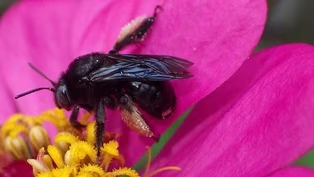
Help Nesting Bees with Dead Plants & Bare Soil
Video has Closed Captions
Clip: S7 Ep1 | 5m 59s | Creating a good winter habitat for bees, creates great pollinators for spring flowers. (5m 59s)
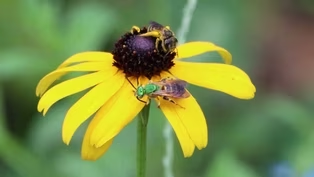
Native Bee Species of North Florida
Video has Closed Captions
Clip: S7 Ep1 | 1m 55s | Exploring the many types of North Florida bees. (1m 55s)
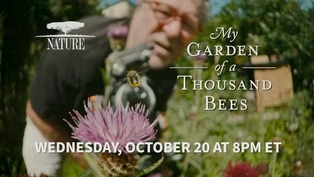
Preview: My Garden of a Thousand Bees
Video has Closed Captions
Clip: S7 Ep1 | 20s | Preview of PBS NATURE documentary airing Oct. 20 at 8pm ET on WFSU Public Media. (20s)
Providing Support for PBS.org
Learn Moreabout PBS online sponsorship












Support for PBS provided by:
Local Routes is a local public television program presented by WFSU