
Local Routes: Preserving the Future (Episode 703)
Season 7 Episode 3 | 29m 15sVideo has Closed Captions
Preserving the local environment, art, and history for the next generation.
We go on an EcoAdventure to the Apalachicola Lowlands Preserve & learn more about family of conservationists who maintain its 80 acres. Plus, we explore the Nokuse Plantation & its 300-year mission to restore native habitats. We celebrate the anniversary of the tree turned art sculpture in front of Leon County’s main library. Also, we discover more details about StoryCorps upcoming visit.
Problems playing video? | Closed Captioning Feedback
Problems playing video? | Closed Captioning Feedback
Local Routes is a local public television program presented by WFSU
Local Routes: Preserving the Future (Episode 703)
Season 7 Episode 3 | 29m 15sVideo has Closed Captions
We go on an EcoAdventure to the Apalachicola Lowlands Preserve & learn more about family of conservationists who maintain its 80 acres. Plus, we explore the Nokuse Plantation & its 300-year mission to restore native habitats. We celebrate the anniversary of the tree turned art sculpture in front of Leon County’s main library. Also, we discover more details about StoryCorps upcoming visit.
Problems playing video? | Closed Captioning Feedback
How to Watch Local Routes
Local Routes is available to stream on pbs.org and the free PBS App, available on iPhone, Apple TV, Android TV, Android smartphones, Amazon Fire TV, Amazon Fire Tablet, Roku, Samsung Smart TV, and Vizio.
Providing Support for PBS.org
Learn Moreabout PBS online sponsorship-!Gulf winds blow through canopy r -!Native names written on the land -!go through the red clay hills.
-Where the scent of long-leaf -Florida pine reach on up -to that Georgia line.
-!Stroll through Tallahassee town -to southern Apalachee bound, -take the local roads -and journey down the roads -we call our home.
-Take the local routes -and journey down roads -we call our home.
-Welcome to Local Routes.
-I'm Suzanne Smith with -WFSU Public Media.
-!And today I'm at the Leroy Colli -Leon County Public Library in T -!This is one of my favorite place -in our community.
-!I love to explore the old and ne -inside the walls of this buildi -!Coming up later in this program, -!going to show you how the librar -helping us preserve your storie -!But first, let's talk trees.
Com -!Not this tree, at least not yet, -!First, WFSU ecology producer Ro -Diaz De Villegas is going to ta -two privately owned preserves -along two iconic North Florida -first, -we start with the smaller of th -!We head out to a patch of forest -along the Apalachicola River, -!where a family of conservationis -maintain 80 acres -!full of rare and uniquely Florid -If you like North -!Florida wildflowers, you like fi -!We put a fire down here on April -and here we are -!five weeks later and I am seeing -!5,10 species of flowering plants -!And more with every week that pa -Look at that.
-Oh my gosh.
-This is called Pituopsis -Oligantha -!really responding well to this b -Oh man.
-And a rare state listed -!and central panhandle indemic -there is a blooming Chapman's -Crownbeard.
-At the Apalachicola Lowlands -Preserve.
-!Fire has opened up the landscape -for plants and animals.
-And today -we see our fair share of the pr -!the rare and the just plain cool -Well, -we're completely surrounded -by the Apalachicola -National Forest here in Liberty -!We have an 80 acre rectangle run -north to south.
-!Yeah, I love in the dirt maps li -So do I.
-!But here's a graphic for good me -!Decades ago, the Coastal Plains -bought this parcel of private p -!tucked within the National Fores -and we preserve a patch -!of the extremely biologically di -!and interesting Apalachicola low -!And we know this area to exist -between the Ochlockonee rivers -and the Apalachicola River -and south of the Cody escarpmen -!The property had been, for the m -in bad ecological shape -when CPI first acquired -this property back in 1992.
-Just about the first thing -that we did to the property was -threw out a match -!because it needed a burn big tim -!It was fire suppressed to the nt -!But look at it now, 30 years lat -!The natural condition of a longl -forest is an open savannah -where the trees are not -so densely packed together -that ample sunlight gets to the -All of these wonderful -flowering plants, herbs -!and whatnot get plenty of sunlig -Oh, look at this.
-Here is a state -listed plant species in bloom.
-This is an exciting one.
-!This is Godfrey's false dragonhe -And what a beautiful bloom -this is in a mint family.
-Oh man, look at that.
-!This is a state listed threatene -and it's endemic -!to the central panhandle of Flor -!This is the yellow pitcher plant -sarracenia -!flava variety rugelii.
Look at t -I love that red patch.
-That's so cool.
-These are music flat woods -with understory plants -adapted to fire from bloom, -but they can survive wet condit -!There are also wetland areas her -with their own flora and fauna.
-Let's go back to the map.
-one of the most prominent -features of our property -is this beautiful Blackwater -Creek over there behind you.
-!That flows across the northwest -of the CPI preserve.
-!And then it makes a big arc to t -comes out and it comes all the -!back to our property and barely -the southwest corner like that, -!then continues to flow south its -and on eventually into the migh -Apalachicola River.
-I am now here in the -middle of a massive woods, -!we have a stink depression wetla -!But, you know, as I'm talking -right now, -looking down into this ephemera -and having a dreamy feeling, -I spot a cottonmouth -about 30 feet away.
-This is our prize -to keep it afloat -and and it was brought forth to -!once again after the proper appl -of ecological fire.
-I'm going to take you down -to see one of the rarest -plants out here -in this whole Apalachicola lowl -!Shining yellow in the sunlight o -by the edge of the swamp.
-So there you go.
-If you look at -!the seepage slope is full of not -plants and animals.
-Oh, and the little oak down -here, they're reminded that -!this is North America's smallest -!Well, we've already had a look a -America's smallest toad.
-!But now what I'm holding is Nort -America's smallest frog.
-This is called.
-Grass frog.
-Very aptly.
-!Osceola's plume, this one's whit -but as the flower ages, -it eventually turns pink and th -Look at this.
-!This is one of the genus calopog -pale grass pink.
-!For Ryan means the Apalachicola -preserved -!is more than the many rare plant -and animal species found here.
-!This is a place formed by family -!I'm part of a family of conserva -!You know, it started with my mot -!and my father, my father, Bruce, -being his son has afforded me -the ability to grow up to be -an effective conservationist.
-My brother, Harley, -we do a great deal of work out -!on this property to get my broth -Tammy Cameron and Chandler, my -!In addition to Harley and me, it -also my wife, Rebecca.
-She is my colleague.
-!We lead the Coastal Plains Insti -together.
-It's wonderful -working with your partner like -And my daughter, Skylar, -my daughter, Skyler, -she's been out here with me -more times than we can possibly -It is a wonderful privilege -being part of the means family -tradition of conservation.
-!For WFSU, I'm Rob Diaz de Villeg -!The Nokuse plantation is a lot -larger preserved than the one w -!Everything about it is big, incl -its 300 year restoration missio -!Rob joins a biologist and his do -to explore some of the highligh -Here we -have a little yellow bellied sl -!Oh, and a fantastic leech on its -That leech -They call this man Turtle -!Bob Walker.
This is a beauty, re -!This is, in fact, the only turtl -we see today as Bob and his dog -!Show us around Nokuse plantation -!The plantation is a 55,000 acre -restoration -!project purchased by businessman -Davis, starting in 2000.
-Davis had a 300 year plan -that would end with mature -long leaf forests grown over -several lifetimes.
-Today, -we'll see some of what's been a -!over the first couple of decades -!And we have something really gre -!Here we have a gopher tortoise b -!This tortoise is about about thi -which means that it's about a s -It's not even adult yet.
-!We haven't seen any adult burrow -What we've seen is subadult.
-!And then that juvenile, which is -Years ago, Lugosi Plantation -!relocated adult gopher tortoises -to this restored sandhill habit -!But we're not finding any active -adult burrows.
-!They're very difficult to reloca -if they're not in that perfect -they want to be.
-They will leave -and they'll find another area.
-And in this case, -they laid eggs before they left -and the coyotes -or the raccoons did not find th -!And we had some actual success w -regeneration of the tortoises h -And here is an area that has -that huckleberry.
-I see a couple of blue.
-!one prescribed fire opens up the -understory for tortoises and th -When we burn this, -the wire grass starts coming up -!almost within the next couple of -!And the tortoises need food stil -wire grass is important to the -!This is one of our legumes for l -which is a milk pea -This is a very important leaf -especially young gopher tortois -!Because that leaf is so tender -gopher apple, -!it will produce a small, whitish -about the size of a grape, -and the gopher tortoises -just absolutely love it.
-Here we have a little back.
-cinneum -!Fire also opens up the understor -for pollinator plants.
-Some provide nectar.
-!Others provide larval food for b -such as the zebra -swallowtail and the monarch.
-!So we can see that an open under -benefits plant in animal divers -But it also allows water -to pass through the sand, -!where it becomes a source for St -!Those just happened to be our ne -All right.
-Run down and.
-!Steepheads form in deep Sandhill -along rivers -carved by the water -that collects beneath them.
-This is a recent fall.
-You would just think -!there would be lots of frogs in -!Snakes in here feeding on the fr -And yet -you don't see -they're here -have alive.
-There was a deer down here, -at least at one time.
-There's a shed deer antler -It's a nice one.
-It's a good one.
-Yeah.
8 pointer.
-He probably wants it.
-You want to -take it.
-It's all yours, Al.
-between the cool, fast, flowing -one shaded canopy -and the narrowness of the ravin -Steep heads are a different -kind of Florida landscape, -!and they're a haven for reptiles -and amphibians.
-!Animals good at hiding in the mu -What a perfect place -!for a cotton mouth just to hang -you know?
-I mean, it really is.
-!It's just so beautiful in here.
-It's just incredible.
And.
-!They have decided to hide, altho -he hasn't even gotten here.
-!You wonder how old is this steep -How many years, -how many millennia does it take -!steephead to grow by a quarter m -by 100 feet or whatever, you kn -Ready, go.
-The same cool groundwater -!that seeps out and forms ravines -another type of habitat here.
-This is a seepage area -where generally it's -at least moist right now -during our drought.
-!Just complete different type of -and soil is still a little mois -even though it's still it's -relatively dry.
-!And because of it being a seepag -!we have these different plants l -!sarracinia here, which is one o -pitcher plants -.
It's really amazing -how the pitcher plants are grow -!and they're not growing on big c -together, they're just spread o -is just as far as you can see -and probably on, -!I don't know, maybe 100 acres he -!And so they have adapted to fire -and without fire, as you can se -!right here, you know, the tai ta -and the different plants will s -!crowding out the pitcher plants -and they need that open sun.
-So when we burn it, -it will burn through it -!and it'll open it up for these p -plants, they rely on fire.
-Most of -Nokuse Plantation -is not open to the public, howe -!You can hike about 27 miles of t -Trail in the property, -!where you can see long live rest -in several stages.
-!Nokuse also operates the E.O.
-!Wilson Biophilia Center where Tu -Bob can teach you -about our native north wildlife -!For WFSU, I'm Rob Diaz de Ville -We've seen a lot of ecosystem -types in just a couple of locat -!and we have many more online.
-!For more stories on Long leaf -forests, steephead ravines -and carnivorous plants.
-!Visit WFSU.org slash ecology blo -Along with those ecosystems, -we've learned a lot -about trees over the years -Tupelo Oak Long Leaf Pine.
-!But five years ago was the first -we brought you the roots of thi -Here's a -!look back at a story from 2016 -where WFSU's Mike -!Plummer showed us how this anteb -turned into an art sculpture.
-!Where do old trees, books and ki -all come together -at the Leroy Collins -Public Library late last year?
-!The facilities management and pu -!in the arborist decided that thi -was really endangering -the people around it -because it was to the point -where we were afraid -it would start dropping limbs o -and it was diseased enough.
-The decision was made -that it had to be taken down.
-!That's library director Cay Home -talking about the grand old ant -!oak that once shaded the front o -Tallahassee.
-!Collins Library Today, its remna -stand as a tribute -to childhood in the written wor -!Tell me about the idea to have -you have drawn to a sculpture w -Where did that come from?
-That emanated out of thinking -about what we could do with the -!and what we could do with the tr -And we know that tree -sculpture is popular here in Le -!and we just thought it would be -to memorialize the tree -!because we knew there would be e -in the trunk to be able to do s -!After chainsaw artist John Birch -I was called by the library.
-!They were told it had to come do -!It turned out it was very rotten -and they hated losing the tree.
-They knew -a lot of people would be upset -!So they called me up and they as -if I could do carving out of it -!We all talked about it and we wa -want it to be something that de -!with children and reading and wa -oriented, commission accepted.
-John got to work, -but transforming the frail -old oak into public art -would prove to be a challenging -!So I knew I had a very hollow tr -!I knew that there was a lot of w -Probably about ten -tons of that tree was still the -!I knew I had to get rid of that -because if I carved that hole o -!I didn't want the tree to fall o -!So I figured one way to remove -all the weight is just cut -all the layer off, -which is the wet wood of the tr -!So I got up on the scaffolding.
-I just cut and cut and cut.
-And when I finally removed -the whole outside of the tree, -!then I went and cut into the tre -where the rot spot was shown.
-And I wanted to cry.
-John started -on his chainsaw creation in Feb -!and like many creative efforts, -it didn't always go -as planned.
-That's a lot of non -!tree right in the center of the -of this tree.
-Yes, and I was worried about -the structure, the strength of -!But the only part that I really -!was this section here and a litt -all the way around it.
-!But when you consider, you know, -100 tons of branches blowing in -I figured -!this was still going to be stron -to just support the carving its -Sure, my ideas -certainly changed as I was carv -!I was going to make the sides of -!into a large book that was, you -three and a half feet tall.
-!But again, I was worried about -removing strength from it.
-And so I -came up with the idea -of having that little bookshelf -!But that is carved from that tre -!And I did not need to go deep on -!So I wasn't worried about the st -The wood, -the planks that are used for th -!I went and I cut those from the -that were -that were available to me.
-So that was put back up.
-!But again, it was cut from that -!The only piece of wood that is n -that tree is the girl.
-!I needed a solid piece of wood.
-!And there was nothing around.
-It would work.
-When I decide -!to change where I'm putting thin -I use a different color chart.
-I want to extend her leg -a little bit further down, -!mainly so that I can put her foo -a little further back.
-I have six sisters.
-!They're very impressive girls, w -!and I thought it would be cute -to have a girl up there -that built the tree.
-Yeah.
-!And she's that girl is important -cause she's the one.
-!She's the constructor of the tre -for the story.
-OK, that is true.
-!But she has a hammer and a nail -She's got a book in.
-The book is telling her -how to build tree forts.
-That boy is actually carved.
-!He's actually part of the truth -in the natural tree.
Yes.
-He's the one that -there was a lot of rot in.
-And also these big cracks.
-So it took a lot of work -to figure out how to put everyt -The carving -took about four and a half mont -!I was expecting two to three mon -It needed to be done -because I had to carve the girl -!I had to cut the tree fort piece -That was not intended.
-I added a lot of things.
-!But again, they changed as I was -so I'd be carving.
-!I knew what I was going to do.
-And all of a sudden, oh, -it would look better this way.
-!So it almost always added more t -If your happy and you know,,, -shout hurray.
Hurray!
-in September, -the county held a dedication to -!the transformation of the Grand -into an opus to reading and chi -!front and center at the Leroy Co -Public Library.
-For WFSU, -I'm Mike Plummer.
-!It's hard to believe that tree w -5 years ago.
-!More recently, WFSU has been wor -with the Leroy Collins Leon Cou -!Public Library on a new project -coming to Tallahassee.
-!It's the StoryCorps mobile tour.
-!Here's a look behind the scenes.
-The StoryCorps -!mobile tour is heading to Tallah -to record our community's local -!and those conversations will tak -!on the second floor of the Leroy -Leon County Public Library.
-!But before their bus gets here, -a lot has to be done, -!especially because of the COVID -In September, -the tour's advance team headed -and to the Leroy Collins -Leon County Library to talk det -We sat down with STORYCORPS -!associate director Danielle Ande -to learn more about how it all -!You know, that's should be an ea -question, but so we're a nonpro -!We've been around since 2003.
-Basically, what we do is -!we try to give people the opport -to record some of their persona -!And we do that in conversation -so people can invite a friend -!or a loved one, a colleague, a n -whomever they want to share a c -with their 40 minutes of time -to talk about anything they lik -We record it.
-We archive it for them -at the Library of Congress.
-If they give us permission to -and then also with their permis -we might share it -!so that other people can listen -and learn from the experiences -of other people.
-So StoryCorps -is founded by a man named Dave -who is a radio reporter, -and he was trying to do a story -!on a housing complex in Chicago, -!and he was having trouble gettin -people that lived there to talk -They didn't know him, -!like, who is this guy with a mic -asking me questions?
-I don't.
I don't.
-I don't want to talk to you.
-!So what he did was he gave a mic -to two young boys.
-!He he said, Hey, go interview yo -interview your grandparents, in -!your parents, interview your nei -about what it's like to live he -And they did.
-Then when you got the tapes -back, you realized -they don't you?
-People don't need, you know, -they didn't need him to tell th -They knew how to do it.
-!And not only that, the connectio -that familiarity between those -created conversations -that he would not have been abl -We started with a small booth -in New York City -!and basically it was just like, -Is this going to work like, -!we're going to invite people her -Are they going to come -or are they going to talk about -!Once we realized that it worked, -that people were enjoying the e -and that it was valuable.
-We realized -we needed to get it out into th -!We custom built an Airstream tra -with a recording studio in the -and we decided we'd partnered -with ten public radio stations -And in doing so, -bring that that that trailer, t -!recording experience to their li -audiences, to their communities -And so it's been since 2005.
-We've been doing just that.
-We've worked -with over 150 stations around t -!I think it's incredibly vibrant.
-!You know, people come for school -they stick around, -they just do interesting things -!It's just a community that keeps -It's very dynamic -and we've never been here.
-!So it's actually changed quite a -!So in March of 2020, like lots -of organizations like every per -!we had to make some really hard -and some pretty, pretty severe -So we took a month -and we developed StoryCorps.
-In partnership with Vonage.
-!We developed an online platform -where we could mirror -!the in-person recording experien -so it still facilitated.
-!There's still a StoryCorps perso -!They're walking you through the -we still archived -at the Library of Congress, -and the mobile tours -kept visiting places .
-!We were just visiting them virtu -!We took our tours back on the ro -So we are currently back -recording in person -!with people, and we'll be doing -obviously until we get to Talla -But we're doing it -a little bit differently, like -!So unfortunately, we won't be re -in the mobile booth itself.
-It's just too small.
-!It doesn't allow for the distanc -that we need to ensure safety.
-!So we're recording in different -and we're -also still giving people that o -So when people -go to make an appointment with -they can decide -if they want to come record -in person with us, -or they can decide to record vi -!so they can make that decision -for themselves.
-The virtual platform runs -the way we've been running it i -runs pretty much the same, -!except we are requiring people -to be masked during their recor -!and we are socially distancing t -from our staff.
-!We have a number of resources, -so we have pages and pages -of sample questions -that people can pick and pull f -!ended questions, you know, kind -different topics and themes.
-!So if you are bringing in your g -!and you want to learn about his -we have questions for that.
-We want people that want -!to come and share their story wi -to come and share their story w -!But also, if you're not a storyt -and you want to tell yours, -!think of somebody in your life -that you may want to know more -!Bring them in an interview that, -honor them with that act of lis -and asking questions.
-!You know, like anything we recor -you, you'll get a copy back.
-!So what might what conversation, -want to listen back to 20 years -I was I always -kind of think or joke.
-!I don't know whatever it is, but -do recordings with my grandpare -!I don't know what my great grand -sounded like.
-!I have no idea what their voices -sounded like.
-I could have a tape of them -reciting the alphabet, -!and I'd be thrilled, you know, -and you're going to be that per -for somebody someday, -you know, -!or that person in your life is g -that person for somebody else s -!And we're just an easy opportuni -to get some of that -!down, you know, so take advantag -if you have any inclination.
-!Come share some of your stories -when STORYCORPS Mobile Tours -comes to the Leroy Collins -Public Library in Tallahassee -November 18 through December 20 -!Reservations to record open on N -third at 10:00 a.m.. -Visit WFSU.org to sign up.
-!That's it for this episode of Lo -!I'm Suzanne Smith with WFSU Publ -You can see these stories -and more on our website.
-!WFMU dot org slash local roots -and while you're online.
-!Follow us on Facebook and Instag -!Plus, sign up for our Community -newsletter delivered weekly to -!It's a great way to stay on top -happening in person -and in the virtual world.
-For everyone at WFSU Public Med -Thanks for watching.
-Have a great week, everyone.
-Magnolia Trees greet -!the southern breeze in the land -where rivers wind.
-Seeds that spring -up from the past -!leave us treasures yet to find .
-Where our children -!play along the land our fathers -built with honest hands.
-!Take a moment now, look around -!at the paradise we have found.
-Take the local routes and -journey down -the roads we call our home.
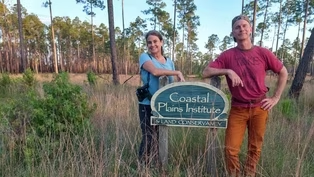
Apalachicola Lowlands Preserve: A Family’s Labor of Love
Video has Closed Captions
Clip: S7 Ep3 | 7m 3s | One family works to preserve an area of rare and uniquely Florida plants. (7m 3s)

How StoryCorps Mobile Tour Works
Video has Closed Captions
Clip: S7 Ep3 | 5m 53s | StoryCorps Mobile tour is coming to Tallahassee Nov 18-Dec. 20, 2021. (5m 53s)
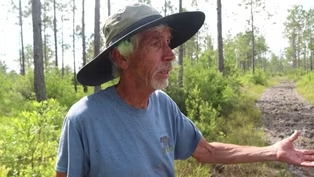
Nokuse Plantation & its 300 Year Mission
Video has Closed Captions
Clip: S7 Ep3 | 6m 46s | “Turtle” Bob Walker & his dog Al lead us through longleaf forests and a steephead ravine. (6m 46s)
Providing Support for PBS.org
Learn Moreabout PBS online sponsorship












Support for PBS provided by:
Local Routes is a local public television program presented by WFSU