State of Affairs with Steve Adubato
Long-Standing Segregation in NJ Public Schools
Clip: Season 7 Episode 21 | 8m 27sVideo has Closed Captions
Long-Standing Segregation in NJ Public Schools
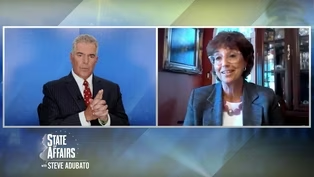
Steve Adubato is joined by Dale Caldwell, Ed.D., President of Centenary University, to discuss the long-standing issue of segregation in New Jersey schools.
Problems playing video? | Closed Captioning Feedback
Problems playing video? | Closed Captioning Feedback
State of Affairs with Steve Adubato is a local public television program presented by NJ PBS
State of Affairs with Steve Adubato
Long-Standing Segregation in NJ Public Schools
Clip: Season 7 Episode 21 | 8m 27sVideo has Closed Captions
Steve Adubato is joined by Dale Caldwell, Ed.D., President of Centenary University, to discuss the long-standing issue of segregation in New Jersey schools.
Problems playing video? | Closed Captioning Feedback
How to Watch State of Affairs with Steve Adubato
State of Affairs with Steve Adubato is available to stream on pbs.org and the free PBS App, available on iPhone, Apple TV, Android TV, Android smartphones, Amazon Fire TV, Amazon Fire Tablet, Roku, Samsung Smart TV, and Vizio.
Providing Support for PBS.org
Learn Moreabout PBS online sponsorship[INSPRATIONAL MUSIC STING] - Once again, we're joined by our good friend and colleague, Dr. Dale Caldwell President of Centenary University.
Dale, good to see you.
- Good to be here.
Good to see you, Steve.
- Last time we were having a conversation about how segregated New Jersey schools are, which has all kinds of ramifications.
You're also not only the President of Centenary but also highly involved in New Brunswick as a leader in the educational community, Board of Education.
and our daughter's in public middle school here in Montclair, and it's pretty integrated.
Montclair is one of the most integrated school systems in the nation, partly because they have magnet schools, partly because there's busing.
But then high school happens, my friend.
- Right.
- And I see all sorts of decisions being made.
We have to make a decision in that regard.
Do you move away from the public school system and go to a private school or whatever?
People can go to another town.
It's a long way of asking, do many New Jerseyans, and Americans, but particularly in New Jersey, the sixth most segregated schools in the nation, do we choose to segregate ourselves and our children, particularly in high school?
- Well, Steve, I really think, and my dad knew and marched with Dr. King, so I'm obsessed about poverty.
And the issue really is more around poverty than race.
And that people look at school systems where they have high free and reduced lunch and they say, "Well I don't want my student, my kid in that school system because there are a lot of poor people there."
And so we have that segregation instead of really integrating and realizing that regardless of your income, there's some brilliant students who come from very little means.
And the world is becoming more diverse.
So by going to diverse schools, you're preparing your students for the realities of the world.
- How much of it is fear?
- A lot of it is fear.
A lot of it is the fear of the unknown.
- Talk about that.
- Yeah, the reality is that change, we grow up in these segregated school systems so we're comfortable with people just like us.
And we also, if you look at the stereotypes of social media and other things, this group is that way and that group is this way, and it starts to feed into these stereotypes.
So they look at kids in New Brunswick as being a certain way, even though it's not true.
Then look at kids in the suburbs- - Hold on.
- And it's a stereotype.
- I'm sorry to interrupt.
- Yeah.
- Sorry for interrupting.
You talked about East Brunswick as the neighboring town, right?
I believe you said- - Yes, yes.
- 80% of their students are white.
95% of your students are Black and Hispanic.
- Yeah.
- So say for argument's sake, there are, I believe, close to 600 public school districts in the nation.
Excuse me, in the state, 600 public school systems.
Some of the towns are too small to have an actual school system.
One superintendent, principal of the high school, its own middle school, administrators, teachers, the cost is astronomic.
So while people complain about taxes, trust me, there's a question here.
They complain about property taxes, school cost being one of the biggest, right?
- Yeah.
- Costs in driving up property taxes.
So let's merge New Brunswick with East Brunswick.
You have a combined school district, only one superintendent, one high school.
Look at how we could cut the cost and potentially cut your taxes, which everyone says is such a big issue.
Tell us, please, Doctor, what would happen if that proposal went out public?
What do you think the discussion would be like?
- Well, the discussion is about jobs.
The discussion is about employment.
What a lot of people don't realize, and I'm also president of the Educational Services Commission of New Jersey, which is the largest shared service program in the state.
And the reality is that people, it's about jobs.
You know, we've tried to merge and do cooperative busing and other things, and people's brother is hired by the busing company.
And there's a lot of politics that goes into this breakdown.
- But nothing to do with race?
- We've gotta stop.
- Yeah, I got the jobs thing.
Trust me, turf, Home Rule, all that.
New Jersey is a Home Rule state.
My town, my high school, our football team, our police department, our fire department.
Listen, I live in Montclair.
We combine... Years back when they wanted to combine the fire departments between Montclair and Glen Ridge 'cause Glen Ridge is a small town, right?
No, we can't have!
But Glen Ridge couldn't afford to have their own.
All these years later, somehow it seems to work really well.
- Exactly.
- Question.
You haven't mentioned race.
- Mm-hmm.
- As a factor and fear around parents say in, and this is no...
I'm not being critical of parents in East Brunswick, but a lot of parents, a fair number of parents, whether they would say publicly or not, are afraid of having their kids integrated with African American kids who come from New Brunswick.
Am I exaggerating that concern?
- It's a fear of the unknown.
I mean, it's a fear of the unknown.
And so one of the things that I've really, and I'm the first African American President of Centenary University, and I'm really letting people know that an African American, I grew up in Harlem, but I went to private schools, you know, is no different than anybody else.
And that's part of what, you know, one of the things we're doing is called intercultural competence.
And we haven't taught that in school.
And so we, colleges have to do that to educate people that it doesn't matter what you look like.
You all bleed the same blood.
- Hm.
- You're focused on the same stuff, but people have these stereotypes.
- You hopeful, Dale?
- I'm very hopeful.
I'm very hopeful - Because?
- Because I believe in the good of humanity, and I've seen it with me.
There are people, you don't know how many people say, "Dale you play, a Black guy plays tennis?"
You know, a Black guy does, he went to Princeton, a Black guy.
And it's not racist.
It's the fact that they've never interacted with a Black guy that went to an Ivy League school.
And so I don't look down.
I say, "Hey, it's my job to educate people."
And if we do more of that, we'll have more integration.
We'll have a better country.
- Where's your grit come from?
- My dad, and I feel blessed, Steve, as I know you do too.
I feel that, you know, but for the grace of God, I'd be homeless on the street.
So I have a responsibility to kind of give back and try to, and that keeps me going.
That keeps me energized.
If I was focused on money and a nice house and a nice car, I'd be depressed.
(laughs) - And, you know, let me also say this.
Back in the day.
I hate when people say back in the day, but it is back in the day, my late dad, Steve Adubato Sr. who- - Great guy.
- Dale knew very well when Dale was in state government at the time.
- Mm-hmm.
- And my dad was building charter schools and a community center.
I would be remiss if I did not say that Dr. Dale Caldwell was incredibly helpful to The North Ward Center, the organization my dad founded, and the Robert Treat Academy, the charter school that he founded in Newark as well.
I don't know why.
I just remember- - He was a great man, a great man.
He's missed.
- He is.
Hey Dale, we'll continue the conversation about the future of higher education on the previous episode.
Trust me, this "New York Times Magazine" about university life and the future of higher education is one thing.
Talking about why our schools are so incredibly segregated, the sixth most segregated schools in the nation when we're not all that, well, we're diverse as a state, but not the way kids go to school.
Complex stuff.
Hey Dale, thank you, my friend.
We'll talk soon.
- Thank you.
Thank you so very much.
- Thank you Doctor, see you next time.
- [Narrator] State of Affairs with Steve Adubato Is a production of the Caucus Educational Corporation.
Funding has been provided by Holy Name.
The Turrell Fund, supporting Reimagine Childcare.
Johnson & Johnson.
New Jersey Sharing Network.
Horizon Blue Cross Blue Shield of New Jersey.
The Healthcare Foundation of New Jersey.
PSEG Foundation.
Operating Engineers, Local 825.
And by The New Jersey Economic Development Authority.
Promotional support provided by Northjersey.com and Local IQ.
And by New Jersey Globe.
- At the Turrell Fund, We know childcare creates transformative early learning experiences for young children, and helps families succeed.
Childcare is essential for the economy, driving financial growth and sustainability across all sectors.
The Turrell Fund envisions a New Jersey in which every infant and toddler has access to high quality, affordable childcare In order to grow, develop and thrive.
Our children are our future.
For more information, visit TurrellFund.org.
The Childcare Cliff and the Funding That is Needed
Video has Closed Captions
Clip: S7 Ep21 | 9m 33s | The Childcare Cliff and the Funding That is Needed (9m 33s)
Should Schools Notify Parents of a Child's Gender Identity?
Video has Closed Captions
Clip: S7 Ep21 | 9m 29s | Should Schools Notify Parents of a Child's Gender Identity? (9m 29s)
Providing Support for PBS.org
Learn Moreabout PBS online sponsorship
- News and Public Affairs

Top journalists deliver compelling original analysis of the hour's headlines.

- News and Public Affairs

FRONTLINE is investigative journalism that questions, explains and changes our world.












Support for PBS provided by:
State of Affairs with Steve Adubato is a local public television program presented by NJ PBS