
Looking Toward the 2026 Legislative Session in Utah
Season 10 Episode 17 | 27m 2sVideo has Closed Captions
Elected officials decide to face challengers or step aside, and major legislative issues emerge.
As the candidate filing deadline for the 2026 elections closes, some elected officials gear up to face challengers while others decide not to seek reelection. The major issues of the 2026 Utah legislative session emerge including water usage for AI data centers, homelessness, and childhood literacy.
Problems playing video? | Closed Captioning Feedback
Problems playing video? | Closed Captioning Feedback
The Hinckley Report is a local public television program presented by PBS Utah
Funding for The Hinckley Report is made possible in part by Cleone Peterson Eccles Endowment Fund, AARP Utah, and Merit Medical.
Looking Toward the 2026 Legislative Session in Utah
Season 10 Episode 17 | 27m 2sVideo has Closed Captions
As the candidate filing deadline for the 2026 elections closes, some elected officials gear up to face challengers while others decide not to seek reelection. The major issues of the 2026 Utah legislative session emerge including water usage for AI data centers, homelessness, and childhood literacy.
Problems playing video? | Closed Captioning Feedback
How to Watch The Hinckley Report
The Hinckley Report is available to stream on pbs.org and the free PBS App, available on iPhone, Apple TV, Android TV, Android smartphones, Amazon Fire TV, Amazon Fire Tablet, Roku, Samsung Smart TV, and Vizio.
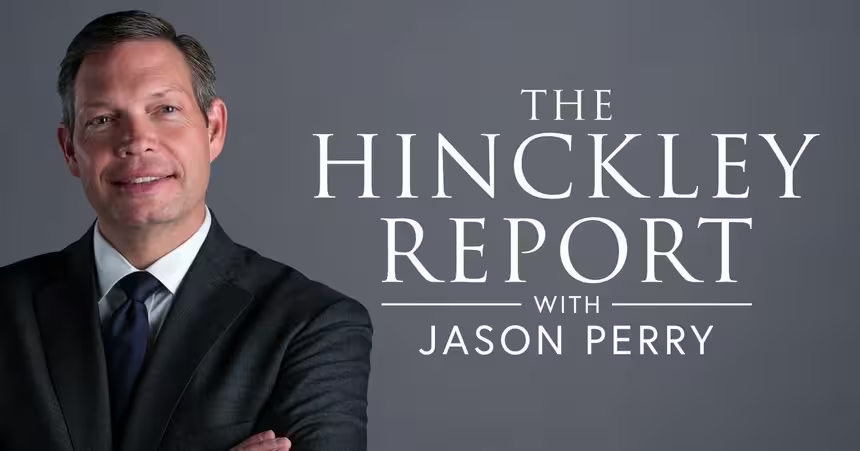
The Hinckley Report
Hosted by Jason Perry, each week’s guests feature Utah’s top journalists, lawmakers and policy experts.Providing Support for PBS.org
Learn Moreabout PBS online sponsorshipJason Perry: On this episode of "The Hinckley Report."
As the candidate filing deadline closes, some elected officials gear up for challengers, while others choose to step aside.
The major issues of the 2026 legislative session begin to emerge.
And changes in US foreign policy signal significant global implications.
male announcer: Funding for "The Hinckley Report" is made possible in part by the Cleone Peterson Eccles Endowment Fund, and by donations to "PBS Utah" from viewers like you.
Thank you.
♪♪♪ ♪♪♪ Jason Perry: Hello, and welcome to "The Hinckley Report."
I'm Jason Perry, Director of the Hinckley Institute of Politics.
Covering the week, we have Sean Higgins, politics reporter at KUER; McKenzie Romero, editor of "Utah News Dispatch;" and Marty Carpenter, partner at Northbound Strategy.
Thank you for being with us.
The holidays are over.
Legislative session is about to start, so interesting.
Also, this is the time when we find out who's running for office.
So interesting this happens right before the legislative session starts, and I want to get into that issue.
Sean, if we can start with you on this.
This happened in 2022.
It used to be if you were going to run for office, you would wait until after the legislative session.
It's had its own set of calculations, but now it's before the legislative session, except with one exception this year, talk about that.
Sean Higgins: Yeah, the one exception is if you are trying to run for Congress, you now have until March to decide on that.
That is largely because of the broader fight over redistricting here in Utah.
Obviously, the Republican legislature pretty upset about the situation right now, having one very Democratic district centered in northern Salt Lake County.
And I think, really, the effort to bump this filing deadline back is to make sure the appeals process of this whole saga is brought to as much of a conclusion as can be before the absolute last minute, before these candidates need to decide whether they're going to run or not.
And I think the interesting part here is we have four Republican congresspeople right now.
One of them will probably be out of a job come November with the way this first district is shaping up, and the partisan divide there.
Jason Perry: Well, it's so interesting, McKenzie, yes, you've got the congressional part, but I want to get to the local part, because we say the first congressional district, if that map stands, we'll talk about that in just a moment, it does have a corresponding impact on the candidates that are in that district, the Republicans as well that are in that district.
McKenzie Romero: Yeah, exactly.
If this first congressional district really energizes Democrats, and based on how wide the pack is getting to run as a Democrat in CD1, what's that going to do when those Democrats go to the ballot to vote for our legislators also?
Jason Perry: Yeah, it's going to be an interesting dynamic, Marty.
Marty Carpenter: Also the possibility, they think, "Hey, this is set up so well for us.
We don't actually need to get out and vote," and so it could actually go the other way.
At this point, there's so many variables.
It's hard to even predict and try to figure out what's going to happen.
I would say this, as far as candidates deciding whether or not they're going to run for legislative seats, very few of those decisions are actually made late.
They're made early.
They're just announced at some point, or they become official because you have to either go declare or not.
But if you're going to win, and you're going to go really run a competitive race, you really have to have your ducks in a row by this point, not another month down the road, or three months down the road in the congressional cases.
Jason Perry: Marty, you've worked with candidates that have been on both sides of this filing deadline in the past, I know.
How does it change a mindset, approach, or even maybe even the kind of bills that get presented if you are waiting to announce or you're announcing right before?
Marty Carpenter: Yeah, I suppose if you're in the legislature and you know that you're not going to run, it gives you a little sense of freedom.
Otherwise, if you're going to run, yeah, I think it does factor into some of the decisions you make.
"Where am I positioning myself on the issues that are going to matter when it comes to my race?"
Now, a lot of times I think we overcomplicate that.
And if you're running for a Utah House seat or even a Utah Senate seat, there may be one or two things that are actually going to give you enough movement within your voting bloc that it would make a difference.
So I don't think it changes everything, but maybe in a few calculated ways you say, "Hey, I'm gonna run.
I'm gonna be real supportive and vocal of that tax cut right now," right?
"I'm going to be very much on the 80% side of this issue, knowing that that's going to help me going into the actual election season."
Jason Perry: So we do know outside of the congressional district.
We'll see who maybe doesn't get on that that's currently a member of Congress.
But what I want to talk about now is the candidates themselves.
Can you give us a couple of interesting races you're watching?
Maybe, Sean, start with the one I'm watching, the closest to get the Speaker, I mean the president of the Senate, Stuart Adams.
Sean Higgins: Yeah, Stuart Adams has, I think, three Republican challengers right now.
I don't think he's ever faced a serious challenge in his entire electoral career.
And I think, really, when you look at the not just Stuart Adams race, but broadly who is challenging some of these more prominent Republican lawmakers, they're not just nobodies.
They're people who have political chops in one way or another.
So I think that's really going to present an interesting dynamic as we get toward the convention season and then the primary season after that, who's gonna be actually taking this seriously and gathering signatures, because that is really the way to get on the primary ballot right now, if you really want to have a competitive primary.
So I think it really speaks to the broader moment in Utah politics right now.
Obviously, Stuart Adams got caught up in some controversy over maybe some, his influencing legislation that benefited a family member.
Other things that have happened in the legislature, certainly with some other candidates as well.
So I really think it speaks not necessarily to Stuart Adams as a legislator, but maybe just the current moment in Utah politics.
Jason Perry: McKenzie, any races you're watching?
McKenzie Romero: We'll be really curious to see how the primary challenge for Representative Jordan Teuscher goes, being challenged by the president of the Fraternal Order of Police, just after he ran his unpopular collective bargaining restriction bill.
So, what does this primary say about how Republicans really felt about that collective bargaining bill?
We're going to find out in this primary.
Jason Perry: I guess we will.
Marty Carpenter: I think that's a really interesting one as well.
The one thing I would say about President Adams's race for re-election there, he's, as you mentioned, he's never had a challenger before.
That's the best scenario.
The second best is to have three plus challengers because they're going to end up splitting some of that vote against him.
And ultimately, he still has name ID that's in his favor within his district, as well as the fact that there are a number of voters who are going to say, "You know what's really good for my home district here, my home Senate district?
Having the Senate president be from here."
Jason Perry: Yeah, absolutely right.
Let's talk about a couple of factors that are playing here.
As of last count, it's over a dozen, maybe up to 16 current members of our legislature are not going to be running again.
That is a pretty significant number.
The average amount of time that someone is in the Senate and someone is in a House seat has been going down.
I'd love to just hear what your thoughts are about.
Let's start with you, because I know you have some thoughts about this, Marty, too.
Why is this happening?
Why are so many people exiting?
And they are from all sides of the spectrum inside the parties.
Marty Carpenter: I'm always more surprised that so many people want these jobs than I am that somebody wants to get rid of this job, because it is the most full-time or full-time plus part-time job in the entire state.
Like, these are actually very rigorous jobs with a lot of important decisions, a lot of data to process, a lot of ideas to understand, a lot of perspectives to understand, and a lot of politics to manage.
So, they're really tough jobs.
It doesn't surprise me so much that people are saying, "Hey, this was a great experience.
I've done this for two terms, three terms, one term, and now I'm gonna step aside."
You're almost going to see, I think, a little bit of a bifurcation there, that some people are going to stay in and stay in a long time.
And we're seeing people stay in leadership positions a little bit longer, especially at the top in the legislature, and maybe some people who are just in one or two terms and then gone.
And there's gonna kind of be an erosion of the middle class there.
Sean Higgins: I think what really stood out to me was just the names that are going to be stepping down for one reason or another, some very prominent names.
Karianne Lisonbee comes to mind, who has really made a name for herself in the Republican caucus, was in leadership for a while.
She made a run for majority leader, did not get that.
But I think Tyler Clancy as well.
He's moving on to be state homeless coordinator, so not retiring from politics per se, but retiring from the legislature.
Carol Spackman Moss is the longest serving woman in the legislature, a Democrat, so that one's maybe not surprising, but just a prominent face.
More prominent faces this year than in past sessions are stepping back.
Jason Perry: McKenzie, one of the comments has been made, some of these legislators, is it's becoming a lot more than just a part-time job.
It's becoming something more than that.
Talk about how that is factoring in from the people that you're interviewing.
McKenzie Romero: Well, one thing that I keep thinking about is just look at the sheer number of bills.
Every year, they are running more bills.
They are passing more bills.
They are doing so much work.
At times the governor has even asked, "Does this bill really need to be a bill?
Could this bill have been in an email?
And where can we scale back?
Where can we focus our efforts?"
Maybe that's something that could ease off.
Jason Perry: It's always interesting when the governor, someone says, "That bill could have been an email."
Marty Carpenter: I-- also Tyler Clancy one.
Obviously, he's leaving to go take a job.
He can't work for two branches of government at the same time, so that's why he's stepping out.
I wouldn't be shocked to see him back at some point.
Like, I think he was an up and comer in the legislature.
I thought he was very effective in the short time he was there, obviously effective enough to get onto the governor's radar so that he goes to take on a big challenge.
But it wouldn't shock me to see him back in some office at some point.
Jason Perry: Okay, well, let's talk about how this makeup will change over time.
It does depend--we already touched on redistricting, Sean.
Some notice was given from the Republican Party this past week, and it was interesting because I think according to the "KSL" article, the legislature is saying the future of Utah relies on one upcoming Supreme Court decision.
That's at least what the headline read.
Put that into context, if that's what you're hearing right now, because tell us what they've asked and what the ramifications will be.
Sean Higgins: Yes, so this really stems from a decision by Judge Dianna Gibson, who basically closed part of the case completely that gave the legislature a narrow path to appeal this decision that instituted the map that we have now with that one Democratic district.
And we are really waiting on pins and needles for what the Utah Supreme Court is going to say.
They already weighed in last summer--sorry, 2024 on this.
And so whether their thoughts have changed so much--they didn't rule directly on the map.
They just ruled on the underlying laws that that drew these maps.
But when we talk about the state constitution, the state constitution is very clear that the legislature shall draw the maps.
But whether they are following laws that are in place right now that govern how those maps are drawn, I think is what the Supreme Court needs to be thinking about right now.
And that question is something that has a lot of different interpretations right now, and a lot of it depends on what your personal politics are.
Jason Perry: I guess that's true.
Go ahead, McKenzie.
McKenzie Romero: Lawmakers have not been shy about showing their displeasure with the judiciary when the Supreme Court decisions have come down that they have not agreed with.
And so depending on how this decision that we're all waiting for goes, if it keeps the map, if it continues to allow this Democratic district to exist, we'll see what kind of a reaction we get, and I don't think it will be quiet.
Jason Perry: Marty, so the announcement was that they're appealing.
No legal briefs have been filed yet, but talk about the core that they're getting to.
The answer that you understand the legislature wants to get.
It's tied to Prop 4, of course, but what's at the heart of what they're going to ask the Supreme Court to do?
Marty Carpenter: I think, you know, in hindsight you would say right from the outset, you should have challenged the constitutionality of Prop 4 to say this is a change you're making at this level of government, but it is superseded by the Constitution.
And that's, ultimately, I think the argument they're going to end up making to the Supreme Court, and we'll see where they land on it.
But yeah, this is a fairly momentous thing for us because, you know, I think you can understand the argument.
We know that every branch of government is pretty protective of their own powers.
The legislature, if anything, over the past 25 years has been on the offense at taking away other people's powers and sort of expanding their kingdom a little bit.
This is the first time they've sort of had something taken away, or at least in the mix of being taken away.
So, surely, they don't like it, and I think they have a really strong constitutional argument.
I don't know.
My eighth grade civics would tell me that ultimately that's what Supreme Courts do.
They look at the Constitution and look at the law, and say, "Do these two pieces of the puzzle fit together?"
And if not, then it doesn't work.
Jason Perry: Well, let's add, McKenzie, another piece to the puzzle, this ballot initiative.
Talk about what's happening with that.
Describe what it is, and then where we are as of today.
McKenzie Romero: Yeah, so Prop 4 came about through a ballot initiative.
Utahns signing on, saying that they wanted an independent redistricting commission.
A new ballot initiative is now seeking to undo Proposition 4, undo that original ballot initiative.
And so it's underway, signature gatherers are out and about, and the big question now is whether or not they're going to make it.
They have less than a month to go.
And as of this morning, Friday morning, have over 37,000 signatures on their way to needing to exceed, to be comfortable, 150,000.
Jason Perry: And this is by February 7, right, Sean, is when they, the signatures need to be submitted, verified by March 7.
In your interviews, the people you're talking to, tell us just kind of what your read is right now.
Has the kind of position changed on this particular issue?
Because it was--Prop 4 narrowly passed.
It was just over 50%, even at the time.
Sean Higgins: Yeah, Prop 4 narrowly passed, and I think we've heard rhetoric, certainly from the governor, who recently said that "I don't think anyone who voted for Prop 4 thought this is what they were intending to happen," when they look at the map we have right now with the really, really blue district in Salt Lake County.
But I think the narratives here are in some ways confusing for a lot of people.
They're not quite sure what they're putting their signature down for.
Are they for, are they against gerrymandering?
I think people have different definitions of what gerrymandering actually is this day and age.
So I think when you contrast this to the effort to repeal the collective bargaining ban law, that was very clear messaging, and it showed in the amount of signatures they were able to gather in such a short period of time.
I believe that initiative gathered over 300,000 signatures in the time allotted for them, and now we're at 37,000, and they have 100,000 left to go.
And I'm just not sure they're gonna get there.
Marty Carpenter: One-hundred and twenty thousand signatures in essentially 30 days.
I'm not really good at math, but it's a daunting number.
I've done this a couple of times in statewide elections where you've had to go out and gather these signatures.
I can at the very least say on January, you know, 9, 10, I would not be super comfortable sitting at 37,000, though in fairness, there is sort of a Moore's Law.
There's a hockey stick to this, right?
You sort of ramp up, and then you can accelerate quite a bit toward the end.
But you make a really valid point.
The number might be 140,708, whatever it is, but it's actually, you're gonna, I wouldn't feel comfortable coming in at under--I mean, I would have set my goal initially about 160 and been okay if I came between 150 and 155 to make sure I could clear the threshold.
Jason Perry: Okay, well, if they get it, it'll be on the ballot.
One more time for the voters to decide.
Can we get into this, the legislative session?
It starts on the 20th, and last count, it was hundreds, several hundred bills already on the website if you wanted to go take a look at those.
But I want to get to some that are going to have huge impacts on the state.
McKenzie, just talk about some that you are watching.
I have a couple of my own, but maybe tell us what you are watching, or at least something you think is going to take up a little bit of time and interest on the Hill this year.
McKenzie Romero: So with our concern about the Great Salt Lake, Representative Jill Koford's bill about data center water policies, and those data centers needing to report their water usage, all Utahns right now want to know where our water is going.
And that's how, that's what's going to inform the decision making about how we can try to conserve water where we need to, get water to the lake, still have water for the things that we want to do.
And so understanding how much water data centers are using can be an important piece in that puzzle.
Jason Perry: Marty, this is an interesting issue for you too, I think, as you work with some of these companies.
AI seems to be, you know, sticking around.
Marty Carpenter: AI takes up a lot of power, and we need a lot of power, and the data centers use a lot of water traditionally, although there have been a lot of advancements in this.
And I know that the data center, the large data center campus they're proposing to build down in Delta, is actually going to use data centers that don't use any water.
The entire data center is supposed to use only the water basically to flush the toilets, and use the sink, and et cetera, so less than a household really uses in any given day.
So it's one of those things where, hey, we do have some data centers that that particular policy is probably a pretty good one, but the technology is advancing to the point where ultimately, and hopefully, within the next, you know, decade that's not really that much of a concern for us.
Sean Higgins: And I think a bigger question will be like, how are we going to power those data centers?
We have certainly a lot of momentum behind nuclear here in Utah.
Lots of state leaders have been putting that framework together over the last couple of years.
We're seeing some bills to continue that work and really accelerate that process.
That horizon has usually been ten years plus, and I think maybe we're trying to get that down to maybe the five-year horizon on deploying these what they call small scale nuclear reactors here in Utah to provide the power for these AI data centers that seem to be the future of basically everything.
Marty Carpenter: The whole state basically creates or generates about 10 gigawatts of power in a year right now.
The project down in Delta, for example, could double that, and then potentially even more as nuclear may be a part of that.
And then we're going to add potentially more nuclear in other parts of the state.
So, it's really interesting to think that the thing that's going to power us is power, right?
We're going to need that electricity, and that's what's going to help keep America secure and competitive going forward, and Utah can be a big part of that.
We can be a big energy producer.
Jason Perry: McKenzie, another thing we're likely to hear a lot about is work on homelessness here in the state of Utah.
The governor put $75 million talking about a campus.
Talk about that for just a little bit, what you're hearing and what might come out of the session.
McKenzie Romero: Yeah, so in the center of all of these bills that the legislature considers every session, the heart of it is the budget.
Who is going to get what money?
Where is that money going to go?
And the ask from the governor for this centralized homeless campus that the state is pursuing, is $75 million.
That's so much money.
Some of that needs to be one time to build it, and then a good allocation to keep it running.
And so as everyone is fighting for money at a time when legislatures across the country have less than they used to, Utah has a good, strong, balanced budget and has for a long time, but that doesn't mean that we have quite as much money to play with as we did before.
So seeing just how much money the legislature does allocate for the homeless campus is going to be an important thing to watch.
Marty Carpenter: Not a small price tag, so you're going to have to effectively communicate and make the argument, "This is an investment that we're going to solve a problem that's been a problem for us for a long time.
We're going to actually address it, and this is the right step forward."
If you can make that argument successfully, you can find $75 million in a $30 billion budget.
Sean Higgins: And it's also important to say that the legislature's priorities are not always the same as the governor's, and we've seen this in the past where the governor has had budget asks for some things on his wish list that get absolutely nothing at the end of the year.
Homelessness, I know, certainly, there are some voices at the legislature who really think that this is a local problem, and local governments need to step up more and do this.
They may balk at a $75 million price tag and maybe fund it at a fraction of that, or not fund it at all.
So, that really is going to take shape as the legislature moves on.
We might get a feel for it maybe halfway through when the executive appropriations really starts getting to the nitty gritty of their budget and what their priorities really are.
Like I said, there are wish lists.
Everyone has a wish list at the legislature--I have my own.
Everyone has their passion project that needs that $10 million, that $1 million, and there's just not as much as there used to be to go around.
McKenzie Romero: And with a question mark on the federal money, as President Donald Trump's executive order pushing money toward treatment and accountability options treating homelessness, rather than housing first options treating homelessness, as the question about whether that will be allowed to proceed as it's challenged in court remains, the state side of this becomes extra important.
Jason Perry: I want to get to a couple of educational items.
Marty, it's interesting, let's talk about mobile phones in schools.
Last year, a bill was passed that said during instructional time.
The push this year, which with support from the governor, is bell to bell.
As you're in school, no phones.
Talk about that for a moment.
Marty Carpenter: Well, it feels like the data is becoming clearer and clearer on this, that our kids can thrive in an academic situation and also in like a social setting at school where they need to be interacting with their peers more without their phones.
That this is I think becoming the consensus.
Like, we need to move this direction.
It is really hard to kind of claw it back.
Politically, the beauty of this is everyone who this will be popular with, parents, can vote, and everyone who it will be unpopular with, students, cannot, which actually makes it very politically possible.
Jason Perry: What are you hearing from parents, or maybe even students if Marty's right about that?
McKenzie Romero: Yeah, well, one of the students who helped push to establish the classroom time ban last year said that she has seen great improvements and real success among her peers, a lot of whom didn't like it and weren't very happy with her for pursuing this, a high school senior who supported it at the time.
And now she says they can see and she can see how they're talking to each other more, how they're spending more time together.
And so if the ban pushes outside of just the class hours, outside of the classroom, into the hallways, into the lunchrooms, onto the playground, then that's more opportunity for those students to be without their cell phones and with each other.
Jason Perry: What were you about to say, Sean?
Sean Higgins: I mean, I think we were talking about AI.
And I think when this bill first came in front of the legislature, I believe it was two years ago, there was a big question of how is this going to be enforced.
Is it just more work for teachers, and I think educators are really reckoning with the power of AI in education and the downside of AI in education.
I think we've seen anecdotal stories of how kids just log on to ChatGPT and how that's their term paper.
That's their book report, and they're not thinking critically anymore.
And I think teachers and educators are really worried about unfettered access to some of these things.
And if they can find a way to mitigate that or use it in a smart way, where it's very regulated through a school tablet or what have you, and not just having the phone in your pocket, pulling up ChatGPT, doing whatever, I think that has really changed the tune as far as the education side is concerned.
Jason Perry: McKenzie, I want to stick with this education because we're going to see some efforts on literacy.
And the Gardner Policy Institute put out a paper this past week that has found that less than half of K through 3 students are proficient in reading in the state of Utah.
That's less than half of our up to third graders.
Our third graders are not reading.
So there's going to be some efforts on this.
Talk about that for a minute, because it's been championed by our legislature, by our governor, by our first lady, and many in the business community, including the Ivory's, who commissioned the study.
McKenzie Romero: Yes, I mean, we knew back in 2020, before 2020, when this push to increase literacy among students by third grade came about, that it makes such a difference in their, in which students succeed, which advance, how they're able to do in school going forward, reaching that literacy point by the third grade level.
And so this push now to continue pushing that by keeping students in the third grade rather than having them advance if they are not at reading proficiency, the hope is that it's going to help them succeed in the long run.
But that also carries the question of what impact does it have on a student to not be able to advance to the fourth grade with their friends if they're not reading?
And hopefully, the motivation to work on reading and proficiency can see some real results for these students if we continue to focus on it.
Jason Perry: Really quick, Sean, one of the consequences might be holding kids back from third grade.
Sean Higgins: And I think the big question there is how parents are going to feel about this, and whether they think it's appropriate for the government to say, "Hey, if they're meeting all these other benchmarks, and they're just a little behind in reading, does my kid deserve to be held back?"
Like McKenzie said, to not be with their friends, and that's a really formative time of their lives.
They're building these friendships that might last a lifetime.
And if you are having a kid start over after a year, that's a big question for a lot of parents.
And I think we might hear from quite a few of them on the Hill this year.
McKenzie Romero: They're looking to the state of Mississippi where they have implemented consequences, I guess, like this for students where their proficiency isn't advancing.
They've called it the Mississippi Miracle, where they have seen success among these students who the push to enhance their literacy, to get them where they need to go, and keeping them back and working with them if they're not, there is increasing retention and success in the long run.
So what can we learn from other states on this is an interesting part of this issue.
Marty Carpenter: Seems like it'd be really helpful to better understand what the cause of this is.
Like, what changed so much that suddenly are kids reading less and playing video games more?
It felt like, you know, 10-15 years ago, we still had the same issue, that third grade was the benchmark, and we didn't have enough reading at grade level by the time they finished with third grade.
But it felt like the argument used to be, "Well, there are some homes where parents are really active in reading with their kids, and then there's some where they're not, and that's usually where the breakdown is."
Is that still the case?
Do we have more homes where parents aren't reading with them?
Is reading just becoming less of a thing?
I mean, I think I heard the statistic is that if you've read one book in the calendar year, congratulations, you're like in the top 20% of all Americans.
The other 80% won't read a book the entire year.
Is it just--I just would love to understand the issue a little bit more, or the cause of the problem a little bit more.
It's great that we've recognized it and recognized we need to do something about it, but what is the actual root cause?
Jason Perry: We'll watch this one closely, consequential issue.
Thank you so much for your comments and insights for this program, and thank you for watching "The Hinckley Report."
This show is also available as a podcast.
Thank you for being with us.
We'll see you next week.
announcer: Funding for "The Hinckley Report" is made possible in part by the Cleone Peterson Eccles Endowment Fund, and by donations to "PBS Utah" from viewers like you.
Thank you.
♪♪♪ ♪♪♪

- News and Public Affairs

Top journalists deliver compelling original analysis of the hour's headlines.

- News and Public Affairs

FRONTLINE is investigative journalism that questions, explains and changes our world.












Support for PBS provided by:
The Hinckley Report is a local public television program presented by PBS Utah
Funding for The Hinckley Report is made possible in part by Cleone Peterson Eccles Endowment Fund, AARP Utah, and Merit Medical.