
Lorenzo Bull House
11/18/2021 | 29m 19sVideo has Closed Captions
Italianate mansion was saved 90 years ago, but a local group intends to preserve it.
This 1851 Italianate mansion was saved 90 years ago, but a local group intends to preserve it in perpetuity.
Problems playing video? | Closed Captioning Feedback
Problems playing video? | Closed Captioning Feedback
Illinois Stories is a local public television program presented by WSIU
Illinois Stories is sponsored by CPB, Illinois Arts Council Agency, and Viewers like You. Illinois Stories is a production of WSIU Public Broadcasting.
Support provided by:


Lorenzo Bull House
11/18/2021 | 29m 19sVideo has Closed Captions
This 1851 Italianate mansion was saved 90 years ago, but a local group intends to preserve it in perpetuity.
Problems playing video? | Closed Captioning Feedback
How to Watch Illinois Stories
Illinois Stories is available to stream on pbs.org and the free PBS App, available on iPhone, Apple TV, Android TV, Android smartphones, Amazon Fire TV, Amazon Fire Tablet, Roku, Samsung Smart TV, and Vizio.
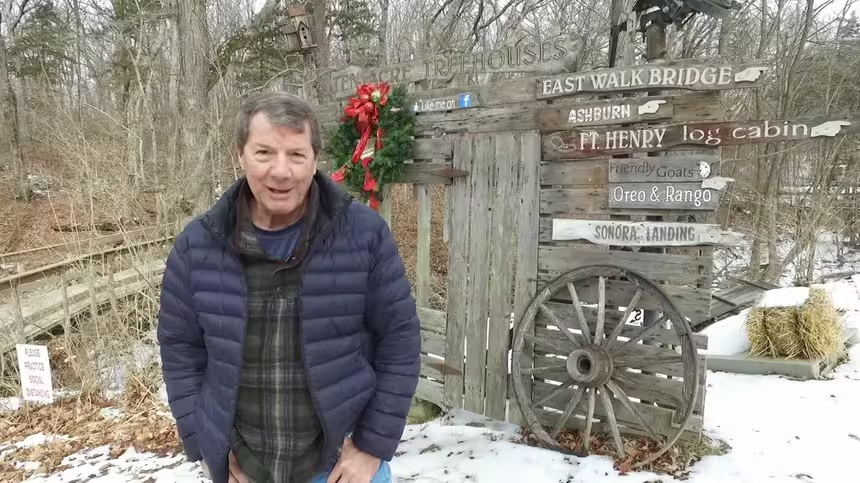
Illinois Stories
Join Mark McDonald as he explores the people, places, and events in Central Illinois. From the Decatur Celebration; from Lincoln’s footsteps in Springfield and New Salem to the historic barns of the Macomb area; from the river heritage of Quincy & Hannibal to the bounty of the richest farmland on earth.Providing Support for PBS.org
Learn Moreabout PBS online sponsorship(upbeat music) - [Narrator] Illinois Stories is brought to you by the Corporation for Public Broadcasting, Illinois Arts Council Agency and by the support of viewers like you.
Thank you.
- Hello, welcome to Illinois Stories.
I'm Mark McDonald in Quincy at the Lorenzo Bull Home.
Also the Lorenzo Bull Park, which is taken care of by the Quincy Park District and information about a community group who has taken an interest in this home, saving this home and turning it into a community asset.
And Dick Wellman is a member of that group.
And he's with us now.
And this is fascinating Dick, because it's not very often that a community group forms a new 501(c)(3) in order to take care of a city treasure, but that's really what the Bull House is, isn't it, it's a city treasure.
- It is a city treasure.
I mean, the Bull family were such a family of philanthropists in Quincy that, you know, we think this property is, is so invaluable to save.
And it's such a central focus in the, in our historic district anyway.
- Yep.
And this has also been, course you're fortunate because it's been used through the years, well used and taken care of by what the Women's Club has been in here.
And they're still involved in.
- It's their home.
It has been since 1932.
- And they'll be part of this group.
- And they're actually part of this group.
And we are doing a partnership with the park district and the Women's City Club spearheaded by our group, Friends of the Lorenzo Bull House.
- And the park district, we should note, that this is one of their parks and they maintain the outside for the groups.
- Yes, they do maintain the outside, do a great job taking care of everything.
- It's beautiful.
This home was, is one of the older ones here in Quincy.
It was built in the 1850s and on this intersection where we're standing, this is really a gem, isn't it?
As far as architecture goes.
- Yes.
The most architecturally significant intersection, or one of the most architecturally significant intersections in the nation.
- And you can see right now there's that's right across a main street right there looking down main street toward downtown a little bit.
Yeah.
It's gorgeous.
It is beautiful.
We happen to be here on a beautiful fall day too, which is really very inviting.
Let's you and I walk up a little closer and talk about - Okay.
- this home and what it's been used for through the years.
Now that the Bulls built it in the 1850s and actually lived here until what?
The depression era.
- Yeah.
I think Lorenzo died in, I forgot what year he died, but his family owned the home until 1932.
His, after he passed away, his daughters kind of took care of it until they moved to Boston.
And then the house was put up for sale.
Of course, that was the depression.
So they, it was closed up and it was just kind of left.
- As we look at the grounds and this is an Italianate mansion.
As we look at the grounds here, and you can see it's expansive, Lorenzo Bull had some ideas about what he wanted this property to look like, didn't he?
He was actually ready to bring in one of the most famous landscape architects in the country.
- Yes, he did.
His first idea was he wanted to have Frederick Law Olmsted be his landscape architect who did Central Park, of course, but he wasn't able to get him.
So Frederick Law Olmsted said he was too busy.
And so he recommended kind of an understudy.
It was this Ossian Cole Simonds, who also became a very famous landscape architect.
- He was actually, I guess he was maybe a student.
- Yeah, I think a student of Olmsted.
- And so when he came in to do this work and we have some drawings of some of the work he was trying to accomplish.
He also did some other work in town while he was here, didn't he?
- Yes, he did.
Down the street, he did Charles Bull, his brother, Lorenzo's brother built a house at 1651 Main.
And he did his property too.
He also later was brought back to do the park district or the park system that we have here in Quincy that runs along the river bluff.
- Well, that's extensive.
That's a lot of work.
So he did, he was here for quite a while.
- Yes.
He was in and out here.
In fact, he spent quite a bit of time I think even staying with the family here, when he was in town.
- Look at this porch, look it goes all the way around.
And it goes around the back too.
- Yes, it does.
- Beautiful.
But property like this is really hard to maintain, isn't it?
Because you can't just patch it up.
Somebody who really knows has to know what they're doing to do it.
- That's right.
And as we look, we can look right over here and see sorta, this is sort of the, what happens to an older home.
This happens all the time, every year.
There's something like this that needs to be taken care of.
And you have to have particularly skillful people to do it, don't you?
- That's right.
And so we're hoping to raise some money to help continue restoration of this porch.
Some of it's being done now, actually some of it was done a few years ago and there's some more that we're waiting on materials, but because of COVID, materials are hard to get.
- Supply chains now.
- Supply chains, yeah.
- But I'd say get ready if you all have signed on to take care of this place and it looks like you have, this is going to be every year, you're going to have another project to take care of.
- That's what we know.
And so that's what we're, our plan is every year to make another list of tasks.
- Well, here we are at 5050 Main Street.
And as you can see, there's a plaque on the house there that says 1851.
So I'm going to take that as the year that this baby was built.
And can you take us inside?
- Sure.
Come on in.
- Well, Dian Link, at the first stop inside the house is of course the front hall, you know, where you get introduced to a parlor on each side and this beautiful expansive way in.
Now you have a personal history with this house because you've been coming here for a while, haven't you?
- I have, I first came to this house in the late sixties as a member of AEUW, one of the organizations that meets here, but I joined Women's City Club when I retired in 2007.
- And to refresh people, that's the group that is part of the 501(c)(3) that's going to maintain this, the Women's City Club, right?
- There are two members on the Friends board that are, that are part of this group, yes.
- So you kind of had a love affair with this house, through the years.
- Oh, I think it's a special house.
I do, yeah.
And there were women way back in the thirties that thought this was a neat house and they should have a Women's City Club similar to what Boston had.
When they were going to sell it, they became really upset.
- Back in 1932.
- Back in 1932.
- Nobody really knew that, that this, it could be torn down.
It could become, you know, it could have anything could have happened to it.
And so that's when the women's group decided to buy it?
- Well, they had it staked out.
They could see the small lots all along Main.
- They were going to tear it down for sure.
- They were going to tear it down.
It was going to auction and they met on a Monday and decided things needed to happen.
- In 1932, it was kind of hard to raise money to buy.
- It was very hard.
Yes.
- How much did they have to raise?
- The heirs wanted 10,000.
So they had that amount to raise.
- And they did.
- And they did.
Initially, they only raised four, but the last day they were able to get the last amount.
- Wow.
Okay.
And so they made the 10,000 dollars.
They must've been sweating bullets.
- I'm sure they were.
I'm sure they were, yeah.
- Take us in.
- Okay.
Come in.
And I'd like to show you the original owners Lorenzo Bull, who's been active in the community.
- Very good picture, yeah.
- And his wife Margaret, and she was also active in the community and with the women's groups.
- Yeah, now did they have a family?
- They did.
They actually had six children.
- Oh I see.
This is the family tree.
- This is the family tree.
They lost one son, you know, at an early age.
But they had five.
- Well, you know, they were very fortunate.
Cause families usually lost more than one.
If they had six kids only losing one was a very fortunate outcome.
- Right, they were.
- The wainscoting, I guess, is original.
And the woodwork we see is all original.
- It is yeah.
The spindles, it was simple, but elegant.
And we have one original piece from the Bull House.
This buffet, the others have all been donated, but this was originally in the house.
- I wonder how that managed to stay and everything else got auctioned off or sold off at some point.
That's kind of a shame isn't it?
I mean, it's wonderful to have, but what a shame that that's all there is left.
- So I don't know if someone had it and I don't know the story of it.
- Maybe somebody tracked it down.
Yeah, yep.
Well, this is very nice.
So you have some other friends here that are involved in the same group that are going to give us a tour of the house.
So thank you very much.
- You're welcome.
Thank you.
- Well, the first room you would enter off, you came in from the right side of the front hall would be this beautiful library.
Judy Nelson, this is a, this is a piece of work.
Now I'm going to guess that this wasn't always a library because usually there was a parlor on each side of the, the main hall usually.
So I'm just going to think that maybe this was originally a parlor.
- I'm, I don't, we don't know some of those things, but it is considered the library now because the shelves, I think were here, the elaborate woodwork was here and the books appeared.
We don't know where they came from.
- But we do know that it was, that this was a renovation.
This was not part of the original layout.
- This room was remodeled in 1870s.
And this had been part of the outdoor porch.
I believe it was enclosed.
- From like here on was porch.
- Yes.
So that it was closed off and made into an enclosed room.
- Yeah.
He wanted a bigger room for the library.
And boy, did he get a beauty?
I mean, I look at this woodwork.
I'd like to know where this was done.
They could very well have been done locally because we had great woodworkers in Quincy.
But there's no really way to know that either.
I wouldn't think he'd wanted to move this very far.
This is just monumental.
And of course, full of books.
And I don't know though, history of the books though, but some of these books stayed here ever since the Bulls left the house.
- Well, it could have been, you know, and as to say, many of them have been donated and sets and so forth.
- These fireplaces in this home are just beautiful.
And this tile fireplace here, of course, a home this size in the 1850s would have had to have a fireplace in almost every room.
- To heat, yes.
- Yeah.
Because there just wasn't any central heat.
It's just gorgeous.
Just beautiful.
Now this, this room and this house is actually available to the public, isn't it?
- That's right.
And I, I'm not sure a lot of people in Quincy are aware of that, but my family has used it on several occasions.
We've had a 50th wedding anniversary here and it's a very nominal price to rent it.
And you know, it's available for showers or receptions.
And I think, you know, people should be aware of that and take advantage of it.
- Does the women's club still play bridge here?
- They do quite a bit.
And fewer and fewer, of course, people do play bridge and you know, so we are trying to use it for other functions.
There's other games.
- It's going to be actually essential that you use it for other functions because somebody is going to have to pay to keep this place up, right?
- And currently the Women's City Club has been in charge of the interior of the house, but it's the same.
Members have dwindled and like many things, the last couple of years not being able to be opened has also hurt.
- Well, you know, you needed a rebirth and that's what this new, this new group is for.
And hopefully what you can do is get some younger folks involved that want to get, you know, that want to see this place thrive again.
So that's the idea.
- It is very important.
- And it is, it's just a beautiful place.
When you look at the, all these high ceilings and the wonderful crown molding and woodwork in this level of craftsmanship in this library, it's just phenomenal.
Hello again, Dick.
- Hello.
- Now on the other side, we were just in the library.
So I came back across the main hall into, with this big parlor.
- Double parlor.
- Yeah.
And this is, this would have been, I don't know, this may have even been separated at some time.
- Might have been separated at one time.
We don't know for sure.
The Women's City Club, of course, when they got this facility, they did a lot of redecorating and remodeling to make it functionable.
- I wouldn't be surprised if maybe there weren't some pocket doors here maybe, you know, that may have joined it, but at any rate, it's a beautiful big space.
And we were just talking to Judy and she was talking about how well, you know, it's all rentable, it's all rentable space and this is a nice big area for a meeting or a, you know, a party of some kind.
- Yes.
There've been lots of parties and functions here.
And of course the Women's City Club quite frequently have dinners and bridge clubs.
- It's all set up for a bridge club.
- But yeah, it's a rentable space through the park district.
- Lorenzo Bull.
He must have been a very smart, ambitious person because he moved to Quincy, and within what, 20 years at the time he moved here, he was able to build this.
- Yeah.
- What did he do to, how did he do it?
- Well, he was a smart guy.
He came here when he was 14 in 1833.
And then he first worked for a judge.
Henry Snow was his first job.
And then a little bit later he started working in a mercantile business and then he and his brother then partnered up and started their own store and then began some other philanthropy or some other businesses.
That wasn't very good.
Some other businesses.
They started the L and CH Bull Organization, which they then became, went into banking as well as they started the water system and the railway system or the streetcar system.
- You've got some storyboards over here from, you know, from their life story and their, and all they were in involved in.
And this is, this is very interesting.
Okay, here we say, this is, this is where we were talking earlier about the fact that it almost got torn down, that the property was, was flagged and marked to be subdivided.
And the Women's City Club came along and raised that 10,000 dollars to save it.
And then here's a little bit about what you were talking about with the, with the businesses that the brothers owned.
- The L and CH Bull Bankers started there, first of all, started their stores and then went into banking.
- So I guess banking was the prime, was their prime moneymaker?
- I think that's probably later on that's where they really made their big money.
A famous building downtown 428 Main Street, the very large Romanesque bank building was their bank.
And actually it was the largest chartered bank in Illinois, south of Chicago for many years.
- Oh, okay.
So if you asked him what he did, he probably said, well, I'm a banker among other things, right?
Okay.
We were talking about, about outside when we were talking about the landscaping and Simmons or Simons.
- Ossian Cole Simonds was his name.
- Simonds, yeah.
This is what sort of, what he had planned, he wanted his garden to look like.
- Yeah.
- And there, you can see a light effect similarly of the house there as well.
- That actually is a sketch of the Charles Bull home.
- Oh, that's the brother.
Okay.
- And so we know that this property was equally rivaled in very prestigious garden.
- And then we also have now, is this, is this brother's home down here?
- No, that's the Morgan Wells house, which was the first Cheerful Home, which the Lorenzo Bull and Margaret Bull started.
They purchased that home for Cheerful Home Daycare, which was the oldest licensed daycare in the state of Illinois.
- Oh, okay.
- That house was unfortunately torn down, but we were able to save a few pieces from it.
- It's interesting, a daycare.
I don't think people considered daycare back then.
- Not back in those days.
- And that would have been really for the wealthy, that would have been for people who for, yeah.
For families who really had more important things to do than watching the kids all day long.
Okay.
And this is a very recognizable building as well on Main Street.
What did he have to.
Now it's the historical societies building.
- That was the public library at one time and Lorenzo and Charles, they started, they were founders in the library, the public library.
And so they raised the money for that building and which is now the historical society.
And I believe Lorenzo was actually one of the first presidents of the historical society.
- Well, that's kind of interesting that his library would become the historical society when that was one of his pet projects.
But yeah, and really quite a design, whoever designed that was, that was a noted piece of architecture.
Still is of course.
- Oh yeah.
Richardson Romanesque.
- Well Dick, Mr. and Mrs. Bull had a daughter who cared almost as much or maybe more for the community than they did.
She went on to really do a number of things, didn't she?
- Right, she did.
She was very instrumental in starting the garden club and the art club.
In fact, the art center currently has one of her watercolors that she did herself.
We hoped to get it to display in this house.
- For those who don't know Quincy very well, in the back here is a beautiful carriage house.
And that's where the art center is and they've built onto that.
So, and it's modern and it's historic in the same.
- At the same time.
- Okay.
So Mrs. EJ Parker had a vision for parks.
I mean, she was a go getter, wasn't she?
- Yeah, she was.
In fact, you know, we've had historic home tours and things like that.
She was also kind of a founder in that kind of project in Quincy.
Her and her husband then developed the park system that we have here at Quincy.
- Okay.
And she also lived right, like half a block from here, right behind this house.
And this is also interesting, your fledgling group has already taken on a project.
And I like this historic photo here because right behind the home we're in, and we're going to take a look at this ring, was a fountain that had been here for some time.
And one of the ladies unfortunately hit the fountain with a car.
The fountain is no longer there, the fountain's gone.
So one of the first things your group did was raise money to build a replica.
- Right.
In our master plan to redevelop the entire grounds into more formal gardens again, we wound up with a memorial donation from our first president of Friends of the Lorenzo Bull House.
And that memorial donation we're using to replace the fountain because we found an exact replica of the fountain that was once there, that was hit by a car.
- Yeah.
But you're fortunate that you did find it because at least you can have one made now.
And of course it may be a while.
- It's going to be awhile, they said.
- Well, you know, when you want custom work done, under these circumstances with the pandemic and the labor shortage and the everything.
We'll see.
But like you say, as long as you're not too anxious to get it.
- Yeah.
But we're, but we are anxious to see it one day.
- Sure.
Barb McClain, the Bulls could have had a large family gathering in this dining room.
I mean, it is big enough for this house.
- It's 28, I think right now, currently.
- Yeah.
Yeah.
And they, they would have had probably a bigger table than this because they would have wanted to take up the whole space.
- Exactly.
We'd love to have one.
- You're pretty well blessed with what you've got here.
We've been talking about the fact that, that, you know, it's available for meetings and this is really a perfect room for, for any kind of a get together.
- Yes.
We have other events as well and are hoping to host more in the future.
- There's not a lot original in here, but there are some period pieces.
And I want to point this one out, because we were talking about the, and you'll have to remind me what the name of the home is, where the daycare was.
- The Cheerful Home.
- The Cheerful Home.
- First daycare in the state of Illinois was here.
- Right.
And what was the name of that home?
- The Morgan Wells Home.
- The Morgan Wells Home, okay.
Well, this is a period piece wasn't here, but the mirror tells a story.
What's the story on the mirror?
It's a mammoth, it's a mammoth.
- It is.
And it comes from the Morgan Wells Home, which was that original daycare center.
But this was the, from the home itself.
And it was donated by Quincy preserves who bought it at auction a few years back.
And they donated it to us, which we're, we're just thrilled to have it.
It's perfect for where it is.
- It weighs a ton.
I don't know how this thing can hold it up.
- I think Dick helped put it up.
- Well, Dick's a strong man then.
- Yes.
- Cause that thing's huge.
- Yes.
It was, it was a mammoth job to put that up.
- Of course, the wallpaper is not, was not here when the Bulls lived here.
- No.
- It's more modern than that.
But that chandelier is, you said it came from a riverboat?
- It came from a riverboat from a gallery at a riverboat.
Yes.
And so it's a beautiful chandelier.
It's got the, the crystals and the, and the pattern glass, and it's just, it's probably pretty appropriate for where it is considering nothing else is totally original.
We'd love to have more original furniture.
So, yeah, but that's hard to come by.
- For years and years, you were able to use what amounts to be a commercial kitchen here, this thing is a really good big kitchen.
Okay, and then they develop some kind of an issue with the air, with the fan in there, I guess.
- Yes.
It's not up to code.
- It's not up to code now.
But if you can raise enough money to get this fan fixed in here, you've got a real asset because you can, you have a big enough kitchen to handle any kind of an event that you would want in here.
- Inside and out, you know, they can have things on the ground outside, which of course we're expanding our gardens as well.
And inside we can handle over a hundred people, I believe.
- Yeah.
Let's go and take a look.
Because this is a gem.
This is something that not too many, not too many homes or event places are going to have.
But you can see, this is probably the original footprint of the kitchen.
I imagined the Bulls had a huge kitchen.
- Yes.
I'm sure they did.
Part of it might have been a summer kitchen.
You know, they might've had a summer kitchen.
Yes, in the early years they might've had and, you know, servants and such, they had different areas for different things, so.
- Wow.
It goes all the way back in here.
There's another, another area there.
- Lots of area for preparation.
- Fantastic.
Oh, I hope you can raise the money to get this back in operation.
- We do as well.
That would be such an asset.
- I mean, you would never have to turn down any kind of a meeting.
And this is interesting because this of course was part of the original part of the house.
This would have been, - Well, you're not going to show the dirty closet.
- Well, it's just a storage now.
but this would have been where the help would go from the kitchen and upstairs.
And they had quarters there.
And I don't know if we have time to show those, but there were some little apartments, little rooms there were where they lived.
- We'd eventually like to make those usable again, access is a problem from outside, I guess.
You have to have certain, meet certain criteria outside.
- Yeah.
Yep.
Well, this is a really great, great room.
And I hope that you'll be able to keep it busy with group with people that want to have, - Well it's already utilized fairly extensively.
- Unions or, you know, meetings or whatever, whatever.
Well thank you.
- Thank you.
- Well, Hollis Axelrod, I've been wanting to come up here because, you know, on the ground floor, many of these Italianate and Victorian homes are kind of have the same footprint.
- Yes.
- When you get upstairs, it goes a little different.
They always seem to want to seem more experimental.
- There's some surprises up here.
- Well, I can't wait.
After you.
- So this is one of the main bedrooms and we do have a lot of artifacts in here, but none original to the house.
So the fun fact with this room is the closets.
The size of the closets are huge.
- Oh yeah.
Yeah, for back then.
- For 1850.
- Yeah.
- This is our big sign of wealth.
- Yeah.
They always avoided closets because they had to pay extra taxes if they had closets right?
But this is, oh wow, and it goes back this way too.
- It does.
So if someone wants to rent the building and they want to have a wedding here, this is where the bride would get ready here.
And this is huge.
And this goes into another bedroom.
- Well, let's just go in.
What the heck?
- And once again, huge closets.
- Let's take a look at this.
Yup.
Yup.
That's wonderful.
And of course, fireplaces in every room, they had to stay warm.
- Right.
And back then they didn't have bathrooms.
So the bathroom is in the hall.
- Right.
All right.
And we won't go across the way because that bedroom looks like this one.
Oh, that's storage.
But there were four bedrooms up here.
- There are.
There are.
- Okay.
- So our plan is that we acquire pieces from that time period and make this more of a museum so we can have tours.
And just recently we got a lot of artifacts from the Quincy Historical Society and Adams county, and they gave us some things actually from the Lorenzo Bull family.
So it's very exciting.
So it's just starting to happen.
- Yeah.
Yeah.
Just from what little I know learned during this program about the Bull family, they had their fingers in everything about Quincy for about 50 years.
And so there's going to be a lot of, it's going to come to light and that you can make a really what would be a Bull museum.
- That's what we would like to do with our tours up here.
Yeah.
Another exciting piece is that we, we're a new board, we were conceived in 2019 and we just got our momentum going and we had to shut down a little bit because of COVID.
So it's very exciting.
We're having our first fundraiser May 5th, 2022.
And we're very excited.
- Well, good for you.
I mean, we certainly wish you the best.
Thank you, Hollis, and we're out of time, but I, I appreciate it very much.
We'll go ahead and publicize your website for you so people can know how to get you.
We've talked about the fact that this place is available for events, and once they raised that 15 grand for that kitchen issue, and you know, they're going to have that fountain built, they've got the porch to work on, but I'll tell you what they're getting there.
And they're going to be, they might be contacting you to become involved.
With another Illinois Story in Quincy, I'm Mark McDonald.
Thanks for watching.
(upbeat music) - [Narrator] Illinois Stories is brought to you by the Corporation for Public Broadcasting, Illinois Arts Council Agency.
And by the support of viewers like you.
Thank you.
(upbeat music)


- Arts and Music
The Best of the Joy of Painting with Bob Ross
A pop icon, Bob Ross offers soothing words of wisdom as he paints captivating landscapes.












Support for PBS provided by:
Illinois Stories is a local public television program presented by WSIU
Illinois Stories is sponsored by CPB, Illinois Arts Council Agency, and Viewers like You. Illinois Stories is a production of WSIU Public Broadcasting.