Lost Louisiana
Lost Louisiana I
Episode 1 | 47m 21sVideo has Closed Captions
Lost Louisiana I
Take to the road across Louisiana to explore landmarks and institutions that are gone but not forgotten including Mervive Kahn’s department store in Rayne, the great Hurricane of 1893 that wiped out Cheniere Caminada, Irish Heritage of Louisiana restored along with a beautiful church, Shreveport’s Louisiana Hayride where country legends first played and the History of Jazz Music.
Problems playing video? | Closed Captioning Feedback
Problems playing video? | Closed Captioning Feedback
Lost Louisiana is a local public television program presented by LPB
Lost Louisiana
Lost Louisiana I
Episode 1 | 47m 21sVideo has Closed Captions
Take to the road across Louisiana to explore landmarks and institutions that are gone but not forgotten including Mervive Kahn’s department store in Rayne, the great Hurricane of 1893 that wiped out Cheniere Caminada, Irish Heritage of Louisiana restored along with a beautiful church, Shreveport’s Louisiana Hayride where country legends first played and the History of Jazz Music.
Problems playing video? | Closed Captioning Feedback
How to Watch Lost Louisiana
Lost Louisiana is available to stream on pbs.org and the free PBS App, available on iPhone, Apple TV, Android TV, Android smartphones, Amazon Fire TV, Amazon Fire Tablet, Roku, Samsung Smart TV, and Vizio.
Providing Support for PBS.org
Learn Moreabout PBS online sponsorship[Music] among the landmarks of louisiana there are many faded reminders of what we've lost or even forgotten common places that seem familiar but distant and even blurred the old stores and signs and town squares can still be found along the smaller roads but in just a few more years they will all be gone it's too late to save many of the things our grandparents thought would last forever maybe the best we can do is enjoy them while we can in the town of mangum the past shines most brilliantly in an afternoon sun the long warm rays washing over this store maybe for the last time and maybe breathing life into the old bricks once again it's terribly romantic of course this longing we feel for a grand old husk of a landmark but there also isn't a soul among us so called as to pass by this old store without at least once wishing it could betray its secrets in mangum the story would contain two floods a fire and a tornado we have a few examples a few for instances of places we are saving places that are dying and places we should all miss dearly people and places in this program and stories of lost louisiana we miss the familiar places like the abandoned stores you'll find in almost every town rain had an old store really an old friend of a hundred years it closed in 1990 a department a big department store with everything in it so it makes it kind of bad president marvin jankauer we're going out very quietly and you would be amazed at the way we have been received by the public since we announced that we're going out in 1884 marvin khan was a young businessman traveling to texas by train he happened to stop here liked it and founded a trading post at the station's door the family business grew and in its heyday covered a downtown block like many merchants of the last century khan his wife and six children lived above the store all the families of rain grew with marvin's until it became the sears and roebucks of central louisiana long-time manager barney foreman we sold horse-drawn equipment [Music] plows georgia stocks wagons hardware and appliances gift wear red ladies ready to wear men's clothing shoes just about anything that a family could use and i really enjoyed it and we're like a family over here people of the area got to know this store as their store you would always hear them say i'm going to my store mervines okay and over the years i've no matter who i talk to they say where do you where do you work and i said murphy in congress oh yes i used to shop there my family shop there my grandparents shop there but sometime in the 80s people stopped shopping at their store they could find what they needed at a chain store or the mall in lafayette the final straw was broken when mervine's new york buyer went under after 77 years marvin's was the firm's first customer the goods were trimmed down to what could fit in the original 1884 sales floor but in its time what a marvel to behold the pneumatic tube accounting system of genius simplicity this is the lamson tube system which as far as we can tell was installed in marvin khan company in 1925. what happens here is when a sail is made the slip and all the money go into this little tube it's closed up this lid is open and it goes up into a central cashier's desk it saves you the expense it saves you the all the problems that you get with a individual cash register everything goes to one central point and it's very very quick here it comes back down the store like so many landmarks quietly faded like so many landmarks it will someday be forgotten when the shops go so do the people or is that the other way around whichever in the end it's more than the places the community is gone too there's not a more tragic or sudden example than a storm a hurricane for instance the place a little island on the coast a charming little village four miles long church school beautiful beach valley furnish a quantity of fish farming came easily the soil was good everyone earned his living one can say aptly for in fact everybody more or less had money brave people and fishermen have perfect understanding worked hard during the week but on sunday there was a feast hubert terrio is a descendant of the people of the shin year the ragged paper he carefully unfolds is a poem written in 1893 the pages are 100 years old now and the words in french describe one day in the shanier they also detail the catastrophe that forever changed a unique way of life the wind blows always increases in velocity then at eight o'clock at night sadness is everywhere 80 miles an hour what speed blows this wind how's the shower water everywhere this is the storm it was a busy and prosperous weekend 100 years ago steamboats took off with seafood a trolley line ran the length of grand isle and late season tourists still swam in the clear water are posed on this southern louisiana beach the families of the shinier thought the drizzling rain that day would pass as it usually did there was sunday mass at the church later in the day a wedding this being the sabbath most people were at home according to the poem the fishermen enjoyed their day off and besides the weather was getting too rough to fish the wind had picked up to a full gale by that sunday night families hurried inside among them days cheremy five years old at the time his eyewitness account is the last you'll ever hear before he died a few years ago he recalled once more in this rare video the horror of that night and the terror that he survived is of water lavella douay remembers it was finished in may of 1893 the family moved in and lived there for about four months until the hurricane came in uh october first it was built by my grandfather nicholas kuron and he and his wife and his two and a half-year-old daughter were in the house with several other people i'm not sure exactly how many other people were in there at the time of the hurricane and during the hurricane it was knocked off its blocks but it survived the storm and the next morning when uh everything was over my grandfather had to walk through waters he said up to his chest to get to his boat this house was built on the bayou thunder side so it was away from the bay so i guess that's probably why it survived and some of the others closer to the bay did not my father lived in uh engineer with his family of nine eight and all schaefer nicole lives in golden meadow his ancestors survived the hurricane to tell a story that's become well known around town he drifted caught himself unlogged then not a swim his family didn't know it knew how to swim but they all drowned he saw a light in the attic and he was at the mulberry tree he dropped this driftwood that he was hanging on and he grabbed the top part of the mulberry tree that's why he always did have mulberry home always anyhow and he hollered he saw a light in the attic and he hollered so they opened the door and they pulled him in that's how he got saved do people around here still talk about it to a degree i mean maybe the older people do but the younger people might not but do you try to keep that story alive stories like this well he wasn't too much to talk about it i heard too much about it every once in a while he hit somebody pop up you know with some nelson cheremy runs a seafood packing house on grand isle much as his chenier ancestors did my grandfather between my grandmother and grandfather lost 13 of them brothers and sisters between the board of them 13 all in one family well like two families i mean two families yeah and uh the only one that survived was uh my grandmother and a brother and my grandfather and his sister the only one that survived out of the whole family and uh and like i said they would do it she never talked about how she took it hard or oh yeah i mean she likes when they moved that placed a little settlement period and uh they live in a little shack made with palomar and no floor and she had four children the stories survive with the older people but jeremy says even his generation is starting to forget a lot of my family went to a lot of trouble but we got out of it and uh but some people are still uh try to work it up but they can bring it to some people with enough years behind them to realize history is important i'm trying to build leave it like it was from 1893 to 1914. take for example john boudreau he runs the hotel at leeville just up highway 1 from the shinier what he's building is a replica of his town as he remembers it people this building that was mr martin mr lafar store house and saloon and the reason why they got three buildings like that in those days they didn't uh they didn't have right to uh it was against the law to have liquor in the store so they had to build a live saloon on the side that's why that's why you see that yeah and this building here was uh the woman of the world what what women of the world iww yes sir that's what it was now these are the building that uh that was there those days that people were living in just set them up yeah okay okay do you do this because if you didn't there'd be nobody else to tell the story of leville forgotten i'm bringing it back to life i'm bringing it i'm trying to bring it back to life i'm trying to make the people not to forget leave your head wars and how we live and everything else you understand i'm trying to show that to the people whoever's got a little bit experience of that try to try to make them remember their past come on down and see it boudreaux says it's important that we all remember hubert theriot says when he was younger he didn't care much for the old stories but now he collects all he can about the hurricane i don't think any of them had ever been through a hurricane before they've been through storms and they all thought it was just a small storm but there are some people that that said before the storm that there was going to be a lot of people that would die and they'd like an avertismo you know something as if they knew like uh as one man he said he was going to die that night within the hour and his wife started to cry thinking that he was going to commit suicide but it wasn't it wasn't that she asked people to to please try to send him from committing suicide and he said he wasn't committing suicide but he was going to drop and he did do you think that a lot of people know about this or do you think that you need to keep the story alive because there are a lot of people i think it would be good to keep the story alive if the kids would be interested but there's a lot of kids i think they don't they're not interested in that actually when my mother would talk about it when we were young we weren't interested and i guess it gets you there just the same when they'll get old and they'll they'll hear about it then they'll be interested that it may be too late there won't be anybody around to tell them what happens these are the people who refuse to let the stories die they say the tragedy of the hurricane is one example of a community surviving in recalling their stories of surviving together the modern residents of the shinier area may find the strength to stay together just a little longer lost louisiana will continue churches and temples are built to stand long after the worldly has crumbled but every now and then a church building is abandoned it's a good thing there is often good conscience among its parishioners in new orleans taking back a church has reawakened the descendants of irish immigrants repairing broken memories of a sad story and a rich culture the lights are coming on again at saint alphonsus for nearly 20 years this church has been closed it had been gradually abandoned by its parishioners they simply moved out of this old neighborhood somewhere in time the gold leaf was painted over with dull beige before we took over the church we had derelicts living in it for about eight or ten years they had come in through the crawl spaces beneath the church and this was a home for them they used to start little fires and trash cans on the high altar here to keep warm in the winter from the first mass celebrated here in 1857 it was an immigrant's church that makes it all the more surprising how ornate and costly its decorations were the money that poor irish laborers paid to furnish their church is a testament to their pride in the community they had built here that pride is still evident 136 years later in bill murphy who is part caretaker part historian for this beautiful catholic church the money that they put the money that they put into it they could bring their their family here and say i built this with my hands because a lot of the people who contributed to the money to build the church actually physically helped direct it and this this was their artifact this was an artifact of their culture murphy knows firsthand why the descendants of the irish immigrants who built saint alphonsus left the old neighborhood coming from the great american dream was to to in here in this irish section of the city was to make enough money to move to the suburbs kids move away and folks want to get jobs in other parts of of the city and things like that does it just naturally happen when i was in grammar school here during the 40s my friends would talk about gee my mom and dad are going to going to make enough money and buy a house in gentilly a move to metairie now i run into them in the neighborhood they come back to the church says how how you doing how are things going we just moved back i bought my dad's old house and they're moving back in the area so they're coming back they're they're even looking for their roots in this particular part of the city something is igniting a new search for roots among irish descendants in louisiana perhaps it's that they see other ethnic groups interested in their cultural ties [Music] [Applause] at a pub on toulouse street they're dancing the jigs and reels again irish americans like sister bernadette mcnamara say her people are getting together more than ever irish musical groups are touring and that's meant new interest in the traditional songs dances and customs every saturday night she has students who dance here and then we're all involved in the dancing that's why i come here saturday night for irish dancing you enjoy that oh i do is it authentic very much so barkeep terry folen has also seen the change in his customers conversations people would show up with st patrick's day for the the idea of green beer or shamrock or leprechauns and that sort of thing that has i suppose much to do with irish americana and very little to do with ireland and when you have uh authentic planet guinness and uh authentic bar people have a tendency i think to start you know the conversations change too and when you have irish an irishman sitting next to you you're more likely to uh for americans would be more likely to be interested in with what their roots mean rather than what they think they've been told they mean yes i know it's a cliche talking about irish history in an irish pub but this happens to be in modern louisiana the only place that irish americans can come to experience some of the original culture [Music] at the turn of the 18th century back when new orleans was the second largest city in america tens of thousands of irish families found homes in this catholic and it's worth mentioning anti-british city pub owner and irishman daniel flaherty the chieftains of ireland left ireland went to spain and france and mccarthy's were part of the big chieftains who left ireland and their grandson ended up in in louisiana and uh next thing there was the battle of the famous battle of new orleans was fought in his backyard and as i think the famous i don't know if i can quote what he said but there was something in in reference of my grandfather left ireland because of them and here they are again out in front of my front yard the red the red coats [Music] it's the classic story of american immigrants with a cruel twist the passage aboard english sailing ships was so miserable and filthy many died on route when they got here they died by the thousands of yellow fever and cholera and tens of thousands more fell while digging the new basin canal through the densest louisiana swamps six miles long 60 feet wide and six feet deep from the heart of the city north to lake pontchartrain a walk through canal street graveyards will reveal just a few of the family names most poor laborers were buried in unmarked paupers fields they unwittingly traded economic oppression in ireland for just a chance here yet for the betterment of water commerce many lost their lives coming from the climate of ireland into this climate was like a night and day difference and this was a swamp then yellow fever and if you're working out in the swamp digging a canal thousands and thousands they don't even know they estimate from fifteen thousand to thirty thousand died and but not just from yellow fever that was transmitted by mosquitoes they didn't know that at the time they called it a stranger's disease it was also those alligators out there oh my god and and and and you know they're they're working the tools of the day were wheeled about a big pic and a shovel they didn't have the equipment they had in the panama canal so i think their feet was more than the panama canal which the french started an american finished irish immigrants soon rose above the cast of laborer to become boarding house operators restauranteurs and merchants they especially gravitated to civic jobs as fire and policemen gradually as they wove themselves into the tapestry of the the existing city the the uh the french the creole the german the spanish that was here lots of them became respected people they made it but somewhere along the way like other groups with a strong cultural identity blending in meant losing their traditions a point of pride and remembrance is the restoration of saint alphonsus all of it is very detailed hand hand wrought work even this altar of saint joseph is interesting this was called the the altar of a happy marriage and you're finally able to restore it yes are starting to we're beginning just beginning just beginning we probably are looking at 10 to 20 re-tying some of the threads of our rich louisiana culture very long time and it will be worth it i think so old theaters have always had a certain romantic pull on people it seems the strand the liberty and eunice there used to be the paramount in baton rouge and if you hang around stage doors long enough you're bound to meet some interesting people that's a big trunk well they don't make them this big anymore but my base metal fits in here jeff and that's the reason i like to have it when my base middle side inside and it don't have the computers in it and but it fits in perfect put the guitar in the trunk and have my base yeah let's see yeah tillman franks knows country music in fact he's known some of the biggest names in country music personally this is like a country music shrine here really every time i come to this old auditorium it brings back so many of their memories to me a lot of interesting folks have come through here elvis and hank and johnny cash and johnny horton and jim reese and just name them on and on webb paris fair and young didn't you recognize my car tillman played with the greatest stars of country music that's him with johnny horton and just behind the young king of rock and roll and by the way hank's wearing killman's suit tonight he'll play the hayride again with the same enthusiasm he did more than 30 years ago it's going to really be a a good show and we're going to have lots of fun here tonight i'm going to slap that old base fiddle out there on the stage tonight it's really going to be fun your country pure country boy like we used to it's going to be fun i'm looking forward to it this building knows country music it sheltered some of the biggest names of all yet most of the time it stands empty big river and i'm gonna sit right here until i die johnny cash johnny horton slim whitman webb pierce lefty frizzell george jones floyd cramer text ritter they've all been here [Music] tillman franks remembers quite a few of them and this is how hank williams jr tells the story of this cradle of the stars well if the opry was the promised land for country musicians on their way up then the louisiana hayride was heaven's gate they flock to it carrying guitars fiddles and songs looking to make some money and a name for themselves hoping for that one big hit that might mean a recording contract and the move to nashville the hayride had a healthy respect for its older cousin but the louisiana show never advertised itself as a stepping stone to the opry it had its own reputation and that was enough to keep its saturday night roster filled the hayride was a steady job a rare piece of good fortune for anybody trying to make a living playing music the hayride had it all gospel live bands comedy men singers and girls but it had something else that made it stand out made it different from the other barn dance radio shows a certain spirit that had a lot to do with its success the show experimented with drums singing styles fancy guitar licks and honky tonk it was daring and it got away with it kwkh went on the air in 1925. its signal reached most of east texas southern arkansas and northwest louisiana station owner w k henderson learned right off that folks in his rural neighborhood had at least one thing in common they liked the music they understood so he gave his listeners country and his commercial sponsors loved him for it [Music] early morning country music shows got to be so popular on kwkh that the station added on a live saturday night show it wound up being a dress rehearsal for the hayride it was plenty tough it was practical you almost starved it was hard to make a living it was uh it wasn't they looked down on music then they called it hillbilly music and it wasn't recognized as really a the force it was because they figured like it was really uh real poor people and uh sorry people that that was the impression that they had it was the type of people in it and it was the image that we had to the public wasn't good back then [Music] when hank came in there and got such a tremendous impact he began to get lots of the people that like other kinds of music when he hit so big like the people that was raised and would wouldn't admit that they liked country music you'd see them down that day right on saturday night it was hank williams and it really did i would say that that that was the impact that began to make it a national recognized show if my daddy changed the show well the hayride changed hank williams too now the return of the hayride may change shreveport the town is paying a new respect to the old music and slowly restoring the old municipal auditorium where it all started elvis and hank started here and in a lot of american tourist minds they left a mighty sweet sound that's enough of a tourist draw right there people tell people elvis presley walked these very steps he really did that this is it this is where he first got national recognition yeah when he first recognized that he could be a supercar happened on this stage right out there in the center when he hit that guitar that's all right mama and the roof come in that's when he broke the floorboards of the hayride are ringing again this time with the sound of the community cashing in in shreveport they're trying to remember the roots of country music in new orleans it's jazz and bookmarks in the history of jazz music are disappearing fast in this case though the national park service may be able to help mine was too bad they got a whole lot of people to come here musicians all out of my musicians coming in and you know what you're doing and then you know what it's worth you know what i mean the value you're doing they enjoy it they come in here and they can't talk to you but they they come into germany hitler some of them places china japan and [Music] musicians in a cozy 200 year old parlor percy and willie humphrey quietly prepared for another evening of jazz this evening it was percy's birthday his 89th birthday this night willie was 93. the humphrey brothers have headlined here at preservation hall for more than 30 years and they were preparing to enter the recording studio to make yet another album someplace i wanted one my brother and i just a couple of days ago what are you doing yeah for money the real kind of money i don't mean no just i don't mean peanuts late arriving jazz fans stumble through the dark room to find all the seats have been taken half of the humphreys visitors tonight are from overseas from france where american jazz is sacred from germany where authentic blues men place sold out soccer stadiums and from japan where jazz musicians are as famous as rock stars those people buy records always buy records and they pay them to listen to them and when they come to the states that's what they want to hear some of them like you think people lived in the states here we hear the music news some songs replace kind of kind of ties them they remember that and they sing them can sing some of the person doesn't sing yeah they get them in the single room you know the people you know decide to enjoy themselves [Music] the crescent city joymakers are one of a handful of old line jazz bands left in new orleans who still play a regular gig in the french quarter wednesdays and saturdays seven half hour sets a night there's no bathroom and no bar just the music in a faded chamber revered as center stage for the soul of [Music] jazz of course it's a bit morbid to mention but practically you can't help wonder what will happen to the music when the musicians pass on the history of jazz music is filled with artists who never committed their talent to vinyl maybe that's a small part of the fascination these visitors have with hearing hot jazz played in person before it's too late for the first half of this century every city was filled with bands of all types brass bands playing patriotic music in parades snazzy uniforms were the envy of every kid who wanted to be noticed with some determination you could make it into the groups who played for the benevolent societies black clubs and white clubs within earshot of each other before segregation and bigotry became really fashionable new orleans was a lot more ethnically mixed and the musical styles and innovations got all jumbled up in what would later be called jazz bands for the church social you hired a band family reunions and political rallies hired the bands too remember these were the days before television before rock and roll even by the 1930s a radio was the size of a refrigerator the musicians made names for themselves georgia tom dorsey lewis dumaine the louisiana shakers the mobile strugglers jelly roll martin and joe king oliver but only die hard jazz fans remember kid ori or the superior orchestra who but the serious collector has ever heard them play on a record hardly anyone that saddens don marquis a self-described jazz nut and curator of the state museum's jazz exhibit this map sort of illustrates this is where we are now the french quarter this is where the mint is back behind the quarter is the treme area that's where the creoles lived over in here was storyville which was the red light district out here at the end of the streetcar line is carrollton there's a lot of dairy farms out there people would travel out in the streetcars and there were a number of parks and baseball parks politicians gave a speech they had a band lay a cornerstone you have a band it was just part of the city so there were a lot there are a lot more bands around to to hear each other and well it was all over town and every ethnic group prided themselves in having brass bands and people would take the smoky mary train which went without the legion field this way and have picnics family gatherings on weekends that was a way to cool off and everybody had music if it was a little family group a guitar banjo player if it was a fraternal group or a club there would be a full band and everybody was in earshot of each other that's where a lot of the early music ideas got exchanged because everybody could hear what everybody else was doing all over town all types of music getting all mixed up then spit out of a horn as jazz in all those neighborhoods this is the treme and if any place is the cradle of modern jazz it's this corner of old new orleans now folks in chicago or even memphis may take issue with that but how about hearing it from some of the jazz men themselves those folks who carried that crazy hybrid music throughout the rest of the nation jazz men like sydney bechet there was this club sydney says that we played at the 25 club that was about 1912 and all the time we played there people were talking about freddy keppard freddy had left new orleans with his band and was traveling all over the country playing towns on the orpheum circuit it seems like everyone along the circuit was coming up to freddy to ask about this ragtime where did it come from and back at the 25 friends of freddy's kept coming around and showing the clippings wanting to know what it was all about it was a new thing back then left from here and went to chicago while many of the most talented musicians stayed home in the treme this was the house of trombone great jim robinson guess what this work crew was installing next door the very day we came to see it a nicely poured brand new concrete parking lot eunice louisiana here they have a national park service interpretive center that means that besides saving old buildings the department of the interior provides cajun cooking demonstrations whip making shows and indian basket weaving presentations since it opened three years ago the center has enjoyed ever higher numbers of visitors and they're the more mature visitors too the ones who spend money every bit of demographic information from tourism officials says the median age of visitors to louisiana is getting higher older people have money to spend on vacations to expensive cities like new orleans already the french quarter is turning to cleaner family style entertainment the aquarium of the americas the whole riverfront and the whole nostalgia thing it used to be bourbon street catered exclusively to the lascivious teen and 20-something crowd what the park service would like to do would be to open some kind of cultural interpretation center for the topic of jazz talking about the history and the roots of jazz in new orleans they think that that may bring in the kind of tourists that we're likely to get over the next decade or so and at that point they'll have something mature and intelligent to see the wheels have begun to turn in washington to help preserve the less concrete landmarks of los louisiana they are as important as any historic site the intangible joy that is jazz music has a chance now to live on willie humphrey died in 1994 one more legend we will keep now as a treasured memory [Applause] foreign the landmarks and the roots of our culture teach us all more about ourselves in part two of lost louisiana we'll take a lonesome trip up a lonely highway we'll travel back in time with a treasured louisiana photographer and will celebrate a renovation miracle as well as the sad story of another landmark's demise join us for the next lost louisiana before it's too late [Music] you [Music] um
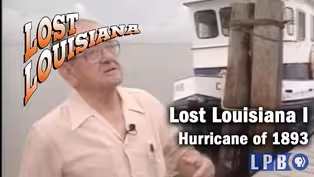
1893 Hurricane, Grand Isle | Lost Louisiana
Video has Closed Captions
Clip: Ep1 | 14m 48s | 1893 Hurricane, Grand Isle | Lost Louisiana (14m 48s)
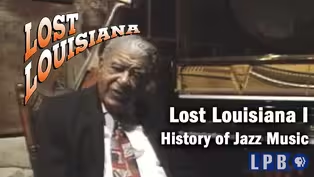
History of Jazz Music | Lost Louisiana
Video has Closed Captions
Clip: Ep1 | 11m 5s | History of Jazz Music | Lost Louisiana (11m 5s)
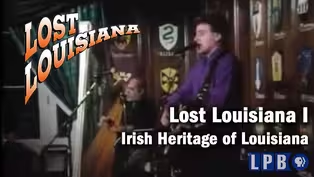
Irish Heritage of Louisiana | Lost Louisiana
Video has Closed Captions
Clip: Ep1 | 8m 54s | Irish Heritage of Louisiana | Lost Louisiana (8m 54s)
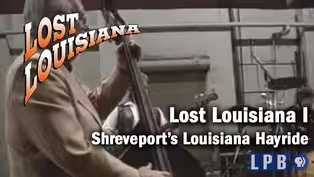
Louisiana Hayride | Lost Louisiana
Video has Closed Captions
Clip: Ep1 | 6m 20s | Louisiana Hayride | Lost Louisiana (6m 20s)
Providing Support for PBS.org
Learn Moreabout PBS online sponsorship












Support for PBS provided by:
Lost Louisiana is a local public television program presented by LPB