
Louisville Nonprofit Researching Stem Cells in Space
Clip: Season 2 Episode 223 | 3m 37sVideo has Closed Captions
Louisville nonprofit researching stem cells in space.
A Louisville-based non-profit is looking to space to find a cure for two devastating diseases. Last month when a Space-X rocket took off for a re-supply mission, it carried with it research from the National Stem Cell Foundation.
Problems playing video? | Closed Captioning Feedback
Problems playing video? | Closed Captioning Feedback
Kentucky Edition is a local public television program presented by KET
Louisville Nonprofit Researching Stem Cells in Space
Clip: Season 2 Episode 223 | 3m 37sVideo has Closed Captions
A Louisville-based non-profit is looking to space to find a cure for two devastating diseases. Last month when a Space-X rocket took off for a re-supply mission, it carried with it research from the National Stem Cell Foundation.
Problems playing video? | Closed Captioning Feedback
How to Watch Kentucky Edition
Kentucky Edition is available to stream on pbs.org and the free PBS App, available on iPhone, Apple TV, Android TV, Android smartphones, Amazon Fire TV, Amazon Fire Tablet, Roku, Samsung Smart TV, and Vizio.
Providing Support for PBS.org
Learn Moreabout PBS online sponsorshipWith today's total solar eclipse, many of us have space on our minds.
Global Base nonprofit is also looking to space to find a cure for devastating diseases.
Last month, when a Space X rocket took off for a resupply mission to the International Space Station, it carried with it research from the National STEM Cell Foundation.
We spoke to the CEO of the Foundation about their research.
The National STEM Cell Foundation actually does three different things research, education and advocacy.
And they are all interconnected.
But in our research platform, we fund research and for specific areas neurodegenerative disease, autoimmune disease, rare childhood disorders and regenerative repair.
And for us, that means orthopedics.
One of the most exciting things we're doing now is that since 2018, we've been funding a first in case study of neurodegeneration on the International Space Station using 3D brain organoids derived from the cells of people with Parkinson's disease and primary progressive M.S..
The ability to observe cells interacting in space in a way not possible on earth is providing valuable new insight into how these disorders develop and accelerating biomarker discovery for early diagnosis and opening the door to potential new cell and drug therapies for these and other neurodegenerative diseases that affect tens of millions of people worldwide.
We just launched for our sixth time on Space x 30 on March 21st, and our next flights will include cells from patients with Alzheimer's disease and test drugs and development for treating neuroinflammation, which is common to all of these disorders.
About 30% of the cells in your brain and spinal cord are actually nerve cells.
But each nerve cell has a community of cells around it.
That water it, feed it, take out the garbage and keep it healthy.
If those cells are talking to each other for any reason, then they will they will stop taking care of the nerve cell.
If they will neglect it and it will begin to degenerate.
And that is sort of the genesis of neurodegenerative disease.
Inflammation is a common marker for all neurodegenerative diseases.
So what you're trying to see is where inflammation begins and how to stop inflammation from impacting people in a way that creates these disorders and keeps them progressing.
Neurodegenerative diseases include diseases like Parkinson's and M.S.
and ALS, Alzheimer's, dementias of all kinds.
In space in 3D, you can see these cells talking to each other in a way that's not possible on earth.
And because you can see those cells interacting in a way that you've never seen them before, and because and because maturation is accelerated on the International Space Station, which means that you can see in an accelerated way what's happening with these diseases, which is especially important for us studying neurodegeneration, which is which are commonly diseases of older populations.
So this is a study of Parkinson's disease and primary progressive M.S.
And what we hope to see while we're up there is a point at which you could intervene with a new cell or drug therapy that would stop that from happening.
And after six flights, these are iterative missions.
So we're gathering data from every flight.
And with every flight, we learn something new that informs the next flight going up.
The National STEM Cell Foundation says it'll be involved in more space launches.
And we'll use information gathered on this mission to guide their research.

Coach John Calipari Reportedly Leaving the Wildcats for the Razorbacks
Video has Closed Captions
Clip: S2 Ep223 | 4m 13s | Coach John Calipari reportedly leaving the Wildcats for the Razorbacks. (4m 13s)
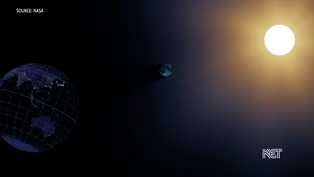
How NASA Solar System Ambassador is Educating Kentuckians about the Total Solar Eclipse
Video has Closed Captions
Clip: S2 Ep223 | 4m 43s | How NASA Solar System Ambassador is educating Kentuckians about the total solar eclipse. (4m 43s)
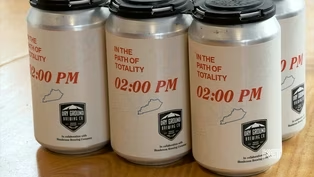
Kentucky Breweries Partner to Make Special Beers for the 2024 Solar Eclipse
Video has Closed Captions
Clip: S2 Ep223 | 2m 48s | Kentucky breweries partner to make special beers for the 2024 Solar Eclipse. (2m 48s)
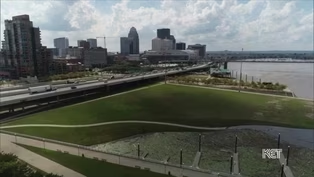
Louisville's Waterfront Park is a Finalist for USA Today's "Top Riverwalk"
Video has Closed Captions
Clip: S2 Ep223 | 3m 23s | Louisville's Waterfront Park is a finalist for USA Today's "Top Riverwalk." (3m 23s)

This Week in Kentucky History (4/8/2024)
Video has Closed Captions
Clip: S2 Ep223 | 2m | This Week in Kentucky History (4/8/2024). (2m)
Providing Support for PBS.org
Learn Moreabout PBS online sponsorship
- News and Public Affairs

Top journalists deliver compelling original analysis of the hour's headlines.

- News and Public Affairs

FRONTLINE is investigative journalism that questions, explains and changes our world.












Support for PBS provided by:
Kentucky Edition is a local public television program presented by KET