
To The Point with Doni Miller
Lucas County Children's Services
Special | 26m 57sVideo has Closed Captions
Randy Muth and Sherry Dunn discuss how the child welfare system operates with Doni.
In recent months, public attention has focused on issues prompting important conversations about how the child welfare system operates, how decisions are made, and where improvements may be needed. At the same time, the agency, like many across Ohio and the nation, is working through a growing shortage of foster parents. Randy Muth and Sherry Dunn discuss how the child welfare system operates.
Problems playing video? | Closed Captioning Feedback
Problems playing video? | Closed Captioning Feedback
To The Point with Doni Miller is a local public television program presented by WGTE
To The Point with Doni Miller
Lucas County Children's Services
Special | 26m 57sVideo has Closed Captions
In recent months, public attention has focused on issues prompting important conversations about how the child welfare system operates, how decisions are made, and where improvements may be needed. At the same time, the agency, like many across Ohio and the nation, is working through a growing shortage of foster parents. Randy Muth and Sherry Dunn discuss how the child welfare system operates.
Problems playing video? | Closed Captioning Feedback
Where to Watch To The Point with Doni Miller
To The Point with Doni Miller is available to stream on pbs.org and the PBS app.
views and opinions expressed in to the point are those of the host of the program and its guests.
They do not necessarily reflect the views or opinions of WGTE public media.
Lucas County.
Children's services plays a crucial role in supporting children and families during some of their toughest times.
In recent months, public attention has focused on issues, prompting important conversations about how the child welfare system operates, how decisions are made, and where improvements may be needed at the same time.
The agency, like many across Ohio and the nation, is working through a growing shortage of foster parents, adding real challenges to an already demanding mission.
These are complex issues that involve dedicated professionals, families and crisis, and a system under significant pressure.
Today's conversation is intended to help us all better understand the realities on the ground, the lessons being learned, and the steps being considered to strengthen care for children in Lucas County.
We appreciate our guests.
Randy Muth, Lucas County Children's Services executive director, and his foster care recruitment coordinator.
Sherry Dunn for joining us for this thoughtful discussion.
This is to the point I'm Doni Miller.
Welcome.
Connect with us on our social media pages.
But you know that.
You also know that you can email me at Donnie underscore Miller at and for this episode and any others that you might like to revisit go to.
wgte / To the point I am excited this morning to have two people with us that you may or may not know, but you certainly know where they work.
They work at the Lucas County Children's Services Agency.
I have Randy Muth, who is their executive director, and Sherry Dunn, who is the foster care recruitment coordinator.
Welcome.
Welcome, both of you.
Thank you so much for being here.
When I talk to you in prep for the show, you said something that I thought was really important, Sherry, and that is that there are a lot of misconceptions out there about what you guys actually do and what you are expected to do and what it means when you show up at someone's door.
And so we thought it might be a good idea to start off by telling people exactly what the Lucas County Children's Services Agency does.
Okay.
Well, we are the agency in the community that takes the lead when it comes to the protection of children.
And how we get our information is from citizens.
I would say our mandated reporters, professional schools who, you know, people who call, who have a concern about kids in our community.
And so that's where it all starts, and that's where people get scared to, I think, Randy, because they know that when you show up or they think when you show up, it's, oh my gosh, I've done something wrong.
Oh my gosh, they're going to take my kids.
Is that the case?
I think that's the perception.
I hope.
Yeah I hope it's not what happens in reality.
You know, Lucas County Children's Services truly is.
And the second part of our mission is to strengthen families.
And that's what we look at as our first and foremost priority.
The last thing we want to do is ask the juvenile court to remove custody.
In fact, we will do everything we possibly can to prevent that from happening.
Yeah.
And does that mean working with families?
Does that mean giving them additional resources?
What exactly does that mean, Sheri, when you're talking about that?
Well, it's combination of both.
It's working with families.
It's also making referrals out to other community agencies to work with families, such as if families need parenting, if they need counseling, substance abuse treatment.
It's kind of a wrap around because like we said, we are the lead, but we can't do this alone.
Right.
It takes a community.
Takes a community.
Absolutely.
And I imagine that the very last thing on your agenda is removing kids.
Like, I imagine that you would do most anything you could as long as the child was safe, not to remove them from an environment that they're comfortable with.
Absolutely.
We know that no matter what the home situation is, removal from that home causes trauma to a child further exacerbates what trauma they might have experienced.
Sure.
So when it's when it does become necessary for us to ask the juvenile court to remove a child from the home, we try very hard then to make sure that the child stays in as natural environment as possible, which usually means with a kinship, somebody who is related or has a preexisting relationship with that child.
We also try to keep the child in the same school district district, if that's absolutely possible.
It's one of the most stabilizing things, the school environment.
So if we have to disrupt the life of a child, we want to do it as uninterruptedly as possible and maintain as many of the preexisting conditions as we can.
Yeah.
And it is, again, always with the best interest of the child in mind.
And and I would think that you would encourage people to continue reporting things that, that they think are uncomfortable, that they're not necessarily putting a family at risk, but in fact could be helping a family do better, get better.
Right.
Every call doesn't lead to a referral, and every call doesn't lead to a removal.
What's your referral, Sheri?
The referral is when someone calls and they have a concern about a child.
And then our intake department takes a call.
They listen, and then we we go through, we have certain points that we go through, certain questions that we ask to see if there is some risk there and if we need to get out and respond to that call.
And if it is something that we need to respond to, it becomes a referral that initially gets assigned to a worker to go out to do an assessment on a family.
You all had a particularly difficult incident last year that resulted in a commission or a committee being formed to take a look at, to take a look at the way operations are handled there.
What do you think?
First of all, what was it like?
What's it like to have an outside committee come in and take a look at your operations?
Well, I welcome it.
And I'm so grateful that 27 members of this community have devoted so much time over the last year to help us look inside, introspective, give us feedback on what the community expects from the agency.
You know the concept.
When you know better, you do better.
Absolutely.
And I can't tell you how valuable it is to have these professionals and stakeholders spend so much time thinking about making us better.
And what a wonderful way to look at it.
Yeah, yeah.
I mean, it's going to be such a it's such a great opportunity.
I, I'm so appreciative of the work they've done.
I'm looking forward to hearing their conclusions and then working with them and the community and implementing those changes.
Yeah, I called it an incident, which absolutely was the incorrect way to describe it.
It was, in fact, as we all know, it was a tragedy.
Yeah.
And what kind of things have you learned so far?
Are you able to talk about those things now?
Yeah, absolutely.
I think what we learned primarily is that we need to do a little bit better job of letting the community know what their role is, what our role is, how we can build and strengthen the protective capacity of Lucas County by working together in collaboration with faith based communities, with mental health providers, with our state court, natural stakeholders, the Juvenile Court, Mental Health Recovery Board, developmental disabilities to ensure that we have as robust and well-informed safety net in this county.
I know it's early in your process in terms of implementing things and thoroughly analyzing things that might come out of the committee report, which has not been released yet, and write about that.
It has not.
Okay.
So when you talk about working with the community, with the faith based community and other agencies that you've named, what does that look like in terms of what would be different for you?
So two things.
First, the communication.
We are really working on getting better at letting the community know what our capacity is, what our needs are, what we need to protect and strengthen families in Lucas County.
And then the second is building or helping the community build capacity to serve those families, hopefully in a different and better way.
Do both of those things sort of filter down into needing more foster parents?
Well, we always need Sherry says.
Yes.
Yes.
Yeah, we always need more foster parents.
It's not it's not just about numbers.
It's about options to one of the things that, as I was saying earlier, if a child has to be removed from their home, the next best thing is to keep them in the same school district.
So we're not just looking for for more foster parents.
We're looking for foster parents that can provide a need in every school district, in every zip code in Toledo and Lucas County.
Yeah, we're going to talk about that a little bit more in a bit.
But what else have you learned from your interaction with the committee?
Well, certainly I anticipate that they'll come up with some best practice recommendations that are always welcome.
But I think that one of the things that I've seen with the task force is that they themselves, when they started this process about a year ago, did not fully understand what we did and what the limitations were.
Yeah.
And as they've as they've progressed over the last year, and I think their understanding has increased, my hope is that they'll be ambassadors.
There have 27 ambassadors throughout the entire county, across multiple professions that can help them help those professions, then achieve that same understanding.
Yeah.
What was the most common misconception that you heard in that committee?
The Children's Services just wants to take your babies.
All right.
Yeah, yeah.
And.
And I think one of the, one of the most common, I think lack of understanding is that I think if you ask the average person on the street what is children's services, do they say, well, you answer the phone, then you d investigation.
And then if the kids at risk, you put them in care, in foster care and then it's it.
That's it.
That's really not actually.
That's just the beginning.
The bulk of what we do is actually working with the families to make it possible, and make it safe for that child to return home as quickly as possible, and to make sure that when they do return home, they stay there.
Yeah.
Sherry kind of alluded to that.
I would love to hear a little bit more about that.
When we come back, we're going to go to a break right now.
But you guys will stay with us, right?
Absolutely.
Thank you.
We will be back in just a few minutes.
To me, community means connecting to others.
I'm Doni Miller and welcome to the Point.
I love PBS kids.
We're a community committed to education.
Discover new ideas, dive into exciting subjects, and engage with the world around you.
I would send them personally a t shirt.
Crime doesn't pay in the old West End.
Pass it on.
That's how we cleaned up the neighborhood.
Vision loss for people is not the end.
It's the story.
It's the next chapter.
WGTE Public media invites you to get out and play day.
Monday through Friday.
It's the 419 powered by WGTE with Matt Killam, Gretchen DeBacker, I'm Kevin Mullen.
What can people expect on the show?
Give me an hour.
A reminder of why this is a great place to live, work and play.
Where you come to watch, listen and learn.
Connect with us on our social media pages.
But you know that you also know that you can email me at Doni underscore Miller at wgte.org And again for this episode, which I'm sure you'll want to watch again and any other extras that you want to see.
Please go to wgte / to the point.
We are talking to Randy and Sheridan from Lucas County Children's Services, and we went to break Randy with your saying that the very last thing you want to do is to take a child in the very beginning of your process happens when you when you intervene.
So what next?
You show up.
You get a phone call.
You show up.
What does it mean to help the family?
Well, when we go out there, we're looking at whatever we can do to help alleviate the reason why the call was made in the first place.
You know, we're looking at those things to strengthen the family.
And we want to talk with the family about what their needs are, what their needs are in terms of in general terms or specifically as it relates to the child.
Well, I would say a combination of both, specifically as it relates to the child and then what relates to them.
Because we help families.
You do.
All right.
This is your time to tell your story.
What is it that people need to take away from this conversation today?
Usually a question I ask at the end, but I want to make sure we get it in right now.
Well, one thing that was said early on and we talk about, you know, working with families and that we want people to know foster care is temporary.
So when we get involved and we have to do a removal, be it with kin or relatives or with foster parents.
Our goal is to, you know, initially reunify that child with their family.
Foster care is temporary.
Yes.
Let's talk about that for a moment.
So for those folks who are sitting at home and thinking, geez, I, I've always wanted to do that.
I really have, but I don't know how to get started.
I don't know what it means.
What would you say to them?
Sherry I would tell them to give us a call because we'd love to talk with them about that.
Okay.
And what would you say to those folks who say, I don't think I can do this?
And I would tell them, I think you can.
What's it mean?
You can't.
What's the commitment?
What's the training?
Well, anybody who's interested in becoming a foster parent has to go through 24 hours of pre-service training.
The first three hours are online, and it's at their own pace.
And then the next 21 can either be online with an instructor or in person at our agency.
And so during that time, I always say that the foster parent pre-service training is so that people can make an educated decision if this is something for them.
And even if people go through the whole 24 hours, we're not going to say, okay, you went through the training, you're going to have to be a foster parent.
Now, no, we want people to make an educated decision about is this something for them and take the time to ask questions.
And what kinds of what kinds of things should they consider when they're thinking about whether this is for them?
I always tell people, if you have children, fostering is a family thing because your kids are going to be involved as well.
So I would say talking to your family, I'm talking to your relatives and your supports, because everybody might not be as crazy about this idea as you are initially.
So sometimes it's worth finding out, right?
You know, you really do need to know.
You need to know.
Okay.
Is it different?
I would think it would be different than raising your own kids a little bit.
It is different.
And I think one of the reasons why is the kids that come to us have been abused and neglected in some, some form of way, and they've experienced trauma.
And so you're going to have to know how to deal with those things.
And so we are going to help you and to bear you.
Is there training for how to deal with kids who have been traumatized?
Yes.
Because after they complete their pre-service training, do the criminal record checks, go through the home study process and all the wonderful paperwork?
Once they become licensed?
There is ongoing training and there is ongoing support as well for foster parents.
How how are kids selected?
How are kids paired with families?
Well, as you go into their home study training and even before then, when my staff and myself, we talk to them, we always tell them, think about the things that you can deal with.
Because I think a lot of times people think about all of the behaviors that they can't.
And so we want them to think about things that you can deal with.
And they can also think about the ages of the children, sex of the children, and even race.
And so when they do the home study, they do a family profile and then that family profile.
It's about the foster family as well as the type of children that they would like to foster.
Are they are the kids if they have kids at home, are those kids involved in the training?
No, they're not involved in the just the parents.
Just the parents.
Yeah.
You know, I always have this thought about whenever I think about being a foster parent, I think I'm going to get a call at 3:00 in the morning and someone's going to say, I'm at your front door with Bobby, and he has his his suitcase and come down and let us in.
No, not quite like that.
Not quite.
And you might get a late night call.
It might be get that.
But you know we're going to want to know.
Are you interested before we pop out there with Bobby.
And how are young are the are the kids Randy or Jerry?
Some of them are coming straight from the hospital.
Yeah.
Newborns.
No kidding.
Wow.
What?
When you when you think about.
First of all, I'm going to ask you guys a kind of not real personal question, but sort of a personal question.
I want to know why you do this.
Why do you do this work, Randy?
My my story is a little different.
I never sought a career in child welfare.
My training is as an attorney, and I was actually appointed by the court in Stark County to represent parents who were accused of abuse and neglect.
And I had a case, and the caseworker really helped me through it.
And we've been married for 30 years and she is still a child welfare caseworker.
So she's the one who introduced me to this field and I fell in love with it, fell in love with the nobility of the field, and knew I wanted to be a part of it.
You know why?
That's an important question.
It's an important question because this is tough work, and you need folks who are dedicated to the mission to stick and stay.
And you always I mean, there are easier things to do than what the two of you do.
So I'm particularly I was particularly interested while you and I knew that you were an attorney chose to do this work.
What about you?
Well, my mom worked for a juvenile court.
And so as a kid, when I got out of school, I had to come down to juvenile court and wait on her.
So I got a chance to see caseworkers, probation officers.
She worked with a couple of the judges.
And so I was around this all of my life.
And so I knew I wanted to get into the helping profession some kind of way, and went to school to become a teacher, but ended up at children's services and been there.
How long now?
Okay, I started at ten, so I've been, but I've been there 35 years.
My goodness, oh my goodness.
In those 35 years, how have you seen children change?
Yes, yes, I've seen the community change in those 35 years.
You know, the cases that are coming in now are more difficult.
Our kids that are coming in have multiple issues where when I started it, it was one thing, you know, mom didn't have enough money to pay rent.
Those aren't the kind of cases that are coming in.
You know, kids aren't going home as fast as they used to, or many of them are not going home at all.
Yes.
So I've been a big change.
I think.
Why do you think from your background, this it's it's different.
Why do you think it's different?
What's made it different?
Well, I think our economy has made it different.
And people's perception of family, I think, has changed say families are different.
Yes, families are different.
In what way?
You're nodding and nodding your head.
I think, you know, the needs of the community changed with the generation.
And one of the well, actually three of the things that we're going to be really working on over the course of the next year or so is being responsive more timely?
We're working with our mental health providers to get crisis intervention in place within an hour, if possible.
I think our society wants the governmental services to come to them, so we're working more in the community, and then finally, we're really working on making sure that families are heard and respected.
They want to know that their caseworker either knows what they're going through, has lived what they're going through, or at least is talking to somebody who has lived experience.
So we're we're trying to do all those.
And if I could, if I could just get a plug in for our survey.
Absolutely.
Please.
And we want to hear from the community.
We've had a number of community listening sessions, about 14 of them over the last 15 months or so.
But the other thing that we've done is we've launched a county wide perception survey asking the community what their knowledge of our agency is, to grade their satisfaction with what we do and to ask them, how effective do you think we are in about 27 service delivery areas?
We're going to use that information to get better.
When you know better, you do better.
So we'll be sending about 25,000 cards out with a QR code so that we get a cross as broad across reference of Lucas County as possible, but we invite anybody to participate.
Maybe the easiest way is just go to our website, Lucas's net landing page.
As soon as you get there, first thing you're going to see is the survey takes about 6 to 8 minutes.
We would love your feedback.
It will make us better.
That's such a cool thing to do really is I want to ask you this.
We have about we have just a minute left.
If you had to identify the biggest challenge that the agency faces right now, what would it be?
Community understanding the its role in providing a protective environment for children.
And is there a way that people can help who might not want to be foster parents?
Yes.
Is there?
What is that?
Well, there's things like we're always in need of school items, clothing for kids, toys.
They can always donate toys all year round other than just Christmas time.
Diapers, diapers.
Oh my gosh.
You know, going to be working with the churches to kind of talk with them about if they have foster families in their in their congregations or relatives who are care how they can support them.
And all people need to do is call you and they can find out more about these things.
Yes.
What number should they call quickly?
I would like them to call for 192133476.
That's my work number.
That's your number.
One more time, please.
(419)213-3476.
Thank you guys so much for coming today.
I really appreciate it.
And you'll come back.
Won't you come back.
So much more to talk about.
So much more to talk about.
And thank you all for spending this time with me today.
I look forward to seeing you the next time.
On to the point.
Enjoy your day.
Announcer 1: The views and opinions expressed in to the point are those of the host of the program and its guests.
They do not necessarily reflect the views or opinions of WGTE public media.
Announcer 2: To the point is supported in part by viewers like you.
Thank you.
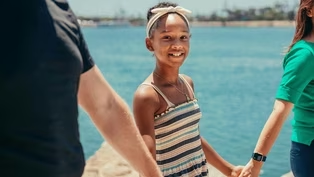
Lucas County Children's Services promo
Airs Friday, May 1st at 8:30 p.m. and repeats Sunday, May 3rd at 11:00 a.m. (30s)
Providing Support for PBS.org
Learn Moreabout PBS online sponsorship New Episode
- News and Public Affairs

Top journalists deliver compelling original analysis of the hour's headlines.

- News and Public Affairs

FRONTLINE is investigative journalism that questions, explains and changes our world.
 New Episode
 New Episode
 New Episode
 New Episode
 New Episode
 New Episode
 New Episode
 New Episode
 New Episode
Support for PBS provided by:
To The Point with Doni Miller is a local public television program presented by WGTE