State of Affairs with Steve Adubato
Lynn Regan; Robert Guarasci; Mary Rizzo and Whitney Strub
Season 5 Episode 36 | 27m 9sVideo has Closed Captions
Lynn Regan; Robert Guarasci; Mary Rizzo and Whitney Strub
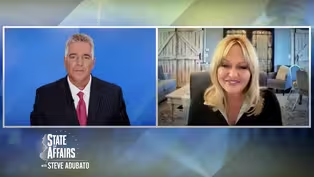
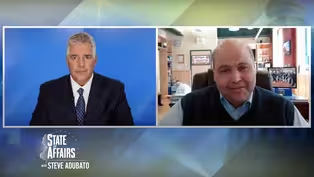
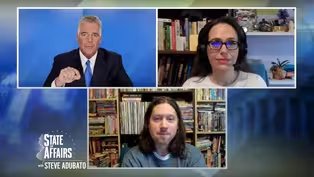
Lynn Regan talks about her son’s battle with addiction and her determination to save him, and the impact of the Russ Berrie Making a Difference Award; Robert Guarasci shares the need to help preschoolers transition back to in-person learning and helping the Paterson community get vaccinated; Mary Rizzo and Whitney Strub discuss the history of Black radical activism in the Newark community.
Problems playing video? | Closed Captioning Feedback
Problems playing video? | Closed Captioning Feedback
State of Affairs with Steve Adubato is a local public television program presented by NJ PBS
State of Affairs with Steve Adubato
Lynn Regan; Robert Guarasci; Mary Rizzo and Whitney Strub
Season 5 Episode 36 | 27m 9sVideo has Closed Captions
Lynn Regan talks about her son’s battle with addiction and her determination to save him, and the impact of the Russ Berrie Making a Difference Award; Robert Guarasci shares the need to help preschoolers transition back to in-person learning and helping the Paterson community get vaccinated; Mary Rizzo and Whitney Strub discuss the history of Black radical activism in the Newark community.
Problems playing video? | Closed Captioning Feedback
How to Watch State of Affairs with Steve Adubato
State of Affairs with Steve Adubato is available to stream on pbs.org and the free PBS App, available on iPhone, Apple TV, Android TV, Android smartphones, Amazon Fire TV, Amazon Fire Tablet, Roku, Samsung Smart TV, LG TV, and Vizio.
Providing Support for PBS.org
Learn Moreabout PBS online sponsorship- [Narrator] Funding for this edition of State of Affairs with Steve Adubato has been provided by Atlantic Health System.
Building healthier Communities.
The Russell Berrie Foundation.
Making a difference.
The Turrell Fund, supporting Reimagine Childcare.
PNC, Grow Up Great.
Community FoodBank of New Jersey.
Johnson & Johnson.
Summit Health a provider of primary, specialty, and urgent care.
The Fidelco Group.
And by The North Ward Center.
Promotional support provided by AM970 The Answer.
And by CIANJ, and Commerce Magazine.
[INSPRATIONAL MUSIC] - Steve Adubato here.
You may know our series Making a Difference.
What do we do?
We feature people who make a difference.
We're honored to be joined by Lynn Regan, who is founder of CFC Loud N Clear Foundation and a winner of the Russ Berrie Award for Making a Difference.
Lynn, good to see you.
- Thank you, good to see you.
- We're gonna put up the website of the organization, tell everyone what it is and why it matters.
- CFC Loud N Clear is a relapse prevention program.
And what we do is, we provide anybody that's struggling with addiction, we help them maintain, strengthen, and find their recovery.
- You know, a lot of people we've met through the Russ Berrie Awards I've been honored over the years, 20 years, I believe at this point plus, to have hosted those events, to have met so many wonderful people who are making a difference.
they provide them Making a Difference awards.
Let's make sure we put up the Russ Berrie websites so people can nominate someone else as we do this.
But one of the things that strikes me is that, so many people form nonprofits to make a difference through some personal experience, some say tragedy in their lives.
Talk about your son, Dan.
He went through some struggles with addiction and you know, he met Percocet when he was in eighth grade with a motorcycle accident like that kind of catapulted into, he was on a full ride scholarship to university and he met Oxycontin at college.
He soon had a $300 a day habit with Oxycontin.
He was caught up in a kind of a pharmaceutical drug ring that was going on with doctors.
He lost everything.
He began selling all of our possessions in our house.
And he went to multiple treatment programs.
And it, you know, if the addiction didn't kill him, the system of treatment was going to kill him.
What ended up happening was every time he came out of a treatment center, he just met more people that were doing drugs, doing drugs that he hadn't tried yet.
And he just kept upping the ante.
And there was nothing for him on the other side of this treatment program, which only lasted 30 days.
If we were lucky, if the insurance would pay for that.
So ultimately we said at the end of his journey and his journey, you could read his journey on our website.
It's very detailed, but, and it's quite a long story, but ultimately his last round, he ended up, you know, tasered by police in a psych ward hold for 15 days.
And in his last treatment center, I wasn't letting him come home until we could figure out what to do for aftercare and that's how CFC happened.
It was (mumbles) - Sorry, I wanna be clear.
I know it's a longer, more complex story, but we're also managing time.
Let me ask you, what is different about what you're doing at the Loud N Clear Foundation.
- So what is different about what we do is we focus specifically on aftercare.
So we focus specifically on people that have already received treatment or have been detoxed and receive treatment and then they come to us.
And what we do is find joy, ignite passion.
We create life scapes and we're a peer driven facility.
- What does that mean?
- That means that we are... We use people that have come through recovery to help people in recovery.
So yeah.
- By the way, tell us about Dan now.
- So Dan is now 10 years clean and sober.
He's married.
He has two gorgeous, I'm not biased by any means, but gorgeous grandchildren he has blessed me with.
And he runs CFC and he runs, you know, he's in recovery full on all the time.
Helping people, you know, find their feet.
- Let me ask you this.
I've asked everyone who's won the Russ Berrie Award for making a difference, what that award means to them and the answer is always different for everyone.
What does it mean to you to win this award and what has it done for your passion to continue your work?
- Yeah, so it was very, very, I was very touched by this award for multiple reasons.
First of all, you have to be nominated and to be nominated by somebody who has passed through and is a member of CFC Loud N Clear, and they have come, you know, full circle.
That's what CFC stands for, coming full circle.
And so it's somebody that came through our program that nominated me.
So I was very touched by that.
I also think it's incredible that the Russ Berrie Award is given to people that, you know, I'm just a mom that many moms have gone through this journey.
And to be noticed is, it does fuel more passion and that makes us continue our work.
And it makes us continue to heal families in this area.
- Hey Lynn, you're making a difference.
We've had the website up throughout the segment.
We'll do that in post-production so that people can find out more about the CFC Loud N Clear Foundation.
And also intersperse, the website for the Russ Berrie Foundation, because the whole idea of the awards the Making a Difference Awards is to nominate people who are doing pretty important, special things that are having a positive impact on the lives of others.
And often it comes from the pain and heartache and the tragedy, and in some cases, in your case, you know, your son, Dan is doing well, but it doesn't always turn out that way for everyone.
So I can't thank you enough Lynn for joining us and making a difference just by being with us.
Thank you, Lynn.
- Great, thank you so much for having me.
- You got it, I'm Steve Adubato, that is Lynn Regan.
We'll be right back.
(grand music) - [Announcer] To watch more State of Affairs with Steve Adubato, find us online and follow us on social media.
- We're now joined by Bob Guarasci who is Chief Executive Officer of an organization called New Jersey Community Development Corporation.
Good to see you, Bob.
- It's great to see you, Steve.
- I don't know how many years ago it was, but our mutual friend Vaughn McCoy took me on a tour through your organization in Paterson, based in Paterson, New Jersey, we'll put your website up.
And I was blown away by the work that you and your colleagues are doing in so many fronts.
But as we do this program as we end 2021, describe the most important work that the corporation is doing and how it impacts the people of Paterson.
- Well, it's hard to pin it down to any one thing, Steve, we are a comprehensive community development and social service agency.
And each day, we serve 4,000 children and families.
And so it could be our 900 student charter school, it could be our teen centers, our afterschool programs.
It could be the hundred individuals that we've taken off the street, moving them from homelessness to apartments of their own.
Housing for people with developmental disabilities, homeless youth.
So we do take this comprehensive approach and I guess it would be like asking a parent to pick his or her favorite child, it's really difficult to do.
- Talk about The Great Falls Promise Neighborhood.
What is it?
- The Great Falls Promise Neighborhood is an area of about 90 blocks in Paterson, fanning out from the historic falls.
And it's a very low income neighborhood.
And it's where we do most of our work.
When I started this organization 27 years ago, I looked at the entire city of Paterson as our footprint.
We decided though that by taking a more place-based approach, taking a page out of the book of the Harlem Children's Zone, if you will, that we could have much greater impact if we focused on a particular neighborhood.
And so that's what we've been doing for the last dozen years.
Our key objective is to work with the 8,000 students who either live or go to school in our neighborhood, helping them with everything we can in the context of moving to college and career.
- Bob, we're part of an initiative that you know well, it's been four years now, Reimagine Childcare initiative.
Childcare is a big piece of what you and your colleagues do early childhood learning.
Talk about that, and what does it mean to quote reimagine childcare, particularly as we end 2021 going close to two years of facing COVID.
What does it mean to reimagine childcare from your perspective?
- Sure.
For us, I think Reimagine Childcare has to do with working with parents, first time parents, even before they have their child.
And so in that context, we've started.
- Excuse me.
Is that what that parent academy is?
- Parent academy, exactly.
- Okay.
- And through parent academy, we do work with expecting first time parents so that they can understand what they'll face once the baby is born.
And it covers topics that include everything from bonding to a baby's health, nutrition, developmental milestones, and alike.
And it's really been so helpful to scores and scores of first-time parents here in Paterson who understand what it's going to be like and makes it that much easier once their child is born.
- It's interesting, Cradle to Career is one of the things you told our producers.
- Well, Cradle to Career is in fact the approach that we take, and you could even say pre-cradle, if you will when I talk about- - Pre-cradle, right?
- Parent academy.
But we have programs that span the entire continuum of a young person's life from the time they are born through elementary and grade school and middle school, high school and then beyond.
And one of the areas that we're hoping to expand our impact is in the area of college readiness, so that it has many Paterson students as possible, not only go on to college, but finish college.
- Hey Bob, the Paterson Family Center, preschoolers, make the connection, but also the impact of COVID on those preschoolers.
- Sure.
Well, you know, here in Paterson, because we follow the calendar of the public school district, the preschool was closed for the entirety of March, 2020 until just this past September.
So those students- - September, 2021.
- Well, correct.
So they were not in class for really a full 18 months, and there's no doubt that that has had a dramatic impact on their readiness to learn and ultimately their readiness to go on to kindergarten.
We tried our best through remote learning, which I think is particularly challenging with three and four year olds.
But nonetheless, I think we've made an impact.
What we're finding now, now that we've returned is that there are some parents who are reluctant to have their child come back feeling maybe that it's not necessary to go to preschool and risk their child's health.
What we're doing is trying to convince them that we've done everything humanly possible to make the space as safe as possible and as much more important that they have their kids come to our preschool and set the foundation for a good educational career.
- Before I let you go, Bob, curious about this.
It's not in the notes, it's not in anything I was gonna be asking you, but you know about this.
Paterson, if I'm not mistaken, has one of the highest vaccination rates in the nation.
- Yes.
- All right.
Really high.
In a community that's largely black and brown.
What role, if any, has your organization played in that?
And what is the lesson for the rest of the region, if you will, where we broadcast and for the nation?
Please, Bob.
- The lesson really is one of leadership.
Our mayor, André Sayegh really has made this a prime objective of his time in office, tackling this crisis in a just incredible way.
And he's enlisted not only our organization, but the entirety of the non-profit community here in the city of Paterson to work with him, to ensure that we could reach that milestone that we have of 85% of individuals being vaccinated.
So it's about leadership on all levels, it's about a single-minded focus and it's really about being as creative as possible in reaching people who might not otherwise want to get vaccinated.
- That's Bob Guarasci, founder and CEO of New Jersey Community Development Corporation.
Bob, good to see you, keep up the important work that you and your colleagues are doing in Paterson everyday.
Thanks, Bob.
- Thank you, Steve, it's good to see you too.
- Same here, I'm Steve Adubato.
We'll be right back.
(grand music) - [Announcer] To watch more State of Affairs with Steve Adubato, find us online and follow us on social media.
- All right, folks, listen, you don't have to be a movie buff to appreciate this segment, but "The Many Saints of Newark," you know, the Sopranos movie, there are two people who'll look at it from a historical perspective.
All the way from Rutgers University in Newark, we're joined by Mary Rizzo, Associate Professor of History, and Whitney Strub, Associate Professor in the History Department at Rutgers-Newark.
(pen tapping) Hey, listen, I don't wanna make this about a movie review.
It doesn't matter whether I like the movie or not.
What matters from a historical perspective is there's so much of that movie, not just about the mob at the time of the '60s in Newark, but the relationship between the African American community and organized crime, La Cosa Nostra, led by Italian Americans, the Italian American mob.
What is so wrong, Mary, historically, and inaccurate about this film?
- Well, you know, I think that it's even sort of less about whether the film is accurate or inaccurate but what stories the film decides are important enough to tell, and so in trying to bring race relations or the topic of race relations in the 1960s and 1970s in Newark into this story about the white mafia, which is essentially what the movie is about, the film really doesn't have much to say that's really of interest, right, so that, you know, sort of racial conflict between the white mobsters and the black rising, sort of a criminal syndicate, is just sort of depicted as this conflict between these individuals, right, that is to serve about prejudice, when really, of course, when we look back at the history of that moment, this is a moment where Italian Americans and black Newarkers were battling over control of the city politically, culturally, and all of these ways, and the film really ignores that sort of larger, much more interesting, frankly, issue that was happening.
- And by the way, as a young child growing up in the city in the early '70s, I will tell you, and lived through the rebellion/riots of 1967, as a little kid, and I gotta tell you something, it was our, the strife, the tension, the confusion, all of it, so fascinating, so interesting, so scary, but none of it was in there.
Whitney, jump in here.
What is the message?
And by the way, I'm not here to advocate any other movie or whatever, but I happened to be watching and was telling Frank Brown, our audio engineer, I've been watching the "Godfather of Harlem," which happens to be, and I wish both of you could see it because to me, the depth of it, the relationships, so complex.
There's a question here, Whitney.
What do we need to understand about the complexity of that relationship between African Americans and whites, disproportionately ethnic whites in our cities, and Newark being one of the biggest?
- Yeah, sure, I mean, to my mind, it begins with the question of what can we really expect from a narrative Hollywood film, right?
I mean, it's not a scholarly history treatise with footnotes, and it's not a documentary like Marylou Bongiorno's "Revolution '67," right, which has the luxury to approach this with a lot of nuance, but that being said, for me, you know, watching this film, I couldn't help but think of recent Hollywood movies that do engage with history in a more robust way, right, whether it's Ava DuVernay's "Selma," Spike Lee's "Da 5 Bloods," "Judas and the Black Messiah," even somebody like Quentin Tarantino, whose films can be problematic but profoundly engaged with history, right, and watching "The Many Saints of Newark," I'm basically left feeling like it was more in the tradition of a costume drama, more in the tradition of, you know, Jerry Bruckheimer's "Pearl Harbor" or "Forrest Gump" or history as just a series of set pieces, right, and ultimately, I think, the political narrative that the film gives us is this individualized story, right?
We get the Italian American mafiosos and then one black character, basically, Harold McBrayer, and his politics are that sort of pull yourself up by the bootstrap, individualized, capitalist, you know, upward mobility, which I think really misses what was going on in Newark at that point, which was a flourishing of a very community-oriented radical black politics, you know, not just Amiri Baraka.
He becomes a figurehead for this, but community organizing across ethnic lines, the Black and Puerto Rican Convention, and the election, of course, - That's right, 1970.
- of the first black mayor.
- And in fact, let's move away from the movie for a second.
I'm fascinated by this, not just because it's, it was my youth in the city of Newark, in Brick City, but Newark is so many other cities, but here's what I'm fascinated by.
So organized crime, and I've often said this on the air, and my neighborhood largely Italian American, the mafia, organized crime, it was a part of the community.
It just was.
It always was, and what was fascinating to me, and I want you to comment on this in terms of 1970, what was so interesting is that in our neighborhood, where we grew up, Italian American, when there was a race between Ken Gibson, a civil engineer who was running for mayor of Newark, against an indicted Italian American, mob-connected, his name was Hugh Addonizio.
He was in the pocket of the mob and went to jail for it, right?
Disproportionately, the Italian Americans in our neighborhood were saying, "At least we're gonna vote for Hugh Addonizio.
Yeah, he's a crook, but he's one of ours."
Mary, do I have that wrong?
- No, I mean, you're absolutely right, and it's that sort of ethnic sort of communal identity that allowed Italian Americans frankly to become the political leaders of Newark, so when Italians began to emigrate to Newark and the rest of the United States in the early 1900s, they were in very small numbers, but as those numbers grew, they realized that there were a couple of sources of power, right.
One was through the underground economy, right, through the mafia, and another, of course, was through politics often, and also as well as the police.
So you know, they brought those together and had these tight ethnic, as you well know, ethnic neighborhoods, ethnic associations, communal groups that were sources of power, but only within, for that homogenous group.
- That's right, and by the way, the police department at the time, led by Dominick Spina, also connected to the mob, they were corrupt as well, and the African American community suffered disproportionally, Whitney, under that leadership, fair?
And by the way, Ken Gibson, the first African American mayor on the eastern seaboard, elected in 1970.
Please, Whitney.
- Yeah, sure, I mean, we see some of that in "The Many Saints of Newark," right.
We see John Smith, the cab driver in 1967 - Forget about the movie, but what do we need to know about it?
I'm past the movie.
What is the, what is, 'cause disproportionately, the Italian Americans in our neighborhood also moved to the suburbs after that.
My family did not.
My family stayed.
They're still part of the city, if you will, but disproportionately, once Ken Gibson became mayor, the first black mayor in the eastern seaboard city, they left.
We, my people left.
That happened across this country.
Did it not happen that way, Whitney?
- Yeah, absolutely.
I mean, that white backlash politics tied in to a white flight that, you know, extracted material resources from cities, happened at the exact moment that Black Power politics were on the rise, and so that's one of the bitter ironies of Newark history and US urban history more broadly, right, that as soon as black political power actually asserts itself, the bottom drops out.
The tax base disintegrates, and then federal policy shifts away from the 1960s Great Society programs that funded cities, and basically, you know, a mayor like Ken Gibson is left holding a pretty empty bag.
- So let me ask you this: fast-forward from 1970 to 2020, election 2021, '22, and beyond.
When you see the Trump dynamics, right, and those who support Donald Trump, and I'm not gonna generalize here, but a high percentage of, significant percentage of those who, people who I grew up with, and their parents, we grew up in the same neighborhood, they're big Trump supporters.
Can you connect that back to what we're talking about right now, Mary?
- Absolutely.
- Or is that just my interpretation of things?
- No, absolutely, and you know, first off, I'll speak personally, right, because I'm Italian American as well, and I absolutely see the same dynamic in my family, right, where there are many of my relatives who are big Trump supporters, and I think part of that is about this mythology that Italian Americans and other white ethnic groups have really taken to be truth, which is that we, our families, pulled ourselves up by our bootstraps, did everything on our own, and it's because we have these tight-knit communities and we worked hard that we were able to move to the suburbs.
- Part of that's true, Mary.
- Of course, absolutely.
I'm not saying it's not.
- Go ahead.
- But at the same time, what we know as well as, I mean, as historians, what we know is that there were policies in place that supported white Americans as opposed to black Americans, so that move to the suburbs, of course, was supported by huge federal investment, in giving people cheap mortgages that were basically closed -- - How about redlining the communities, - to black people.
- where banks would not give loans or mortgages to people who were African American to make sure the community stayed white?
- Absolutely, that history, I think it's becoming more well-known, but it's really butting up against that mythology that we've all been taught to believe, which is that, you know, we, our families, white Americans, have gotten where we are just solely from our hard work, and then therefore, if you believe that mythology, then when you see other people struggling, then it must be their fault.
- And there's a lotta resentment there.
- Right?
Yeah.
- There's a lot of misplaced resentment, and go ahead, Whitney.
I'll give you the last word there.
I know I'm oversimplifying this and personalizing it because I just see so much of it around me right now.
Go ahead.
- No, if you wanna see the origins of Trumpism in Newark, I mean, just look to Anthony Imperiale.
- How about Anthony Imperiale?
Was he, was Anthony Imperiale, who happened to be, go back and read, my father's nemesis at the time in the neighborhood, he was an avowed white supremacist racist.
That, to me, was the beginning of a lot of what we're seeing today.
- Yeah, I mean, if you look at quotes from Imperiale in the late 1960s, it sounds exactly like Donald Trump in 2016 or 2020.
It's a sense of white grievance politics, framing people of color as a frightening other who's undeserving, and vigilante politics as well, carrying weapons around with this false sense of fear.
Yeah, and all of that, you know, it's something, I think, that makes a richer narrative than a gangster melodrama in this "Many Saints of Newark."
- Hey, Whitney, Mary, I wanna apologize for getting on my soapbox.
It's too close to home for me.
(Whitney laughing) - No, it's great.
- And it's way too close to home.
(pen smacking) I wanna thank both of you for joining us.
We'll have you back to talk more about history from a whole range of perspectives, and we appreciate you and all of our friends from Rutgers-Newark.
All the best.
- Thank you so much.
- Good to see you.
- I'm Steve Adubato.
That's the best we have outta Rutgers-Newark.
We're good.
See you next time.
- [Narrator] State of Affairs with Steve Adubato Is a production of the Caucus Educational Corporation.
Funding has been provided by Atlantic Health System.
The Russell Berrie Foundation.
The Turrell Fund, supporting Reimagine Childcare.
PNC, Grow Up Great.
Community FoodBank of New Jersey.
Johnson & Johnson.
Summit Health The Fidelco Group.
And by The North Ward Center.
Promotional support provided by AM970 The Answer.
And by CIANJ, and Commerce Magazine.
How do you create change?
By cultivating hope.
And we see that every day, in the eyes of our preschoolers, in the souls of the seniors in our adult day program, in the minds of the students at Robert Treat Academy, a national blue ribbon school of excellence, in the passion of children in our youth leadership development program, in our commitment to connections at the Center for Autism, and in the heart of our community, the North Ward Center, creating opportunities for equity, education, and growth.
Guiding Individuals Through Addiction Recovery
Video has Closed Captions
Clip: S5 Ep36 | 7m 29s | Guiding Individuals Through Addiction Recovery (7m 29s)
Helping Preschoolers Transition Back to In-Person Learning
Video has Closed Captions
Clip: S5 Ep36 | 27m 53s | Helping Preschoolers Transition Back to In-Person Learning (27m 53s)
Newark's History of Black Radical Activism
Video has Closed Captions
Clip: S5 Ep36 | 12m 27s | Newark's History of Black Radical Activism (12m 27s)
Providing Support for PBS.org
Learn Moreabout PBS online sponsorship
- News and Public Affairs

Top journalists deliver compelling original analysis of the hour's headlines.

- News and Public Affairs

FRONTLINE is investigative journalism that questions, explains and changes our world.












Support for PBS provided by:
State of Affairs with Steve Adubato is a local public television program presented by NJ PBS