
The AUXdacity
Lyrically Speaking
Episode 5 | 26m 46sVideo has Closed Captions
Explore songwriting, from inspiration to lyrics showing music connects emotionally.
Explore how music is written, from inspiration to composition. Songwriters share journeys, challenges, and breakthroughs, revealing how lyrics become music and connect through emotion.
Problems playing video? | Closed Captioning Feedback
Problems playing video? | Closed Captioning Feedback
The AUXdacity is a local public television program presented by SCETV
Support for this program is provided by The ETV Endowment of South Carolina.
The AUXdacity
Lyrically Speaking
Episode 5 | 26m 46sVideo has Closed Captions
Explore how music is written, from inspiration to composition. Songwriters share journeys, challenges, and breakthroughs, revealing how lyrics become music and connect through emotion.
Problems playing video? | Closed Captioning Feedback
Where to Watch The AUXdacity
The AUXdacity is available to stream on pbs.org and the PBS app.
Providing Support for PBS.org
Learn Moreabout PBS online sponsorshipNarrator> This podcast is made possible through listener contributions to the ETV Endowment of South Carolina.
♪ opening music ♪ ♪ ♪ Welcome to "The Auxdacity," a podcast where music, culture, education and politics collide.
I'm Courtney Thomas, advocate, creative and your co-host.
And this is a space where lyrics become lessons, beats become history, and voices get amplified.
Every episode we sit down with artists, educators and cultural voices to explore how music shapes who we are, past, present and future.
And I couldn't do this without my co-host, Kennedy.
Hey, what's going on, y'all?
I'm Kennedy Alexander.
I'm a high school teacher and a stand up comedian.
"The Auxdacity" is about having the courage to speak your truth.
Turn the volume up on your story and connect the dots between sound and society.
Kennedy Alexander> And of course, we want to thank SheJay T.O.
for setting the tone.
Courtney Thomas> When words carry weight, they leave an impact.
Local poet and wordsmith Titus Davis brings powerful storytelling and intentional works to the stage.
Catch his performance at the end of the show.
Kennedy Alexander> And joining us for today's episode of 'Lyrically Speaking,' We got to my right.
Ms.
Nikky Finney, American poet and educator.
We also got Dan McCurry, who's a songwriter, composer and a music educator, and we also got a spoken word artist, Mr.
Titus Davis.
So, Ms.
Nikky, tell us a little bit about yourself.
Do people want to know who is Nikky Finney?
Nikky Finney was born in Conway, South Carolina, in the middle of the Black Arts Movement in the 1960s.
<Okay> everything about the Black Arts Movement shaped me.
Nikki Giovanni, Mari Evans, Toni Morrison, James Baldwin.
There were poets speaking their truth.
<Yeah> Which is what you just said.
The music of Nina Simone, my father was playing in the basement.
So all of that made me, help make me who I am today.
And, what is amazing is that, that is the main message and the mission of what you are talking about here today.
So I feel very much at home in this space.
Kennedy Alexander> Okay, now, we're glad to have you here.
What about you, Dan?
Tell the people a little bit about Dan McCurry.
I started music at around age ten, piano, violin, trumpet, and, but songwriting was really what captivated me <Yeah> around middle school.
And I went off to college, and I just wanted to become a better songwriter.
Kind of fell into the music education part, because, you know, it's better than, working my food and bev gig that I had.
I wasn't very good at making sandwiches; [laughs] and really fell in love with teaching and just sharing that joy with my students.
Kennedy Alexander> Okay.
Well, welcome, Dan.
All right, Titus, tell us who is Titus.
A native of South Carolina here, you know.
I always, you know, loved, videography, camera work because I thought it was my way to tell a story.
And I started writing poetry because my brother and sister wrote poetry, so I thought it, my brother inspired me because I was trying to get a girl at school, so that's why.
So I wrote my first poem.
But I realized how fulfilling it was to write a poem and express myself and then later on, talking with friends and family who had issues or had things going on, or had, wanted to express themselves but didn't know how to and I could write poems about that.
So just being able to tell a story with words was something I've always enjoyed and loved doing.
Kennedy Alexander> That's dope man.
Courtney Thomas> Titus, we're going to come back to that love poem.
I have to know how that ended up.
[laughs] Nikky, you mentioned growing up in the Black Arts Movement, so that was a time.
Let's talk a little bit about the place.
<Yes> I want to know how South Carolina shaped who you are as a poet, because I've read some of your poetry.
And South Carolina is a place that holds a lot.
<Yeah> Some are contradictory.
But, I mean, we have Strom Thurmond and we have Modjeska Simkins.
So how did South Carolina shape your work?
Nikky Finney> It was a cauldron, you know.
It was like, this is where I was born.
My father was a young civil rights attorney.
My mother was a first grade elementary school teacher.
So we had to know how to read.
We had books piled up everywhere around us.
There was a man who used to come by our house, and he had books in the trunk of his Buick, and my father bought every book he ever brought up to the door.
We didn't have bookstores back then.
This is a, I mean, it wasn't like 1000 years ago, but I'm just saying small town, rural America, my father understood the power of books.
My mother understood the power of words.
So my becoming a poet wasn't so far fetched, even though he also wanted me to go to law school, but that was like, no, we're not doing that.
So, I naturally feel like I have an affinity for language.
I grew up in a community where people were telling stories on the porch.
People were telling stories in the kitchen.
People were telling stories at civil rights marches.
While the adults were making placards that we're going to march through the streets, the children were watching.
I was watching and trying to figure out how could I also be involved in the civil rights movement, where I couldn't go out in the streets because it wasn't always safe, right.
But I could do something.
I pull out my notebook and I take some detailed notes on what I saw around me.
The other thing you asked about, Strom Thurmond, Modjeska Simkins.
South Carolina has a very, it's not controversial.
It's almost like, the poet has to be the one to tell the story about the truth about South Carolina, because South Carolina wants to be a very polite state.
We want to be gentlemen and ladies, and we don't want to get into the muck in the mire of history.
That's my job.
But it's also my job to do that in a way that has a kind of tenderness, because poetry is about beauty.
Poetry is not me jumping up on that table with my placards saying what's right and wrong.
I need to bring anybody listening to me into the fold of language.
And so, I don't want to preach.
That's for other people.
But I do want to bring you into the storytelling angle of what it means to be a Black girl growing up in South Carolina in the 1960s.
Kennedy Alexander> Yeah.
Being able to tell the story is like super important.
<Super important> Something you mentioned, though, that made me think about my childhood is the guy selling the books, the encyclopedias, the world books.
<That happen to you?> Yeah, yeah, yeah, yeah, yeah.
<Bookmobile> Yeah.
[laughs] It was funny.
The guy that was selling the books, for whatever reason, my, my stepdad didn't let him in the house, and so, Nikky Finney> Oh, he didn't come in the house.
Kennedy Alexander> He couldn't come in the house.
So we all sat on the porch and the guy fell through the porch.
It was hilarious.
Like, yeah, he didn't sue us.
I mean, he wasn't going to get nothing.
We didn't have nothing.
But, that made me think about that.
<Yeah> But then how has South Carolina, how is South Carolina kind of shaped, like the kind of composer and songwriter that you are?
Dan McCurry> Well, I would say specifically Charleston, where I've spent most of my life and went to the College of Charleston, and continued to stick around.
My family's there.
The opportunities that I found have been a real blessing for me, you know.
I'm able to just do music, which is hard to do, have a family, still be an artist.
In college, there were a lot of opportunities to perform.
So I was doing a lot of jazz groups and rock bands and just doing that in college and, sort of supporting myself, you know.
But, I know plenty of musicians who are able to do what they do and not have to do some other side gig.
<Right> So that's been really helpful because I feel like I have a certain freedom that I might not have in New York City.
I know a number of people who have gone there, and they come back because it is really hard to make it there doing arts.
Where, here in Charleston, you know, there's just so much, I think there's a, like, a yearning for more, more culture, more opportunity.
So I like being in Charleston because of that.
And that might not have been something I think I realized early on, but I've grown to really appreciate that.
Kennedy Alexander> I don't know, one thing about Charleston, like, Charleston is such a melting pot or becoming a melting pot of different cultures and influences.
So you have people, those kind of exports or being imported into Charleston, they want that experience like we had it wherever we came from.
And so we want to experience it in Charleston, as well.
That's cool that you get that opportunity is kind of, you know, do your thing without, you know, having to worry about, "Oh, man, how am I going to pay for the bills?"
Dan McCurry> I just think if it weren't, yeah, a lot of it has just been accidental.
It's not like I made this as a plan.
<That's art> Yeah, just, okay this opportunity.
Yeah, sure.
I'll figure that out.
And, I realize, like, I'm just so fortunate that it's worked out that way because I could easily not be doing this and not have had, you know, being able to work with the students that I work with.
I will sometimes say is that, I don't know who's teaching who.
You know.
Because I feel like sometimes I'm the one really getting the value here, you know, because these kids are amazing and it's wonderful to be a part, a part of their story.
SheJay T.O.> You're teaching a new generation, but how you guys grew up, both you and Nikky, you came up in a different time where, you know, poetry meant something.
The words mean something, and music meant a lot more than it may mean now.
How is that teaching the new generation, you know, based on the passion that you had and developed to now to where, you know, the message is a lot different.
So, how is it kind of keeping them engaged and trying to, you know, remain, keep that foundation, though?
Dan McCurry> Yeah.
For me, I do a lot of music composition and songwriting with students, and at some, it was only maybe five years ago where I realized I've been spending so many years not validating their creativity.
And then with one student I said, "Yeah, let's, that was really cool.
Why don't we write something?"
And then I just started to expand that, and it just really lights the kids up.
Courtney Thomas> Titus, I want to get into, what you said about your reason for starting poetry, because I think a lot of that resonates with maybe dance students.
So, can you talk a little bit more about your early poetry journey?
Titus Davis> Like I said, you know, some girl at school, I wanted to try to talk to.
My brother was like, write a poem, you know, and, I think she probably was already talking to somebody, so it didn't work out.
But one thing my brother and my sister always taught me was that you have to write the truth.
Like you have to be honest with what you're writing about.
And I think to Nikky's point far as, you know, just South Carolina, in a sense, and its history, it can be romanticized a lot.
But I think my brother and sister always challenged me about the truth of South Carolina.
So when it comes to my poetry, I was always someone who had to, like, research.
Like, I gotta research.
I gotta find out what's going on.
I got to find out, like, what some details about what was happening, what was going on.
So when I write about this and I'm talking about the moon and I'm talking about, you know, two moons merging, creating a bigger moon, or, you know, the bigger the Earth, the more the moon, you know, those kind of thing.
Like, you can't just randomly say that you got to have facts.
And the climate we're in now in America, truth is very important.
<Yeah> So, I think just writing poetry is just something that I always felt like I can tell a story.
I can give that feeling, give people a buzz, but I want them to leave, like saying, hey, let me go research what he talked about when he said, you know, far as, you know, far as, dark skin, wanting to be light.
<Yeah> you know, women in Africa using Ambi to lighten their skins because society is saying that's what's beautiful.
You know, I want people to leave feeling good, but also feeling like, man, I need to research some things.
I need to find out what he's talking about.
Come talk to me, or do your own research.
<For sure> Kennedy Alexander> And that's super important.
Like being able to tell those stories and like, we all know, here, like those conversations like don't just happen in a vacuum.
And like, we got some cool correspondents here at "The Auxdacity."
So let's hear what they had to say.
What's up, mi gente!
I'm Claudia and I'm here with TréDay and Brittany Turnipseed, and we are actually here at the Richland Library because you just had an amazing performance.
♪♪ I want to get to know you.
So, tell me a little bit about some of the inspiration, that you had growing up when it came to the artists that you listened to.
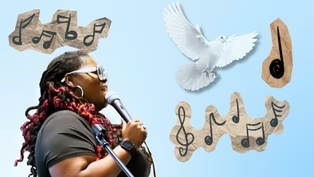
Brittney Turnipseed> A lot of the inspiration that I have comes from a mixture of the secular and the sacred.
Church music is very influential, especially listening to, like, The Clark Sisters, Yolanda Adams.
When I was growing up, I went to Bethlehem Baptist Church.
And so, I didn't realize, like, how influential the singers we had there were.
And not just like some of the major name singers, like being exposed to people like, Regina Skeeters being exposed to people like, The fruit of the Spirit.
It was an old school group back in the day, Columbia.
So being, exposed to those different voices as well as, like, mainstream artist, my best friend in my head, Jill Scott, Ella Fitzgerald, just, all those things kind of coalesced to kind of make who I am as a musician or as a singer.
Claudia Banks> For the up and coming creative that sings, and songwriter and everything like that, what piece of advice would you give them?
Brittney Turnipseed> Do everything now.
Do all the things now.
Don't be afraid.
Don't think, Well, I'll do it when I've got more experience, or I'll do it when I've got more, this behind my name, but do it now.
Do it afraid.
Do it nervous.
Do it scared.
But just do it.
And take the chances, like Ms.
Frizzle use to say, "Take chances, make mistakes, and get messy."
TréDay> What is the South Carolina music scene to you?
What has been your experience?
Brittney Turnipseed> Oh my God, it is wealthy.
I mean it is full and saturated of talent.
I think sometimes as a native, we can get jaded because we are so used to hearing good music.
We are so used to hearing good singers, good writers, good producers.
And I think a lot of times people think, I've got to go to become, I've got to go here, I've got to go to Atlanta, I've got to go to New York.
And it's like, no, baby is right here.
TréDay> All right, guys.
Well, that was "The Auxdacity" media pass.
Remember to have "The Auxdacity" to leave your mark.
We're out!
Kennedy Alexander> As I'm always like wondering like when I talk to like, songwriters or other storytellers, like, what's your, like, writing routine like?
I'll start with you, Nikky.
Like, what's your writing routine?
What does that process look like for you?
Nikky Finney> I write everyday.
<Okay> I don't write the same thing everyday.
I don't work on the same thing everyday, but writing is a discipline.
I don't, I always talk to my students about you play the tuba, you run.
You know, why when you come in my classroom as a young poet, do you think that there's not a discipline attached to this act, right.
So, I like that my muscles are ready to, like, do the work of being a poet.
That's really important to me.
But in terms of inspiration, in terms of being in the world, I love the out of doors.
I was born by the Atlantic Ocean.
My grandparents had a farm up in Newberry, South Carolina, so I went from the extremes of a mountainous environment to the ocean environment and those kind of, play a really important, part in who I am as a poet.
But what I really find inspirational is the visual.
I'm a really visually inclined human being.
So as I walk in the world, if I take in something that really just kind of stays with me when I get back home, I want to try to describe that in as much detail as I can when I'm writing about it.
I don't, I believe that in the specific is the universal, not the other way around.
Sometimes people tell you, oh, well, write universally and then everybody will be able to understand your story.
I don't, I want to write specifically about my mom dressing to go out on a date with my dad, spring, a certain kind of perfume before she goes out, right.
Your mom doesn't have to have that perfume in her cabinet, but what you get is your sensory involvement in the moment, your sensory involvement in the storytelling.
And that is a very detail, moment.
And poets, I think, have to really forget the people on your shoulder, right.
The editors who say, "Well, that's a very, Chanel Number Five is a very specific perfume."
I say, "Yeah, but, that's what my mom, that's what she put on."
<Yeah> Now your mom might wear something else.
<White Diamonds> or a powder Yeah, right?
<White Diamonds> Exactly.
But you don't have to say, "Well, I don't know.
I can't enter that poem because my mom didn't do that."
We are human beings who are led by our senses and by our memories.
And that's where storytelling comes in, you know, every step of the way.
So, I get home, I'ma always have a piece of paper or a notebook I don't write on my phone.
That's just my generation.
I love, I love a pencil.
I love how it smells.
I love how it feels on the page.
And so that's my process for doing that.
And I want to catch the image, the metaphor, the symbol, because I know that's the door, the window that will bring me into the heart of the poem.
Courtney Thomas> And I think art is just an incredible tool for helping us build empathy.
And that's something that's really interesting to me, because how do you teach people how to bring those sensory moments into their, composition, into their songwriting?
So can you talk a little bit about how you inspire young people to bring themselves into their work?
Dan McCurry> Yeah.
So, when I work with students now, I just say, hey, listen, I am totally open to you writing a composition or a piece.
You just bring me your ideas and I'll try to help you sift through them and see what might work the best.
So once they do that, I've got these rules that I just kind of realized through teaching and have done, probably done 150, 200 songs and compositions with students.
The rules that I ended up with, for writing something that's probably pretty good are be interesting, be memorable and be something people want to hear again.
And if you can check those boxes, you've probably done something pretty successful.
And that's something, are there exceptions?
Yeah, of course.
But when I'm trying to teach somebody, I just want them to be, you know, start out by like, I need to write something.
And that seems pretty, pretty successful and can connect with people.
And then as time develops, they'll figure out their own rules and what resonates with them.
But I'm just trying to give students, like, a good starting point.
Courtney Thomas> Yes.
Good foundation.
Kennedy Alexander> And so, before we wrap, Titus, you know, you being from Charleston, also, you're aware what's going on in the world.
How does your artistry, your storytelling blend kind of like with what's going on culturally, Titus Davis> I feel, you know, when you gave the intro, at first you mentioned about turning your volume up on your story.
And I think, you know, Nikky made a great point that sometimes you can't tell other people's story.
So sometimes from the world aspect, the world may be saying, hey, all was going on.
And I'm like, I don't know what's going on in California and New York.
I only know what's going on in Charleston.
<Yeah> So when I write, you know, my goal is to give people insight and to turn the volume up on what I know about the issues that I see.
You know, like, you know, in Charleston area, you know, I've seen a lot of displacement.
I've seen a lot of inequality, I've seen a lot of, you know, things happen that forced close family members to me out of their areas because they said, "Oh, the water system is not working, so we can't live here."
But then as soon as they push those people out, they find a way to redo the water system, and now they can come build high rises and people from New York and move down and live there.
So, I think when it comes to writing poetry, I'm just trying to tell my story and like, again, I just feel like I always have to make sure I'm doing my research to give truth behind it.
I want to entertain you, yes, but I also want to educate you.
And I feel like in that process I want to have the metaphors, the similes.
I want to be able to make the words sound good and flow good coming off my tongue.
At the end of the day, I want to make you think as you're feeling good.
<Yeah> SheJay T.O.> So next question.
In that process and that research that you do, to be able to tell the truth, like, who are some of the storyteller or poets before you that influenced you?
And anybody can actually answer that, as well.
Titus Davis> For me, I grew up a Nikki Giovanni fan, basically because my sisters and my brother was.
But honestly, my brother and my sister was my most influential writers because I saw them write.
I saw them live about what they write about, and I saw my, like, my sister was like, my family's poet.
So if somebody passed away, they want her to write a poem; somebody's birthday, they want her to write a poem.
Somebody just graduated from college, she was like the poet for every situation, and she was so good at it.
Me, I'm horrible at that.
I can't, like people can't give me a moment on Thursday and write for something on Saturday.
No, it takes me too long to go through my process.
But it's something about her writing that I'm still reading today poems she wrote years ago and finding newness in it.
And I think that's beautiful, knowing that I can kind of ask her two questions, and we're not studying it in a English class about somebody who passed away, and we can't ask them questions.
<Yeah> So my sister would probably be my most influential storyteller.
SheJay T.O.> That's dope.
Kennedy Alexander> Man, listen, this has been a really, cool conversation.
I want to thank y'all, like, for having you guys on the show.
Huge thanks to our guests for joining us, and to you for tuning in to "The Auxdacity."
Make sure you follow us on social, subscribe on YouTube, and catch us on S.C.E.T.V.
and South Carolina Public Radio.
Courtney Thomas> And don't forget, we've curated a Spotify playlist today.
For today's conversation, search "The Auxdacity" and listen along.
Kennedy Alexander> Listen and have "The Auxdacity" to leave your mark.
♪ You're gorgeous, You're gorgeous, You're beautiful.
You're gorgeous, You're gorgeous, You're beautiful.
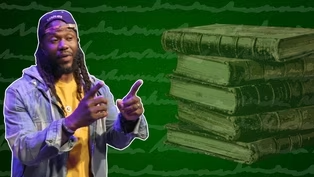
My sisters, why try mixing beauty with perception, seeking perfection when clearly you've crossed that line into deception.
Now conception.
See, you've faked it so long you've lost all sight of realization.
For now, what you see patrolling the streets, TV screens, internets and books got you shook.
For society has took all of your innocence.
Faded self-esteem, now you all displeased with your looks.
See, unhappy physically, you have fallen into a pit.
Now your consciousness has just took a hit.
You ready to quit for your love of self ain't legit, So you throw a fit 'cause the rumor going around says your complexion just ain't it.
See now your stocks are dropping and you feeling a great depression you're worth is lessening and all the negativity is festering.
So with gesturing in the way you carry yourself, it's clearly implied that your beauty is in questioning.
Now think about that.
Is your beauty in the eyes of the liar backstabber and deceiver or is truly your beauty in the eyes of you, the beholder?
See, someone should have told you about your ancestral line when dark chocolate was the normal.
See, sun-baked skin that glistened like pure gold, never old, but royalty.
Just listen as the story is told.
See, queen is in your blood.
Truly of a goddess, an icon.
And I can go on, but what's beautiful is the skin you got on.
So flaunt on the complexion that was given by The Creator of all beauty and everything living, because you're reflecting the one you believe in.
So quit grieving and blossom into that rose that you are and spring forward into your season of being beautiful to you.
For what I'm seeing is the epitome of love in way your skin is shining, redefining society's description of skin color and how dark skin needs to be lightened and that's just frightening.
So allow me to enlighten you and perhaps take it a little deeper.
Let's go inner.
But, your purity of heart and being a peacemaker, not a faker, but you hunger for righteousness, only trying to please your father, not your partner 'cause in that, those cats truly might depart you.
But otherwise God will even place you on a cover of a magazine entitled "Yahweh's Covergirl."
See, timeless beauty, black diamonds, the African beauty of voluptuous black pearl.
See, sometimes despised by this world.
Truth be told, they desire to be with and like you, amazing Black girl!
See spiritually illustrious, no need for referral.
So take a bow, my Black sisters.
Take a bow, my Black sisters.
For you're beautiful, beautiful beyond words!
♪ closing music ♪ ♪ ♪ ♪ ♪
Video has Closed Captions
Clip: Ep5 | 2m 32s | Brittney Turnipseed, a South Carolina musical artist, opens up about her journey in music. (2m 32s)
'Yahweh’s Covergirl' - Titus Davis
Video has Closed Captions
Clip: Ep5 | 2m 27s | Titus Davis delivers “Yahweh’s Covergirl.” (2m 27s)
Providing Support for PBS.org
Learn Moreabout PBS online sponsorship











Support for PBS provided by:
The AUXdacity is a local public television program presented by SCETV
Support for this program is provided by The ETV Endowment of South Carolina.