
Mackinac Policy Conference, Memorial Day, ‘Detroit We Dey’
Season 7 Episode 52 | 26m 46sVideo has Closed Captions
The Mackinac Policy Conference, Memorial Day, the “Detroit We Dey” film and weekend events
Hear what’s planned for this year’s Detroit Regional Chamber Mackinac Policy Conference. Three U.S. military veterans talk about the importance of the Memorial Day holiday and how they individually commemorate. A Detroit filmmaker showcase the city’s Nigerian community in a short film “Detroit We Dey.” Plus, check out events happening around the city on “One Detroit Weekend.”
Problems playing video? | Closed Captioning Feedback
Problems playing video? | Closed Captioning Feedback
One Detroit is a local public television program presented by Detroit PBS
Mackinac Policy Conference, Memorial Day, ‘Detroit We Dey’
Season 7 Episode 52 | 26m 46sVideo has Closed Captions
Hear what’s planned for this year’s Detroit Regional Chamber Mackinac Policy Conference. Three U.S. military veterans talk about the importance of the Memorial Day holiday and how they individually commemorate. A Detroit filmmaker showcase the city’s Nigerian community in a short film “Detroit We Dey.” Plus, check out events happening around the city on “One Detroit Weekend.”
Problems playing video? | Closed Captioning Feedback
How to Watch One Detroit
One Detroit is available to stream on pbs.org and the free PBS App, available on iPhone, Apple TV, Android TV, Android smartphones, Amazon Fire TV, Amazon Fire Tablet, Roku, Samsung Smart TV, and Vizio.
Providing Support for PBS.org
Learn Moreabout PBS online sponsorship- [Narrator] Just ahead on "One Detroit," we'll hear what's planned for this year's Detroit Regional Chamber Mackinac Policy Conference plus three US military veterans talk about the importance of the Memorial Day holiday.
Also ahead, a Detroit filmmaker showcases the Nigerian community for a PBS digital series.
And we'll share some ideas on holiday weekend activities in Metro Detroit.
It's all coming up next on "One Detroit."
- [announcer] From Delta faucets to Behr paint, MASCO Corporation is proud to deliver products that enhance the way consumers all over the world experience and enjoy their living spaces.
MASCO, serving Michigan communities since 1929.
Support for this program is provided by the Cynthia & Edsel Ford Fund for Journalism at Detroit Public TV, the Kresge Foundation.
- [announcer] The DTE Foundation is a proud sponsor of Detroit Public TV.
Among the state's largest foundations committed to Michigan-focused giving, we support organizations that are doing exceptional work in our state.
Visit DTE foundation.com to learn more.
- [announcer] Nissan Foundation and viewers like you.
(smooth music) - [Narrator] Just ahead on this week's "One Detroit," in recognition of Memorial Day, a group of veterans talk about their time in the military and how they honor their fallen comrades.
Plus, a Detroit filmmaker shares the story behind her short film, selected for a PBS series about life in the Midwest and Peter Whorf and Cecelia Sharpe of 90.9 WRCJ have a rundown of holiday weekend activities in Metro Detroit.
But first up, the Detroit Regional Chamber's Annual Mackinac Policy Conference takes place next week.
Business, policy and community leaders will gather on Mackinac Island for important conversations on issues facing the state.
Zoe Clark, Michigan Radio's political director and One Detroit's newest contributor, sat down with Chamber CEO, Sandy Baruah and conference chair, Matt Elliot, President of Bank of America Michigan for a preview in this future of work report.
(upbeat music) - So, for folks who are new to Michigan or haven't heard of the Mackinac Policy Conference before, what is it?
Why does it matter?
- So the Mackinac Policy Conference is unique.
It's a terrific asset that the Chamber happens to be stewards of, but it's essentially Michigan's senior management retreat that takes place on an island where we have you sequestered with no cars, mediocre cell phone reception.
But a management retreat in the sense that we're bringing together academic leaders, business leaders, civic leaders, obviously political leaders, to be in one place at one time to really address the opportunities and challenges that Michigan has before us.
What are we gonna do about these opportunities and challenges?
And the great thing about it is is that all these leaders are there.
I mean, these are all C-suite leaders and they're all accessible.
If you're media, if you're a fellow attendee, everyone's accessible on equal terms and relationships are created, discussions are had that would take months to schedule individually.
But you can have dozens of them in the span of an hour.
- Matt, as chair of the conference, you get to put a big imprint into the theme.
And the theme this year is "The Power of And," tell me about that and how you're thinking about that theme.
- Well, as Sandy mentioned, this is a conversation amongst business leaders, civic leaders and others, that in the current environment is very often framed in either or terms.
Okay, you're a Democrat or Republican, you're left or right, you're Spartan, Wolverine.
But we all know from a lot of personal experience, and all of us have this, is that the best ideas, the best solutions come when multiple points of view are brought to the table, sometimes after a really healthy debate.
And so what we wanna do is leverage that power of and, bring some concepts together that may have some constructive tension to them and see if we can drive forward for better solutions for everybody.
- Here at "One Detroit," the future of work is something we talk a lot about.
Talk to me about the future of work and how that might intertwine into these conversations up at the island.
- We will cover the future of work in several different ways.
The most obvious one is we'll talk a lot about talent.
And one of the things we're gonna do, not only in this session but others, is try to do a level set with some data.
We'll also talk about things like electrification and the transformation of the automotive and mobility industry, which will have a huge impact on all of us in Michigan.
- Help me understand, for someone living right now in Detroit and southeast Michigan, who isn't going to the island, how what is happening on the island could affect daily lives in the future of Michigan?
- So I'd say two things.
First of all, what happens on the island doesn't stay on the island, it is the opposite of Las Vegas.
First of all, the sessions are streamed so what our audience is seeing when you're sitting in that main theater room listening to either Bill Ford or Liz Cheney or Fareed Zakaria or Santa Ono, you can watch for free, thanks to our partnership with Detroit Public Television.
The second thing I would say is that the conference has a great history of working on long term challenges that eventually come to fruition that affect all of us.
Example one, outside these windows you can see the building of the Gordie Howe Bridge, that is something that the conference and the Chamber worked on for literally 20 years, highlighted at the conference.
The car insurance reform bill was signed at the conference in 2019 celebrating a bipartisan win in today's very non-bipartisan environment.
The final pieces of the grand bargain that got Detroit through the municipal bankruptcy were sealed at the conference.
So there's a whole history of things, both big and small, that kind of come to fruition or get their roots started at the conference.
- This is going to be the first conference in well, ever, where Democrats are running the show in Lansing, right?
The governor, both chambers of the legislature, has that changed the dynamic as you put this conference together?
Or expectations of what might happen with this sort of trifecta?
- Regardless, who's in control, if it's the Rs or the Ds, we try to program the conference in a very bipartisan way.
We take pride in the fact that the Detroit Regional Chamber is a bipartisan business organization, we work with and equally are offended by both sides of the aisle.
The way it does change is that obviously when you have Democrats in control or Republicans control, you'll see more of that party on stage.
Like for example, our governor and the mayor of Detroit, both Democrats, they're gonna be featured.
If they were Republicans, you would see them as Republicans.
- Matt, what are you most looking forward to from the conference this year?
- I'm very excited about a lot of the speakers.
I have our CEO, Brian Moynihan, coming.
He'll talk about how the power of and impacts our company and the work that we do around the world.
Liz Cheney, we've mentioned, will also be there.
And what we're hoping is that those speakers, but also many of the panelists, drive a dialogue that sounds different and lasts longer frankly.
And as Sandy said, should go beyond the porch, should go beyond the island because we really want to sort of start conversations that drive forward for more ands for the state of Michigan.
- Sandy, what are you most looking forward to?
- I am really looking forward to this kind of this umbrella theme that Matt has created about the power of and, knitting things together.
We need to move as Michiganders away from trying to address our challenges and address our opportunities through purely a programmatic approach.
We need to set an umbrella.
What is the culture in which these programs are taking place?
What is our North Star?
So tying together or weaving together these multiple ands to create a bigger picture for a bigger strategy.
- [Narrator] And Detroit Public TV will provide live coverage of the Mackinac Policy Conference at onedetroitpbs.org beginning Tuesday, May 30th.
Plus a special one-hour episode of "One Detroit" from the conference airs on June 1st at 7:00 PM.
Let's turn now to the Memorial Day holiday coming up on Monday.
It's a day to recognize the men and women who gave their lives for this country.
"One Detroit" contributor, Bryce Huffman, spoke with three military veterans about what the holiday means to them.
(smooth music) - Since 1868, Memorial Day has been a time to honor fallen soldiers from every branch of the US military.
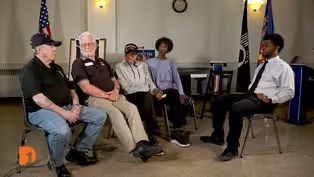
At the VFW, or Veterans of Foreign Wars, Post in Royal Oak, we sat down with three veterans to talk about how each of them commemorates the holiday.
So Houston, tell me again, how did you begin serving?
- How did you begin serving in the Army?
- I began to serve in the Army, in 1943, when they drafted me.
- [Bryce] This is Houston Pritchett, a 103-year-old World War II veteran and his daughter Deborah.
Pritchett is hard of hearing, so his daughter helped relay my questions.
To his right are Mike Sand and Phillip Smith, both are Vietnam veterans.
And Mike, how did you begin serving?
- I was drafted and rather than be drafted, I enlisted in the Air Force for four years as opposed to two.
- All right.
And how about you, Phil?
- The draft was going on.
My neighbor, a friend of mine, came to my door, knocked on it and said, "What are you doing?"
I said, "We're going to work."
He said, "No, you're not.
Let's go down to the Marine Corps and join."
And I did.
- So tell me, when you first joined, how did friends and relatives respond to that?
- Friends and relatives didn't respond too good, when I first went in the Army.
They were kind of upset.
- Why is that?
- I never did get around to figuring that out 'cause I was scared about going.
- And when you joined, what did people think in your life?
- Well, of course the '60s was a difficult time.
You had the, the Peaceniks and the Patriots.
And my father was World War II, my uncles were Korea, and I felt it was my obligation to serve and I figured if I was gonna serve, I'd gain something out of it, so the Air Force was kind enough to accept me and a lot of my friends.
I was kind of drafted when the war was really picking up, 1967.
And I had been dating my high school sweetheart for two and a half years.
And rather than be drafted, I joined.
So I said, "I won't be back for four years.
You think we should get married?"
And before I said married, she said, "Yes."
So we married right outta high school and spent four years together in the military.
- Nice.
And how about you, Phil?
How did people in your life respond?
- Well, it's kind of funny because a recruiter thought I wasn't old enough, wasn't 18.
And I was, and he told me I had to get a signature from my parents to go in.
I said, "I'm already 18," "Doesn't matter.
You don't look old enough."
So I got my stepfather to sign the paperwork.
My dad was already in the Army, he was still in the Army.
He was a POW, prior World War II.
And he was proud.
He didn't think I would ever make it in the Marine Corps 'cause of how they are.
But I got through the basic and went on.
So, but everybody was proud.
- Tell me about a friend you served with, who unfortunately didn't get to make it back home.
- I was involved in the air war, spent time in Thailand and we did the bombings of North Vietnam, Laos, Cambodia, Operation Rolling Thunder.
We lost many pilots, many pilots.
We had two reconnaissance aircraft crash.
One had 19 guys on board, the other one had 21 guys on board.
So there's a lot of folks on the Wall that I didn't have personal contact with, but they're with me today.
So I can just say that I'm sad.
I'm sad about it.
- [Bryce] Veterans are sometimes filled with survivor's guilt, feeling bad that they came home while others did not.
Smith says instead of feeling guilty, he just remembers those who didn't come home.
- And I, well, you continue on.
And I dealt with a lot of veterans.
The job I had, I was a veteran service rep. And you deal with those all the time.
And you still remember some of 'em, a lot of them, especially members in your organizations that have passed on.
- All right.
And how about you, Mike?
Did you ever deal with survivor's guilt?
- Well, I'm glad to be here and I feel for those who haven't.
I've been to the Wall twice in Washington DC.
We named my VFW post after World War I guy and a World War II hero.
And I guess you could say we feel guilty because we're here and they're not.
But we did what we had to do and that's why we served the manner that we do.
- Did you ever experience that?
And how did you process that?
- Did you experience survivor's guilt?
And if you did, how did you handle it?
- No, nothing to be feel guilty about, I didn't figure.
I was doing the best I could to get a job done and come home to my family.
I didn't feel guilty about it at all.
- How do you honor your fallen comrades and other veterans in your everyday life?
- Just to get down to it.
I just let the everyday life go on.
Nothing I could do about it.
I've done the best I could and I'm glad it's over and hope nothing like that don't happen again.
- And I just have one more question, how do you personally celebrate Memorial Day and why is it important?
- Memorial Day is a day of remembrance of those who have went before us, the ones who have fallen.
I celebrate, I guess I go to Memorial Day Parade in Dearborn.
I'm part of that, probably the last, I don't know, 10, 12 years or more.
- I encourage people to go out and celebrate Memorial Day, not just shopping at the store, not just having picnics, not just get together, but appreciate what we call the Guardians.
And I don't care if the Guardians are your police and fire, your National Guard, Homeland Security, our military people.
They put their lives on the line and we're gonna be participating in the St. Clair Shores 70th Parade.
They honor veterans like you wouldn't believe.
There's 14 conflicts that Detroiters have served in over the years and were not appreciated.
We have the Montford Point Marines, we have the Tuskegee Airmen, we have the Triple Nickel Airborne fellas, we have 1500 Junior ROTC cadets march in our Veteran Day parade.
Why aren't they being recognized?
And I'm asking the city of Detroit to help us provide a Veterans Memorial in the city in a prominent place, so we can recognize all these people and encourage our young Junior ROTC cadets and our young Marines and our Air Force cadets.
Because the service, I will tell you, the service probably saved my life and I've gained so much from that and I'm giving it back.
- [Narrator] Detroiter Ozi Uduma is among eight emerging filmmakers of color whose work will be featured in the Homegrown Future Visions Project, now streaming on PBS.
The project showcases short films about the histories, cultures and prospective futures of the Midwest.
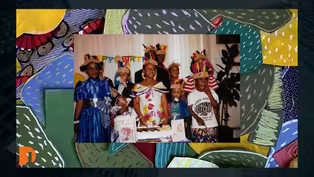
Uduma's film, "Detroit We Dey" examines the history and future of a social club founded by Nigerians who immigrated to the city in the '70s and '80s.
"One Detroit's" Bill Kubota spoke with her about the story behind the film.
(smooth music) - Right now it start with the adults to do their new year or end of year.
And you know what that means?
It means dance, dance, dance and dance.
- [Bill] "Detroit We Day," a short PBS film about the lives of Nigerians in Detroit, preserved in snapshots and on VHS tape.
- To the uninitiated, this is an extremely chaotic scene, but for me, this is what it means to be Nigerian in Detroit.
The title is basically Nigerian English or Nigerian Pidgin and it's just essentially rough translation of "Detroit, we're here."
Of all the places my parents, aunties and uncles could have immigrated to, they chose Detroit.
It was my way of fusing both one part the Nigerian community, and also like the kind of throw to acknowledgement of Detroit, I should say.
They came to a place that was the complete opposite of where they grew up.
I'm really excited for the larger community to see the film because they.
- [Bryce] Detroiter Ozi Uduma directed "Detroit We Day."
- There has been a lot of like just pride and happiness around the existence of this film and some type of documentation of the history of the community.
- [Bryce] The Nigerian diaspora, many immigrated to the United Kingdom and places across the US.
- Outside of Detroit, we have everywhere from Chicago to New York.
Houston, Texas is the one that is like, I would call the headquarters of the Nigerian diaspora, Atlanta, LA, so the Nigerian diaspora is pretty big.
But in terms of Detroit, a lot of folks came to Detroit because of the educational opportunities.
So a lot of the elders in my film went to Wayne State.
- We don't know anybody here.
We don't have family here.
I've never been in a big city before.
So it was scary, of course.
- [Film Participant] It became obvious to many that were here to stay.
- [Bryce] Military oppression in the old country had worsened.
Through their social club, Nigerians here found a way to hold onto their culture.
- The old Bende Cultural Association of Michigan became a pillar of support for new immigrants from the Bende area of Abia state in Nigeria.
The kind of big umbrella organization, the Nigerian Foundation of Michigan was founded sometime in the mid, I think, late '80s, early '90s and so those parties had been going on for a long time.
- And then when they go to these events and then they wear their Gele, they wear their rapa, you see the beauty and the elegance of our clothes.
It also amplifies the beauty and the elegance of our culture and where they come from and who they are.
You know, you kind of you try to navigate two worlds, right?
Because here in this household, you're Nigerian, you're not American.
It's very clear that that's the statement that's said.
But when you go to school, right, you're just a Black kid.
- It is not just the Nigerian community that we're growing up with, but the larger Black community in the Detroit area.
And so for us, it was easier in some ways, I think.
I think there was always fears from our parents that, oh, would people make fun of us because our names are different.
Or the kids eat different foods, we're not sending them to school with peanut butter and jelly sandwiches.
We're sending them to school with rice and plantains and how will the other kids react to our children?
As a majority Black city, it feels like home.
There's so much pride in being a Detroiter of the diaspora.
(native drumming) - [Bill] To be West African in Detroit, there's more awareness now.
The music, the food, it's the internet and social media spreading the word.
- There are a lot more Nigerian restaurants that are very popular in the city.
Turning on the radio and hearing Afrobeats was something that I never imagined would happen as a kid.
I don't have to do too much of the explaining about this community as much, especially to folks who are in the Metro Detroit area.
There's a new generation of young Nigerians in the city using their talents to preserve the work, history and culture of our people.
Now what I've learned as of recent is that a lot of people don't know that there are a lot of Africans in the Midwest, particularly in Detroit.
I don't want folks to fear the fact that there are folks who are immigrants, folks who are maybe not a part of the traditional American story who are here in this country.
- [Bill] In her film, Ozi Uduma asks, "Long term, how can Detroit's Nigerian traditions be kept alive?"
"Detroit We Day" is a start.
- Everybody's story, everybody's histories should be documented.
I hope things like my film can act as a bridge or act as this piece to help connect one family to another family or one potential group of friends to another group of friends.
Because I think those bridges and those connections are very, very important.
- [Narrator] Ozi Uduma's film, "Detroit We Day" premieres June 1st.
Go to OneDetroitPBS.org to learn more.
Now let's look at some of the events and activities coming up in Metro Detroit.
Peter Whorf and Cecelia Sharpe of 90.9 WRCJ have today's "One Detroit Weekend."
- Hi, I'm C Sharpe with 90.9 WRCJ.
- Hi, I'm Peter Whorf with WRCJ.
Cecelia, let's talk about a few things people can check out over the weekend and beyond.
What are you cooking up, C?
- [Cecelia] Well, I've got something good, Peter.
I'm gonna start right here in our own backyard in The Cube at Orchestra Hall, tomorrow night, harpist Brandee Younger will be here paying homage to legendary Detroit harpist Dorothy Ashby and premiering music from her latest album, "Brand New Life."
It happens at 8:00 PM in The Cube at Orchestra Hall.
So Peter, what are you stirring up over there?
- Well, at the DIA, folks can drop into a drop-in workshop on Bojagi.
Generations of Korean artists have made patchwork cloths called Bojagi.
Traditionally, they created these cloths from scraps of fabric found in the home, carefully sewing them together by hand, using them to cover food, wrap gifts or carry everyday items.
Classes are on May 27th and 28th from noon to 4:00 PM.
- The Movement Music Festival is one of the most anticipated events of May.
If you want to keep the music going long after a night at the festival ends, look no further than Spot Lite Detroit.
Spot Lite is the host of the Official Movement Afterparties.
On any given night, you may hear Louie Vega, Ricardo Villalobos, Carl Craig, DJ Minx or Kevin Saunderson.
Catch the beat, May 27th through the 29th at Spot Lite Detroit.
Peter, Memorial Day weekend is also a time to commemorate those who lost their lives.
- That's right.
And Monday, May 29th at 9:30 AM, the Dearborn Memorial Day parade, Michigan's oldest Memorial Day parade, will return for its 97th year, hosted by the city of Dearborn and the Dearborn Allied War Veterans Council.
The parade honors veterans and those who lost their lives while serving their country.
- Friday through Sunday, join the DSO and powerhouse vocalists, Tamika Lawrence, Coco Smith and Blaine Krauss as they celebrate leader, icon and singer, Aretha Franklin.
Performances are Friday at 10:45 AM and 8:00 PM, Saturday at 8:00 PM and Sunday at 3:45 PM.
Peter, you know Aretha Franklin had so many hits, what's one that you can't get enough of?
- Gotta be "R E S P E C T." How about you?
- It's "Ain't No Way."
That's the one for me.
- There's so much happening around Detroit over the weekend.
For 90.9 WRCJ, I'm Peter Whorf.
- And I'm C Sharpe from 90.9 WRCJ.
Here's more of what's happening for this weekend.
Hope to see you around.
(smooth music) - [Narrator] That will do it for this week's "One Detroit," thanks for watching.
Head to the "One Detroit" website for all the stories we're working on.
Follow us on social media and sign up for our weekly newsletter.
- [announcer] From Delta Faucets to Behr Paint, MASCO Corporation is proud to deliver products that enhance the way consumers all over the world experience and enjoy their living spaces.
MASCO, serving Michigan communities since 1929.
Support for this program is provided by, the Cynthia & Edsel Ford Fund for Journalism at Detroit Public TV, The Kresge Foundation.
- [announcer] The DTE Foundation is a proud sponsor of Detroit Public TV.
Among the state's largest foundations committed to Michigan-focused giving, we support organizations that are doing exceptional work in our state.
Visit dtefoundation.com to learn more.
- [announcer] Nissan Foundation and viewers like you.
(smooth music) (upbeat piano riff)
Detroit We Dey film highlights city’s Nigerian community
Video has Closed Captions
Clip: S7 Ep52 | 5m 10s | Detroit filmmaker premieres Detroit We Dey short highlighting the city’s Nigerian communit (5m 10s)
Michigan veterans commemorate Memorial Day
Video has Closed Captions
Clip: S7 Ep52 | 7m 9s | Michigan veterans commemorate Memorial Day with reflection and remembrance. (7m 9s)
One Detroit Weekend: May 26, 2023
Video has Closed Captions
Clip: S7 Ep52 | 2m 49s | Check out some events happening around Detroit this weekend on “One Detroit Weekend.” (2m 49s)
Providing Support for PBS.org
Learn Moreabout PBS online sponsorship
- News and Public Affairs

Top journalists deliver compelling original analysis of the hour's headlines.

- News and Public Affairs

FRONTLINE is investigative journalism that questions, explains and changes our world.












Support for PBS provided by:
One Detroit is a local public television program presented by Detroit PBS