
Macon/Athens, Ga
Season 6 Episode 4 | 25m 34sVideo has Closed Captions
Music Voyager travels into the heartland of Georgia to understand the culture, arts and people.
Music Voyager travels into the heartland of Georgia to understand the culture, arts and people that have helped create the 'sound' of America. From Macon to Athens, the home of Georgia University, this creative corridor of Georgia has spawned the likes of Otis Redding, Little Richards, The B52s, REM and others.
Problems playing video? | Closed Captioning Feedback
Problems playing video? | Closed Captioning Feedback
Music Voyager is a local public television program presented by WLIW PBS
Macon/Athens, Ga
Season 6 Episode 4 | 25m 34sVideo has Closed Captions
Music Voyager travels into the heartland of Georgia to understand the culture, arts and people that have helped create the 'sound' of America. From Macon to Athens, the home of Georgia University, this creative corridor of Georgia has spawned the likes of Otis Redding, Little Richards, The B52s, REM and others.
Problems playing video? | Closed Captioning Feedback
Where to Watch Music Voyager
Music Voyager is available to stream on pbs.org and the PBS app.
Providing Support for PBS.org
Learn Moreabout PBS online sponsorshipBradley: Have you ever had a dream where you find yourself on a stage and you realize you don't know your lines?
What do you do?
Well, for me, this was real.
But after an epic road trip through the heart of Georgia's music scene, I was ready for it.
Because along the way, we learned about crowdsurfing from a violin virtuoso, met the children of an American icon, and felt the spirit of Duane Allman in The Big House.
There were knives.
There were grits.
There was rock 'n' roll.
This is "Music Voyager."
♪♪ Trust the locals... [ Gunshot ] You got one, man, a tree branch right there.
[ Laughs ] ...play with fire... Ahh!
...never turn down a good meal...
Talent!
...because if you let one thing lead to another... Ah!
...the voyage... Ahh!
...never ends.
♪♪ Life is good right now.
♪♪ Athens, Georgia, is a college town.
Conceived and built from its inception as a center of culture and learning.
it's home to the University of Georgia Bulldogs, and these days it's consistently ranked as one of the best music towns in all of America.
To find out why, we start by meeting up with the Athens-born rock band The Whigs.
Bradley: What do you think it is about Athens that kind of lends itself to this sort of creativity?
I know it's got a historic music scene, but what did it do for you guys?
I think, you know, there's lots of places for bands to play.
There's lots of bars in town, and it's easy to get some stage time.
Places like the 40 Watt -- you know, always there.
It's my favorite place to hang out.
Bradley: Like so many other nights, The Whigs are headed to the 40 Watt tonight, a welcome homecoming after nonstop touring.
Bradley: You guys need a sax player?
We don't need a sax player.
[ Laughter ] Riding around with Parker from the Whigs in Athens, it becomes clear that there is a bar or music venue on pretty much every corner.
You're going by some classic spots here.
Coming up here on our right is Georgia Bar.
That's probably the bar that I've spent the most time in.
Going down to the 40 Watt.
Here's where we're playing tonight.
Look at us on the marquee.
Yeah, yeah!
Man: Hell, yeah.
Even for a band that's played "The Late Show" and toured around the world, playing this venue in this town just means something extra.
I kind of get anxiety playing at home 'cause we've played for a lot of these people for such a long time.
It's like I always just want to put on our best show to date for Athens.
Parker: ♪ I know what I want ♪ ♪ I know what I need ♪ ♪ I'll take a little more ♪ ♪ More than you might think ♪ ♪ It's just part of the point ♪ ♪ It's just what I see ♪ ♪ Hit me ♪ ♪ I took a little more ♪ ♪ More than you might think, yeah ♪ Bradley: Parker was right.
They don't need a saxophone.
The Whigs were just fine as three pieces.
♪ So hard ♪ ♪ Hit me so hard ♪ ♪♪ [ Cheers and applause ] [ Mid-tempo music plays ] Bradley: The next morning, The Whigs point me to one of Athens' most well-respected restaurants.
The music scene in Athens and the food scene have always been closely intertwined.
It's just part of life here.
The National also seems to have become part of life here by fusing Southern and Mediterranean food and serving it up in what used to be the garage of a tire recapping plant.
Executive chef Peter Dale keeps the menu fresh.
I see a whole lot of shrimp here.
Yeah.
What's going on?
We're only four hours from the coast, and one of our buddies, Dan, goes down, meets the shrimp boats in the middle of the night, fills up coolers for us, and then they're back here in time for lunch.
So we're peeling fresh Georgia shrimp.
Wow.
We're doing our play on a shrimp and grits.
And then because we are a little Mediterranean, we'll do some Spanish chorizo in there.
Whew!
So, it's sort of a Mediterranean spin on a Southern classic.
Sounds delicious.
Yeah, but perfect for a cool day.
♪♪ Wow.
The shrimp -- you can just taste how fresh it is.
The grits, as well.
They're really finely ground.
Yeah, yeah.
Really creamy.
Really creamy, really nice.
And I can taste the chorizo, like, oil in there.
You guys gotta get in here.
I wish I could just feed it to you, really.
I really wish I could.
Sorry.
Mmm.
[ Laughs ] Peter's obsession with all things local leads to delicious food, but he takes his obsession one step further.
Even his kitchen knives are locally sourced, which is why I'm now in a shed in the middle of the woods, surrounded by some bearded guys wearing leather aprons, holding massive razor-sharp blades.
Peter wants to buy one.
Luke: How does that kind of feel?
Wow, that's cool.
Luke and David at Bloodroot Blades create the coolest-looking knives... We make one-off pieces.
...that satisfy the rigors of the busiest restaurant kitchen and serve as keepsakes by incorporating materials like scraps of cloth that have specific meaning to each knife's owner.
It's really hard to keep Scrappy or grandma's quilt or something around, but it's really easy in terms of a knife.
People use it every day, so it's sort of the perfect combination of nostalgia and pragmatism.
Bradley: Yeah, I was gonna say, it's like a practical heirloom or like a practical sort of memory artifact.
Right.
Kind of rare to find that these days.
Bradley: Okay, quick review.
Peter makes local dishes using local ingredients using locally made knives that are created using local materials.
I feel like I'm in the Middle Ages or something.
And what does this have to do with music again?
I came from a musical background.
I have a degree in cello performance, actually.
My motion on this grinder when I'm pulling a knife across it is a lot the same as me pulling a bow across a string.
And if you hang around Bloodroot Blades long enough, you start to hear actual music in their work.
[ Tools working rhythmically ] It's something you can just get lost in.
[ Tools working rhythmically ] [ Saxophone plays ] [ Rhythmically sounds continue ] ♪♪ Bradley: Okay, that got weird.
I need a drink.
"Musical Voyage," take one.
Bradley: Fantastic voyage.
Kishi: What's this thing?
That is the Rosemary Beach, Florida, with a rosemary simple sirup, gin, and a full grapefruit.
Ah.
Tasty.
Do you actually like it?
I actually like it.
I actually like it.
Yeah.
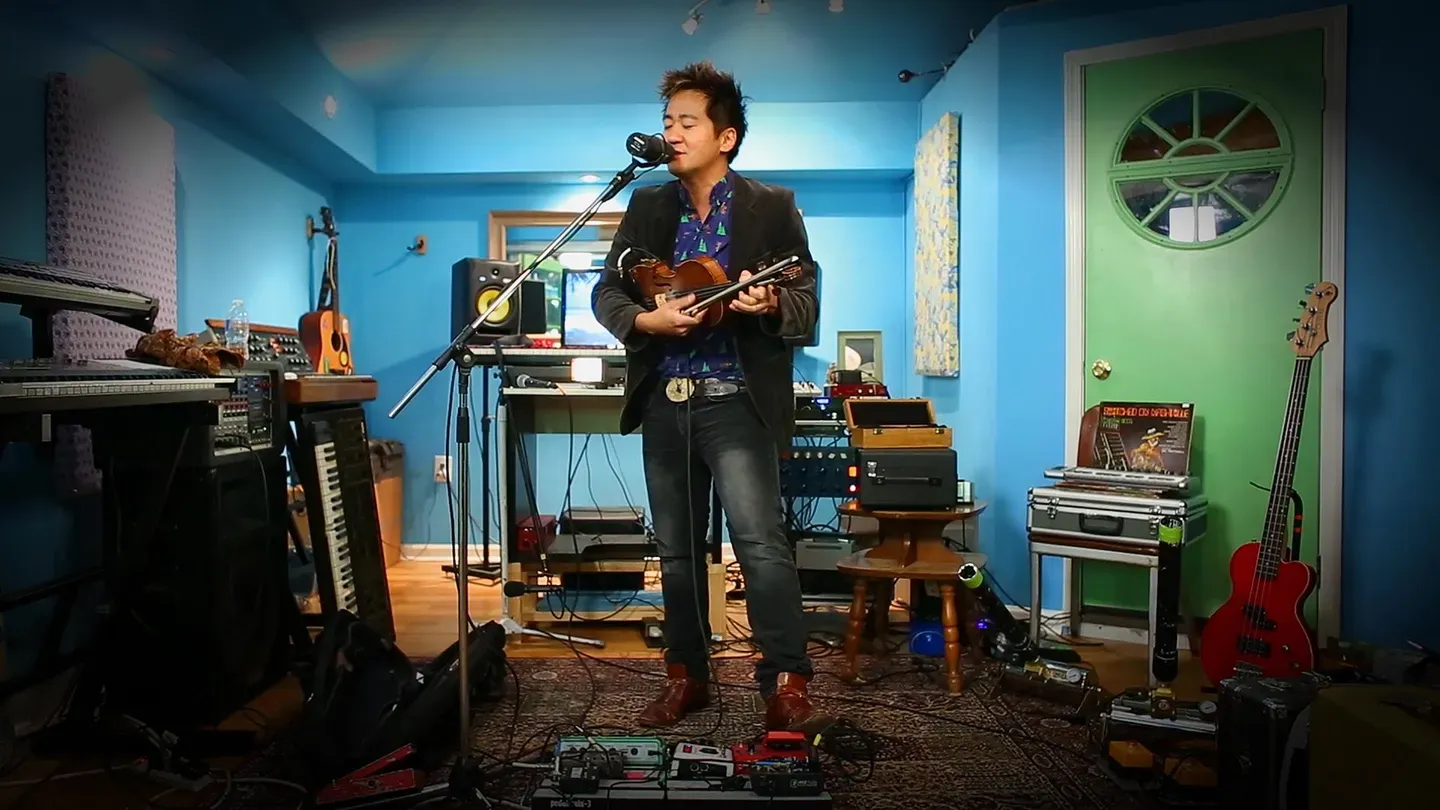
Bradley: This is singer, composer, and violinist Kishi Bashi, who recently moved to Athens and has invited me to his favorite bar.
I have a lot of friends who actually work here.
It's the first sense of like, kind of community that I got.
And it's not just like a bar.
They have, like, fresh-squeezed grapefruits and, like, a pretty cool menu that's just, like, what you want to eat, not necessarily what you should eat.
[ Laughs ] This place and, you know, The National are kind of along the same vein, farm to table.
Yeah, the food culture here is like extremely high.
Kishi Bashi's friends call him "K." He invites me to his house where he's got a new home studio out back.
So what about the town did you fall in love with?
For the small town that it is, that it's got this really vibrant music culture and there's professionals here that I work with all the time.
Ironically, K doesn't even need other musicians to create a room full of music, using just his voice, his violin, and some other effects pedals.
[ Philosophize In It!
Chemicalize With It!"
plays ] ♪♪ ♪ I fell in love with you the only way I know ♪ ♪ I went for many miles until I couldn't go ♪ ♪ Concerned but anyways ♪ ♪ I didn't even know about you and me ♪ And apparently K has learned, even as a violinist, how to play at rock-'n'-roll venues.
I like standing, like, really close, like crowds that I can, like, crowdsurf and stuff.
Hold on, hold on.
You've crowdsurfed?
Yeah.
Yeah.
There's a whole tour where I did an all-crowdsurf tour.
God.
It's really easy.
You say, "Hey, I'm going to take a picture."
And then they all kind of come up and then you're like, "Sike!"
And now I'm on you, you know?
♪ Picture our wedding, it'd be summer sour and summer sweet ♪ ♪ We'd paint the ceiling red ♪ ♪ We'd go to the Greek and straight to the street ♪ ♪ Concerned but never bleak ♪ ♪ We'd find the day about you and me ♪ ♪ And with our eyes we shall see ♪ Your music is dancy, but it has a lot of emotion.
You know, you're singing, and just some of those, like, long, sweeping, kind of dreamlike movements in them.
And it's really nice to listen to.
♪ It's you ♪ ♪♪ Bradley: K's move to Athens, has given him the space to spread out that he never had in New York City.
But it's also kept him connected to his musical community, both fellow musicians and great venues, such as the recently rebuilt Georgia Theatre.
It's a historic music hall that tragically caught on fire a few years back.
Bradley: It's crazy.
You can see, like, the charbroiled, like, wood slab that's hanging over and an old doorway.
Sounds delicious.
[ Laughs ] A few blocks away is another large music hall, the Classic Center, which tonight hosts one of the country's hottest touring bluegrass bands, Old Crow Medicine Show.
Down in Georgia today!
♪ Well, come on ♪ ♪ Whoa, whoa ♪ ♪ Well, come on ♪ ♪ Whoa, whoa, whoa ♪ ♪ Yeah, come on ♪ ♪ Whoa, whoa, whoa ♪ ♪ Come on ♪ Bradley: I heard Athens was a great music town, but seeing it firsthand has blown me away.
But a music scene like this doesn't happen overnight.
So, what's the deal?
How did this all start?
[ Mid-tempo banjo music plays ] Folk music historian Art Rosenbaum offers some clues.
And a song.
Here in Athens and almost any other southern town, there were vernacular musicians who might play at a house party or a fish fry or a square dance and not have aspirations of becoming part of what we now call the music industry or the music business.
They made music for family and community.
♪ People around here treat me like a dirty dog ♪ ♪ Oh, people around here treat me like a dirty dog ♪ ♪ Make me sleep down in the hollow log ♪ Bradley: Art's connection to the Special Collections Library at the University of Georgia leads to another clue.
Apparently, by the 1970s, there was a new kind of vernacular musician in Athens -- the art school party kid.
Michael Lachowski was one of those kids.
In 1979, it was pretty much the Old South.
And on campus there was a really vibrant scene at the art school.
There wasn't much to do, so we kind of made our own scene From this party scene sprang a little band called the B-52s, whose beehives and campy dance rock propelled them into the national spotlight.
It kind of came in a little bit after the B-52s because they hit it big with their first single and they just took off and moved to New York.
Our band, Pylon, kind of filled the void there.
We were really known for a kind of minimalism and a particular kind of beat that ended up being very danceable.
When R.E.M joined this growing musical movement and became one of the biggest bands in the world, Athens was pushed into another musical stratosphere.
R.E.M.
-- to their credit, they got real big, they stayed here.
So, you know, Athens started turning into something starting around that time that Pylon broke up, around 1984.
Just as I'm starting to feel like I understand the Athens music scene, Michael shows me something that changes everything.
What?!
Did you see this?!
What is this place?
Michael: Somewhere in here they're keeping up with, like, Georgia music history, including my band, Pylon.
Well, if my music ever got into some sort of archive, I'd be completely humbled and beside myself.
And old.
[ Both laugh ] Wandering around these massive vaults, I can feel the weight of Georgia's rich music history.
And I'm realizing that to understand music around here, I have to see cities like Macon, where Otis Redding, Little Richard, and the Allman Brothers exploded onto the world stage.
How could so much influential music have sprung up in one place like that?
I got to hit the road and find out.
♪♪ Want some peanuts?
I mean, that's why we stopped.
So, how did boiled peanuts even start?
I have no idea.
It's just like a bean, a salted bean.
Could make a dip out of it.
That'd be banging.
Arriving in Macon, you can feel life slowing down just a bit.
♪♪ It's a quaint little town full of classic large Southern homes and churches.
I want to find out why this town has nurtured so many fine musicians over the years.
And I think I've got the right guy to show me.
How are you doing?
Hey.
Good to meet you.
Good to meet you, too.
You're totally my hair twin.
Nice hair, man.
This is ridiculous.
This guy, Roger Riddle, is a local music journalist and deejay.
We meet up in an old soul food joint in the middle of town.
This was the place where the Allman Brothers used to hang out and eat.
Really?
And Mama Louise, she would feed them.
And as the story goes, the guys sat down, the whole band came in one day, and they ordered two plates of food for like six guys.
And Mama Louise was like, "Oh, we can't have that."
So she fed the whole band and whenever they got hungry, they would come here, she would feed them, they would go off, they would do their show, make enough money, come back, and pay for the food they ate.
That's so great.
And years down the road, they showed how much they appreciated it when they took her on tour with them to be their personal caterer.
Seriously?
Yes.
If you want to get the true H&H experience, you got to have the fried chicken.
You're speaking my language right now.
Fried chicken is my language.
Let's do this.
Right on.
Oh, boy.
Oh, boy.
You got to try the macaroni and cheese.
The collard greens are good.
The succotash, you can't go wrong.
In fact, you just can't go wrong.
You just can't go wrong.
You can't go wrong.
I love a place where you can't go wrong.
I'm going to take a five-minute break.
[ Laughs ] Bradley: Incredibly, Mama Louise is now in her mid 80s... Hey, Mama Louise, do you mind if we join you?
Help yourself, darling.
Thank you.
...and is still at the restaurant almost every day, making sure that its new owners keep using many of the recipes that she's refined in her 70 years of cooking.
This is happening right now.
This is very typical of what a meal was like if you're at home with your family in Macon.
I'm gonna try the succotash.
Oh, yeah.
The lima beans, corn... Corn.
...tomato, all stewed together.
Yes.
A little onion in there.
Little onion in there?
There's some special seasoning.
Yeah, yeah, you can't even tell me.
You'd have to kill me, right, kind of thing?
Right, right, right.
[ Laughter ] Mama Louise told us how to do it.
Thank you.
Thank you for sharing your knowledge of cooking.
You're welcome, darling.
Bradley: The Allman Brothers didn't just eat in Macon.
They lived here, in this house specifically.
Schenck: The reason it's called The Big House is because it was the biggest house they'd ever seen in 1970.
As the base of operations for the Allman Brothers from 1970 to '73, The Big House was the launch pad for the band's rapid ascent to fame.
This is where they sat, listened to music, played a little bit of music, chatted, and got to be, you know, just normal human artists.
Did they do a little something else, too?
You know, there may have been a little partying going on.
You know, there's a seven-head shower.
Some people got cleaned in the shower.
Some people may have gotten dirty in the shower.
Who knows?
[ Laughter ] It's a special place.
Now a museum, The Big House tells the story of a band on the way up, but also that of a tightly knit group of people whose closeness would soon be tested.
And one of our prized possessions is this beautiful Goldtop Les Paul that was Duane Allman's.
[ Guitar strumming ] Duane Allman was famous for his silky smooth lead slide, a sound that helped launch Southern rock as a commercial genre.
Rolling Stone has even named him the second greatest guitar player of all time, behind only Jimi Hendrix.
But Duane tragically died in a motorcycle crash in Macon just two years after forming the band with his younger brother, Greg.
[ Guitar playing rock melody ] ♪♪ Guitarist J.D.
Simo pays homage on the very Goldtop Duane played.
♪♪ ♪♪ ♪♪ ♪♪ One of Macon's other great musical icons also passed away far too young.
Otis Redding was killed in a plane crash at the age of 26.
But his children live on keeping the family name and foundation alive and well.
I know that when Papa Otis passed away, you guys were pretty young, But what kind of person do you get a sense that he was?
Very loving, very caring.
He let the kids get away with everything.
[ Laughs ] I was so young.
I was only 3.
And he was buried on my fourth birthday, so I really wasn't aware of very much of what was going on.
Education was very important to him.
And we know that that's what he would be doing today if he were still alive.
He would not only be doing the great music that he that he did, but he'd really be pushing education and music and arts programs in his community and beyond.
What about Macon do you think drew the soul singer out of him?
You know, Macon is known for having a lot of churches.
And, you know, my father sang in the church, came from a very, very religious family.
And I'm sure that that had to have a lot to do with pulling -- you know, putting a lot of soul into him because there's definitely soul in the church.
Bradley: Otis III not only honors his father's legacy, but he followed in his dad's rather large footsteps.
He and his brother, Dexter, formed a funk band called The Reddings in the early 80s.
I couldn't help but notice that there's this Rolling Stone cover.
Yeah.
You know?
And it's kind of like about children of big stars.
And what did you experience, you know, maybe in terms of a shadow or, you know... Well, most definitely I had to learn to live with it.
And the early years, it was -- it was a lot easier because people looked at us as, "Oh, those are Otis' kids, and let's take a listen to that.
That should be fun."
And after the six albums and the the hits were over, it gave me an opportunity and a chance to really get into the roots of soul music, the roots of my dad's catalogue.
I'm happy doing what I do, but I can't really fill those shoes.
There's only one Otis Redding, you know?
So I respect the king of soul.
Right on, man.
I respect him so much, too, and his beautiful music.
The time Otis has spent with his dad's catalogue comes through in a song of his own called "Leaving Me."
♪ Talking 'bout leaving me ♪ ♪♪ ♪ Talking 'bout leaving me ♪ ♪ I don't know where you're gonna go ♪ ♪ I got my bags packed, baby ♪ ♪ I'm going with you ♪ ♪♪ ♪ It's a cold, cold world ♪ ♪ Living out here all alone ♪ ♪ Sun, no shine to sing ♪ ♪ Out here on my own ♪ ♪ And I don't wanna go back ♪ ♪ To the way it used to be ♪ ♪ Oh, so long ago ♪ ♪ 'Fore you was here with me ♪ ♪ Talking 'bout leaving me ♪ Actually, my father passed away when I was about 2.
And I can totally relate to kind of, you know, just that side.
My father was not Otis Redding by any means.
Right.
But nonetheless, like, he was a musician, and he did leave some music.
And there's something amazing about going through that, you know?
So that's what you get the talent from.
I heard you.
This guy gives me a CD.
I didn't know what to expect.
♪♪ Bradley: Having touched the echoes of Macon's past, I want to see what's happening right now in Macon.
So I meet back up with Roger Riddle downtown.
I'm from New York, play saxophone.
What do you think a place like Macon has to offer for me?
The support.
If you were to come to Macon, I bet you every band would let you play with them.
Really?
I'm sure of it.
They'd push your music just like they push everybody else's music.
I think you'd get along with the other bands.
And the people here, they're full of flavor.
They're just like you.
Macon's supportive atmosphere has apparently allowed music of all types to flourish.
Right in this very coffee shop, there is a growing singer-songwriter scene fueled by the Redding Foundation's songwriting summer camp.
♪ This is some, this is some ♪ ♪ Heart of the state, we are bleeding as one ♪ ♪ We are everyday heroes living past ♪ ♪ And this is some ♪ ♪ This is some ♪ ♪♪ Bradley: Classical music has a world-class home at Mercer University's McDuffie Center for Strings.
The level of the facilities and the quality of the musicianship we find at Mercer is really impressive.
[ Classical music playing ] And behind the scenes in Macon, connecting all the local music is Roger Riddle.
I infiltrated the newspaper so that I could write about my friends in the up-and-coming bands.
So, when no one would write about us when we were doing it, now they had someone on the inside... Nice.
...who's like, "Tell me when your shows are."
So that's how I got connected with everybody.
I know a little bit of everything that's happening in town because everybody knows that I can help put them out somewhere.
And tonight is no exception.
Roger is putting on a show at the Cox Capitol Theatre featuring two of Macon's up-and-coming acts.
Back City Woods is a bluegrass band that has the energy of a punk show.
Whoa.
♪ It's hard to say what you wanted me to say ♪ ♪ It's hard to say what you wanted me to say ♪ Widows Pills is kind of an alt-country band.
♪ So I'm heading back down to Georgia ♪ And they're one of the newer bands that have made a big splash here in town.
♪ And I got women on my mind ♪ ♪♪ ♪ Now I want to make a little love ♪ ♪ I wanna drink from a friendly cup ♪ ♪ Oh, I'm tired of all the killing and the lies ♪ It's exciting to be able to take somebody from out of town and say, "Hey, this is what we've got going on."
♪ And the lies ♪ Bradley: And what's exciting for me is that the bands here tonight do exactly what Roger predicted they would.
[ Mid-tempo music playing ] Before long, I find myself invited on stage, playing country music to a crowd that knows good music of all kinds.
Here in Macon, they've experienced a music history that rivals any town in America, and they've supported their music in the churches, through their food, through the legacy of their biggest stars, and through an overall commitment to music education.
♪♪ Yeah!
Feeling all that support as an outsider makes this experience on stage a dream, not the scary kind of anxiety dream, but an amazing dream that I won't soon forget.
Alright!
Y'all give it up for Tacuma!
[ Cheers and applause ] [ Up-tempo music plays ] ♪♪ ♪♪ ♪♪
 New Episode
- Arts and Music

Innovative musicians from every genre perform live in the longest-running music series.

- Arts and Music

Join the legend for a musical journey through the people and places that shaped her career.


 New Season





 New Episode
Support for PBS provided by:
Music Voyager is a local public television program presented by WLIW PBS