
Main Street, Lexington
Clip: Season 31 Episode 17 | 5m 54sVideo has Closed Captions
Lexington's 250-year history can be observed on a walk down its Main Street.
One thing most cities across our nation have in common is a street named Main Street. Lexington, Kentucky, is no different. Lexington's history dates back two and a half centuries – a history that visitors and citizens can observe as they take a stroll down Main Street.
Problems playing video? | Closed Captioning Feedback
Problems playing video? | Closed Captioning Feedback
Kentucky Life is a local public television program presented by KET
You give every Kentuckian the opportunity to explore new ideas and new worlds through KET. Visit the Kentucky Life website.
Main Street, Lexington
Clip: Season 31 Episode 17 | 5m 54sVideo has Closed Captions
One thing most cities across our nation have in common is a street named Main Street. Lexington, Kentucky, is no different. Lexington's history dates back two and a half centuries – a history that visitors and citizens can observe as they take a stroll down Main Street.
Problems playing video? | Closed Captioning Feedback
Where to Watch Kentucky Life
Kentucky Life is available to stream on pbs.org and the PBS app.
Providing Support for PBS.org
Learn Moreabout PBS online sponsorshipOne thing most cities across our nation have in common is a main street indeed named Main Street.
Lexington is no different.
Now, Lexington has a history that stretches back two and a half centuries.
A history that visitors and citizens can observe as they take a stroll down Main Street.
[music playing] [music playing] In 1780, the founders of Lexington, Kentucky, began to expand beyond the walls of their fort to build a city.
Eventually, streets were drawn up to divide the land, centering around one street, Main Street.
Little did the founders dream of a future where more than two centuries of Lexington's history would line this street.
Main Street today immediately greets visitors with the park testifying to the city's claim as horse capital of the world.
Thoroughbred Park is a representation of early Lexington when horse owners challenged each other to races down city streets.
These bronze statues designed by Gwen Reardon display the excitement of horses rushing for the finish line.
Along much of Main Street, visitors will find many more statues testifying to Lexington's love for the horse.
Just down the block from Thoroughbred Park is a reminder of another era for the city's history.
Great construction of Lexington renovated the Wolf Wile Department Store for its headquarters, but the Wolf Wile name on the building still remains today.
For decades, people from Lexington, Fayette County, and beyond would travel downtown to shop at large department stores like Wolf Wile, Purcell's, Woolworth's, and Ben Snyder's.
At Christmas, the streets would fill with families dreaming of gifts to come long before the age of malls began.
Near great construction stands a Lexington treasure, the Kentucky Theatre.
This movie theater opened in 1907 to great fanfare, and the beautiful sconces and chandeliers that have welcomed film aficionados through the years welcome moviegoers today.
The block of buildings where the Kentucky Theatre sits is a string of older buildings that end with a newer building from 1920, the Hotel Lafayette.
While this hotel has been restored to serve as a city government building, it too tells of another period of Lexington history.
The Hotel Lafayette, along with the Phoenix Hotel, provided many rooms for visitors arriving at Union Station, a large train station built on Main Street in 1907.
The Phoenix Hotel was a landmark for Lexington for over a century, dating to before the Civil War.
The Phoenix Hotel was torn down in 1987.
The Fayette County Public Library was moved from the Carnegie Building in Gratz Park to a new building at this location, along with the addition of Phoenix Park.
One curious habitant of Phoenix Park is a camel with its Bedouin rider high atop a granite pedestal.
This marker was donated in 1926 by William Ingram to Lexington as Point Zero to help give travelers the right distance to different locations in the bluegrass and beyond.
The artist chose the camel for its being an ancient form of transportation.
Standing at this mile marker reminds one of the different forms of transportation the city has seen, from horse-drawn carriages, then advancing to electric streetcars with their tracks, and occasional problems, and then finally, the automobile.
Across Main Street from the library and this mile marker is the current Fayette County Courthouse, completed in 2001.
It's the sixth courthouse in Lexington's history.
[marching band playing] The courthouse looks out onto a large plaza used for annual city events, including Festival Latino.
There is another special event that has attracted citizens through its history, the parade.
[marching band playing] Whether looking on as suffragettes paraded for the right to vote, or cheering the arrival of Santa Claus, and even welcoming elephants when the circus came to town, Lexington kids of all ages have always found the parade a memorable time for all.
Many buildings that watched over these parades for more than a century are still active in downtown life.
The first skyscraper to be built, with an elevator going 16 floors, has been renovated into an upscale 21c hotel.
In 1976, a Civic Center was built that would anchor the west end of Main Street.
And just as the east end is anchored by a park dedicated to horse racing in the bluegrass, the Civic Center became home to another famed sport of the bluegrass, with Rupp Arena, the new home for the Kentucky Wildcat basketball team.
Named after basketball legend, head coach Adolph Rupp.
This arena brings sports fans and large concerts to the city, expanding the economy and expanding the dreams of those pioneers from long ago when they first created Main Street.
[music playing]
Video has Closed Captions
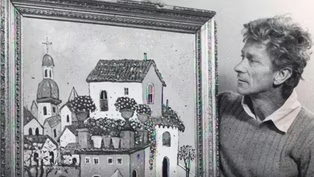
Clip: S31 Ep17 | 7m 49s | A look into the colorful world of renowned artist Henry Faulkner. (7m 49s)
Video has Closed Captions
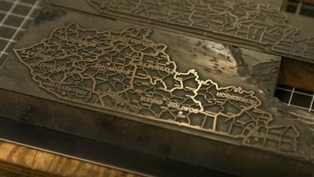
Clip: S31 Ep17 | 8m 25s | A history of mapping the Commonwealth of Kentucky. (8m 25s)
Providing Support for PBS.org
Learn Moreabout PBS online sponsorship












Support for PBS provided by:
Kentucky Life is a local public television program presented by KET
You give every Kentuckian the opportunity to explore new ideas and new worlds through KET. Visit the Kentucky Life website.