Wyoming Chronicle
Maj. Gen. Staci Jo Huser in Command
Season 15 Episode 21 | 27m 8sVideo has Closed Captions
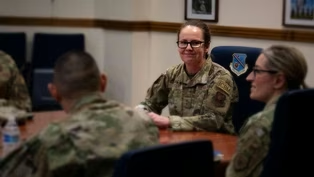
Maj. Gen. Stacy Jo Huser is the first woman to command at F.E. Warren Air Force Base.
For the first time a woman is in command at F.E. Warren Air Force Base in Cheyenne, one of the pivotal strategic components of U.S. Defense. Meet Maj. Gen. Stacy Jo Huser.
Problems playing video? | Closed Captioning Feedback
Problems playing video? | Closed Captioning Feedback
Wyoming Chronicle is a local public television program presented by Wyoming PBS
Support provided by:

Wyoming Chronicle
Maj. Gen. Staci Jo Huser in Command
Season 15 Episode 21 | 27m 8sVideo has Closed Captions
For the first time a woman is in command at F.E. Warren Air Force Base in Cheyenne, one of the pivotal strategic components of U.S. Defense. Meet Maj. Gen. Stacy Jo Huser.
Problems playing video? | Closed Captioning Feedback
How to Watch Wyoming Chronicle
Wyoming Chronicle is available to stream on pbs.org and the free PBS App, available on iPhone, Apple TV, Android TV, Android smartphones, Amazon Fire TV, Amazon Fire Tablet, Roku, Samsung Smart TV, and Vizio.
Providing Support for PBS.org
Learn Moreabout PBS online sponsorship- Major General Stacy Joe Huser of F.E.
Warren Air Force Base in Cheyenne has a unique position.
She's the first woman ever to command 20th Air Force headquartered here at F.E.
Warren.
I'm Steve Peck of Wyoming PBS.
This is "Wyoming Chronicle."
(bright music) - [Announcer] Funding for "Wyoming Chronicle" is made possible in part by Wyoming Humanities, enhancing the Wyoming narrative to promote engaged communities and improve our quality of life.
And by the members of Wyoming PBS.
Thank you for your support.
- We're very happy to be accommodated by you at Warren Air Force Base today.
I've lived in Wyoming all my life and I've never been here before, so thank you for that.
And you're the first woman to have your job, and what is that job, as you describe it?
- Yes, sir.
So I am the Commander of 20th Air Force, and as the Commander and my team here, we oversee four other Air Force bases, so four wings as well as a helicopter group.
- So what are those?
- So we have three, what we call ICBM Wings, Intercontinental Ballistic Missile Wings.
And they're located here at F.E.
Warren, one at Minot Air Force Base in Minot, North Dakota, and one at Malmstrom Air Force Base in Great Falls, Montana.
And then our fourth wing is Kirtland Air Force Base in Albuquerque, New Mexico.
And then we also have a helicopter group, which is located here.
- I see.
So that's a big area.
- Yes, sir.
- And this is an Air Force Base.
It would not be accurate to say that you are the Commander of the base exactly.
But you were once.
- Yes, sir.
I was the Commander here from 2017 to 2019, and I am lucky to come back as the 20th Air Force Commander.
- 20th Air Force is always, the command base for 20th Air Force is always at Warren.
- It has been for the past couple of decades, yes.
- So you're a General, Major General.
My dad was a World War II veteran and he had a manual that I used to look at when I was a little kid.
It had all the ranks and the insignia, but I, like a lot of little kids are, was interested in the different insignia.
So I wanna ask you just a little bit about that.
Major General means you've got two stars.
Do you have them?
- Yes, sir.
They're here.
- Two stars.
And the Brigadier gets the one star, what's the three star General?
- Three star is Lieutenant General.
- And General is short, am I right in saying, for General Officer?
- Correct.
- So what does it take to be a General compared to being a Major or a Captain or a Colonel?
- So I would say as you move up the ranks, and just like you correctly pointed out, a General Officer means that you don't have to be the expert on the thing that the people do.
You don't have to be the expert on maintaining the vehicle or the mission-related equipment, the communications equipment.
You are more general.
So what I like to tell people is I take care of the people who are doing the mission.
I am providing them a vision.
I am making sure they have resources.
I'm making sure they feel supported, that their families have what they need.
That way they are not worried about all of those other things.
They can focus on doing the mission that we need to do every day.
- So you moved through the officer ranks yourself acquiring more knowledge and experience and responsibility I suppose.
What did you do to get a second star compared to the first?
Is it just a matter of seniority or more to it than that?
- So some of it is seniority, and then some of it is experiences.
I've grown up in the business that we do in the ICBM business.
And so my leadership has put me in different jobs that teach me different skills, give me a broader, again, going back to that General, giving me a broader knowledge, broader perspective over our enterprise and building me up to be that leader who can not only know what our mission is and oversee our mission, but again, take care of the people who are doing the mission.
- For example, returning to F.E.
Warren as you did within the past year, right?
- Yes, sir.
- But you had been here before and so you knew for example the nuts and bolts of kind of sort of being the mayor of the base as well because there are a lot of people here, 10,000 or thereabouts at Warren Air Force Base?
- So the, the folks who work here is about 4,000, and if you add in their families and their children, the number gets significantly larger.
- You mentioned that that's a significant part of what you think about.
Well, speaking of families, I haven't spoken to many Generals, but the two that I have spoken with before both came from military families.
Dad was an officer, grandpa was too.
Is that the case with you?
- So my dad was enlisted in the Air Force, but he retired after 20 years of service when I was only two years old.
So I have no memory of living on an Air Force Base with him.
And I didn't grow up with those Air Force experiences, and honestly, I never had any intentions of joining the Air Force.
It wasn't anything I considered until I had been out of college for a couple of years and working and trying to figure out what to do with my life.
And I knew a person who was in the Air Force and he told me what his life was like, how much money he made, which was twice as much money as I was making at the time.
- What was your job then?
- I was working in a hospital laboratory as a phlebotomist, which nobody likes.
So it was very appealing to join the Air Force and find a new career.
And I went down to the recruiter and they signed me up.
Then I went off to officer training school.
- Now that's a story I don't think I had heard before.
Someone thinking, I could get a raise if I joined the service.
But you've been to college, had a degree, so you could enter service then as an officer, and those are the better paying jobs, I guess, than the enlisted positions were.
What was your degree in college?
- I'm a Psychology major.
- I've seen your resume since then and you have the equivalent of many, many more degrees.
The training, the continuing training, which I presume is still going on, it piles up one on top of the other till you have lots and lots of certification, authority, knowledge, expertise in different areas.
But began as a Psych major.
- One of the things I really love about the Air Force is they invest a lot in the development of their people, whether enlisted or officer.
It feels like people are in constant professional development, constant education, whether it's helping pay for a degree, or if it's in my case where they send me to advance schooling and other professional programs.
For example, I got the opportunity to do a fellowship at Stanford, which is a once in a lifetime experience, but I'm just one of many people.
The Air Force does that.
It invests in every single person, not only to make them a better military member, but I think it makes them a better human being.
It teaches them skills, it teaches them leadership, how to manage people, how to manage resources.
So it is one of the great benefits of being in the military.
- The expectation is almost all of them will be civilians again one day too.
I became aware of your position through a press release sent out by the Air Force.
And the Air Force was really excited and wanted me to know, wanted media people to know that here was the first Commander of 20th Air Force, first female Commander.
They seem to think that was a big deal.
Do you think so?
- I do think it's a big deal.
- Not just because it's you.
Exactly, I do think it's a big deal, and you're right.
Not because it's me, but because it shows all the women who are coming behind me that this is something they can aspire to.
And it shows women who aren't even in the military yet.
It shows young girls in middle school and high school and college that the military is something they can aspire to.
My specific career field, the nuclear enterprise is something that they can join and be successful in, and they can have a family and still do it.
- Because this is not the kind of Air Force Base I think the average person might think of who watches "Top Gun" or "Maverick" or something.
There aren't fighter jets zooming around here.
There's not even an airstrip on this base.
Am I right about that?
- You're right.
- Anyway, so there are lots of different kinds of military bases clearly.
So this is your job.
You talked about your profession, the business that you're in, the the nuclear enterprise.
- So it's something that I would say the American public is not normally aware of, which is probably a good thing.
It means we're doing our job very quietly.
As you said, you don't see a lot of activity.
All of our intercontinental ballistic missile sites are spread across hundreds of miles.
There's people monitoring those sites at all times.
There's defenders, there's maintainers, there's operators spread across five different states monitoring these systems, making sure that they provide a credible deterrent for our nation, and that we're assuring our allies.
But when we're doing our job, most people don't know it or realize it, but it's a good thing because our adversaries know we're doing this mission.
And it keeps them in check and it gives them that little question, I'm not gonna mess with the United States or their allies today because we're doing our nuclear deterrent mission.
- So it's a lot of activity.
Never-ending, 24 hours a day every day of the year of the decade, you're preparing and being ready to do a job that the objective is that you never want to have to do.
How many people in the Air Force, do you know offhand?
300 and some thousand, right?
- There's 300 and some thousand active duty, and then when you include everybody else, it's hundreds and hundreds of thousands.
And then under 20th Air Force, we have 12,000 of those people.
- I'm getting to how rare it is to reach the position that you've reached.
So say there are 330,000 active duty Air Force members.
There are only about 300 and some Generals I think.
And how many women do you know?
- I don't know, but not very many.
- I looked into it.
I think there are only about a hundred and some who've reached Major General level.
So it's one in 2,000 people gets to be where you are.
When you were talking to your friend when you were working in the hospital lab and realized that you could enter service as a young officer, as a Lieutenant, were you thinking one day I'll be a General?
Is that how it goes or what was that like for you?
- Never, I thought I would stay in for four years and figure out what I wanted to be when I grew up and then leave.
But four years came and went and I realized that I really loved what I was doing, but I loved the people I was working with even more.
And it was at that point I decided I would never leave until the Air Force said they were done with me.
But I never, even in my wildest dreams, thought I would go this far.
Every promotion has been kind of a surprise to me.
Like, oh, they want me to stick around another couple of years.
So it's been really fun.
I've been really lucky.
- How does that work?
Say you're a Captain and the next rank up is Major.
You said it was sort of a surprise, it's not you get a phone call, you're now a Major, or here's an opportunity for you, would you like to apply for that?
Is there an exam that you take?
What's the procedure?
- So for us, there's certain timelines.
Once you're a rank, there's a certain amount of time and experience and then you meet a board.
And your entire record goes up to this board and you get racked and stacked against your peers based off of your record, the things you've done, what your leaders have thought about you, your experiences, what kind of education you've achieved, whether professionally or personally.
And then they decide in those moments whether or not you'll get promoted to the next rank.
And you're not really getting promoted because of what you've done, though that's how they make those decisions.
But you're getting promoted because of what they expect you to do at the next rank.
- Each time it happened, you said, "Yes, I think I will try that."
You used the term missilier.
Is that what you still consider yourself to be?
- Yes, I do.
- What's your definition of of that?
- So for me, a missilier is one of those operators that sits underground across one of five states and monitors our ICBM force, our intercontinental ballistic missiles.
- Are people doing that at this moment?
- Oh, 24/7.
- And you did that?
- I did.
- Where was that?
- I've done it at all three of our ICBM wings.
So when I first started out, I was at Malmstrom Air Force Base in Great Falls, Montana.
I worked there for my first missile assignment.
And then when I was much older, my first Colonel job was at Minot Air Force Base and we call it pulling alert.
So I sat nuclear alert up at Minot, and then I sat nuclear alert here at F.E.
Warren when I was the Wing Commander.
- As a General - I was a Colonel.
I was a Colonel at that time.
- You still could do that if you had to.
- Unfortunately I can't anymore.
Because of my most recent job with the Department of Energy, there are certain things that if you have certain experiences or certain knowledge, you can no longer pull a nuclear alert just as a safety feature.
So I can go visit, but I can no longer sit nuclear alert like a regular crew member.
- You're an Air Force General, but you say you had a job with the Department of Energy, Department of Energy hires military officers?
- Very, very few.
So the Department of Energy, what a lot of people don't realize is the Department of Energy is actually the department that designs and produces all of our nation's nuclear weapons.
And then the militaries employ those nuclear weapons.
So I was very lucky and it was a very rare experience because you're right, they have very few military members, and I was one of their highest ranking military members.
And my job was essentially to serve as a liaison between the Department of Energy and the Department of Defense.
- Where was that job, in Washington?
- It was in Washington.
- So you've been stationed out of the country overseas?
- No, I haven't, - Haven't been.
But you've seen lots of places in the states.
You're built for travel and you know how to pull up stakes and move when you need to.
That's a life you like or at least you're used to.
- It is, and I'm very lucky because my husband does not mind moving.
He's also a Psychology major and he doesn't mind moving.
And my kids, though they're 14 and 16, and I thought it would be more challenging at this age, they also don't mind moving.
And they've had to move a lot.
Every one to two years for the most part for their entire lives.
- Well that makes me wonder, I don't think you are assigned to be the Commander of the 20th Air Force for a specified amount of time, but the expectation is you wouldn't do it for the next 20 years probably, right?
- Normally most of my predecessors did two to three years.
So that's what I'm planning on.
But it just depends where the Air Force needs me.
- What is your predecessor doing now?
- My predecessor went to be the Deputy Commander of Air Force Global Strike Command and got promoted to get his third star.
So it's pretty exciting.
- Is it a similar delineation from one star to two, from two to three, as it is from Lieutenant to Captain, say that you're gaining more experience or being invited to take on more duties?
- It is a different process because going to two star is the last time you actually meet a board to get promoted.
When you move to three star and four star, it's because leaders want you in that three star position.
So you're getting promoted based off of the position that you're going to.
- Three star?
- If they want me to, I will take it.
- Wouldn't say no.
- I have three criteria for leaving the Air Force.
It's if the Air Force says they're done with me, if my family says they're done moving and they don't wanna do it anymore, or if I feel like I'm no longer effective.
If any of those three things happen, then I'll be done.
Otherwise I will happily stay as long as I can serve.
- Has any of those things come up before as at least a factor to consider or?
- I think this last summer was the first time I even mentioned the possibility of retiring.
I told my family like, "Hey, we don't have to move again.
I could be done."
And the look of shock on my children's faces, I knew that they wanted to keep going and they were happy to keep moving.
- Of course they lived here once before.
- And they have very fond memories of living in Cheyenne.
- Do you live on the base?
- I do.
- You do?
- I have a beautiful house that I do not deserve.
It is huge.
It's historic.
It's beautiful.
It's incredible.
- When you were here before in a very high ranking position, did you live on the base then as well?
- I did.
- Is that because there's family involved or what determines who lives on the base and who doesn't?
- Typically, if you're in a leadership position, there is normally a house that would be designated for you to live on on the base.
And most leaders choose to do that because then they're close to the mission, close to the people.
They can respond quickly if anything happens.
And then there's also additional housing.
So if military members and their families just want to live on the base, they can apply for a house on base.
So F.E.
Warren and our others have lots of military housing available.
- One of the factors about the base that I think may be of a little bit less concern to you now, but probably was considerable factor in your job previously at Warren was that it's a huge, integral part of the city of Cheyenne as well.
It's gotta be one of the biggest employers, including non-military people.
I've encountered this once before.
The base is involved with the Cheyenne Chamber of Commerce in hosting activities and participating in them around the city, not just on the base.
I'm assuming that's community outreach and community membership is something that's gotta be an important part of what the base is all about.
- It's incredibly important.
And especially the communities around our bases, these northern tier bases in Montana, North Dakota, and Wyoming and New Mexico.
They're small communities a lot of times.
But the members are so connected to the base, they're so supportive.
They advocate for our airmen, they advocate for our families, our missions, they're our friends.
They develop different programs to help take care of airmen and families.
It's just incredible.
And we're very, very lucky to have the communities that we do.
- Do you have a typical work day?
I mean, you work in an office, right?
And you're not driving around in a tank or a Jeep or a flying around place.
You are an administrator at a very high level.
You had a meeting right after our interview, I've heard.
Can you tell us anything about that or who it'll be with?
- I sure can.
So the meeting when we're done is with my four Wing Commanders who are directly underneath me as well as the helicopter group Commander.
And it's a standing meeting that we have every two weeks just to see what's on their minds and for me to give them updates.
Because of course I'm here at F.E.
Warren, but they're in different parts of the country.
They're in Montana, North Dakota, and New Mexico.
So I don't get to interact with them as often as I would like.
So it's our time to share information that we wouldn't normally get to share with each other.
- You're a psychologist by training as well.
Must help some, huh?
- I think so.
It helps me.
Well, it helps me understand people, read people, when I'm in a meeting, I'm staring at faces to see what everybody's thinking about the topic that's being discussed or what's not being said.
And I usually know by a look that somebody has on their face whether they wanna contribute, but are hesitating.
So that's helpful for me to call them out.
- [Steve] You talked about the little girls who might be following you.
As you look back on your career in the military, what's been good about it that you might say, "Hey, you could try this or you shouldn't rule this out."
- There's incredible education benefits.
There's the opportunity to live, at least in my experience, live in different places around our country.
For different career fields, you can go overseas.
The paycheck is nice for me.
I come from a very small town.
My mom ran a restaurant.
My dad ended up working in the post office after he retired from the Air Force.
So for me, the money is decent.
People get a housing allowance to help fund their home, whether it's on-base or off-base.
And I would say most importantly, in my experience, it's been the sense of comradery.
Especially in this business, if I see somebody with a missile badge on them, I automatically know.
- [Steve] Where's your missile badge?
- Just climbing up my shoulder.
It's this guy.
But when I see someone with that missile badge, there's this automatic, I know you, I know what experiences you've had.
If you tell me where you've been stationed, I've probably been there.
I probably know the people you've worked with or your boss.
So it's just that instant bond that I really love about the military.
- There's less and less of that sort of common bonding among people today.
At least it seems to me.
I'm thinking of my father born in 1924, and men of his age, almost everybody had been in the service and they had that thing no matter where they were, who they met, probably they had that shared experience.
Now not everybody serves anymore in this way.
But you're saying that that's something you value, at least the people you see in uniform, you've shared something.
- Yes.
And a lot of times you'll hear the phrase, your Air Force family, and it really is your family.
Through good times and hard times, it's the Air Force family who's there to either celebrate with you or hug you when something bad happens or bring you a meal if you're injured or just had a baby, they're really there for you.
And that includes our communities.
I consider them our Air Force family too.
- Are you known around the Cheyenne as far as you can tell?
- I think so.
I'm lucky because I was here for two years before and I made a lot of connections in the community then.
And a lot of those people are still here.
And I've reconnected with many of them.
- You have an outgoing sort of demeanor to you?
I know you don't get to be a Major General unless you can give a command as needed.
I didn't know what to expect, honestly.
Was I gonna be afraid to speak to you or have you be all standoffish or something?
I don't get that feeling.
You probably do a good job of helping humanize the image of what an Air Force General is.
Does that matter to you at all or is it just part of who you are?
- It does matter to me.
When I first joined the Air Force, I had an image in my mind of what a military person was supposed to look like.
- I think a lot of people do.
- And I tried for a long time to fit that mold and it was very difficult.
And I didn't feel good about myself.
I didn't feel comfortable in my own skin.
Some of it was just maturing, probably having children.
I realized, well I'm gonna stop trying to be what I think I'm supposed to be and I'm just gonna be myself.
I'm just gonna be my authentic self.
And if the Air Force doesn't like that, that's okay.
I was gonna leave after four years anyways.
But like I said, they've kept promoting me, they keep me around.
So they're just encouraging this behavior in me.
- And when you're home, you're mom, you're not General Mom.
- Exactly.
And that brings its own challenges.
The Air Force doesn't look like it used to look decades ago.
It's a lot more diverse.
There's a lot of people waiting to have children till later in life.
So a lot of people my age now have young children, and in the past, the kids would've been long gone, probably in college or even married with families of their own.
So we look different now.
So not only am I a two star, and not only am I the 20th Air Force Commander, but I'm a wife and I'm a mom with a 16-year-old and a 14-year-old who need new shoes or have to go to the doctor or have clubs and sports.
So I've gotta make sure all those things happen.
- So your two children, teenagers now, old enough to start thinking about what life might be like after say high school.
"Mom, I'm interested in a military career."
How would you react if they said that to you?
- So far, they haven't showed any interest in the military.
They do enjoy, like I said, they enjoy the military life.
But they haven't shown an interest in doing that themselves.
But if they did, I would just emphasize that maybe get your degree first, go to college, mature a little bit on your own before you make that final decision.
- That's what you did.
- Yes.
- You didn't join up the day after high school graduation.
Some people do that.
Nothing wrong with it.
Count on those people throughout all branches of the service.
But there was more than one way to do it.
And you're living proof of it.
I appreciate your time with us today.
Very interesting to get to know you and think about you doing your work here.
Congratulations.
- Thank you.
- And I think you're just setting a great example.
I know you're trying to.
I thank you for being with us today on "Wyoming Chronicle."
- Thank you.
(bright music)
Maj. Gen. Stacy Jo Huser in Command Preview
Video has Closed Captions
Preview: S15 Ep21 | 30s | Maj. Gen. Stacy Jo Huser is the first woman to command at F.E. Warren Air Force Base in Cheyenne. (30s)
Providing Support for PBS.org
Learn Moreabout PBS online sponsorship
- News and Public Affairs

Top journalists deliver compelling original analysis of the hour's headlines.

- News and Public Affairs

FRONTLINE is investigative journalism that questions, explains and changes our world.












Support for PBS provided by:
Wyoming Chronicle is a local public television program presented by Wyoming PBS