
Making a Difference: Service to Others; Lorie Rodimer
9/16/2023 | 27m 35sVideo has Closed Captions
Making a Difference: Service to Others; Lorie Rodimer
Two Russ Berrie Making A Difference Award Winners highlight their activism in public service and the difference they’re making in their communities. Panelists include: Norma Bowe Robt Martin Seda-Schreiber Jacqui Tricarico goes on-location to the NJ Sharing Network 5K Celebration of Life event to speak with Lorie Rodimer about her son Tyler, who gave the gift of life through organ donation.
Problems playing video? | Closed Captioning Feedback
Problems playing video? | Closed Captioning Feedback
Think Tank with Steve Adubato is a local public television program presented by NJ PBS
Making a Difference: Service to Others; Lorie Rodimer
9/16/2023 | 27m 35sVideo has Closed Captions
Two Russ Berrie Making A Difference Award Winners highlight their activism in public service and the difference they’re making in their communities. Panelists include: Norma Bowe Robt Martin Seda-Schreiber Jacqui Tricarico goes on-location to the NJ Sharing Network 5K Celebration of Life event to speak with Lorie Rodimer about her son Tyler, who gave the gift of life through organ donation.
Problems playing video? | Closed Captioning Feedback
How to Watch Think Tank with Steve Adubato
Think Tank with Steve Adubato is available to stream on pbs.org and the free PBS App, available on iPhone, Apple TV, Android TV, Android smartphones, Amazon Fire TV, Amazon Fire Tablet, Roku, Samsung Smart TV, and Vizio.
Providing Support for PBS.org
Learn Moreabout PBS online sponsorship- [Narrator] Funding for this edition of Think Tank with Steve Adubato has been provided by The Russell Berrie Foundation.
Making a difference.
Hackensack Meridian Health.
Keep getting better.
Community FoodBank of New Jersey.
Valley Bank.
The New Jersey Economic Development Authority.
NJM Insurance Group.
Serving New Jersey'’s drivers, homeowners and business owners for more than 100 years.
New Jersey Sharing Network.
The North Ward Center.
And by The Healthcare Foundation of New Jersey.
Promotional support provided by ROI-NJ.
Informing and connecting businesses in New Jersey.
And by Meadowlands Media.
A print and digital business news network.
[MOTIVATIONAL MUSIC] - Hi, everyone.
Steve Adubato.
You're about to hear an important conversation on making a difference.
Making a difference in the lives of others, particularly as it relates to social justice.
Service to others.
We feature two winners of the 2023 Russell Berrie Award for making a difference.
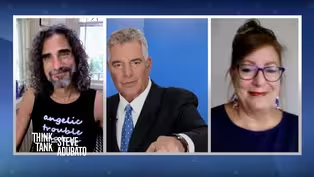
We're honored to be joined by Robt Martin Seda-Schreiber.
He is chief activist and founder of the Bayard Rustin Center for Social Justice.
We're also joined by Dr. Norma Bowe, as Director of Be the Change NJ and Professor of Public Health at Kean University.
I wanna thank both of you for joining us.
- Thank you for having us.
- Yes, indeed.
It's an honor and pleasure, Steve.
Thank you.
- You got it.
Robt Martin, do this for us.
As a student of the Civil Rights Movement who knew of Bayard Rustin way back, tell us what, other than the fact that he worked closely with Dr. King.
1963 March on Washington and Bayard Rustin.
Who he was, why he matters so much, so people understand the context for the name of the organization, please.
- I appreciate the opportunity to raise up the name of such an incredibly important civil rights hero, queer Black icon.
He was, when I speak about Bayard Rustin, people think I'm engaging hyperbole.
And I often do, but not when I'm talking about Bayard.
Bayard Rustin organized the march in '63.
He inspired the Freedom Riders.
He sat down on a bus before Rosa Parks did.
He spoke truth to power.
He coined that term.
He was the godfather of intersectionality some 20 years before Dr. Kimberle Crenshaw coined the term.
He did all these things and so, so, so much more.
But he was lost to history.
He was edited out of history books, excised from the stories told, because of who he loved, who he was.
- You were at the march?
- Was I at the march?
Actually, I marched on Washington in the Womb a few years later, but not at that one.
- Okay.
So, and your name, Robt Martin.
Robert F. Kennedy and Dr. Martin Luther King, Robt Martin.
- Yes, indeed.
Robert F. Kennedy, the good one.
And Martin Luther King, of course, a king in all sense of the word.
It's a mantle that I hold proudly.
My parents named me, gave me this mantle, gave me this honor, gave me this privilege, and I carry it forth every day in the work that I do.
- Thank you.
Dr. Bowe, explain to us, Be the Change.
What is it as we put up the website?
And also make it clear that Kean University, one of our higher ed partners, please, Doctor.
- Yes.
So Be the Change was largely a student activist group.
About 14 years ago, we started doing things like going down to the Gulf after the BP oil spill.
The students here, they didn't wanna meet about it, they didn't wanna talk about it.
They wanted to do something.
We completely made over a teen homeless shelter, and then brought nine of 12 teens here to Kean University as students.
And then that just lit the fire for everyone.
We realized we had something really big going on here.
And in 2015 we became a nonprofit.
Our name Be The Change, of course comes from the famous Gandhi quote, "Be the change you wish to see in the world."
- Be the change you hope to see in life.
- And yeah, be the change.
So we believe that you're not who you say you are.
You are what you do.
And when we see something happening in the community, we wanna do something to make it better.
We work in partnerships with dozens of other community-based organizations.
We have things like garden projects.
We've completely homicide mapped all of Newark, for instance.
We take empty lots and we turn them into garden projects.
We are embedded in the community and we love the work we do.
- And real quick, before I go back to Robt Martin.
That food insecurity, as you and your colleagues see it, is in fact an issue of social justice, please.
- It is a social justice issue and it may, Steve, be the greatest social justice or civil rights issue of our time.
So many people are food insecure.
Be the Change gets food from the Community Food Bank in Hillside and we deliver food every single week to two to 300 families.
And every time I think our list might get smaller, Steve, it gets bigger.
There are so many people hungry.
And especially this time of year with school closed.
But we're very dedicated to food security.
We also feed the homeless at least once a week.
And we're very involved with homelessness relief as well.
Thank you.
- Thank you.
Robt Martin, do this for us.
Your organization, dedicated to creating safe spaces to assist people who are homeless, food insecure, as Norma mentioned, victims of violence, and are members of the LGBTQ plus community.
Talk about the last part in particular.
- Indeed.
Well, first of all, if I may, much love and respect to Dr. Bowe.
What incredible work you're doing.
Thank you for doing it, my friend.
That kind of angelic troublemaking is what we all aspire to.
And I believe that the work we're doing together, we are the first responders.
Now we are the ones that are hopefully heading off crises, rather than putting people into them.
So thank you so much for all the work you're doing and the kids are doing, and your organization is doing.
It's an incredible honor to be on the program with you.
And Steve, - Right back at you, Robt.
- Thank you.
And Steve, to answer your question directly, yeah.
I was a public school teacher for almost 25 years.
I taught in the same school I went to as a student.
In that time, in middle school, I created the first Gay Straight Alliance in a middle school in New Jersey.
And it was the continuation of my journey.
Understanding that these kids and our families needed these safe spaces.
And that's not just a term that we bandy about lightly.
This is something that's lifesaving, that is life-affirming, that shows people and gives people the recognition and the respect they deserve, they need.
And we're so honored to provide it.
We have dedicated trained volunteers here at the center every day to make sure that we're open for folks who need or want a space.
And that might be a conversation, might be a meaningful moment shared.
It might just mean that they want to come in and read one of the thousands of books we have in our dedicated social justice library.
- Real quick follow up.
And I see the Russell Berrie Award for Making a Difference over your right shoulder.
And meeting both of you and the other honorees.
I've said this many times, I've been honored to emcee, to host that extraordinary event, the Russell Berrie Awards for Making a Difference, the annual event at Ramapo College.
It is great to, it is powerful, impactful to see, to be with all of you.
But I want to ask you, Robt, real quick follow up on that.
Being acknowledged with your colleagues, you're talking about Norma before.
And Norma, I'll ask you the same thing.
What impact has that had on you?
Why does it mean so much, Robt?
- Oh, it's an incredible, extraordinary honor.
And what a meaningful moment it was.
And thank you Steve, for the work that you've done for so long with the organization.
They've been doing this for decades.
And it seems like a lot of these awards are superficial.
A lot of these awards don't have much meaning behind them.
The Russell Berrie Foundation has been, and Ramapo College supporting it, has been doing this in such a fashion.
It's incredible their vision of who they choose to honor and how they choose to honor these folks.
And, I can say, as a queer person like myself, be honored in this way, it means something to me personally, obviously.
It's a great honor.
I am thrilled.
I'm over the moon.
But it means so much more to our beloved community who sees someone like myself or Dr. Bowe, or all the other honorees and they were incredible.
And every year they are incredible.
To see all those folks honored and the people in the communities they serve, it's such an inspiration, and allows us all to move forward together in that parallel journey we're taking.
- Robt Martin, to your point, we're gonna put up the website for the Russell Berrie Foundation for people to acknowledge and recognize and nominate.
There are different periods when the nomination process is open, but go on that website to find out more.
Doctor, you heard Robt Martin talk about his perspective and his view of that event.
But also winning the award and being with your colleagues, making a difference.
What has it meant to you?
- Well, I wanna ditto everything that Robt said.
I could cry thinking about being nominated by my group, by my colleagues here at Kean University.
I didn't know that I was being nominated and I frankly was quite shocked when I found out that I was an honoree.
None of us do this for the recognition.
We do it because it makes a difference.
And service work is very healing work.
- What do you mean by that?
Norma?
- Well, - What do you mean by that?
- Yeah.
So I teach a course on death here at Kean University, Steve.
It has a three-year wait list.
We have a lot of people grieving.
Our young people are grieving the loss of their grandparents, for instance.
But many of them have lost people to suicide.
Three quarters of my classes have lost people to homicide.
People have been discriminated against, that Robt so eloquently has been talking about.
There's so much grief.
And I find that service work is grief work.
It takes us from feeling helpless about certain situations and it gives us some power over our circumstances.
It gives us some power over the change that needs to happen in some of our communities.
When we go into a community, for instance, and make a garden, especially in a high-crime, let's say, area.
It gives people hope.
It gives people the opportunity to get out and be together, in a different kind of way and to be a real neighborhood.
And so we don't do it for the recognition.
We do it for the work.
It's very meaningful and purposeful work.
But it was just, I can't even describe the feeling that I had when I found out that I was an honoree.
It was extraordinary, especially from the Russell Berrie Foundation, which is just an extraordinary organization.
- Robt Martin, let me follow up with you on this.
You talked a little bit about why you do what you do.
What your parents taught you, gave you, showed you.
Not just simply by what they said, but more importantly by their actions.
For you, with the LGBTQ plus community being targeted by so many by, Talk about what the real human impact has been, not just from a social justice point of view, but from a human point of view on the LGBTQ plus community at this point in time in 2023.
Please.
- Yeah.
This is a dark moment.
This is a difficult time.
This is a tender time in our nation's history and our culture, especially for queer folks.
And for us it's always about resilience.
And we just had our Pride Parade and after party here in Princeton exactly a month ago.
And we had over 4,000 folks marching in solidarity, dancing in celebration, because we have to embrace who we are, how we love.
And that's the way we win.
That's the way we move forward.
And the Center is extraordinary because we get to embrace that intersectionality that Bayard Rustin embodied.
And by doing that, we get to bring together all of these different disparate, beautifully diverse communities.
And we get to do these extraordinary events and these powerful programs.
We have Martha Hickson, who is an award-winning librarian, who is absolutely my North Star.
And she has created our Defenders of the Right To Read program.
And what we're doing there is we are working toward combating censorship, battling book banning, and making sure that our kids and our adults, and by the way, we are just as involved with our seniors and our elders in the community to make sure that when they go to a library, when they go to school, when they're in the greater community, they can see themselves in the stories they read, in the things that they see.
And it's the only way that we can find those windows and those mirrors to be able to move forward and to say, "This is who I am.
And I'm inspired by this person, or that story or this incident or this gathering."
And that's what we do here at the Center and that's what we do in the greater community.
- Well said, Robt Martin.
Norma, I'm gonna come back to you on this.
In a couple minutes left.
In the polarized environment that we live in, and the people can decide for themselves how the political process is playing out.
But this isn't political, it's more human, and in terms of society and the way we interact with each other.
Where is the silver lining, the reason, not even reasons plural, the reason, the primary reason why we should be positive about making a difference, particularly when it comes to service to others and social justice, with all of what's going on.
And it seems like a lot of hatred and divisiveness.
The reason to be positive, other than seeing the two of you and the other Russell Berrie awardees for Making a Difference is?
Please finish that sentence.
- Well, Steve, programs like this.
We're only hearing negativity and we're only hearing about things that polarize us, right?
People are good.
People are inherently good.
And people want to help others.
People want to make communities a better place, a safer place, like Robt so eloquently talked about.
People wanna make a difference.
And that's the real story.
It's not all this negativity.
It's really not about politics.
It's about people.
- Well said.
We'll continue the conversation, I promise, with you and the other Russell Berrie awardees for Making a Difference.
And Robt Martin, to you, thank you.
To you, Dr. Norma Bowe, thank you for the work you're doing every day.
We appreciate it.
We look forward to talking down the road, okay?
- Thank you, Steve.
- Be good, everybody.
- You got it.
We're right back after this.
To watch more Think Tank with Steve Adubato, find us online and follow us on social media.
Recently my colleague Jacqui Tricarico and I went to the New Jersey Sharing Network 5K It's a great event, it's an inspiring event.
At the event, Jacqui and I spoke to a whole range of people involved in organ and tissue donation but one person in particular that you're gonna wanna meet is Lorie.
Jacqui interviewed Lorie.
Now Lorie, Lorie's son, Tyler, I believe he was 21, passed away in 2019.
Tyler was an organ donor, gave the gift of life to three people, gave them that gift of life.
They are here because of Tyler and also countless other lives were impacted by Tyler's gift to them.
Jacqui talks with Lorie, a compelling important conversation about organ and tissue donation.
- Uplifting Music.
- I'm Jacqui Tricarico on location at the New Jersey Sharing Networks 5K here in New Providence, New Jersey.
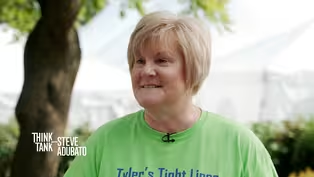
And I am so honored to be joined by Lorie Rodimer, who is the mother of Tyler, who gave the gift of life.
Lorie, thank you so much for talking with us today.
So first, we have to learn about Tyler.
Tell us about your son, Tyler.
- Oh, he was a great kid.
He was 22.
He had just graduated the prior year from East Stroudsburg University and had a great career in criminal justice, and he worked for Hudson Farm Club, which was an outdoor sportsman's club.
And he was kind of working his way into being there full, well, he was there full-time, but he was kind of gonna get a career there.
And it would've been beautiful 'cause he wouldn't have had to work a day in his life.
- He loved it.
- He just loved being outside.
Yeah, great kid.
He was an Eagle Scout, only child.
Great kid.
- Love of your life and-- - Yup, love of my life.
- And in 2019, as a mother, a parent's worst nightmare.
- Worst nightmare.
- Happened to you.
- Yes.
- And your husband.
- Yes.
- Talk about that day.
- Yeah, I was in bed actually and he, you know, he got up early that morning.
He gets up early every morning to go to work, and was with his father in the morning, having their coffee and off they went.
I got a call from one of his buddies and I thought, you know, "Good morning, Brody, what are you doing?"
And, he said, "Mrs. Rodimer," he says, "Tyler had an accident."
And when he told me they were airlifting him to Morristown, I thought, "Oh my god."
I said, my immediate reaction was his head.
And sure enough it was.
So, it was a horrible day.
Didn't know if he'd make it through the night.
And that dear boy, he lasted two months in the ICU.
Many surgeries.
We always had hope that everything would turn out.
And one day, actually it was on his birthday, March 4th, one of the doctors came in and he said, "You know, Tyler may never wake up."
We're like, "Are you kidding me?"
So, there's a lot of painstaking conversations with doctors, and clergy, and your family, and you know, what do you do?
But the bottom line was, he would not have wanted to live the way he was living.
So, it was a terrible decision for a parent to make.
But it was when we had to make.
- And during that time, when were you approached about organ and tissue donation?
Because what I know is that he did check that box on his license.
- He did check that box.
- And you didn't even remember that or think about that.
- I really didn't.
- Yeah.
- Actually, that was a horrible thing too.
You know, there was a new doctor, part of the trauma team, and he came in one day and asked me if I had been approached by the Sharing Network.
And of course, as a mother, I didn't know what the Sharing Network was.
And then, of course the light bulb goes off, saying, "Oh my gosh, do you mean organ donation?"
And he said, "Yes."
And I thought, "Are we there now?
Is that where we're at?"
And a nurse came in that night in her street clothes and tried to make it right and she said, "This is not how we operate."
And from that point on, I mean, I was all over it.
I mean, the Sharing Network had been so supportive and anything we needed, and they were great.
They were really great.
- Knowing that Tyler had made that selfless decision-- - Yeah, in high school.
- All those years ago, in high school.
- Yeah, yeah.
- How did that make you feel?
Did it make it a little, just like that little bit easier for you to move forward with his wishes?
- For me, it did.
For my husband, it did not, he struggled with it.
My husband was not an organ donor on his license.
I was, and actually, when Tyler came home from high school, he said to me, they were doing their driver's ed.
- Yeah.
- And he said, "Are you an organ donor, Mom?"
And I said, "I am."
And he said, "What about dad?"
I said, "No, I don't think he is."
And he asked him and he wasn't.
And I said, "So really, it's your choice.
You decide what's right for you."
You know what, it's a beautiful decision to make.
And as a parent, we could have chosen not to do it, but it was just an easy, it was easy.
Help somebody out.
- Talk about who he helped.
- Oh my gosh.
- Who did he help?
- He helped two women with his kidney donation, both kidneys, and a man with his liver.
And then since then we found out that he helped two people with genetic disorders with his heart valves, and 16 women with his skin donation.
12 of them, women with mastectomies that needed skin to heal.
That's just beautiful.
It's a beautiful legacy he left, for me, you know, to honor.
When you're in this terrible group of people that lose their children, which I am, a lot of people don't have a beautiful story and I do.
I have a legacy to honor and I do this every year.
And some of those people come and they, it's just, it's awesome.
- And the New Jersey Sharing Network has become a family for you.
- They're family to me.
Oh sure.
- Yeah.
There's been a lot of ups and downs over the past couple of years.
- Oh, sure.
- Describe that and just how important they've been in your life.
- You know what?
You try to make something good out of a tragedy and they're there to help you do that.
And they hold your hand.
I didn't even know what the walk was.
Somebody, we came two weeks, no, two months after Tyler died to the first walk.
I think there was 10 of us.
And after that, it was like all-in, 'cause these people were, they're just the most beautiful people you'll ever meet.
They're genuine.
They'll do anything for you and they're so supportive of your mission and your journey, really.
'Cause it's a grief journey, it doesn't ever end.
You know, you remember every day.
- Of course.
- I'm able to talk about organ donation every day to everybody.
I talk about him and that's part of my story.
So, it's awareness and it's a beautiful story to share.
- Yeah.
And so you said 10 people on that first walk.
How many now?
It's "Tyler's Tight Lines".
- "Tyler's Tight Lines".
- And I know you're up there at the top.
- He was fly fisherman.
- Yes.
- [Lorie] Which is where the tight lines came from.
- [Jacqui] Beautiful.
- [Lorie] His buddies came up with the name the first year, 'cause I didn't know.
And, I think this year we have over 100 people.
I think we're one of the biggest teams this year.
- [Jacqui] Yeah.
I think I saw you third or fourth on that line, on the website.
- Yes.
And you know, we're pretty up there in the rankings for how much money we've made, which is awesome.
- [Jacqui] Yeah.
How's that make you feel, and your family and friends?
- It shocks me every year because, you know, the first year we made $2,000 and the next year we did maybe eight and then we went to 13.
I'm like, "I'm never gonna get past that."
This year we have over $24,000.
- That's amazing.
- It's just mind boggling to me.
- That's incredible.
- Yeah.
- Lastly, I know that recently you did get in touch with one of the families, one of the gentlemen that received one of Tyler's organs.
Talk about that process, what that was like for you and if you feel ready to be able to talk and meet that person because I know it's different for every family and every person who's going through this grief journey.
- So when we originally, we originally wrote letters to all three of the recipients and heard back from two, the two women from the kidneys.
And they were kind of generic letters.
They were, you know, blessed that Tyler did what he did, but I think they were overwhelmed by it too, I think.
And never heard from the liver recipient.
And then all of a sudden, actually, I went to Pasadena to celebrate Tyler on the float, the Donate Life float this year.
- Oh, yes, mm hm.
- And when I came back, one of the people from the Sharing Network called me and she said, "You're not gonna believe it, but you got a letter from the liver recipient."
And it was a gentleman that, I think he said he was 72 when he got the liver, yeah, the liver, and he was 78 now and he said he has I think seven kids and 25 grandkids.
And since he got the liver, he got to see, I think three or four of his grandchildren born.
And he said if it wasn't for Tyler, he wouldn't have been here to do that.
And I just think that's, oh my gosh, I wanna meet them so bad.
- Yeah.
- So it's my turn now to write a letter to them and express that and I'm going to do that.
I just haven't had a chance.
- Yeah, no, that's incredible.
And I look forward to hearing about it from you and that experience with meeting him.
- I'm sure that'll be a very emotional day.
- Of course, of course.
- But beautiful.
- Yeah, yeah.
Well I'm so glad that we can use this moment to celebrate Tyler and his amazing selfless gift-- - [Lorie] Ah, thank you.
- To so many people that he touched, that he saved their lives and helped in their journeys, in their health journeys.
So thank you so much for speaking with us today.
- Oh, you're welcome, thank you.
- [Narrator] Think Tank with Steve Adubato has been a production of the Caucus Educational Corporation.
Funding has been provided by The Russell Berrie Foundation.
Hackensack Meridian Health.
Community FoodBank of New Jersey.
Valley Bank.
The New Jersey Economic Development Authority.
NJM Insurance Group.
New Jersey Sharing Network.
The North Ward Center.
And by The Healthcare Foundation of New Jersey.
Promotional support provided by ROI-NJ.
And by Meadowlands Media.
- I am alive today thanks to my kidney donor.
I am traveling and more active than ever before.
- I'm alive today thanks to my heart donor.
I'm full of energy and back singing in my church choir.
- I'm alive today thanks to my lung donor.
I'm breathing easy and I'm enjoying life'’s precious moments.
- They are about 4,000 people in New Jersey waiting for a life-saving transplant.
- Donation needs diversity!
- For more information or to become an organ and tissue donor, visit NJSharingNetwork.org.
Making a Difference: Service to Others
Video has Closed Captions
Clip: 9/16/2023 | 16m 52s | Making a Difference: Service to Others (16m 52s)
Mother of Organ Donor Honors Her Son's Gift of Life
Video has Closed Captions
Clip: 9/16/2023 | 10m 32s | Mother of Organ Donor Honors Her Son's Gift of Life (10m 32s)
Providing Support for PBS.org
Learn Moreabout PBS online sponsorship
- News and Public Affairs

Top journalists deliver compelling original analysis of the hour's headlines.

- News and Public Affairs

FRONTLINE is investigative journalism that questions, explains and changes our world.












Support for PBS provided by:
Think Tank with Steve Adubato is a local public television program presented by NJ PBS