One-on-One
Making a Difference: Women’s and Maternal Health
Clip: Season 2023 Episode 2625 | 16m 27sVideo has Closed Captions
Making a Difference: Women’s and Maternal Health
Steve is joined by a panel of NJ non-profit leaders & Russ Berrie Making A Difference winners to discuss women’s and maternal health. Panelists include: Mariekarl Vilceus-Talty, President and CEO of Partnership for Maternal and Child Health of Northern NJ Bridget Cutler, Founder and Co-Executive Director of Moms Helping Moms Fraidy Reiss, Founder and Executive Director of Unchained At Last
Problems playing video? | Closed Captioning Feedback
Problems playing video? | Closed Captioning Feedback
One-on-One is a local public television program presented by NJ PBS
One-on-One
Making a Difference: Women’s and Maternal Health
Clip: Season 2023 Episode 2625 | 16m 27sVideo has Closed Captions
Steve is joined by a panel of NJ non-profit leaders & Russ Berrie Making A Difference winners to discuss women’s and maternal health. Panelists include: Mariekarl Vilceus-Talty, President and CEO of Partnership for Maternal and Child Health of Northern NJ Bridget Cutler, Founder and Co-Executive Director of Moms Helping Moms Fraidy Reiss, Founder and Executive Director of Unchained At Last
Problems playing video? | Closed Captioning Feedback
How to Watch One-on-One
One-on-One is available to stream on pbs.org and the free PBS App, available on iPhone, Apple TV, Android TV, Android smartphones, Amazon Fire TV, Amazon Fire Tablet, Roku, Samsung Smart TV, and Vizio.
Providing Support for PBS.org
Learn Moreabout PBS online sponsorship(upbeat music) - For those watching this entire program you just heard from the First Lady of the great state of New Jersey Tammy Murphy, talking about maternal and infant health.
We expand that conversation to a issue of women's health and the choices they have, the choices they do not have, and what needs to be done.
We're joined by leaders, advocates in the field of women's health.
We're joined by Mariekarl Vilceus-Talty, who is President and CEO of the Partnership for Maternal and Child Health of Northern New Jersey.
And Bridget Cutler is Founder and Co-executive Director of Moms Helping Moms.
Fraidy Reiss is the founder and Executive Director of Unchained at Last.
I'm wanna thank all of you for joining us.
Let's talk about this, Mariekarl, the disparities that the First Lady talked about, largely based on race, having to do with maternal health.
Talk about how serious the problem is and why we are not making more progress?
- Well, we know that the issue is abhorrent.
It is so difficult to make progress, because it is so multifactorial.
The issues are really upstream.
We cannot start with when you go to the hospital the episodic care.
We have to start with upstream issues.
So at the partnership, we attempt to make an impact every day with the programs that we have.
We have over 30 programs that are in the community.
We reach approximately 40,000 people a year with our various programs.
Anything from lead prevention, parents' teachers, anything that we are doing, we're working with the First Lady, Nurture New Jersey.
We have connecting NJ for people who have questions about their reproductive information, where to get help, how to refer people.
So it's about that scaffolding and amplifying the voices of the community.
When they need help, they need to know where to get help.
You just can't show up at the hospital and say, "Oh, I wasn't able to get prenatal care."
So if you can't get prenatal care, then you reach out to us and we are able to assist you with that.
We have grass root efforts that work every day to make a difference.
So that's really important.
So it's all of us working together to make that difference.
- Right, and that's why we're putting up everyone's website so people can find out more.
And let me ask you, Fraidy, tell us exactly what Unchained at Last is?
You've joined us in the past you've told your compelling story, Unchained at Last, the nonprofit committed to...
Finish that sentence.
- Committed to ending forced and child marriage in the United States.
And we do that through both direct services and advocacy.
- And that's very much related to women's health and a choice that you did not have, by way of background, let everyone understand how you came to this fight to be the advocate that you are as a survivor.
- Yeah, I came to this out of my own experience.
As you said, I'm a forced marriage survivor.
I grew up in Brooklyn, in New York City, but in a very insular religious community where I was forced to marry as a teen to a stranger who turned out to be violent and then trapped in that marriage with no reproductive rights, no sexual rights, no financial rights, even limited legal rights under religious law in that community.
I was not even allowed to divorce my husband.
Only he as a man had the right to divorce me.
So after I managed to escape, I founded Unchained at Last to help others in this horrific situation.
- And Fraidy, before I move to your colleague, to Bridget, is this still happening?
- Oh, it is happening.
And at any given time at Unchained we have between 90 and 100 open cases.
And we're just one tiny non-profit organization based here in New Jersey, but operating nationwide.
And we also know in terms of child marriage or marriage before the age of 18 which often is forced and can easily be forced, because of children's limited legal rights.
We know that between 2000 and 2018 300,000 minors were married in the United States.
Some as young as 10, almost all of them girls married to adult men with an average age difference of over four years.
So yes, this is happening a lot in the United States.
- And Fraidy, the website of Unchained at Last has been up.
And now we move to Moms Helping Moms.
Bridget, tell everyone briefly what Moms Helping Moms is and how it's part of this larger initiative and this campaign, this effort to promote better women's health and frankly create healthier choices for women, particularly women of color, who are treated less than what any one of us would want for our own loved ones.
It's happening consistently and it's been happening for too long.
Please, Bridget?
- Sure, so Moms Helping Moms is primarily a baby supply, diaper supply and menstrual supply bank.
So what we do is we distribute basic essentials to underserved families all over the state.
Two of the major things that we focus on that really affect women in a lot of different ways are something known as diaper need and something known as period poverty.
So diaper need, which affects one third of the families in our country, that is the inability to be able to access a sufficient supply of diapers to keep your infant clean, dry, and healthy.
So as I said, about a third of families report that they're facing this need, and of them about 60% actually report that they're unable to go to work or to school or really just to live their lives and be productive citizens, because of a lack of diapers.
That primarily is due to the fact that if you need to utilize any sort of childcare, you are required to drop off diapers for your child.
Those centers do not provide diapers even the ones that are, a low cost and available to low income families.
You still have to have the diapers.
So those 60% of families are reporting that they're missing up to four days of work per month which you can imagine is setting them back tremendously.
- But hold on a second.
There are not government significant government subsidies in this regard?
- There are not, no, there's no current government program that is helping families with purchasing diapers in any significant way.
TANF, which is a very small amount of families receive, and it is a very- - TANF, is a federal program.
- Low amount of money.
It's very hard, that could possibly cover purchases of diapers.
However, families need to pay their rent, they need to pay their electric bills, they need to buy food.
There's rarely any money left.
So really, there is no significant program that's helping families.
They have to come to organizations like ours.
- So Mariekarl, it's clear that the government state and federal government only doing so much clearly not doing enough.
Ironically, we had a guest on recently who said, most people in urban communities, particularly Black and Brown men and women are not looking for a handout, they're looking to create a stronger economy.
I'm sure all that's true, but at the same time, if you can't afford diapers and therefore your child can't be in childcare, because the childcare center doesn't provide the diapers, it's not a handout, it is just acknowledging that people start at a very different place in this race of life.
I'll get off my soapbox.
Mariekarl, help us on this the Dobbs decision by the United States Supreme Court allowing each state to determine what their policy would be vis-a-vis Roe v. Wade and a right to a legal abortion for a woman.
Talk about the impact of the Dobbs decision on the work you and your colleagues are doing.
- So I want to add that with Bridget, we are so happy that we do work with her to ensure that people get some information about the diapers and where they can be found using Nurture New Jersey and connecting NJ diaper drives and so on and so forth.
So with the consortia, what we do is really provide reproductive education.
Education is the key.
We're lucky enough to live in the great state of New Jersey where we are not affected as much, but we do understand that people will be traveling to New Jersey probably to get some reproductive rights that they have made the decision that they want.
At the partnership, we offer education, education to different services, education that you can make a really informed decision for yourself and your family.
And that is really key to ensure that women, children and their families are thriving to make sure that they're getting the education and the referrals that they need to make those socioeconomic choices for themselves and their families.
So, the decision in other states is abhorrent.
We know that Black and Brown women are really at a disadvantage.
When you look at the 2016, 2018 report about the state of maternal mortality, that 80% of these pregnancy complications, 80% are preventable.
We have to look at upstream issues.
We have to look at those social indicators.
I hate to say determinants of health- - So you're talking about...
I'm sorry for interrupting, social determinants of health.
- Yes, they are social determinants, but determinant is such a strong word that we really need to say, we need to look at them as indicators of health, because it does not determine my livelihood.
if I live in a certain neighborhood.
It is really an indicator that I can change and we can change those indicators with education about systematic racism, about weathering, about where we start and where we begin.
Like you said, it's not a handout.
We're looking for a hand up.
We are looking to amplify voices.
We're looking to ensure that when I go into anywhere doctor's office, a hospital to get urgent care that I receive equitable, inclusive care, that they look at me and listen to me and hear what I am saying, as opposed to using stereotypical language, and stereotypical ideas of what they believe I should be doing or saying or experiencing, very important.
- You know it's so interesting, Fraidy as I come back to you, that Bridget and Mariekarl sharing information not-for-profits working together.
People watching might say, well, what weaves all these organizations together?
But the reality is, while Mariekarl talks about the right to a legal safe abortion, again, people can decide what they believe those limits should be.
But right now the states are determining that.
If there's a forced marriage, very often we're talking about a forced pregnancy.
Your organization's, your advocacy is linked together.
Is it not a fact that there are more forced pregnancies in forced marriages?
Obviously, please Fraidy, talk to us.
- Yeah, absolutely, that's a really good point.
So the forced pregnancy in forced parenthood is important in terms of forced marriage, because a, it is unfortunately an effect of and it is caused by a forced marriage, as you said often leads to forced parenthood, forced pregnancies as I experienced within my own forced marriage.
But the reverse is true as well, that often a rape and a pregnancy then lead to a forced marriage.
Parents who think that a pregnancy outside of marriage is shameful and are willing to sacrifice their own daughter to cover up that shame or to prevent some nice guy from going to prison.
We see that all too often.
And in fact, what we're doing now is studying the impact of the Dobbs decision on race of a child marriage in the United States.
We're very concerned that because of the Dobbs decision we're going to see an increase in the already very high rate of child marriage in the United States.
And we're also, by the way partnering with Columbia University professors on a study of forced marriage, forced marital sex and forced parenthood in the United States.
The first study of its kind we're going to start that in January.
- Let's make sure we stay on, we monitor that situation and report back on those findings.
I'm gonna come back to you, Bridget.
You're talking about period poverty.
Please clarify, help us understand that the disparities that we're talking about for young women as it relates to their menstrual cycles and how they're able to deal with that is largely based on economics, race and socioeconomic factors, please.
- Yeah, so about 25% of people who menstruate report that they cannot, they don't have access to the number of products that they need every month.
They are not currently available in schools.
This means that a lot of young girls as well as older women, are missing school and they're missing work.
- Millions, these are millions of young women, girls and...
Hold on, I'm sorry.
- And in addition to that it's really the stigma around menstruation is that it's disgusting and it's unclean when really it's just a healthy biological process.
Because of that stigma, especially young people in schools, they feel so much shame and they lose their dignity, on top of feeling anxious and having higher levels of depression and missing out on their education, because when you miss a couple days of school a month, guess what?
That's a whole lesson, that's a number of lessons and a variety of subjects and it's a really solvable problem.
I mean, it costs $5-7 per student per year to be able to provide these products in the schools.
And we feel that it's a basic essential, it's a public health issue if they don't have them, and they have the right to have them just as they provide toilet paper in the bathroom, menstrual products are another necessity that needs to be provided.
Our children should not have to be dealing with these problems.
- I only have a few seconds left, I wanna be clear on this.
So Bridget, you're saying in the school budgets it's not across the board mandated that no, it's not, as if this is controversial.
Our daughter happens to be 12.
It is what it is, it happens.
And to say that, oh, nevermind.
It's just that the fact that there's even a debate about this speaks for itself.
But way more importantly to Mariekarl to Bridget to Freddie, to each one of you and to your organizations, it's one thing to be recognized as Russ Berrie awardees for Making a Difference and fighting the fight every day, but to come on and join us and motivate and inspire others to make a difference in their community, particularly as it relates to women's health, is really important.
We thank you for being the leaders that you are every day.
We thank you so much and wish you all the luck and I promise you we'll have you back in the future.
Thank you very much.
- Thank you.
- Thank you Steve.
- I'm Steve Adubato.
We thank you so much for watching.
Hopefully, we'll see you next time.
- [Narrator] One-On-One with Steve Adubato has been a production of the Caucus Educational Corporation.
Funding has been provided by The Russell Berrie Foundation.
The New Jersey Economic Development Authority.
The Turrell Fund, supporting Reimagine Childcare.
RWJBarnabas Health.
Let'’s be healthy together.
Kean University.
The Healthcare Foundation of New Jersey.
Horizon Blue Cross Blue Shield of New Jersey.
New Jersey Sharing Network.
And by Robert Wood Johnson Foundation.
Promotional support provided by NJ.Com.
And by ROI-NJ.
- I am alive today thanks to my kidney donor.
I am traveling and more active than ever before.
- I'm alive today thanks to my heart donor.
I'm full of energy and back singing in my church choir.
- I'm alive today thanks to my lung donor.
I'm breathing easy and I'm enjoying life'’s precious moments.
- They are about 4,000 people in New Jersey waiting for a life-saving transplant.
- Donation needs diversity!
- For more information or to become an organ and tissue donor, visit NJSharingNetwork.org.
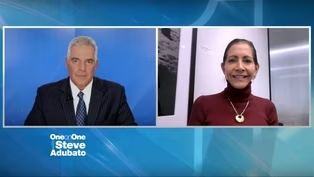
First Lady of NJ Combats Maternal Health Inequities
Video has Closed Captions
Clip: S2023 Ep2625 | 11m 11s | First Lady of NJ Combats Maternal Health Inequities (11m 11s)
Providing Support for PBS.org
Learn Moreabout PBS online sponsorship
- News and Public Affairs

Top journalists deliver compelling original analysis of the hour's headlines.

- News and Public Affairs

FRONTLINE is investigative journalism that questions, explains and changes our world.












Support for PBS provided by:
One-on-One is a local public television program presented by NJ PBS