
Making Sense of Change
1/19/2023 | 25m 46sVideo has Closed Captions
Making Sense of Change
In this episode of InFocus, we talk with an SIUC Scientist about the impact of atmospheric river phenomena – particularly as it relates to California at the start of 2023. In addition, a look at how organizations are looking to break down barriers to care, including climate issues.
Problems playing video? | Closed Captioning Feedback
Problems playing video? | Closed Captioning Feedback
InFocus is a local public television program presented by WSIU
Support provided by:

Making Sense of Change
1/19/2023 | 25m 46sVideo has Closed Captions
In this episode of InFocus, we talk with an SIUC Scientist about the impact of atmospheric river phenomena – particularly as it relates to California at the start of 2023. In addition, a look at how organizations are looking to break down barriers to care, including climate issues.
Problems playing video? | Closed Captioning Feedback
How to Watch InFocus
InFocus is available to stream on pbs.org and the free PBS App, available on iPhone, Apple TV, Android TV, Android smartphones, Amazon Fire TV, Amazon Fire Tablet, Roku, Samsung Smart TV, and Vizio.
InFocus
Join our award-winning team of reporters as we explore the major issues effecting the region and beyond, and meet the people and organizations hoping to make an impact. The series is produced in partnership with Julie Staley of the Staley Family Foundation and sponsored locally.Providing Support for PBS.org
Learn Moreabout PBS online sponsorship(upbeat music) (electronic music) - Welcome to another episode of InFocus.
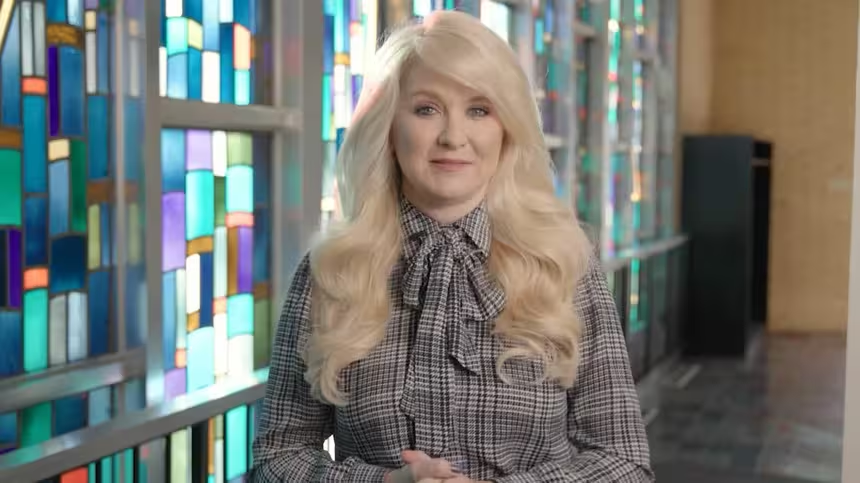
I'm Jennifer Fuller.
You've probably seen the images or read about the phenomenon happening right now on the west coasts and it all has to do weather events that are a part of an atmospheric river.
A lot of questions are out there about what exactly is an atmospheric river?
And what does it have to do with climate change?
We thought we'd talk with an expert about that and that is Dr. Justin Schoof.
He's the Director of the School of Earth Systems and Sustainability at SIU Carbondale and a Professor in the Geography Department.
Professor, thanks for coming in.
- Thank you for having me.
- So for people who are unfamiliar, we know that this atmospheric river has contributed to an astronomical amount of rainfall in California over the last several weeks.
But what is an atmospheric river, what's going on?
- Sure, so as the name implies, an atmospheric river is a feature in the atmosphere that is kind of long and sinuous like a river would be.
So a typical atmospheric river may be a couple thousand kilometers in length.
Usually less than 1000 kilometers in width and really limited to just a few kilometers in death.
So you could think of this as a rivet of moisture in the atmosphere.
That allows for moisture to be transported over very long distances.
- People may be familiar with waves of moisture when it comes to rainfall.
Particularly in the Midwest, we think about those spring and summer months that can get so very wet, so very quickly.
But this is an extreme version of that it appears.
- It is.
So what happens in the climate system is that the tropics are much warmer than the mid latitudes and because of that we have a lot more water evaporating from the global oceans in the tropics.
So what that means is that when we get moisture from the tropics moving in to the mid latitudes, it's characterized by high amounts of water being present.
Atmospheric rivers, those affecting the West Coast in the U.S., usually originate in the tropical Pacific.
So we have for example, convection associated with tropical disturbances and it's when mid-latitude systems can kind of tap into that moisture and draw it into the mid latitudes that you get these features that we call atmospheric rivers.
- Similar to the phenomenon that causes a hurricane?
- Well, so yeah.
I mean a hurricane gains its strength because the evaporation of water from the ocean ultimately leads to a recondensation of that water vapor.
Any time we have condensation of water vapor in the atmosphere there's a lot of action.
And the reason for that, is that just as you have to put energy into water to make it evaporate, you get that energy back when it condenses.
So when it moves in the opposite direction, you get an energy release.
So the most energetic systems that we have on our planet are those that are associated with a large amount of water being condensed from the vapor phase to the liquid phase.
- Let's talk a little bit about how these atmospheric rivers both interact with and are effects of climate change.
There's been a lot of talk.
- Yes.
- About extreme weather and how things change because of climate change.
So how is climate change causing these atmospheric river phenomenons and what does it say to you about you know, what's coming in the future?
- Sure so there are lots of facets to this.
Most people think of climate change as being characterized primarily by a warming of the lower atmosphere.
Any time we warm the lower atmosphere, we're going to increase evaporation.
Not only do we increase the amount of water that evaporates from the oceans but we actually increase the amount of water vapor that the atmosphere can hold before it's saturated.
What that means is that when we have events that involve precipitation, if everything else stays the same, we're going to get more precipitation because the air that's converging into one place to produce precipitation has higher moisture content to begin with.
There are other factors that can play into this as well.
So for example, if a thunderstorm has a larger footprint, it will draw in more moisture.
So if the footprint of a thunderstorm changes as a function of climate, we don't know if it does or doesn't.
But if it does, then that could also lead to more precipitation.
If you have a larger cyclonic system that can draw in moisture from a larger area, that can produce more precipitation in the system.
So we have a number of factors that are kind of working together to make precipitation systems more intense and the thing that's really important about that is that increases in extreme precipitation are both theoretically predicted as a consequence of warming but they're also one of the things that we can already see happening in the record.
So we know that in many, many mid-latitude locations we're seeing an increase in extreme rainfall events.
We had the issue with Hurricane Harvey that some listeners will remember from Houston a couple of years ago.
You know, we've had an instance just last summer north of St. Louis where we had something like 14 inches of rainfall in a 24-hour period.
So we're seeing this manifest in lots of different ways.
Atmospheric rivers are one of them.
So as the world warms, you get higher humidity in the atmosphere and therefore these atmospheric rivers which are now the dominant form of moisture transported in the mid latitudes, those are gonna be wetter.
So the real action with an atmospheric river happens at landfall.
Right?
Because the moisture is moving along.
It's happy to just be moving along over the ocean.
What happens is when it interacts with the land surface, you get a little bit of lift.
And that little bit of lift is all you need.
It's the same thing that happens in lake-effect snow when you have cold air flowing across the lakes.
Nothing happens until it interacts with the land.
You get that little bit of uplift, when the air interacts with the land surface, that's what causes the precipitation.
- Perhaps I'm taking a leap here but we saw that massive amount of snowfall near Buffalo, New York.
- Yes.
- Not that long ago, similar situation?
- Again, kind of an unprecedented situation.
Even for people that live in Buffalo, they were not used to having this.
And one of the problems there was that even residents that had lived there for a long time didn't really know what the risk was.
We heard about the terrible loss of life.
I think it was 34 lives lost in Buffalo, that's pretty incredible.
In this day and age, that we'd lose that many lives during a blizzard and a lot of people thought that it would be fine to walk two blocks to the grocery store.
And so what we also see is that there's a social part of this because the people that are most impacted by this are the people that are least prepared to deal with it.
- We've been talking for a little while, we've seen in the media and people have been studying the fact that climate change is bringing more extremes.
So before we were talking about the atmospheric rivers in California, we were talking about extreme drought and concerns about would people need to abandon communities altogether because they had no source for potable water.
Now there are people saying, "Well all this rain, "it's filled up all the aquifers, "everything's fine, we'll be good."
You know, even the snowpack in the Sierra Nevadas and other mountain ranges.
It's all rebuilt and everything's fine.
Tell us what that really is.
- Okay, so places in coastal California got between 30 and 50 inches of rain since Christmas.
That's the equivalent of about what we get in southern Illinois in an annual total.
So we're talking about huge amounts of precipitation.
As that atmosphere, wherever it makes landfall you get a lot of precipitation right along the coast, some of it moves inland and then interacts with the mountain ranges.
So you get a lot of snow.
So people along the coast of California were absolutely decimated by, I mean there's no place that can handle that much rain without having issues with runoff and flash flooding and that sort of things.
So they're dealing with landslides and a lot of issues.
Further inland of course, they do have now 250% or something like that of their annual snowpack which actually will be very important when springtime comes around because that snowpack will feed the streams and so on and provide important components of their hydrology.
However, a lot of what we hear with water problems in the west is related to the Colorado Basin.
Lake Mead, Lake Powell for example.
Those lakes are currently at a third of their normal levels and so this is not really going to alleviate the longterm water problems that plague the western U.S.. That's gonna, if we had maybe 10 years like this in a row, that might do something.
But even then, the west on a trajectory toward longterm drying and if something doesn't happen pretty soon, those dams will be sufficiently low that they won't be able to produce hydroelectric power.
- Lots of layers there, sure.
- There's so many layers.
- Sure.
Now there are a lot of people who perhaps don't live anywhere near California, don't know anyone in California.
Who are sitting here in the Midwest and saying, "This doesn't impact me."
But I'm thinking of stories like what we saw late in the fall, early in the winter where on the Mississippi River, people could walk out to, there's a rock in the river.
And that hasn't happened in decades if not hundreds of years.
So there are similar phenomenon when it comes to extreme rain, extreme drought here in the Midwest.
- Absolutely and there is some sense that things are maybe becoming a little more flashy.
So out west for example, one of the issues that we know is going on is that the winters are getting warmer and shorter right?
But they tend to be punctuated by more extreme events and we kind of are seeing that in a lot of different places.
We're on the subject of atmospheric rivers and it's important for viewers to understand that atmospheric rivers also impact us right here in Illinois.
So there are tropical moisture blooms that kind of travel across Central America and come up into our region through the Gulf of Mexico.
We might understand those as kind of the driver of those summer nighttime thunder storms where you might get that three or four or five nights in a row and a lot of that moisture is coming from, either an atmospheric river of sorts or in some ways, that's often known here at the Great Plains low level jet but they are very closely related.
The other place where we see atmospheric rivers that viewers would be familiar with is that a lot of times, in a mid-latitude cyclone, you have a cold front and you have a lot of precipitation right along that cold front.
That precipitation is actually moving from south to north along the cold front usually.
The moisture is, the humidity.
And so that's often an atmospheric river that's actually feeding the moisture into the low.
The low pressure system itself is drawing the moisture in and helping to maintain the flow of moisture from the tropics to the mid latitudes.
- Even over land?
Are we still seeing some of those extreme?
- Even over land.
So what happens is that the extreme happens where the moisture piles up.
So if you have air flowing from the south to the north, then where does that happen?
It's actually like the northern terminus of that atmospheric river which often happens over Iowa.
That's why Iowa is kind of known, and northern Illinois are really known for this nighttime precipitation max during the summertime.
A lot of that is driven by moisture flux that doesn't, it comes from further south than the Gulf of Mexico.
- So you talk about mid-latitude seeing these changes, these extremes.
There are mid latitudes in the Southern Hemisphere.
Of course we think of our counterparts in Europe and in other parts of the world.
- Of course.
- They are seeing similar phenomena?
- They are and there's a lot of interesting discussion right now in the climate science community about why.
And there's sort of a couple of leading theories.
A lot of climate scientists have thought for a long time that the tropics are where the action is.
In other words, most of what happens in the mid latitudes is related to the tropics and people are familiar with that.
They've heard of El Nino and La Nina.
These are tropical phenomena that impact our climate.
But if you look at climate change, climate change has happened in an exaggerated sense in the polar regions.
So if you look at the warming, the north polar region has warmed more than anywhere on the planet.
We've lost ice, we've lost snow and it's hard to imagine that that doesn't somehow impact the dynamics between the north polar region and the mid latitudes.
So there are kind of competing theories on this.
There's one group of scientists right now who feel that the change in the Arctic climate is changing the mid latitude weather during the winter.
So winters overall are becoming warmer and shorter but they are being punctuated by these extremes that are related to changes in the Arctic.
That you know, the polar vortex is doing this kind of thing in the Arctic and once in awhile, a load breaks off and comes in the mid latitudes.
It's those kinds of things.
It's the dynamics that drive these extreme events rather than maybe the overall warming.
Now there's another camp that says no, as the climate warms, winters will have to become less severe.
Right?
And probably in time, I think I belong more to that camp.
But we have a climate system that's highly variable.
So we could warm by five degrees, we're still gonna get snowstorms in the winter.
We won't get them as often as we will but every once in awhile, you'll still get a doozy.
Just like they did in Buffalo.
As I mentioned, people were in Buffalo having no idea about how bad things really were in terms of the wind-driven snow.
The worst weather disaster in U.S. history in terms of money was also recently, February 21, in Texas.
When the Texas power grid went down.
That was a winter event as well.
So there is some evidence that we're getting some really extreme winter weather that could actually be a response to warming.
- There are a lot of people who are hearing the news about climate change, they're seeing areas where people are making changes.
Whether they're trying to find more sustainable ways of living, shopping local when it comes to groceries and things like that and they still see these changes in these extremes.
So what is on the horizon?
Is there a way to scale some of this back?
Or are we on a trajectory now that we can't come back from?
- There are decisions that we still have to make about what our future holds.
The reality is that the world has warmed by somewhere between a degree and a degree and a half.
Most of that warming is us.
And so we can see what the implications are of a degree to a degree and a half of warming.
We're living them right now.
What the experts would say, what the IPCC would say for example is that every additional increment of warming, no matter how small, a tenth of a degree, a half a degree, a degree, any additional warming will be associated with additional impacts.
So you know, the warming that we have right now, we're kind of committed to.
The only way to get rid of the warming we've already produced would be to draw carbon dioxide and other greenhouse gases out of the air which is very hard to do given current technology and it's very expensive.
So we're faced with, without action, we're gonna continue to see the consequences of climate change get worse and worse and worse.
Now we have to be careful because our level of confidence in attribution is not the same across all types of weather events.
So for example, we have very high confidence that land and marine-based heatwaves are getting worse and we also have high confidence that that's because of humans.
Okay, now when you look at something like say, tropical cyclones.
Tropical cyclones are much rarer, they're harder to study and you know, they existed long before we did right?
So some of the worst hurricane in U.S. history happened a long, long time ago and they were not impacted by climate change.
So it's really, really difficult for these individual events to say anything.
Now there is a kind of emerging science called rapid attribution science where there are a couple of groups in the world doing this now.
Where they take an event and they pour all of their resources into it for a matter of a month following the event to do a rapid attribution study and actually be able to say, "This event was 20 times more severe "because of climate change than it would be "if climate change didn't exist."
- There are also, we should point out, there are parts of climate change that actually could, dare I say, benefit humans.
In terms of for one example, growing seasons.
If you typically have a one-crop growing season, maybe you can fit two in.
Are there other things that a warmer climate can actually benefit?
- There probably are some other benefits, but I think they're largely outweighed.
I'm really glad that you bring up the example of agriculture.
Because a longer growing season generally is good, if everything else stays the same.
But a longer growing season with more hydroclimate variability, that is more flood, more drought, more flashy type of precipitation regime, that's not necessarily good for agriculture.
The other thing that's happening, I've got a doctoral student working on this now is that you know, we have warming in some areas, like for example in the Central Valley in California that's actually reducing the chilling hours during the winter.
So that has implications for the health of fruit trees and that affects our region as well.
So if you have winters getting warmer and warmer, it's possible that fruit trees will not get the correct number of chilling hours.
An adequate number of chilling hours.
That is cold weather that's not below freezing but not too warm.
If they don't have adequate chilling, they will not come out of dormancy in spring which means they won't flower and they won't produce fruit.
It also means that if the spring is getting warmer, then we get earlier greenup and then we have higher risk from late frosts.
So that's something that people all over deal with but that's something that really can affect us right here in Southern Illinois.
- I imagine this is a science that is just changing at a speed that's almost hard to keep up with.
- There is a lot going on.
For sure.
- Certainly.
Dr. Justin Schoof is the Director of the School of Earth Sciences and Sustainability at SIU Carbondale.
Thanks for taking the time.
- Thank you so much.
- And climate change is just one impact on how people are able to get from point A to point B and a lot of times that has to do with how they get access to care.
We take a closer look again at some of the issues that people face in finding adequate care in Central and Southern Illinois.
WSIU's Benjy Jeffords took a closer look at what's happening when people are searching for care and sometimes the care has to come to them.
- [Benjy] People in rural communities sometimes have many obstacles to overcome finding healthcare.
Those can include transportation, a lack of providers, high deductables or insufficient insurance coverage.
Some organizations try to help by traveling to those that need it.
Jennifer Meyer is a Clinical Instructor of Dental Hygiene at SIU's School of Health Sciences and says COVID-19 forced them to make some changes.
They hold open clinics throughout the year, but this year people had to come to them.
- Normally we are a mobile clinic and we will travel to different sites but just due to some restrictions this year, we've decided to do an in-house event.
We're gonna try and do another one in the next couple of weeks.
- [Benjy] Meyer says there's an advantage to holding the clinic on campus.
- It's difficult to get a mobile unit out to places and there's a huge shortage of providers.
So it just seemed more beneficial to have everyone come to us and then we have everything that we need set up in the clinic and ready to go for the event.
- [Benjy] The 30 openings they had filled up quickly.
- We put the flier out on Tuesday and we filled our appointments in two hours and we're still taking patients on a waiting list in case we decide to do another event.
(machine whirs) - [Benjy] Just before school started, the Department of Defense and the Delta Regional Authority brought the SI Wellness Mission to Carbondale and offered free basic health services to anyone that came to the Civic Center.
Lieutenant Colonel Slade Lindquist with the 325th Field Hospital says they have a wide range of services available at these missions.
- We're offering single vision glasses and exams to identify any health issues with their eyes.
Same with medical, wellness exams, high school physicals.
School physicals for children.
No age limits.
Dental, if they have, basically a dental wellness exam, cleanings to a limited extent but more extractions and fillings and then like say again, mental health wellness and chaplain services available to patients as well.
- [Benjy] Mary Blossom brought someone to the Wellness Mission who's a refugee from Afghanistan that recently arrived in Carbondale.
- I sponsor her and she needed medical attention and we found that this organization is offering free health, dental, vision, behavioral and so it was a really good fit for somebody that needs those resources and has no income at this time.
- [Benjy] Blossom thinks it's wonderful so many people are getting the help they need for no cost to them.
- Having lived in the area for a long time, I realize that a lot of these rural areas have a lack of resources.
And especially for those that are in need of support financially.
And this has been a great organization and everybody's been treated like royalty.
I just can't say enough of what a good program this is.
- Sean Smith recently moved to Carbondale and saw this as a great opportunity for his family to get caught up on their health needs.
- Getting the help that I need, well that me and my family need.
So we can get back into our medical stuff getting going.
Getting the boys taken care of so they can get ready to start school next month.
- [Benjy] Blossom says this couldn't be a more pleasant experience.
- There's so many people on hand, they're all with a smile and a friendly face and escorted people through this process.
You know, you'll have people that are a little anxious because of their health concerns and maybe even be in a little bit of pain and everybody's supported them with a lot of emotional and physical support here.
- [Benjy] Blossom thinks the timing of this event came at just the right time.
- I have worked in the school system and retired from that but I know what an obstacle that is, just to get kids in the door to start school with physicals.
So this is good timing, especially in the summer.
- [Benjy] Leslie Durham with the Delta Regional Authority says there's a lot of planning to make something like this possible.
- From start to finish, it's a two-year process.
We get these communities that want to participate, have to make an application and we assist with the application and it literally takes two years to do this.
It's not an overnight thing to be able to do the logistics for such a big mission like this.
- [Benjy] Durham says patients use these missions to help fill gaps left by their insurance and sometimes patients learn about health issues that they didn't know about.
- Sometimes the Medicaid doesn't pay to have your teeth removed but they will pay for dentures.
But you have to have your teeth removed right?
And it's really expensive.
So you can come here and have your teeth removed and then go get your dentures.
And that's something that they weren't able to do before.
So things like that.
I know that you know, most of this is screenings.
So they've been able to identify pre-cancer.
And life changing things that folks just could not get before or just couldn't make the, or didn't live close to and have that opportunity.
- [Benjy] Durham says people can find out what other types of assistance is available in the area.
- You have to have a lot of community support and you're gonna see that the hallway where all those tables were will be full of resources for people to take advantage of and I know it's crazy, but even people that live in the community may not know what's available.
So this is a great opportunity to be able to take advantage of what's out there and it's more important now than ever that we maximize what's available to us.
- [Benjy] The mission performed 2400 procedures for 755 patients.
For InFocus, I'm Benjy Jeffords.
(electronic music) (upbeat music)

- News and Public Affairs

Top journalists deliver compelling original analysis of the hour's headlines.

- News and Public Affairs

FRONTLINE is investigative journalism that questions, explains and changes our world.












Support for PBS provided by:
InFocus is a local public television program presented by WSIU