
Manny Crisostomo
Season 2023 Episode 3 | 26m 47sVideo has Closed Captions
Pulitzer Prize winner Manny Crisostomo talks about learning from his 40+ years in photography.
Manny Crisostomo has spent over 40 years using his perceptive eye to immortalize moments into photography that would earn him numerous awards and accolades - including a Pulitzer Prize - giving the opportunity to share voices and stories of those who may not have been able to before, including Hmong refugees and the students of Southwestern High in Detroit.
Problems playing video? | Closed Captioning Feedback
Problems playing video? | Closed Captioning Feedback
SAINA is a local public television program presented by PBS GUAM
This program has been made possible by the Government of Guam Education Stabilization Fund.
Manny Crisostomo
Season 2023 Episode 3 | 26m 47sVideo has Closed Captions
Manny Crisostomo has spent over 40 years using his perceptive eye to immortalize moments into photography that would earn him numerous awards and accolades - including a Pulitzer Prize - giving the opportunity to share voices and stories of those who may not have been able to before, including Hmong refugees and the students of Southwestern High in Detroit.
Problems playing video? | Closed Captioning Feedback
Where to Watch SAINA
SAINA is available to stream on pbs.org and the PBS app.
Providing Support for PBS.org
Learn Moreabout PBS online sponsorshipWell, my start into photography was kind of dubious at best.
I remembered I was a senior at Father Duenas Memorial School and Tommy Camacho, the yearbook editor said, "Hey, you know, you want t take pictures for the yearbook?"
I said, "Sure.
Let me ask my brother Herman.
My brother Herman's a really well known famous photographer here on island."
But I think he was off island at the time.
But he gave my sister his old camera which was a Pentax spotmatic.
So I borrowed it from my sister and me and Tommy went around and I'm photographing and I'm photographing and- After about a week or two, Tommy goes "Hey, let's develop the film."
So I'm like, "Okay."
So I opened the back of the camera to give Tommy the film, and there was no film.
For two weeks, I was photographing something that wa just basically in my mind's eye.
[MUSIC PLAYING] So I grew up in Sinahånña.
There's nine of us in my family, so I'm in the middle.
My dad was a carpenter.
He worked for the Navy.
Mom had the beauty shop.
Neither of my parents finished high school and they saw the value in education.
They were able to send most of us to.
We went to public elementary school, but I end up going to St.
Jude, Bishop Baumgartner and Father Duenas.
I always think back abou how committed my parents were.
But also, you know, growing up, my parents had this thing and it's a really- it's kind of I've talked to people in doing the Manaotao Sanlagu.
The CHamorus that live stateside documentary.
A lot of the CHamoru parents didn't want us to speak CHamoru as much.
They wanted us to be- to learn English more.
My friend Rob Perez said, "Yeah, they my parents are like, you know- we're going to teach you guys English.
You're going to be super fluen in English because, you know, we think they'll increase your chances of getting jobs and stuff."
There was sort of that perio as I'm doing this documentary, there are a lot of people that were sort of my contemporaries that experience that there was sort of this push to not learn CHamoru.
I know CHamoru.
I don't- I can speak it.
I hold my own, but- Rob's a- Rob a fantastic journalist, an award winning investigative reporter and he said that's one of the few things he regretted.
That he didn't get to know- learn CHamoru as much.
So fast forward the following summer.
I was offered an internship at the Pacific Daily News.
It was a writing internship, and I really, really enjoyed that.
And then that following summer I went back, there was a new executive editor at the Pacific Daily News, and I said, "Hey, I would like to get back full time for the summer.
Just to continu to learn the craft of writing.
I really enjoyed it."
He says, "Well, your writing isn't up to the quality that we want here at the PDN."
And so I was like, totally, like, taken aback.
I was like, "Holy crap, I really love this.
I really got into journalism and, and I was just told right in my face that I didn't have the chops to do it.
After my initial shock, I said "I really want to stay in the business.
Is there anything you have for me that I can do this summer?"
And he goes, "Well, the photograhers said they need help.
Do you have any photo experience?"
I was like, "Yeah, I have a photo experience."
So there I was in the darkroom that summer.
The photographers would be out photographing.
I'll be cutting up their negatives.
They had books and magazines of photography all over the darkroom back in the day at the Pacific Daily News.
I said "Wow, this is really, really cool."
So not too long after that, I got my tax refund and asked my mom to get me a camera and she got me the Canon F1 at the Navy Exchange.
And I remember being really mad at my mom.
I'm like "I said, I wanted the Pentax Spotmatic."
Not knowing that the Cano was about 50 to 60 times better.
Then just throughout that summer I worked on the weekends I started taking pictures for the Triton Calls at UOG where I was one of the editors of the newspaper and just kept learning photography.
I went to th University of Missouri-Columbia because they had the- The best photo journalism program in the country.
Went there.
Graduated.
I went to Michigan and went to Detroit.
Not too long after that, I started doing work on the violence that was happening to to the children in Detroit.
I think one year, 85 children under the ages of maybe 5 to 16 were killed in Detroit violently.
I spent about a year at the juvenile detention facilities in Michigan.
We did a series called "Too Young To Die."
I had a bunch of young teens show me the guns they had.
They were 12 or 13.
They were showing me their guns.
I went out with the narcotics officers.
And I started documenting all that.
But then I got to thinking, I'm like- We can't just sa "The kids in Detroit are bad."
That they're killing each other.
I said, "There's got to be more."
So I found an inner city high school in the city of Detroit called Southwestern High School.
It was a really neat high school because it had this really wonderful mix of Caucasian whites Hispanics and African-Americans.
And I approached the superintendent of schools and said, I wanted to spend a year.
But I didn't want to just go in there and take pictures and say, "This is the state of high school.
This is the state of, you know, the violence that kid have to go through in Detroit."
I said, "I want to spend a year and find out the thing that make a high school tick."
Which includes dating, proms, homework, basketball games, you know, puberty and what both young men and young women go through.
But amidst all that ther in this part of Detroit that was there was a lot of unemployment.
One of the auto plants closed.
And these kids are literally walking through abandoned homes where there're crack cocaine or crack deals were being made on their way to school.
So I spend a year fro the first day on till graduation The kids got to know me.
I would photograph and I would put pictures up on their display cases at around the school, and they saw tha I wasn't putting up pictures of kids posing.
Doing signs; whatever they do.
They got to see what I was photographing.
And after a while, they just kind of ignored me.
Not too long after graduation, the Detroit Free Press ran 12 pages.
I wrote all the stories, and the following yea the newspaper entered it in the Pulitzer prize and I won the prize the following year.
And that thing was called The Life and Times of Southwestern High School.
So what happens with the Pulitzer is the editors kind of know if you're a finalist.
But the thing is, nobody knows second and third place.
They just after a while they just announce the winner.
So I kind of knew that because I had some colleagues that kind of went through that process.
They told me like maybe three or four days before they were going to make the final announcement.
And those are the most nerve wracking three or four days.
And I remember being really, really upset because I was I was doing a lot of sports photography, and I was they were having the March Madness and I was following you know, I was doing sports photography I think University of Michigan got to the Final Four and I'd been photographing them throughout the whole year.
And they said, "You're not going."
And I'm like, "What?"
And I remember calling my mom and I said, "Mom, I'm up for this thing called the Pulitzer Prize, and I'm probably not going to get it, but it's a really big deal."
And my mom said, "Okay, boy, I'm going to go to St.
Jude and light some candles for you."
And I was like, "Oh."
My mom said that she didn't even think or ask or whatever.
She just believed.
She always believed in what I did.
And she knew I loved it.
She said she was going to light candles for me at St.
Jude.
And 48 hours later, I received the prize.
Wow.
At some point, I was just kind of sitting there in Detroit being really, really mahålang for Guam.
I won this amazing award and I am so grateful for it.
This is one of the most amazing things you can receive.
And yet I still felt a little empty, like it didn't really fulfill me.
And I just said, "I got to find a way to go back home."
I wanted to parlay winning the Pulitzer to be able to give me a chance to apply for grants, and we haven't really had anything that was a documentation of the CHamorus by a CHamoru And I felt really strong- strongly about that.
And that's how I sort of frame the grant to do Legacy of Guam: i kusumbren CHamoru.
And so I spent a year got great stuff.
I asked for a couple more month to get the book in production, and I was all set to go back to Detroit and there's two major newspapers in Detroit.
They're part of the the Newspaper Guild, and they went on strike.
They ended up being on strike for almost eight months.
And I had a choice between goin back to Detroit in the winter.
Hold a picket line and make $35 a day or to stay in beautiful Guam.
And so I just I quit and I stayed and- and found some people who supported me in in producing Latte magazine.
I did commercial work to pay the rent, advertising, working for corporate clients.
But everything I made was poured back toward shooting as much as I can about Guam and the culture.
One of my really best friends at FD was Tony Sanchez.
And Tony passed away at a younger age.
And I still think about him all the time.
And his son, Simon, is a photographer.
I met him during FestPac.
You know, we were talking today and he kind of answers- ask sort of the same question, but he came at it a little different.
And he says, "Man, Uncle Manny, I kind of just watch you and you're like so relaxed.
You're just like-" And I go, "What do you mean?"
When I'm photographing, I'm like, super intense.
And Simon said that "I was watching you at FestPac and there was this one sho where you just kind of saw it.
I was watching you.
You saw it.
You framed it.
You took a couple of shots and then moved on."
And then he goes, "Then I see the book and I see the pictures.
And he goes, "Holy crap, I didn't even see that."
I was right next to you.
I didn't see that."
The best part about photography to me is that you become present.
You have to be present at the moment.
If you're not present with the camera in front of your face or if you're looking back on it, you know, you lose stuff.
What I mean abou being present is a lot of times, we're driving and we're thinking about where we're going to eat for dinner or how we're going to pay for the kid's tuition and all this other stuff and your mind's going all different places.
But when you're taking pictures, when you're in photography, you just- you know, you just got to be zoned in.
I was trying to explain Simon that.
It's like I don't know.
If I'm working, I'm working.
You know, if I see something, I'm gonna try to get to that point.
When it comes to performances, like mostly FestPac.
I would shoot the performance, but I really love what goes on backstage.
I love the preparation.
I love the anxiousness.
And then when they come out, the relief and the joy of nailing it.
And I just I kind of look for those moments When I pick up a camera and I'm asked to document somethin or I choose to go to an event.
I just kind of want to see things unfold in front of me, be present in the moment and catch whatever it is I can.
Sometimes I succeed.
Lots of times I fail; by my standards.
But I'm going to keep trying.
At the PDN there was a CHamoru photographer named Manuel Perez and his thing was so cool because his credit was always like "Photo by Manuel."
I'm like, you know it's like the early version of, Madonna or Liberace or Bono or whatever.
And I think they just switched to Manny from there.
And he was CHamoru and he took his time with me.
He was super patient with me, Taught me everything.
He'll look at something and I'll say "What do you think?"
And he goes, "Wel what's the significance of it?"
And he had me realize that there had to be more from a picture than just people or scenes or landscapes.
What is it you're trying to say?
What is it in the imagery that would make people want to stop and pick up the newspaper or stop at a gallery opening and just linger at that photo?
In this exhibit, at CAHA which spans 40 years.
I'm finding out that the way I was seeing, the way I was composing, the way my lines and the layering I have in my photographs, it has not deviated much.
When I was taking pictures at 17, 18, 19 to now.
I'm in my early sixties.
For some reason, whatever- God given talent I was given in the craft and the art of photography.
It was there from the very beginning.
I went to school and not that I learne about shooting and composition, I learned how it's defined.
I tell people I think a lot of my success in terms of photographing and engaging people and getting people to open up or to let me in there and then being super aware o once I'm given that access and being very respectful of that access that I capture them the way they are.
I was telling this one editor, I said, "I think it's kind of like this CHamoru thing that we have called inafa' maolek.
Right?
We're better helping each other than being in our individual silos.
So if I go to an event, I learned growing up from my mom and dad and my aunts and uncles, if inafa' maolek right?
Take care of each other.
My mother's always like, "Take care of your brothers and sisters.
Be nice to your brothers and sisters."
And if I'm sent to photograph somebody.
I'm aware that that person is giving up their time for me to be there.
And I need to honor that.
I'm photographing you either for the newspaper or magazine or a client.
But we're together in this relationship.
You need to give me something of you.
I need to be aware and be able to capture that.
That's as honest as it could b and as respectful as it could be for the end result, whether it be newspaper, magazine or a book.
I just go in to shoot and I'm "Manny."
And part of being Manny I guess I'm realizing, especially when I work stateside is that CHamoru Manny has got a little bit of inafa'maolek in him.
Somewhere, somebody very generously gave me this gift Thank you.
I was traumatized when that PDN executive editor told me my writing sucked.
And I'm very awar and I'm very cognizant that when when young photographers or older photographers that just started photography would ask me for advice.
I try to be really, really careful, because I don't want that experience to affect whoever it is that's asking for advice.
So when I talk to young photographers, I'm always really intereste to see how passionate they are.
Are they going to be able to be like me?
I started taking pictures when I was 18 and, we're almost talking about 45 years.
Are you going to be just as passionate as I am 45 years later?
Still taking pictures.
Still carrying all the heavy stuff around your neck.
Still enjoying it.
Still loving the chase of a good photo or the moment of interaction of somebody when they let you in for a brief moment to take their picture.
When you get home from your day job and you're tired and you see beautiful light falling on your kids in the room, in your home.
I mean, are you going to pull out a camera or you just gonna say, "I'm too tired to do this."
My wife and kids are back in California, but my daughter and my grandkids are here and they wake me up every morning.
"Papa California, we gotta go to school."
I take out the camera, we walk to the bus stop.
I'm photographing every day going to the bus stop.
There'll be rainbows and the cloud formations will change.
But every day for the last three weeks, I would take that same walk to the bus stop with my granddaughter.
And they're all variations of the same shot.
I mean, are you that passionate enough that you would get up at six in the morning, 15 days in a row and photograph the same thing over and over again and seeing if there's something else there?
I did this workshop for GUMA and I was telling them about ho some of the things I want to do, I asked the universe.
I remember working for the Sacramento Bee and I was going down almost every day to the San Francisco training camp and this long drive in there, and I have this book on- audio book on Manifesting Your Destiny.
And it's like, "What do you want?"
Tell the universe what you want and stuff.
And finally I said, "I want to go to Guam."
Then the audio book goes, "What else?
What else?"
"I want to go to Gua and I want to go three times."
"Tell us what you really want."
And I said, "I want to go Guam and I want to go three times and I want somebody to pay for it.
Within the next two years I had three paid trips to Guam.
But if you're not projecting it, if you're not saying it.
It's one thing to think about it but if you got to- At some point, you just gotta start saying, "Hey, I want this."
Say it, believe it, and the find ways to get to that right.
I tell people that, "Hey, if this is what you really want?
Go on and do it, man."
I read something on Instagram recently that says, "The natural state for humans is happiness."
And that if you're not happy, you're not in your natural state.
And I've been thinking about that a lot.
When I'm feeling kind o like tired or down or exhausted.
I mean, we're breathing, we're living.
We don't know if we're going t be breathing or living tomorrow.
And you just sort of got to take every moment.
I'm always in a state of gratitude.
I get up in the morning and my left foot goes down and it says "Thanks" and my right foot goes down it says "you."
"Thank you."
There's just so muc I've been really blessed with.
There been so many opportunities that was given to me.
You know, I'm just grateful.
I'm grateful for you guys being here helping me tell my story, hoping my story would reach other people and then they can also grow and manifest what it is that they wan and then they will pass it down.
Flying into Guam always gives me joy.
And I remember one time I was just like so mahålang.
I was like, "Whoa, where is the pain pangs coming from?"
Right?
And I have this wonderful canoe carving by Segundo Blas that I brought back with me.
It's a galaide at the sail and somebody's in it.
And I took it and I put it in the pool and took pictures of it.
It alleviated the mahålang pain there for a while.
I was talking to somebody when I was doin this Sanlagu thing and she said, "The mahålang is the longing, right.
We're longing for home.
We're longing for people that we care about.
We're longing for family.
We're longing for food, the music."
And she goes, "The mahålang is the longing.
And the only way to mitigate the longing is to find a sense of belonging."
And she said, "Go find othe CHamorus that live in the States and be mahålang together.
And in the process of being mahålang, your longing, you're part of a belonging.
There's just somethin about our culture, our people, who we are innately that when we get together, it's just- there's so much joy in it.
Video has Closed Captions
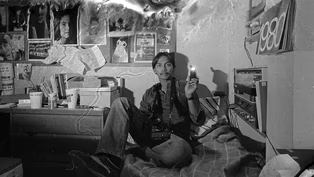
Preview: S2023 Ep3 | 30s | Manny explains the importance of presence. (30s)
Providing Support for PBS.org
Learn Moreabout PBS online sponsorship













Support for PBS provided by:
SAINA is a local public television program presented by PBS GUAM
This program has been made possible by the Government of Guam Education Stabilization Fund.