
Many Chicago Homeowners Facing Higher Property Tax Bills
Clip: 11/19/2025 | 9m 23sVideo has Closed Captions
Cook County Assessor Fritz Kaegi explains what's behind the hike.
Cook County Assessor Fritz Kaegi argues the property tax system favors corporations, and is pushing for change.
Problems playing video? | Closed Captioning Feedback
Problems playing video? | Closed Captioning Feedback
Chicago Tonight is a local public television program presented by WTTW
WTTW video streaming support provided by members and sponsors.
Many Chicago Homeowners Facing Higher Property Tax Bills
Clip: 11/19/2025 | 9m 23sVideo has Closed Captions
Cook County Assessor Fritz Kaegi argues the property tax system favors corporations, and is pushing for change.
Problems playing video? | Closed Captioning Feedback
How to Watch Chicago Tonight
Chicago Tonight is available to stream on pbs.org and the free PBS App, available on iPhone, Apple TV, Android TV, Android smartphones, Amazon Fire TV, Amazon Fire Tablet, Roku, Samsung Smart TV, and Vizio.

WTTW News Explains
In this Emmy Award-winning series, WTTW News tackles your questions — big and small — about life in the Chicago area. Our video animations guide you through local government, city history, public utilities and everything in between.Providing Support for PBS.org
Learn Moreabout PBS online sponsorship>> Some homeowners are searching for answers as they grapple with hefty and hearty property tax bills.
A new report from the Cook County Treasurer's Office says declining values for downtown commercial properties are shifting the tax burden on to homeowners Cook County Assessor.
Fritz Katie argues the property tax system favors corporations and says he's pushing for change.
Joining us to talk about this is the assessor himself for taking.
Welcome back.
Thanks for joining Thanks for having Brenda.
So as we just mentioned, we keep hearing at the explanation is that the valuations for commercial properties have fallen bus sort of tipping the seesaw to increase the valuations for residential properties.
Help us understand how that calculates.
Well, that's true.
far as that goes, so when we finished our reassessment of Chicago, homeowners would have had actually 2 percentage points.
Let's >> of the burden.
Then they started with because we saw a residential values going up.
But we saw a commercial values being higher than where they had been in the last 3 assessment, which is right after the pandemic.
But they were cut.
These values were cut at the Board of review by nearly 20% for commercial properties were is only for one percent for residential properties.
And that shifted about half a billion dollars of the burden.
According to the treasure on the homeowners.
That's about $700.
That's tacked on to the tax bill of every single home in Chicago and in some of the neighborhoods where we're seeing big increases this accounts for more than half of the increase.
>> So instead of you said when you initially started, it would have been about 2%.
But now the Treasury saying it's about 30%.
The median.
I think see you have a median increase.
Some people's bill was 16% according to the treasure.
But those on homeowners, Reza, commercial bills hardly changed at all.
And the typical commercial bill downtown fell.
28%.
So the question is, is this appropriate?
Now?
The county made a study of commercial properties and their sales over the last several years after the pandemic.
And it found that the board review his cut commercial properties.
A 25% low in 2 out of those 3 years, too low in 2 out of those 3 years, meaning that there's too much burden that's been shifted on the homeowners in the past.
And I'm worried that this has happened again because I hear the same stories that heard brand us about how people are suffering.
They're shocked by the increase in these bills that are already stacked on top insurance, electricity, health care, all the other elements of inflation that affect people of especially affects people who work because seniors who have the senior freezer protected from these increases that allowed them stay in place.
But people who work don't have some of these protections and we need to think about what we can do for them.
So you mentioned that some neighborhoods in particular experiencing the worst of it some south and West side residents have seen their tax bill go up significantly.
>> Property taxes for homeowners went up by 133% in West Garfield Park.
99% in North Lawndale compared to nearly barely 6% in Lincoln Park.
How is it that this increase then is falling disproportionately on communities whose median home values are so much lower than those in Lincoln Park.
This really goes back to affordability.
So in some south and West side, neighborhoods, homes were home areas where homes used to sell in the 100,000 range or 150,000 range.
>> They're selling now in the $250,000 Range, for example, West Garfield Park Northland Austin.
So when you have those kinds of increases that can lead people's bills to be rising.
But why, you know, why are you know, prices rising in these neighborhoods?
It's because people who are searching for homes who are making maybe 60, 70, $80,000 a year.
They can't afford to buy a home on the North side, they're priced out.
So they've been looking in south and West side neighborhoods been driving up the most affordable prices home the home.
The prices for the most affordable home.
So that's the driver of that happening here.
But what really disturbs me is that these increases need not have been so big about $700 per home is tagged onto them because of the cuts that have been made on commercial properties, which we suspect 2 excessive on commercial properties.
And it's not just office buildings.
This is on hotels.
This is on data centers.
This is on retail properties, industrial properties that are apartments that are doing pretty well.
>> And so there's the you say there's the cuts that are happening at the Board of Review on those commercial properties.
But for as far as the increases in some south and West side neighborhoods, what about park, etc?
How much of those increases are driven by improvements in those neighborhoods and growth?
I think it's a lot of things.
First of all.
>> There are really great things happening in our neighborhoods, up in the people who have stuck it out through doldrums of the housing crisis that happened in the late 2000 the 20 teens.
They were pummeled by falling prices.
Their mortgages were underwater.
But a lot of people stuck it out and have taken care of their neighborhoods.
When you look at Austin, when you look at Garfield Park, when you look at North Lawndale, people have a lot of pride and their neighbor.
They have taken care of it in the end there.
They're now getting return on their investment.
So the last 3 years on the south and West sides, there's been more wealth creation in the growth of values in people's homes and over the last 20 years.
So that's good news.
Of course, it's hard when people's bills go up.
What makes you know and everyone, you know, needs to be paying their fair share.
Of course.
But when we're seeing big cuts on commercial properties and big industrial properties, commercial properties, corporate properties and its pushed onto the homeowner.
When past studies have shown that these cuts have been excessive.
That is what I find extremely concerning.
And that's what I'm fighting against.
So there's a tax bill and there's the assessed value.
Of course, the treasurer's report released earlier this week also found that West Garfield Park North Lawndale resident saw their property value assessments.
>> More than double.
That's right.
What's the cause Again?
This is affordability.
So a match in Austin a few years ago before the pandemic.
You can buy a house and the.
>> Maybe below $150,000.
It's very hard to find a home in Austin below $250,000.
Now.
And the reason also he's a great neighborhood.
Great things are happening that are they have great.
There's a revival in the the commercial strips there.
The homes are really nice.
And people were looking at homes are looking all over the city for affordability.
If you're someone who's making 60 70, $80,000 in your priced out completely out of buying a home in on the North side.
And if you've been an apartment where rents are rising, may be stuck there during the pandemic.
You go a home in Austin, right?
you're going to pay a little bit these neighborhoods across the city, which are great.
>> The kids to make sure that people's assessment estimated accurately.
We have to follow the prices.
The people are paying out there.
That's our duty and our and our office.
But we want to make sure that we get that right.
We try to walk humbly so we can go through a checklist about what homeowners can do to make sure that they're not paying more than they have to.
>> You say your office is advocating for a circuit breaker to relieve homeowners.
What is that what it looks like?
That's right.
So a circuit breaker program is a kind of property tax relief.
>> Program for people whose bills have spiked.
29 other states have programs like this of scour the nation meeting with her peers to see how those can work.
And with really important because this is the kind of relief that would help people in neighborhoods that are experiencing gentrification like the kind that we talked about for seniors who are falling off the senior freeze.
And for Pete for working people.
We need to have more protections for people who work and we don't have enough of them.
So how the with the circuit breaker work?
The program that we propose would be if your bills by 25% or more, you would get really for up to half of the increase in your bill for 3 years there would be income Your income would have to be below $100,000.
Is our proposal.
And I've written an op-ed with the meeting, mayors in the West and south suburbs who have high tax rates whose taxpayers have experienced problems just like this last couple years and has the support of the self and mayors and managers and the south and regional mayoral black caucus.
What's been reception from lawmakers so far?
Well, what we hear is that budgets are extremely stretched in Springfield, but the weeds here from legislators that there's a lot of need, what we've heard from leaders is that let's try to make a program that can work statewide.
So it's not just Cook County.
So we're going to be working into signing legislation just like that and introduce it in the spring.
And real quick before we let you go, talked a lot about the Board of review have not heard from them in time for this segment tonight.
But how would you argue for 4 different calculations once those appeals are made to the Board of Review's a commercial properties?
>> Or accurately valued?
Well, the good thing is that there's a road map.
county study group made so that will get more accurate assessments from the outset and will be fewer cuts on appeal.
So Beavis burden so be passed on a homeowner's that needs assessment will be more accurate.
There's more than a dozen recommendations.
>> It's led by study group led by President Preckwinkle.
We've already started implementing these.
We agree with him wholeheartedly.
And board review is working with us to implement them as well.
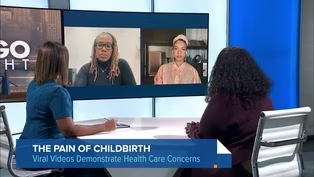
Recent Incidents Raise Questions About Treatment of Black Pregnant Women
Video has Closed Captions
A woman in labor was discharged from an Indiana hospital and gave birth in a car minutes later. (10m 39s)
Providing Support for PBS.org
Learn Moreabout PBS online sponsorship
- News and Public Affairs

Top journalists deliver compelling original analysis of the hour's headlines.

- News and Public Affairs

FRONTLINE is investigative journalism that questions, explains and changes our world.












Support for PBS provided by:
Chicago Tonight is a local public television program presented by WTTW
WTTW video streaming support provided by members and sponsors.