Vermont This Week
March 1, 2024
3/1/2024 | 26m 45sVideo has Closed Captions
Bill Approved to Extend Motel Program, Send Aid to Flood-Impacted Towns
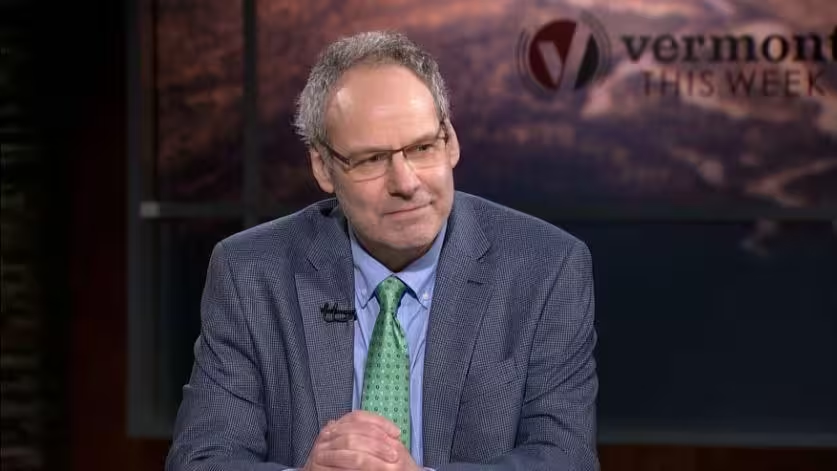
Bill Approved to Extend Motel Program, Send Aid to Flood-Impacted Towns | Concerns Over Costs Associated with the Renewable Energy Standard Bill | Proposed Amendment Concerning Sheriffs, State’s Attorneys Stalls | Panel: Cat Viglienzoni - Moderator, WCAX; Abagael Giles - Vermont Public; Kevin McCallum - Seven Days; Stephen Biddix - NBC5.
Problems playing video? | Closed Captioning Feedback
Problems playing video? | Closed Captioning Feedback
Vermont This Week is a local public television program presented by Vermont Public
Sponsored in part by Lintilhac Foundation and Milne Travel.
Support provided by:


Vermont This Week
March 1, 2024
3/1/2024 | 26m 45sVideo has Closed Captions
Bill Approved to Extend Motel Program, Send Aid to Flood-Impacted Towns | Concerns Over Costs Associated with the Renewable Energy Standard Bill | Proposed Amendment Concerning Sheriffs, State’s Attorneys Stalls | Panel: Cat Viglienzoni - Moderator, WCAX; Abagael Giles - Vermont Public; Kevin McCallum - Seven Days; Stephen Biddix - NBC5.
Problems playing video? | Closed Captioning Feedback
How to Watch Vermont This Week
Vermont This Week is available to stream on pbs.org and the free PBS App, available on iPhone, Apple TV, Android TV, Android smartphones, Amazon Fire TV, Amazon Fire Tablet, Roku, Samsung Smart TV, and Vizio.
Support the crew
Help Mitch keep the conversations going as a member of Vermont Public. Join us today and support independent journalism.Providing Support for PBS.org
Learn Moreabout PBS online sponsorshipThis week.
Homeless hotel housing extended, but with a new price point for payouts here have this cap in place at this point in time.
We've been negotiating.
They didn't quite believe that it was going to happen.
What we're seeing right now is, is actually good news.
Watch how much it will cost to increase Vermont's renewable energy goals, a financial fight in Montpelier, and a setback for the push to create more oversight of some elected officials ahead.
From the Vermont Public Studio in Winooski.
This is Vermont this week, made possible in part by the Lintilhac Foundation and Milne Travel.
Welcome back to Vermont this week joining us on our panel today Abigail Giles from Vermont Public.
Kevin McCallum from Seven Days and NBCs Stephen Biddix.
Thank you all for being here.
The Budget Adjustment Act sending aid to Vermont towns hit by flooding also extends the homeless hotel.
Motel program.
But as you heard the governor say at the top of the broadcast, there is a cap on how much the state is willing to pay for rooms after today.
As of earlier this week, there were 1700 households in the General Assistance Housing Program before the state paid $130 a night.
But starting today, it goes down to 80.
Kevin, do you think hotel motel owners are going to take that $50 cut or are they going to pull out of the program?
We're hearing that most, if not all, of the hotel owners in the program are grudgingly accepting the $80 cap.
They were.
Most of them making a pretty good profit at $130 a night under this program.
The administration has been making it very clear that that was not going to work for them long term.
And so there was this open question about how many would actually stay in the program at a lower rate.
And there was real fear that if you set that rate too low, that too many hotel owners were going to pull out of the program, and then we'd have another crisis on our hands with vulnerable people on the street.
That didn't happen.
The legislature and the administration figured out a way to set a cap that was flexible enough to address some of the concerns of some of the motel owners, but also save a great deal of money under the program.
And even in Chittenden County.
So I know that was where some of the most concern was that some of the motel hotel owners in Chittenden County were going to say no.
Yeah, that was definitely concerned, especially in folks in Burlington.
But from what I'm hearing, everybody's on board and as I say, is grudgingly, they're not happy about having to take that profit cut.
But for now and again, it's only through June 30th they're willing to accept that cap.
Families currently in the program earlier this week expressed some fears that after today they weren't sure where they were going to be living.
And advocates for homeless housing call that unacceptable.
There has been absolute notably no notice from the administration to our most vulnerable Vermonters about what's going to happen to them just a couple of days from now.
So, Stephen, has there been clarity on this?
How many people may lose their hotel housing?
Who remains eligible?
If anyone loses it?
Yeah, I think there's a lot to be determined still when it comes to that.
We've kind of seen this program throughout the process.
There's a lot of wishy washy.
This is the right word, but the numbers are kind of different.
They're constantly evolving, constantly changing.
We've seen how the Agency of Human Services over time has kind of had to change their dynamic with their program and sending people out into the field because those numbers weren't quite as clear last year when this whole kind of thing started to blow up, if you will.
So not to my knowledge, at least I'm aware of a specific number of people that may be going back out.
Mm hmm.
The governor indicated he thinks that some motel and hotel owners, as you alluded to, Kevin, have taken the opportunity to cash in on the program and said the state was paying too much.
Now, I imagine, though, Kevin, some of the lodging establishments might have looked at that number a little bit differently.
Sure.
No.
If you're a motel owner and you've got homeless families living in your motel full time, I mean, there are costs of that service.
It's not tourist popping in.
Right.
Paying paying you a fee and leaving the next day with a cup of coffee.
And going on about that, there's there's a significant additional cost to running a motel that's specifically dedicated to homeless folks, let's be honest.
And so they've always said that, and they've always said that to justify the high rate.
But there's also an occupancy level where they have full occupancy for their hotels.
I mean, there's no room at the inn, literally.
And so that is a profit driver as well, when you've got every single room in your facility rented out every night.
That's money in the bank.
Did the security deposits.
The state is paying have any influence on that in terms of some of the damages the hotel owners might have incurred from the tenants who are living there?
Did offset some of that need to raise the cost per night.
You know, I'm not really sure about that.
I hadn't really heard the security deposit coming into the debate about the cap very much this time around.
It was.
I know that they tried to build in some flexibility in the $80 so that if a motel owner said, I can't I can't make a profit at $80 a night, that they said, well, okay, if that's true, if you're like in Chittenden County and you're saying I'm out at $80, they definitely baked in some flexibility where they could negotiate directly with the owner on other things that they're getting costs for.
So there might be a way that the state will be able to help some of these motel owners who say that's that's too low for me.
As we mentioned, flooding aid is part of this budget adjustment as well, Steve.
And remind people what kind of help is now heading to towns hit during the summer storms?
Yeah, certainly roughly just over $12 million or so broadly in say, for for the most hardly hit communities, whether it's Barre, Montpelier, Johnson and Ludlow, they're all getting around $3 million combined.
And it's going to be have block grants half for federal matches and lawmakers are very excited.
Representative Jonathan Williams ran home after the Senate passed a bill and said, go tell the city council here.
We have help coming.
We have money coming.
On Friday, he spoke on the House floor when the House passed it through, essentially the governor just how happy and excited he was and just why it's so necessary.
And there's also the other side.
There were some people have question like, hey, we're a month and a half into the session now.
Why has it taken this long to finally get money to these communities that have needed it so much because people or cities like the area can use it to replace money from an sensible tax they didn't get from people not going, people not shopping, because a lot of things just had to shut down and they lost a lot of revenue throughout the year.
It bears repeating that that was like the number one thing that lawmakers did like on day one.
Remember, they all gathered out there on the steps and made a very clear plea to their colleagues to support money for a municipality impacted by the flooding.
And so, yeah, there was some growing frustration that it had been a month and a half and they hadn't pulled the trigger on it.
How much would it cost Vermont to go greener, faster?
That's the debate between the governor, lawmakers and interest groups right now.
There's nothing easier in politics than to claim we need to do more of something without having to articulate the tradeoff, because it's always, always a tradeoff.
So it's disappointing, but it's not unsurprising that the governor wants to do less in a longer period of time than, you know, the House and the Senate want.
You know, they want more climate action.
They want more leadership out of Vermont to fight climate change.
So, Abigail, a war of words there.
Talk about what sparked it.
What are lawmakers considering what the renewable energy standard bill.
Yeah so I think like sort of stepping back at the big picture, there is a conversation right now in the building with this bill about how how much Vermont wants to require utilities invest in new renewables that are within Vermont's borders or in our region new renewables.
They're more expensive than buying power that's already built.
It just is the way it is.
Although the costs of renewables are coming down over time, and you've got a proposal from lawmakers that would effectively double the amount of power utilities buy from these new renewables by 2030 and take the bigger utilities in the state to 100% renewable on that timeline.
And the reason the new renewables are so important in this picture is because new renewables on our system are what displace fossil fuel in our electric supply.
So everyone agrees if we want to reduce our emissions, we need more new renewables.
The question is where and how much it costs.
The Department of public Service put out some numbers that were based on some planning that belco had done.
I think it's really important to note that no one has analyzed how much the proposal lawmakers has put forward would cost.
We really don't know at this point.
And the big sort of elephant in the room is transmission.
So, you know, the lines and poles, the power that is on our system.
We have a situation in Vermont where we have places on the grid, where there there isn't the infrastructure capacity to accommodate new, new renewables.
And so the question I think that's playing out between lawmakers and the governor is, you know, if we know in the future, regardless of how much new renewable energy we build, we're going to have to upgrade our infrastructure.
It's really about how fast we build out those new renewables and how much of it should be within our borders in Vermont.
And and can we do that in a way that has the least burden for ratepayers who ultimately pay for things like line upgrades and substation upgrades?
And so that, I think, is sort of at the core of the tension that's playing out right now.
And a lot of that debate is over the cost.
As you mentioned, no one has really gotten an exact number, if you will, on how much this plan would cost.
Why is it so difficult to put a number on that?
Well, there are a lot of variables that are up in the air that are really about policy.
You know, there are you know, so the grid operator has to make sure that there is enough power running through its equipment all the time.
That's their commitment to to to to all of us and what regulators require them to do.
And, you know, we for a long time have had a grid where power ran one way.
And in the future with renewables, you know, there's there's it's it's too directional.
So we're talking about kind of transforming a system that has built to been built to do one thing for a long time for our future.
And as Vermont electrifies, it's important to note that regardless of what we do with renewable generation in the state, we are going to have to spend a lot of money to upgrade that infrastructure as a small rural state.
I think the question that brings the uncertainty is, you know, are there ways that utilities can manage load?
You know, can they it's called curtailing power and resources.
You know, are there other policy choices we can make to encourage developers, for example, to focus on building renewables in places in the state where we have the infrastructure capacity already to to accommodate that new power?
So that's that's what makes it so hard to get those numbers firm and ironed out.
Utilities, are they on board with this?
So utilities really came together with lawmakers, environmental groups, renewable developers and rallied behind the compromise bill that lawmakers have put forward.
The administration had its own proposal, which it developed from a sort of a process where it really kind of tried to sort of ask Vermonters what they wanted from their electric portfolio and from electricity.
The administra ation wants to take more time to get to that 100% level, and they don't want to take a tiered approach.
They don't want to customize it to each utility.
They say, look, every utility in the state should have to reach 100% clean energy standard by 2035, and that would include nuclear.
But really, the big cost driver and the differences in the programs are around this idea of, you know, how how much each proposal requires new renewables to be part of that 100% picture.
And again, it's sort of, you know, that's how you displace fossil fuels on our electric system.
So there's this question here, I think, of what what is Vermonters, what is Vermont's fair share of that cost as a region?
But undoubtedly, what lawmakers are putting forward has the biggest dent from a global perspective on emissions.
If you if you look at what it would mean for the broader regional grid, the question I don't think anyone knows the answer is how much either these would cost and if one has major savings associated with it, I just don't know yet.
A proposal in the legislature aimed at setting qualifications for states, attorneys and sheriffs.
Now on the back burner, the proposed constitutional amendment would allow for the removal of elected officials like sheriffs and states attorneys if they don't meet the standards set by the legislature.
But Proposition one was sent back to the government operations committee, prompting this admission of failure from the Senate pro tem.
After some weeks of conversation with the Senate that the will was not here in the Senate to advance Proposition one to the House.
I am sorry about that, and I regard that in some sense as a personal failure.
And I own that.
Stephen Not often we hear a lawmaker admit to failure so openly.
How big of a priority was this for Senator Bruce and some others?
I think for some in most of the Senate Government Operations Committee, this was a massive priority and this was a big loss for them, it seems.
I mean, just in the past year and a half, we've had two states attorneys in hot water, one sheriff and one sheriff.
Now, John Kerry's more still being the sheriff without his law enforcement license, which was taken away back in December.
In this proposition, one would have allowed the legislature to be able to create bylaws and, you know, maybe create a suspension or create something, because right now it's you keep doing your job, you step down, or legislators have to go through the impeachment process.
And there's just kind of a gap there that they were looking to fill.
But yeah, definitely a big hit to some people in the statehouse.
The buzz is growing over the proposal before lawmakers that would ban pesticides that are toxic to pollinators.
Neonicotinoids, though, are used to treat seeds that keep and keep pests, said Bay.
Some farms are concerned about what would happen if those go away.
Abigail This ban has been pushed for years.
It is seeing some momentum so far from lawmakers.
You know what's briefly kind of at issue here, though?
Yeah.
So I think since earlier conversations about this this pesticide in the building, New York State actually passed a law that phases them out by 2025.
And as part of that process, Cornell did a huge literature review where they took a look at studies that examined both the impact of these this pesticide on pollinators, on bees, and also the efficacy for crop yields, especially for vegetables and for corn and soy.
Some more than 90%, I think, by some estimates of the corn and soy seed in Vermont is a coated prophylactic, particularly excuse me, with vionic adenoids and looking at more than a thousand studies from places like New York, Canada, Cornell found essentially that that seed coating it didn't dramatically increase crop yields.
So they said, you know, the science really shows we see an adverse impact for pollinators.
We don't see a huge benefit for corn and soybean.
But the administration, I think, has expressed some concern, which has been echoed by dairy farmers, saying we'd like to see some Vermont specific studies come back to see how this might play out here.
But the scientific community has been pretty emphatic that they think this is this is it's the time to get rid of these pesticides.
Now, based on what you were hearing at the state house, do you think the governor or lawmakers will push this through, or do you think there's going to be a pause somewhere?
Well, I think this is really going to have a difficult time in the Senate.
Right.
You know, Bobby Starr, the chair of the Agriculture Committee, is very skeptical.
I spoke to him the other day.
He, as you recall, a couple of years ago when this came forward, he very much sided with dairy farmers as not wanting to do anything that's going to create additional regulatory burdens on them.
We have to kind of remember New York and Vermont are very different places.
Right.
And so my sense is that the agricultural industry in New York is a little more diversified than it is in Vermont.
And so and also in Vermont, the conventional dairy farms are a extremely politically influential group of people.
And if you proposed to sort of fundamentally change the way that they grow feed for their animals, right.
That changes their costs.
That changes their confidence in their ability to, you know, to get that feed themselves.
If they can't do it themselves, they have to buy it from elsewhere.
So we all know that Vermont's dairy farmers are on the edge.
Right, in many ways.
And so I think this bill, while super well intentioned and has momentum from many people in the agricultural but also in the beekeeping community, well, I think it has momentum.
I think it might hit a brick wall in the Senate in coming weeks and maybe it can get over that wall.
But I think it's going to have a tough time.
I think it hit another wall if it get to the governor as well.
So he hasn't specifically said that he would veto it, but he much prefers a study to keep going.
And we've also heard from apple orchards also, that's a big part of Vermont.
They have issues with it as well because they use those chemicals to help keep maggots and bugs away from their fruit.
Then everyone loves apples and this would also play a big factor for them as well.
Yeah.
And interestingly, so when kind of the rubber hit the road, if you will, in committee this week, right before the vote, they did actually include a carve out for apple growers to be able to spray when their trees will actually fruit growers, I should say to to spray when they're their trees aren't flowering or their plants aren't flowering with the idea that that would sort of mitigate impacts of pollinators.
Haven't seen a lot of research about the sort of efficacy of that there.
But I think those tensions came to bear with folks who are dairy farmers, even on the committee who said, you know, this is starting to look like we're treating the dairy industry unfairly by giving this carve out for orchard for orchards and fruit growers.
Meanwhile, orchard go certainly testified and they said this is this tool.
It feels very important to us.
So in other statehouse news, the lawmakers considering a shake up of the Fish and Wildlife Board.
Kevin, you've been looking into this proposal.
What is it?
Why is there pushback to it, though?
Well, there's been for a long time concern among the, let's call them, animal welfare advocates that the way in which the state crafts rules for hunting and fishing and trapping is is is not open, not transparent, and is dominated by people who do those activities.
Right.
And so there's been pressure to sort of increase the number of voices on what's called the Fish and Wildlife Board.
It's a 14 member board appointed by the governor, and they're all hunters, fishers and trappers, essentially.
And so animal rights or animal welfare advocates argue we've got to broaden the number of and diversity of voices on this board.
Otherwise we're just going to keep getting hunting and fishing practices and rules that that, that don't that aren't modern, that they're sort of like the way it's always been done in the state of Vermont.
And so this bill would change the way that that board functions, and it would change the way that the appointments are made to that board.
And the assumption is that if you get the legislature to make some appointments to that board, that they would probably put some people from animal rights groups on that board.
And the administration and the Fish and Wildlife Department just says that's a bad idea.
If you start having people who are as one person, derisively refer to them as bunny huggers, right on this panel, that's supposed to be setting the rules for hunting, trapping and fishing, that that's just going to set up a bad dynamic and and conflict.
That's they're not going to be able to move forward on stuff.
They're just going to have a philosophical opposition to what their role is.
And so the bill is still moving forward, though.
Senator Chris Bray, I don't even know where it is.
I think it's either about to be voted out or already has been, and so it's moving forward.
Not really sure how far it's going to go.
Do either of you have you there referred whether you think, you know, if it reaches the governor that he would say, you know, nope, the yeah, the governor does not like this bill.
I haven't heard him specifically say that he would veto it, but certainly the administration opposes it.
I think another interesting piece of this bill is that it would broaden the sort of purview of the board it would become.
The board would also become advisory.
So right now they write the rules.
It's kind of a unique set up in state government.
That way the Department of Fish and Wildlife would be doing the rule writing.
But where the board now has this very narrow jurisdiction over fish and hunting and fishing and trapping regulations, this board would have really input into any rulemaking that the Fish and Wildlife Board does and a Fish Wildlife Department does.
And the department's been pretty clear that they have concerns about how that might gum up the way that they manage wildlife in the state broadly.
So I think that's something that probably the governor might have something to say about as well.
I wanted to get to Kevin here because there was a kind of a changing of the guard, if you will, at the state house.
Long time state house sergeant at Arms Janet Miller steps down.
A replacement has already been found.
Who is it?
Do we know this person?
Is that women?
Are they a familiar face as well at the state house?
Yeah.
So just today there was a vote in the legislature to pick the new sergeant at arms, and Agatha Kesler was elected essentially by the legislature to that post by only two votes, she got 84 votes.
And the other person running for the for the gig, Mike Farrant, who is in the building and has been there steadily for the last seven years, he got 82 votes.
So it was very close, a nail biter.
That was a bit of a surprise to some people.
But Agatha is well known in the building.
She worked in the legislative office back in the day.
She went to do some other things.
She now works in the Secretary of State's office.
She's well-regarded.
People said many fabulous things about her, her and and they say that they need somebody in that post who's going to sort of do a good job of juggling all the different roles of that building.
Right.
That's a tourist destination.
That's a place where we make laws.
It's a it's it's an art gallery.
It's you've got these pages and the little green jackets running around delivering message to everybody.
It's kind of a complicated place with lots going on all the time.
And you need someone who can kind of be, as one lawmaker described to me, an air traffic controller for the state house.
So Agatha Kessler, elected today and I'm sure she's very excited about it.
Well, I did want to mention briefly this week outside the state house, more than 60 Vermont lawmakers called for a cease fire in Gaza.
They signed a letter asking President Biden Jesus power to end the conflict in Israel in Gaza, while other lawmakers said they should focus on issues closer to home.
Stephen, what kind of does this say about Vermont's lawmakers attitude towards being more involved in international politics, even national international politics?
Well, lawmakers I spoke with that signed on to that letter, over 60 of them.
So they want to show their support and say Vermont's been known a lot of times to work with oppressed people and kind of take that side of things.
And so, yeah, the big thing is, hey, we're with you.
We want to help.
We want to show our support, even though some on the other side are like, Hey, we live in Vermont with the second least amount of people in the United States.
Do people over there really care what the Vermont legislature has to say or President Biden himself was kind of the big other argument.
But it's kind of just both sides, one wanting to show their support with Palestinians, with the other one saying they don't want to be antisemitic and they want to show their support for Israel.
These two interesting, of course, coming when you think about Vermont's primary being on Tuesday and the fact that in Michigan, many voters withheld their commitment of votes to President Biden over as a protest in a way of his handling of the conflict in Israel and Gaza.
And we know certainly that Vermont's primary is on Tuesday.
We have Republican presidential candidate Nikki Haley visiting the state this weekend to try to convince voters here to cast their ballots for her.
Kind of a lot of national politics coming to a head in Vermont this week, especially with voters, you know, deciding on their candidates for, you know, each party for presidency this Tuesday.
Kevin, a recent University of New Hampshire poll, though, indicated Vermont Republicans would still support Donald Trump over Haley, 61% to 31%.
So why do you think she would choose like to visit here that, you know, right before Super Tuesday?
Well, I know she's going to Maine in the morning.
Right.
So she's in the neighborhood already.
She's coming through.
And I think, you know, Phil Scott endorsed her ahead of New Hampshire's primary.
And I think this is sort of a way to sort of, you know, demonstrate that she appreciates that and that she recognizes that the state is.
Well, that poll aside, it's not a place that is really super fans of Donald Trump and so I think she views it as an opportunity to notch a win here in Vermont as part of this.
You know, she's probably not going to do well in a lot of other states.
And so I, I actually was surprised to see that she was coming.
And even some of the Republican lawmakers who are on her leadership team in Vermont, when I called them to say, you know, hey, here's Nikki, Haley's coming, and they were not even sure that that was true.
I don't know about that.
I saw it on Twitter, but we have to confirm that.
So there was even some surprise and raised eyebrows that she was coming.
But yeah, there's going to be a lot of people to show up.
And I and the governor, Scott said he's going to go on Sunday.
So it should be an interesting day.
I think it's because we have an open primary and she's kind of hoping some people will cross over from a ballot they would normally take to try to win.
Yeah, there's going to be some protest votes against Trump for sure by Democrats in the state.
And so whether that can put her over the top based on that poll, we'll see.
But it's going to be something we watch closely.
Tuesday is also town meeting day.
School budget's a major issue for most communities in Vermont.
Other communities like Burlington will choose a mayor in Burlington's case for the first time in 12 years.
Others are focusing on local infrastructure.
So there will be a lot to watch in on Tuesday's vote, which of course, next week's issue of Vermont.
This week we'll be tackling in great detail.
I wanted to thank our panel for coming this week.
Abigail Giles from Vermont Public.
Kevin MACCALLUM from seven days and Stephen Biddick take care of everyone have a great one and.

- News and Public Affairs

Top journalists deliver compelling original analysis of the hour's headlines.

- News and Public Affairs

FRONTLINE is investigative journalism that questions, explains and changes our world.












Support for PBS provided by:
Vermont This Week is a local public television program presented by Vermont Public
Sponsored in part by Lintilhac Foundation and Milne Travel.