
March 11, 2024
Season 2 Episode 203 | 27m 31sVideo has Closed Captions
U.S. Congressman Morgan McGarvey re-introduces the Justice For Breonna Taylor Act.
U.S. Congressman Morgan McGarvey joined U.S. Senator Rand Paul in Louisville to re-introduce the Justice For Breonna Taylor Act.
Problems playing video? | Closed Captioning Feedback
Problems playing video? | Closed Captioning Feedback
Kentucky Edition is a local public television program presented by KET
March 11, 2024
Season 2 Episode 203 | 27m 31sVideo has Closed Captions
U.S. Congressman Morgan McGarvey joined U.S. Senator Rand Paul in Louisville to re-introduce the Justice For Breonna Taylor Act.
Problems playing video? | Closed Captioning Feedback
How to Watch Kentucky Edition
Kentucky Edition is available to stream on pbs.org and the free PBS App, available on iPhone, Apple TV, Android TV, Android smartphones, Amazon Fire TV, Amazon Fire Tablet, Roku, Samsung Smart TV, and Vizio.
Providing Support for PBS.org
Learn Moreabout PBS online sponsorship♪ ♪ >> If we can do this in Kentucky.
We can do this nationally.
Y 2 U.S. lawmakers from Kentucky are working together to bad no-knock warrants across the country.
>> We are tracking people to our state.
We're tracking them to come and experience our services and then the waivers are available to them for 7 to 10 years.
>> The wait may be over for thousands of Kentuckians meeting and home supports.
What we found is that people said that this had a profound impact on their lives.
What one University of Kentucky researcher is calling an overlooked emergency when it comes to overdose deaths.
>> Production of Kentucky Edition is made possible in part by the KU Team Millennium Fund.
♪ ♪ ♪ >> Good evening and welcome to Kentucky EDITION on this Monday March.
11th Hope you had a great weekend.
I'm Renee Shaw.
Thank you for spending some of your Monday night with us.
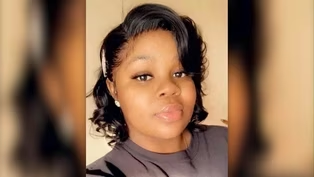
>> This week marks 4 years since the death of Breonna Taylor.
The 26 year-old EMT was shot multiple times by police who received a no-knock warrant for her Louisville apartment as part of a drug investigation.
No drugs were found in her home and the case field nationwide protests against police brutality and systemic racism today there was a bipartisan and by camera will push for new federal legislation to ban no-knock warrants nationwide.
U.S.
Congressman Morgan McGarvey joined U.S.
Senator Rand Paul in Louisville to reintroduce the justice for Breonna Taylor Act.
>> Happened here on March.
13th of 2020 is not an isolated incident in our community or in our country.
Dozens of civilians and law enforcement officers have died during no-knock raids across the United States.
We know that executing no-knock warrants can be deadly.
And that's why we did something about it.
And the Kentucky General Assembly.
In Louisville passing laws that restrict or outright ban the use of no-knock warrants.
If we can do this in we can do this nationally.
I do this not only because they care about the people behind the door.
Also care about the police shootings, a very dangerous rate for police to take.
And yeah, there's a lot of better ways to arrest people that don't involve going in the middle of the night.
>> None of this really stops.
Emergencies are still are emergencies.
All those do exist and will have emergencies for people to go in.
I'm very quickly, but it should be the norm, which should be really the exception and only under exceptional emergency conditions when someone's, you know, life is being threatened.
I'm glad that comes from an RV has taken the lead on this.
Now.
>> Senator Rand Paul introduced similar legislation in 2020 but it failed to gain traction on Capitol Hill this time.
Both policymakers are hopeful for a different outcome, adding that the bill will be tied to federal money for law enforcement.
>> I think it will be a bipartisan bill.
It's linked to a Department of Justice money.
So you have to look for sort of a federal link that might affect policy.
And so we say if your entity gets Department of Justice money, which is a lot of different entities that you would be bound by the no-knock rules.
And it also says if it's a federal entities of its a federal warrant that's being served, that you wouldn't have a no-knock raid as well.
I'm very hopeful that this will move forward.
I'm sorry that it took the death of breonna to get everybody unify.
A divided government does give an opportunity to get things done and it gets an opportunity to get things done where there's agreement and where we have agreement on this is we want our communities to be safer.
We want our citizens to be safe and to be free from unreasonable search and seizure and their homes.
We want to protect our first responders.
That's what banning no-knock bill.
Not once does.
It makes our community safer.
Ultimately it protects people in their homes at the tax law enforcement officers who have to serve these warrants.
And so maybe in divided government.
This gives us an opportunity to make some progress, particular when you have Democrats and Republicans coming together on the same issue.
>> Last March, the U.S. Department of Justice released findings of its two-year investigation into the Louisville Metro Police Department.
That was prompted by Taylor's death.
Some of the findings included instances of LMPD unlawfully arresting people of color use of excessive force and the illegal use of no-knock warrants.
>> And education news.
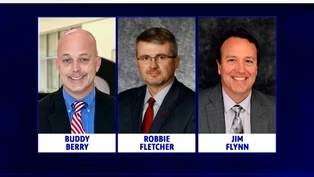
It's now down to 3 and the search for Kentucky's next education commissioner, the Kentucky Board of Education announced 3 finalists have been selected to potentially replace former commissioner of education Jason Glass who left the post in September of last year.
The 3 are buddy Berry who has served as superintendent of the minutes independent school since 2010.
Robbie Fletcher, Lawrence County School superintendent since 2014 and Jim Flynn who was served as the executive director of the Kentucky Association of School Superintendents since 2019, the finalists will be interviewed by the Kentucky Board of Education in Louisville next week.
The board hopes to have a new commissioner named by the end of the month.
The new commissioner, though, will need to be confirmed by the state Senate.
Keeping schools safe.
That's our topic tonight on Kentucky tonight.
Kentucky schools are supposed to have school resource officers or sro's, but many of them can't afford it.
We'll talk about Senate Bill 2, a bill that would let schools bring in military veterans and retired police officers to provide security.
You'll hear from a panel of dart experts on this and educators and we hope you'll send us your questions and comments on Kentucky tonight tonight at 8 Eastern 7 central right here on KET.
The state budget is still up for debate and consideration this legislative session.
Disability advocates say so far they're winners as June LaFleur reports, historic investments will go to services that support folks with intellectual and developmental disabilities and KET them and communities.
We all live in.
No one's too shy to dance at Down Syndrome of Louisville.
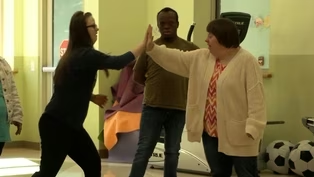
>> We just KET their minds and bodies moving dozens of adults with Down syndrome to come here during the week for the day program.
It's like school.
41 year-old Chris Paine takes life skills.
Classes at DSL is called relationships.
>> We're learning about president patients and taking people's boundaries.
>> DSL supports people with Down's from birth to end of life.
It's the largest organization of its kind in the country.
>> I understand it that folks have moved here just for DSL.
as I understand it, folks have also moved to Indiana.
For Medicaid services from Louisville.
>> State Medicaid pays for most clients at Dia Cell, but not Chris.
His dad pays out of pocket and that's one reason why Chris only attend once a week would become more often with the Absolutely.
Medicaid waivers offer a lot, but they're not guaranteed to everyone and folks end up on wait lists that are notoriously long but was frustrating for so many is that we are attracting people to our state.
We're tracking them to come and experience our services and then the waivers are available to them for 7 to 10 years.
There are about 15,000 waivers available at any given time for those with intellectual and developmental disabilities.
>> But there are 10,000 people on the waiting list.
Kentucky's waivers offer amazing support say advocates likes Sheila Schuster.
That's why she wishes more people had access to them and they're sole purpose is to try to KET people.
Out of institutions, quite frankly, waivers typically pay for therapies.
Day programs, personal care, alterations to make someone's home more accessible and respite.
So family caregivers can have a break.
The supports for community living waiver, notably offers housing, though not everyone wants or needs that.
A lot of the disability movement as a round, what we call nothing about us without us.
So you want people to be able to decide where they want to live.
>> And if they have a support network that wants to KET them at home.
Then you need to look and see what what needs to happen for this person to be able to be at home.
And today, disability advocates push state lawmakers to tackle the waiver waiting turns out this year lawmakers did hear those demands and the House budget is like the nominal.
We have never seen so many slots allocated statehouse.
Lawmakers earmarked 10's of millions of dollars to add 2,500 more waiver slots.
It's mind blowing.
It's so exciting.
That's more slots for people like Emily Guy who has cerebral palsy is our house.
We sit in the living room together.
>> give with us is like a family.
She's lucky enough to have the supports for community living waiver.
Emily lives in the suburbs of global and her house looks like any other in the cul-de-sac.
It's just owned and operated by killer support.
This neighborhood is the only one like this, the United States that's fully integrated.
So we built 17 homes.
>> And then all the other homes that, you know, and within that 99 >> are owned by other people.
And we did that because historically, people with intellectual disabilities were sort of pushed off to the side and without a voice and we didn't want them just to live in a community of other people with intellectual disabilities.
We want you to be their neighbor.
>> This is possible with help from caregivers like MIA Rose, she made a career change during the pandemic and hasn't looked back since and literally within the first week of training.
I felt this passion like that been missing mind higher adult life like I should have been with this community for years.
She's like my.
>> Another mother to me.
>> I can tell you think Amy stayed represents these providers and caregivers there 100% always people with massive parts.
>> She tells lawmakers if they want to help people with disabilities, they have to help the provider workforce.
That's why the state House budget earmarked nearly 50 million dollars to better reimburse providers that offer these Medicaid services so that when sites are released, providers have to be ability to ramp up.
You know, for higher wages, you know, hire more employees and oftentimes purchase homes for individuals to live with things like that.
All of which.
Requires capital, right.
These investments won't end the waiver.
Waitlist in Kentucky, but it will help thousands more people and their providers live a little easier.
>> For Kentucky Edition to >> Thank you, June.
Kentucky's House of Representatives passed its version of the state's two-year spending plan several weeks ago.
Now, the budget and these additional waiver slots rests with the state Senate.
Kentucky's attorney general is pushing to end the state's death penalty ban.
Executions were halted in Kentucky in 2010 after Franklin Circuit Judge Phillip Shepherd ruled the state needed to update its regulations.
The Kentucky Supreme Court sided with the ruling among the regulations.
The courts found problematic.
No automatic.
Stay of execution for death row inmate is believed to be intellectually disabled in a motion filed late last week, Attorney General Russel Coleman, a Republican as the Franklin Circuit Court to lift the ban.
He says the Beshear administration published an amended capital punishment regulation, bringing the state's policy into full compliance with the court's 2010 ruling.
Kentucky currently has 26 inmates on death row.
2 bipartisan bills seeking to abolish the death penalty have been introduced this session.
Both call for life in prison without parole instead of the death penalty.
Neither Bill has received a committee hearing.
Kentucky has hit a milestone in its efforts to clear up the state's voter rolls.
Kentucky secretary of state Michael Adams says the state has now removed more than 212,000 dead voters from the voter rolls last month.
More than 15,000 voters are removed.
Adam says a majority of those removed were dead.
Others were taking off voter rolls because they moved out of the state, had felony convictions voluntarily.
Do you registered were judged mentally incompetent or head duplicate registrations?
Kentucky benefits from a spending bill that just passed the U.S. Senate.
Senator Mitch McConnell says the bill includes money for construction at both Fort Campbell and Fort Knox.
More than 25 million dollars for the Kentucky National Guard and 3 million for the Blue Grass.
Army Depot.
There's money to help fight drug abuse funding for water systems, broadband infrastructure, and a proposed federal prison and Letcher County.
The bill also includes 40 million dollars to fight the spread of the Asian carp in Kentucky waterways.
30 million dollars will go for development projects in areas wants to used for mining.
The bill is now headed to President Joe Biden for his signature.
♪ Each year, more than 112,000 Americans died by overdose.
More than 2000 here in Kentucky.
The loss of life is not the only tragedy.
Each death leaves behind families, friends and others to grieve the loss.
A study co-authored by a University of Kentucky researcher found that 4 in 10 people know someone who died by overdose.
She calls the impact of those left behind, quote, an overlooked emergency.
More now on the study in today's medical News.
>> We really seen overdose exposure and suicide exposure has similar.
They're posted when times causes of deaths of people often don't talk about how the person they cared about died and when they don't talk about it, they don't realize that this is a common experience.
And so starting to work with these investigators at Rand, they have similar questions about opioid overdose overdose in general.
How common is this experience?
What we found is that 40% of people KET one at least one person that had died of an overdose.
But really it was more likely to be in that 2 to 5 or even more than 5% range.
So that want to know someone the dies of an overnight overdose.
It's likely you're going to know more than one person.
We call this an overlooked emergency because there's lots of reporting and information available to the public on overdose.
We see the number of deaths have increased exponentially over the last few years.
And the disconnect is we talk about overdose prevention.
We talk about substance misuse prevention, but we don't talk about is this Harvell impact on those people less daunting.
What we found is that people said that this had a profound impact on their lives and what we don't know is the research hasn't really told us yet.
How is this a risk factor for people for their future substance misuse as well as other mental health difficulties or even things like suicide.
I think the takeaway from the study is that as we're thinking about the or opioid epidemic and this crisis of overdose deaths, we really need to focus not just on prevention, but on helping those left behind because folks who are left behind to care about someone that died of an overdose are probably going to be at risk of their own drug misuse and possible overdose and other long-term consequences.
I think it's really important to figure out how to help those people left behind.
So that systematic research would be a first start and really figuring out what are their needs in terms of their substance misuse behavior and mental health and bereavement needs.
So each state has a plan to for suicide prevention.
That also includes post mention helping those left behind and so over do should be very similar in my opinion.
>> The study also found people who lived in the New England region and east South central region, which includes Kentucky.
We're more likely to know someone who died of an overdose >> well, if you were a little extra tired today, you are not alone.
Millions of Americans lost an hour yesterday because of daylight saving time.
We talked about the impact this has on our health last week.
But what about the policies behind the decision for that?
We turn to the council on state governments, executive director and CEO David Atkins.
>> Lot of state to consider this issue.
In fact, there's nearly 500 bills since 2015 to make Daylight Savings Time permanent in state legislatures across the country.
It's clearly one of those things that catches the public's imagination.
There's a law that was enacted in 1966 by the federal government that essentially says states can opt out of Daylight Savings time and make standard time permanent.
But they can't do the opposite.
They can't make daylight savings time permanent.
And although nearly 20 states have already passed resolutions or legislation to make daylight savings time permanent, those laws wouldn't go into effect, obviously until Congress change that.
That law from 1966, and the difficulty is if you live in Cincinnati, for example, coming to New Cross the bridge, an Ohio is on Daylight Savings Time.
Kentucky stays on standard time.
You have to move your clocks back and forth.
You never be on time for a meeting.
We don't give us a pretty good excuse because we we could say that we're late for everything.
If you lived in Kansas City, Missouri, on the Kansas side of the state line, if they had one time compared to Missouri, again, you have a kind of a patchwork quilt.
In fact, those states that have enacted legislation to say that they would go to permanent daylight savings time generally say that they will only become affective if the states surrounding them also go to Daylight Savings Time, which kind of begs for a national solution?
I think it is one of those things.
Americans like to think about but I doubt if it's ever going to get across the finish line anytime soon.
♪ ♪ >> Spring begins next week that only will we see more flowers and warmer weather hopefully, but also more chances for severe weather.
KET Cristol dot and recently sat down with a panel of weather and climate experts to discuss Kentucky's changing climate.
>> And impacts it may have in the future.
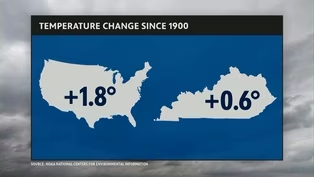
>> Kentucky's climate summary from NOAA shows that Kentucky's average temperature is warmer than it used to be.
Now this is since 1900.
So temperatures in Kentucky have risen by 0.6 degrees Fahrenheit since the beginning of the 20th century.
Kentucky's temperature hasn't written risen as much as the U.S. average increase of 1.8 degrees Fahrenheit.
Okay.
Now I want to go back to to want it when it 0.6 degrees.
That doesn't sound like a lot.
Is that significant?
>> And it really doesn't sound like a lot.
But when you factor in that when you have warmer temperatures, the atmosphere can hold more moisture.
It has the potential to really help to develop stronger storms.
Yeah, that could be pretty significant across the area.
And then you also have to remember the city of Louisville at south as well.
If you look at the urban Heat Island effect, a drastic difference that you can see between downtown Louisville and other places that you could end up with more of an impact.
Are they a major city compared to other locations?
And then also with that warmer weather, you have more of that moisture.
Water conditions were developing areas, even more and more pavement or asphalt.
The potential for more flooding.
We were talking about that earlier.
Urban flooding can be incredibly dangerous and and much again, we're getting back to that turn around.
Don't drown.
So once again, preparation being weather aware.
It's certainly going to be key as we're heading for it and going into a pretty wet and potentially stormy season.
Yeah.
Okay.
Shane, 0.6 degrees Fahrenheit.
That doesn't sound a lot.
What else is that can affect tomorrow's timeout?
Flooding?
What what else might we have impacts?
>> Well, that affect storm seasons 2 in the shifting of them.
We talked about tornado alley hoop.
A lot of us have heard of that Dixie Alley, like do the winter season.
And then in the Plains there, Tornado Alley would include Kansas, Oklahoma, Texas.
We often think of the intense tornadoes happening here in the spring to early summer months.
There's been a slight northeastward shift in traditional tornado alley over the last decade or so.
Some of that contributed to the warming that we've seen during that time.
We just came out of a very warm winter for Kentucky as a whole over both Louisville and Lexington.
February was a top 5 Warren February for Puig.
It was the warmest February all time.
We warm things up is to want to just mention, you increase the lower at this year's capacity to hold more moisture.
Water vapor, thereby increasing the chances for heavy precipitation and then stormy year conditions, especially when cold front sweeping in from the north and west.
So we contribute that to having slightly warmer temperatures.
Yes, especially nighttime temperatures.
The night time temperatures being warmth.
When your low temperatures, 56 degrees when it should be 20 to 30 degrees for a climatology.
It's a big problem.
Say the storms.
>> That form out under a graves county and further West Alton Missouri.
And then they start going east and it's nighttime and there's a lot of feel right now.
Temperatures and moisture.
We look at new point.
There's a lot more moisture in the atmosphere and I just can't tell you the number of tornadoes I have after 10 o'clock at night, I would guest for the entire year, the tornado count is probably at least 15 to 20% between those cool months that he talked about and we get one.
We're 2 of these darn cool CSA squad night.
When your convective system squall lines, these lines of storms that come through and they produce a lot of wind.
But on the leading edge of that, they spin up.
These will tornadoes on there and they can get your house.
I worry most about tornadoes at night.
More than anything because because people go to bed, right.
When you want to do at night, you're tired.
You want to go to bed that the Bowling Green and I could not tell you the number of people I just went to a Christmas party.
I had enough to drink tonight.
I'm going to bed is whether people are full of You know, and what was posted to wait all night long for the storms.
I'm like, yes, be prepared.
Have a plan.
What do you do if you're going from that party went into a church when you go into driving from soccer practice, have a plan.
Stand >> you can learn more about the plan.
Stan, when you watch severe weather staying safe, that airs tonight right after Kentucky tonight at 9 Eastern 8 central right here on KET.
As usual.
We have an interesting mix of personalities to talk about, including a legendary trained engineer and a game show host is our Toby Gibbs looks back at this week in Kentucky history.
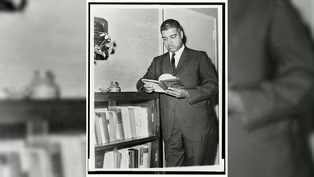
>> Whitney Young junior drowned while swimming in Nigeria on March 11, 1971 Young was a civil rights later born in Shelby County.
He graduated from Kentucky State University and went on to serve as executive director of the National Urban League.
The Kentucky General Assembly rejected the 15th amendment to the U.S. Constitution on March 12, 18 69, the amendment guarantees the right to vote regardless of race.
Even though Kentucky rejected in other states ratified it and it became part of the U.S. Constitution in early 18, 70 Kentucky finally approved it in 1976.
Famed engineer John Luther Casey Jones was born in Missouri on March 14th 18.
63.
>> But his family moved to Casey, Kentuckyian Fulton County.
And that's where he picked up the nickname Casey, as Casey trained the Cannonball approached a Mississippi town on April.
30th 1900.
We realize there were already 3 trains at the station.
The slow down enough to minimize the impact of the crash.
He was killed, but all of his passengers survived.
Chuck Woolery, the host of Love Connection and the first host of Wheel of Fortune was Born in Ashland on March 16, 1941.
He served in the Navy, then became a salesman singer and actor before hosting Wheel of Fortune.
Starting in 1975.
Speaking of television Lexington's first TV station, WLTX signed on March 15, 1955. station gave Governor Lawrence weather may cause skin cap since W Lex was like symptoms Pioneer Station.
And that's a look back at this week in Kentucky history.
I will be good news.
>> Thank you as always.
To be Gibbs, we hope you'll join us and just a bit at 8 o'clock Eastern, 7 central for Kentucky tonight, we're talking about school safety with a panel of lawmakers and educators.
Do not miss it.
KET in touch with us here at Kentucky Edition, you can find us on the PBS video app and you can send us an e-mail.
Give us a story idea at the address on your screen, public affairs at KET Dot Org.
I'm Renee Shaw.
Thank you for joining tonight.
I hope to see you right back here in a little bit to watch Kentucky tonight.
♪
Video has Closed Captions
Clip: S2 Ep203 | 3m 20s | Study shows 42% of people know someone who died by overdose. (3m 20s)
Investing in Disability Supports
Video has Closed Captions
Clip: S2 Ep203 | 5m 26s | The state budget is still up for debate this legislative session. (5m 26s)
Justice for Breonna Taylor Act Reintroduced
Video has Closed Captions
Clip: S2 Ep203 | 3m 46s | McGarvey joined Paul in Louisville to re-introduce the Justice For Breonna Taylor Act. (3m 46s)
Video has Closed Captions
Clip: S2 Ep203 | 2m 8s | Potential policies to change Daylight Saving Time. (2m 8s)
Search for New Education Commissioner
Video has Closed Captions
Clip: S2 Ep203 | 52s | Finalists have been selected to potentially replace the former commissioner of education. (52s)
Video has Closed Captions
Clip: S2 Ep203 | 4m 53s | Weather and climate experts discuss the impact of Kentucky's changing climate. (4m 53s)
This Week in Kentucky History (03/11/2024)
Video has Closed Captions
Clip: S2 Ep203 | 2m 7s | A look back at this week in Kentucky's history. (2m 7s)
Providing Support for PBS.org
Learn Moreabout PBS online sponsorship
- News and Public Affairs

Top journalists deliver compelling original analysis of the hour's headlines.

- News and Public Affairs

FRONTLINE is investigative journalism that questions, explains and changes our world.












Support for PBS provided by:
Kentucky Edition is a local public television program presented by KET