
March 13, 2024
Season 2 Episode 205 | 27m 31sVideo has Closed Captions
The Senate unveils its state budget plan with some changes to the House version.
The stage is almost set for budget negotiations as the upper chamber unveils a different executive branch spending plan than the House.
Problems playing video? | Closed Captioning Feedback
Problems playing video? | Closed Captioning Feedback
Kentucky Edition is a local public television program presented by KET
March 13, 2024
Season 2 Episode 205 | 27m 31sVideo has Closed Captions
The stage is almost set for budget negotiations as the upper chamber unveils a different executive branch spending plan than the House.
Problems playing video? | Closed Captioning Feedback
How to Watch Kentucky Edition
Kentucky Edition is available to stream on pbs.org and the free PBS App, available on iPhone, Apple TV, Android TV, Android smartphones, Amazon Fire TV, Amazon Fire Tablet, Roku, Samsung Smart TV, and Vizio.
Providing Support for PBS.org
Learn Moreabout PBS online sponsorshipWell, I always like to say that, you know, at the end of the day, this is taxpayer dollars.
The Kentucky Senate passes its version of the state's two year spending plan.
What brought the secretary of the U.S. Treasury to Kentucky?
I hope it creates some some bridges that are desperately needed, not just for Appalachia, but for rural Americans.
Plus, what Apple Shop is doing to share the stories of Eastern Kentucky.
Production of Kentucky Edition is made possible in part by the Cette Millennium Fund.
Good evening and welcome to Kentucky Edition on this Wednesday, March the 13th.
I'm Rene Shaw.
Thank you for spending some of your Wednesday night with us.
The stage is almost set for budget negotiations as the upper chamber unveiled a different executive branch spending plan than the House.
In a matter of hours, the Kentucky Senate's version of the state's two year spending plan and a plan to make one time investments went from committee to floor action and it got overwhelming support.
Our Clayton Dalton has more on the clashing budget ideas as we start tonight's legislative update.
We ask ourself the question how do we ensure that we are competitive in the next century?
We started by recognizing the the amazing strides made by our colleagues in the House of Representatives and then added to that by making strategic decisions about how to invest our resources, about how to help areas in need, about how to create a modern economy, and by investing in our in making our state a great place to live.
The Senate published its version of the state budget, making some changes to the version passed in the House.
Spending plans are divided into two main bills.
First, House Bill one allocates money for one time expenses and projects.
The Senate almost doubled with the House appropriated, including an extra pension check for state retirees.
We will spend $75 million for a tiered one time 13th check for retirees of the care systems, as well as the state police retirement systems.
The new House Bill one includes a $100 million for revitalization projects in Louisville and more project money for Kentucky's public colleges, rural health care and criminal justice training.
It is the belief of the sponsor, and I believe the committee as well, that these investments in our people, in our energy, in public safety and education, in economy, in health, quality of life and infrastructure in our communities are both necessary and worthy.
We stand at an odd juncture in history where we have taken in far more in receipts than we anticipated.
And we have one time moneys and we maintained our commitment to spend those monies in a way that it is a one time spending and not only does not incur recurring obligation, but instead stimulates recurring economic activity.
House Bill six is the main budget or the executive branch budget for the upcoming biennium.
This fund state programs, agencies, operations and employees.
One notable difference.
State workers would get less of a raise than was proposed by the House.
All other involved in the state compensation system will see a 2.6% increase in each year of the biennium.
The Senate budget spends more money than the version passed in the House.
Senator McDaniel explained how much and where it's going.
So in our budget, we spend about $300 million roughly per year more in general fund dollars in the first year.
That comes from the performance funding model, $100 million there.
It comes from additional money that we put in Department of Health and Family Services, and it comes in the increase to break it down.
The Senate wants to spend more money on education in both K-through-12 and college settings.
Seac, which is funding for public schools, is slightly increased, but performance based funding, which is money for colleges and universities, is significantly increased in this bill, almost doubled.
But there's no specific provision for teacher raises.
Senator McDaniel said the desire to continually decrease the state income tax was factored into their budget proposal.
Yes, absolutely.
That was incorporated in this.
In fact, our second year spending plan took out about $390 million, specifically for the idea that we would be able to hit the trigger to lower to three and a half percent at the beginning of 26.
McDaniel said there will always be critics of the budget, but that financial discipline should guide the budgetary process.
And I think most importantly, we've tried diligently in the two bills that work together to spend one time money and one time places that would be transformational.
But in the state's budget, we have long advocated that discipline is the thing that will get us to the appropriate resolution.
And I think that the discipline we've shown over the last decade has given us the opportunities to make the investments we're making now for the next decade.
The Senate budget bills passed out of committee unanimously a few hours later.
The bills passed on the Senate floor with bipartisan support.
These bills will go back to the House where lawmakers will either approve or reject the Senate's changes.
For kentucky edition, i'm clayton dalton.
Thank you.
Clayton also and the new budget from the senate, it increases juror pay significantly, an increase that takes the daily wage from $5 to $25 a day.
Robust debate in Frankfort today over a constitutional amendment on school choice.
Just one day after House Bill two passed a specially called committee, The bill was put on to vote for the in the House floor.
The bill is sponsored by State Representative Suzanne Miles, a Republican from Owensboro and House GOP caucus chair.
It would ask Kentucky voters to decide if the state's constitution should be changed to allow future state lawmakers to consider providing financial support for students who are not in public schools.
State Representative Chris Fugit from Chaves was one of three Republicans to speak against the bill today, citing the needs that still exist and his area after historic flooding.
We have needs in our education system in the mountains and whether people some people, it appears sometimes really don't give two hoots about eastern Kentucky.
Some of my teachers in our county are eligible for government assistance.
I said to start this conversation, I'm for House Bill two.
After the needs are met that we have already in the education system, we have.
Several Democrats also spoke against the bill many times.
They were ruled out of order by the speaker of the House for making comments that he says were not focused on the bill.
That's something the bill's sponsor reminded Democratic State Representative George Brown.
We are talking about a constitutional amendment.
Our constitu lution from 1891.
In 1891, we did not have the internet in 1891.
Quite frankly, a third of us would not be allowed to be on this floor having this conversation right now in 1891.
You are neither one would be allowed to vote.
So the discussion today is whether or not we put a constitutional amendment on the ballot in November for the voters to decide if they want the General Assembly to have the conversation.
Not mandate, not insist.
There are no items in this bill with any funding, any rolls, any regulations, anything to that matter.
It is solely to put an amendment on the ballot to give the voters a choice, to make a decision if they want us to have that conversation.
The debate lasted more than 2 hours.
Ultimately, House Bill two passed on a vote of 65 to 32.
It now moves on to the Senate with just nine days left in the 2024 General Assembly session.
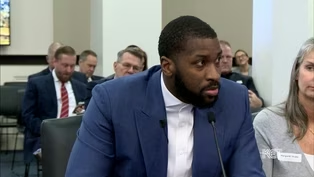
Well, former NBA and University of Kentucky player Michael Kidd Gilchrist was back in front of state lawmakers today.
Kidd Gilchrist, who has a stuttering condition, has been voicing his support for a bill that would expand insurance coverage for those seeking treatment for the speech impediment.
Last week, he spoke before a state Senate panel.
Today, it was a House committee where some members shared their own experience with stuttering before casting a yes vote on the bill.
I appreciate just being heard.
You know, on behalf of 1% of our population, as well as people who stutter.
So, yeah, that's why I'm up here today.
I have a first cousin who recently passed away and he grew up with a terrible, terrible stutter.
And in high school he had an English teacher who forced him to give oral Booker parts and there were no speech pathology or anything like that in his schools at that time.
So he he ended up quitting school over it.
This actually means a lot to me.
This is something that I've grown up with.
When I was in school, I was in speech therapy.
I stuttered pretty badly in school.
Sometimes it still shows up on the House floor.
Sometimes it's it's it's there.
BELL 111 passed unanimously.
The bill is sponsored by Republican State Senator Whitney Westerfield of Fruit Hill, and that's in western Kentucky.
Well, thank you.
That was the message today from Kentucky's Family Resource Centers and youth service centers to lawmakers in Frankfurt for their continued support.
We talk to the people who work at these centers about their work and keeping kids in Kentucky in school.
Family resource Centers are in elementary schools and they still serve students and families, but the focus is more on families.
So they're a family resource center.
Youth services centers are in middle schools and high schools.
We again, still serve students and families, but the focus is a little bit more on the students.
So our components look a little bit different.
We help provide things.
Anything that keeps a child from attending school.
We try to eliminate the barriers with clothing to help them with college preparation and especially at the high school level.
We offer many different aid programs, fast food programs.
We continue to address chronic absenteeism in school and mental health and social emotional learning for our students.
Without Family Resource Resources, service centers, I think that our students, our staff, our families, I think they wouldn't know what to do or where to go.
You know, we're some of the only people that has a lot of contact with our students that knows where they come from and what they have to go through.
We wear many hats, but mostly we just love our kids and want to see them succeed.
These centers, sometimes called Friskies, have been in Kentucky since 1990 with the formation of the Kentucky Education Reform Act.
Kentucky now has 887 of them.
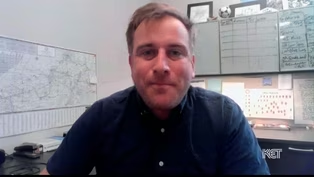
Time now for a midweek check in of some major political developments in Kentucky so far this week with Ryland Barton, who is the senior editor, one of them with NPR state's team.
Good to see you.
Good to see you, Renee.
So let's start by talking about a bicameral by partizan effort by some members of the Kentucky federal delegation to deal with no knock warrants.
We know that today is actually the day four years ago that Breonna Taylor was killed in her Louisville apartment.
The byproduct of a no knock warrant.
Tell us what these two gentlemen in Congress want to do to change this from ever happening again.
Yeah.
So this is a proposal from Democratic Congressman Morgan McCarthy and Republican Senator Rand Paul that would it would seek to ban no knock warrants from being issued across the country.
And this would apply to local no knock warrants with how they'd attempt to do this nationally is by a tie federal funding to local law enforcement agencies to whether those local law enforcement agencies have been or their local governments that have banned no knock warrants.
Rand Paul actually proposed a version of this bill back in 2020.
It didn't go anywhere at that time, probably with it was a bipartisan effort then.
But they're hoping that this time around that they can get a little bit more bipartisan support.
And there's not a lot of things that are passing out of Congress these days.
So it's it's really hard to imagine what exactly can get the interest of both chambers to pass anything at this point.
But this if it's going to happen, it seems like something that is bipartisan has better chances, and this is something that has the support of every mother as well.
They had a press conference about it earlier this week.
And to renew your efforts to try to get it passed this year.
Yeah, well, we'll see how that goes.
So going now to Frankfort, there's a lot of activity.
We are ten days and counting.
Today is day 50, actually.
And so time as the sand is easing out of the hourglass, as we like to say.
There was a controversial measure and Frankfort, a lot of them are, but this stirred up open records and open government advocates about access to public records.
And the sponsor of the bill says he's just trying to close a loophole in the law that hasn't addressed how business can be conducted through electronic communications.
Tell us about this.
Yeah, So this is this bill has been pared down a little bit since earlier in the legislative session when a lot of open government advocates for saying, you know, this is totally eviscerating the state's open records law.
Now, they're not totally happy with it yet.
They say that there's still a loophole in this provision pertaining to documents that would be part of public work.
That's including a lot of non public email accounts or public devices that those devices, that information still wouldn't be, you know, pursuant to the Open Records Act.
Granted, this this bill attempts to deal with that by saying, well, public officials aren't allowed to use they're required to use their official machines for official business.
But they say that's not enough.
There's not enough penalties.
There's no guarantee that officials are going to do that.
And we've seen that time and time again.
Officials do want a public word on their on their personal devices.
And this is something that we saw last year with the debacle over the little school system of rolling out its new bussing program.
There was reporting that it depended on communication between people on cell phones of showing to show some of the the problems that took place at that point.
So open government advocates are still worried that this would severely walk back Kentucky's open records laws right now.
But it passed out of the House.
So it's it's advancing.
There are also some Republicans, though, that joined Democrats in opposition to the bill and it doesn't just apply to officials.
But, I mean, he said hundreds of thousands, the sponsor, hundreds of thousands of Kentuckians.
This could apply to active employees and board members.
Right.
And they would have to have a government issued email address.
So that would I think a lot would have to happen if this bill were to become law.
Right.
Disruptive of legislative hearings.
A So this is interesting how this was prompted.
And there is a bill that is getting some traction in the General Assembly that would address and criminalize disruptive, disrupting legislative hearings.
What's all this about?
Yeah, this is this is something that happens every year.
There are usually disruptions of some legislative processes, whether there are what lawmakers would consider disruptions, which are really false, protesting what's going on in the legislature.
And a lot of times what that looks like is, you know, really packing committee hearings when they're when controversial pieces of legislation are being heard.
So this would create criminal penalties for, you know, first and second offenses for a misdemeanor charges for folks who disrupt legislative proceedings.
I will say there are already laws on the books that allow people to be punished, charged or disrupting legislative proceedings.
We saw this last year when there's some boss who interrupted the House chambers during debate over Senate Bill 150, the anti-trans bill, and they were charged.
And people have been convicted for for disrupting that.
But these lawmakers want a specific charge related to disrupting a legislative hearing would expand what those instances could be.
And it's still unclear exactly how this would be applied yet.
But I think some of you know, some advocates, some people are worried that this would change how the public is able to interact and also voice their displeasure with what is going on in Frankfort.
And finally, in just about a minute remaining, the Kentucky Safer Act House Bill five had a pretty robust hearing on Tuesday night and a lot of scrutiny.
And now there are two Senate rewrites of that bill.
Where is this likely headed?
Yeah, so this is advancing through the legislature.
So Senate Judiciary Chair Whitney Westerfield issued his own.
So as the two version of this bill that would walk back some of the some of the, you know, tough on crime decisions here or at least require a little bit more studying of them, especially things that are not related to violent crimes.
There's a more of a more robust, a more refined version of this from Senator John Schickel.
I would preserve a lot of what's already in the bill.
And going forward, it looks, Westerfield said, that it seemed like there wasn't enough support for his.
We will get another vote on this and maybe a little bit more discussion, hopefully on Thursday, where lawmakers will hash this out.
But no matter what, if one of these versions passes, the House and the Senate will have to come to an agreement on a final version of this.
We are getting down to the last and this is nine more days in the legislative session.
So there's a lot of work that'll come up with the final version.
And it's a really sweeping bill that would do everything from, you know, increasing penalties for certain crimes to criminalizing homelessness and allowing the expanding states expand your ground laws.
So there's a lot of discussion on that.
Well, we'll keep our eye on it all.
You're exactly right.
Nine more days left.
And there was a change made to the legislative calendar, too, that would allow them some working days and to be in committee to help hash out the budget as well.
So a little adjustment to give them some time to make it all happen before April 15th.
Thank you so much, Raelyn, for your insight.
We always appreciate it.
Thanks, Renee.
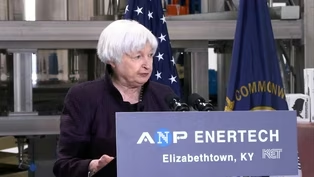
U.S. Treasury Secretary Janet Yellen was in Kentucky today on hand to help cut the ribbon on a new $50 million manufacturing facility in Elizabeth Town.
This is Korean based advanced Nano Products First U.S. factory.
The company manufactures electric vehicle battery components.
It's expected to supply Ford Motor Company's blue Oval desk plants and Glendale, as well as other plants along the Interstate 65 and 75 corridors.
Yellen spoke at the event, calling the factory another example of how electric vehicle related investments are paying off.
We're starting to see the impacts from our policies and investments for middle class Americans in communities across the country.
Here in Elizabeth Town, an expansion will create almost 200 jobs, and they'll be good ones expected to pay an average hourly wage of $40.
The fact that Fort Knox is nearby means there's already interest from veterans.
Among others who haven't always had the opportunities they deserve.
Yellen also says clean energy investments have doubled to more than $4 billion a month in states that have relied heavily on fossil fuels like Kentucky.
She says that's due to the Biden administration tax credits targeting those communities.
The U.S. could ban the tick tock social media site if its Chinese owner doesn't sell it.
The US House voted in favor of that idea today.
The vote was 352 to 65.
The opposition is from a mix of Democrats and Republicans.
Congressman Thomas Massie, a Republican from the fourth District in Kentucky, and Congressman Morgan McGarvie, a Democrat from the third District in Kentucky, both voted no.
The rest of Kentucky's delegation voted for the proposed ban.
FBI Director Christopher Wray says the Chinese government could use Tik Tok to control software on millions of devices and spread misinformation to divide Americans.
Critics of the proposed ban say it violates the First Amendment.
The bill now moves to the US Senate, where its future is uncertain.
Now US Senator Rand Paul opposes the bill on First Amendment grounds.
In a statement, he said, quote, This act is not securing our nation.
It's a disturbing gift of unprecedented authority to President Biden and the surveillance state that threatens the very core of American digital innovation and free expression.
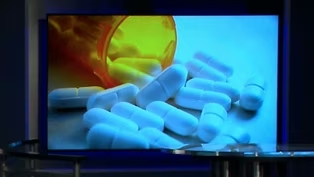
Kentucky's Republican attorney general wants the state to rethink ibogaine.
That's a psychedelic drug used to treat opioid addiction.
Russell Coleman wants the Kentucky Opioid Abatement Advisory Committee to reconsider the $42 million allotment proposed to research ibogaine use during a committee meeting on Tuesday.
Coleman said his office was developing new preventive programs to combat the opioid crisis, including programs geared toward youth outreach.
But he says there are still could be a place for ibogaine in his plans.
If someone brings forward and Ibogaine research proposal that fits the criteria of this new innovative grant proposal, I hope this commission will give it full and fair consideration.
It's not zero sum.
Brian Hubbard first proposed ibogaine last year when he was executive director of the Opioid Abatement Advisory Committee.
Hubbard left that job and now has a similar job in Ohio.
Ibogaine was backed by then Attorney General Daniel Cameron.
Right now, ibogaine is illegal in the United States.
Kenny Payne is out.
As men's basketball coach at the University of Louisville.
You have all fired pain today.
He'd been coach for two seasons.
His record was 12 wins, 52 losses.
The team was eight and 24 this year.
In a statement, athletic director Josh Hurd says it's time for a change.
You have Elwell buyout the rest of Payne's contract, meaning he will receive about $8 million.
Apple Shop is a media art, an education center in Whitesburg that's been a major voice telling the stories of eastern Kentucky and Appalachia since 1969.
And now there are more ways than ever to hear those stories.
The details and our look at arts and culture each week that we call Tapestry.
If you really think about the way we view media and the way media has changed in just the last 15 years, it's astronomical.
So we've really been working this last couple of years, especially once the floods here of like, how do we make our stuff open and accessible to the community really, given that availability.
And so we are slowly releasing all of our catalog onto YouTube.
So every week you're getting two new Apple Shot films.
We're streaming through YouTube, but we've also been working with this really great company to really help us get out to larger distribution platforms.
So we are now accessible on Amazon Prime to the Roku and more platforms are being acted hopefully as we speak, that people are more interested in people than in ideas.
Initially, it's been great.
It's been like really, really fun to see how excited and engaged people are.
Our numbers keep growing.
We really encourage anyone to subscribe to our YouTube channel because we celebrate the way we sound, we celebrate our history, we question our history, we push, but, you know, it's it is sort of hopefully creating a better understanding of who we are.
So it's just been really exciting to see so many different generations of people in engaging and interacting and sharing through social media.
I think it's important to pass down the traditions of the speech and the way we say things because that's where it came from.
My mom and then it came from if we're ever supposed to be this melting pot or this patchwork quilt that we all we all are supposed to be a little bit different, and that's okay.
And so I think having media that represents us is pretty important.
And I also think like breaking down the stereotype of who we are is pretty important that it's not all white coal miners, you know?
There's a there's a diversity of people who live and thrive and work to make this place better.
Here.
And that they have.
Apple Shop has been working out of temporary offices in Jenkins following the floods of 2022.
Well, that'll do it for us tonight, but we hope to see you right back here again tomorrow night at 630 Eastern, 530 Central for Kentucky Edition, where we inform, Connect and Inspire.
We hope that you'll connect with us all the ways you see on your screen, Facebook, X and Instagram to stay in the loop.
We welcome you to send us a story idea to an email Public Affairs at T Dawg.
And of course you can find us on the PBS video app on your smart device and phone.
Got a great show lined up for you tomorrow practice Friday as I call it Thursday until I see you then take really good care and have a great night.
Video has Closed Captions
Clip: S2 Ep205 | 1m 8s | Kentucky's Attorney General wants the state to rethink Ibogaine. (1m 8s)
Video has Closed Captions
Clip: S2 Ep205 | 2m 33s | Appalshop is giving people more ways to hear stories of eastern Kentucky and Appalachia. (2m 33s)

Video has Closed Captions
Clip: S2 Ep205 | 1m 57s | Kentucky's family resource and youth service centers thank lawmakers for their support. (1m 57s)
Video has Closed Captions
Clip: S2 Ep205 | 7m 46s | Mid-Week Political Check-In (3/13/24) (7m 46s)
Video has Closed Captions
Clip: S2 Ep205 | 3m 12s | Robust debate in Frankfort over a constitutional amendment on school choice. (3m 12s)

Video has Closed Captions
Clip: S2 Ep205 | 4m 28s | The Senate unveils its state budget plan, with some changes to the House version. (4m 28s)
Video has Closed Captions
Clip: S2 Ep205 | 1m 30s | Michael Kidd-Gilchrist voices support for bill expanding insurance for stuttering. (1m 30s)
U.S Secretary of Treasury Janet Yellen in Kentucky
Video has Closed Captions
Clip: S2 Ep205 | 1m 28s | U.S. Treasury Secretary Janet Yellen help cut the ribbon on $50 million plant in Kentucky. (1m 28s)
Providing Support for PBS.org
Learn Moreabout PBS online sponsorship
- News and Public Affairs

Top journalists deliver compelling original analysis of the hour's headlines.

- News and Public Affairs

FRONTLINE is investigative journalism that questions, explains and changes our world.












Support for PBS provided by:
Kentucky Edition is a local public television program presented by KET