Vermont This Week
March 15, 2024
3/15/2024 | 26m 47sVideo has Closed Captions
Temporary Shelters Sparks Backlash |Crossover Week | Budget Adjustment Act
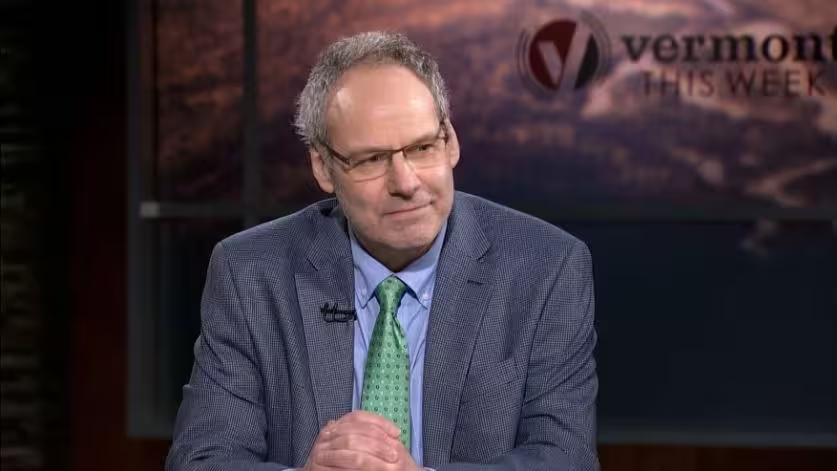
Scott Admin Plan to Open Four Temporary Shelters Sparks Backlash | Crossover Week | Scott “Deeply Concerned” About $15mil Budget Adjustment Signed Into Law | Panel: Mark Davis - Moderator; Pete Hirschfeld - Vermont Public; Sasha Goldstein - Seven Days; Sarah Mearhoff - VTDigger.
Problems playing video? | Closed Captioning Feedback
Problems playing video? | Closed Captioning Feedback
Vermont This Week is a local public television program presented by Vermont Public
Sponsored in part by Lintilhac Foundation and Milne Travel.
Support provided by:


Vermont This Week
March 15, 2024
3/15/2024 | 26m 47sVideo has Closed Captions
Scott Admin Plan to Open Four Temporary Shelters Sparks Backlash | Crossover Week | Scott “Deeply Concerned” About $15mil Budget Adjustment Signed Into Law | Panel: Mark Davis - Moderator; Pete Hirschfeld - Vermont Public; Sasha Goldstein - Seven Days; Sarah Mearhoff - VTDigger.
Problems playing video? | Closed Captioning Feedback
How to Watch Vermont This Week
Vermont This Week is available to stream on pbs.org and the free PBS App, available on iPhone, Apple TV, Android TV, Android smartphones, Amazon Fire TV, Amazon Fire Tablet, Roku, Samsung Smart TV, and Vizio.
Support the crew
Help Mitch keep the conversations going as a member of Vermont Public. Join us today and support independent journalism.Providing Support for PBS.org
Learn Moreabout PBS online sponsorshipIts crossover day in the legislature and on many big issues, consensus has never felt more out of reach.
Phil Scott's last minute plan to open for temporary homeless shelters has ignited outrage and efforts to find common ground on Vermont's housing crisis appear to be faltering.
This isn't anything new.
For years, I've seen the legislature play the game of combining housing proposals.
I support with others I don't.
That actually made the problem makes the problem worse.
As I said, if we truly have a housing crisis, we need to start treating it like one.
Meanwhile, Nikki Haley supporters in Vermont try to regroup while Becca Balint gear up for another campaign.
And we have historic developments in the worlds of soccer and fungi.
All that and more ahead on out this week from the Vermont Public Studio in Winooski.
This is Vermont this week made possible in part by the lintel foundation and Milne travel.
Welcome back, everyone.
I'm Mark Davis from Vermont Public.
It's been a very busy week.
It's one of those weeks where some news is unfolding as we record this show right now and may change by the time you hear this.
But we've got a great panel to try to explain everything that's going on right now.
Let me introduce you to all of them joining us from seven days, editor Sasha Goldstein from Vermont, public reporter Peter Hirschfeld.
And joining us remotely, reporter from Vtdigger Sarah Mearhoff Thank you all so much for making the time today.
Going to be a busy show.
We begin with the latest in the long running saga of Vermont's motel housing program.
Today has long been the day when the latest iteration of the adverse weather program for unhoused Vermonters was supposed to unwind.
While some people can remain in motels, it means that about 500 people would lose 24 hour shelter access starting today.
Of course, the question has been what would become of those 500 people?
Pete, a few days ago, the Scott administration rolled out an answer to that question, a temporary answer, and it's proving deeply unpopular, isn't it?
Yeah, a remarkable turn of events that, as you rightly pointed out, is breaking literally as we speak.
And we're not going to understand the fallout from this event for a few days.
But in order to understand what's going on, we need to rewind three weeks.
Lawmakers were looking at a scenario where on March 15th, there are 600 families living in motel and hotel rooms right now.
And on March 15th, this key date was going to arrive.
That was going to mean a decent number of them were going to be evicted from those motel rooms.
They put together a piece of legislation that they thought would avoid that mass eviction that based on sheltering.
And what they did was change the definition of disability.
And that was intended to catch a bunch of people who otherwise would not qualify for motel and hotel housing after March 15th.
The the Scott administration has not, in the legislature's mind, at least done enough to make sure that people are in motels housing had an opportunity to get that disability status in advance of this eviction date.
And so now we find ourselves here on March 15th with the prospect of 500 people losing shelter, hence the construction ad hoc construction of these four temporary shelters across Vermont.
It has sparked what I would say is one of the most tense moments between the legislative branch and executive branch that that I've seen in state politics.
And what we see right now are Democratic leaders accusing the governor of willfully disregarding legislative intent as a way to quash a motel housing program that he's long had concerns with.
So this is a story that has legs, and we're going to be hearing about it for a long time.
I want to talk some more about the political tensions here, but it's also fair to emphasize concern among advocates for these 500 people could not be higher.
Let's hear from Vermont legal aid attorneys speaking on this issue.
This is as everyone's so far has said, a manufactured emergency.
The General Assembly worked hard to avoid this situation and the administration has ignored that directive and created an emergency that they're proposing to address in a completely inhumane manner.
Vermonters deserve better.
Sara, you've been in the state house today reporting on this issue.
What's the latest in the discourse or describe the dynamic down there?
Yeah, I would say that what you said about that, the concern for folks in this program right now and their safety and their lives are at an all time high.
I was at a press conference yesterday with House Speaker Jill Kaminsky and Representative Theresa Wood, who is really, you know, kind of the spearhead here on all of the negotiations on the House side with the motel program.
And they were unequivocal.
They said lives are at risk here.
There are lots of concerns over where these folks are going to go.
The trauma that comes with a mass on housing like this or can come from a mouse in housing like this, the instability that it can wreak havoc on these folks.
And then in terms of politically, I think Pete said it best.
The tensions between the the administration, the fifth floor and the legislature over this are, I would agree, at an all time high on this.
Theresa Wood had a really unequivocal quote yesterday.
She said, quote, The step that's happening right now appears to us to be in direct disregard to legislative intent and really trying to achieve what the administration wanted to do from the beginning, which was the unhoused the people in adverse weather conditions.
I mean, I don't think it's any plainer than that, frankly.
They're really not beating around the bush on this one.
And Sara, it's probably worth sort of reemphasize in exploring the vision here, the plan from the Scott administration is this is a very temporary thing and that many of these 500 people should be able to find other arrangements, other housing, within a matter of days.
In this current housing environment.
Right.
What talk is there in the state house as to how plausible that idea might be?
Yeah.
I mean, I think we all know very well on the show, both panelists and viewers of this show know how incredibly difficult it is to find housing in this state right now.
I think that it's fair to very strongly question those claims as to whether folks can find housing in that short of an order.
The other thing that representative, what was talking about yesterday is that the administra ation is basically proposing that or saying that this this group of people have to vacate the motels, but they might be allowed back in if they're found to be still qualifying for those rooms.
And to that, she asked why even prep these people out of their shelter for possibly a couple of days, only for them to be allowed back in?
How are they going to be transported to and fro?
What happens to their work situation?
Some of these temporary shelters that the administration is proposing would only be accessible to folks at night to sleep out at night time.
What about people who work the night shift?
You know, where are they going to go during the day?
There are a lot of unanswered questions here.
And the clip that you played from Legal Aid, I think, says really well that, you know, advocates say that this is a manufactured crisis, that it didn't have to be this way, that this is a policy decision and this date was frankly kind of arbitrary.
And perhaps the only people who are more frustrated by this than the lawmakers in the legislature are officials in these four communities Rutland, Brattleboro, Berlin and Burlington, who learned quite literally just a few days ago that there were going to be large, temporary shelters opened in their communities.
This was not their decision.
Sasha, explain sort of how Burlington reacted to this news.
Yeah, I was on a meeting yesterday that involved Mayor Murray Lineberger, a lot of state officials, city officials, downtown business owners.
And this was Thursday afternoon.
Mayor Weinberger said they got a full briefing on what this would mean at noon that day.
They'd only first heard about it on Tuesday evening.
So these communities are really feeling like this was sort of foisted upon them with no collaboration and sort of just told, you know, here it comes.
Some of the questions were about zoning.
You know, how how was this actually get through that the state's kind of just saying this is a change of use that this is going to turn an old state office building that was only recently vacated by state workers turning it into this shelter.
Really imagine this is going to be an open room with up to 100 people sleeping on cots.
So it's not the private rooms that these folks had in motels.
There's not room for them to store their things.
So when they leave during the day, they're going to have to take everything with them.
So there are some some serious concerns about that.
We heard from next door at the Burlington site, the Green Mountain Transit bus station is there.
They say thousands of people are commuting every day there and we're going to have more people coming out.
The high school students at Burlington who go to school in a former Macy's downtown are just right down the street from this, and they're coming to school as these folks are going to be leaving the shelter around 7 a.m. in the morning.
So I think there was a lot of anger and confusion about this.
Miro Weinberger was was very upset.
I haven't seen him that kind of fired up about something in quite some time.
And the story is much the same in Rutland.
That's a downtown building where now out of nowhere, seemingly 100 unhoused people are going to come.
Pete.
What are you going to be looking at in the weeks to come as this story plays out and the relationship between the governor and the legislature?
Yeah.
And what one thing to spotlight about what's also saying what's going on in these other communities.
These shelters are meant to exist for a week.
These this is a 4 to 7 day operation.
We're talking about cots that are being repurposed from the COVID surge sites that we saw in 2020.
The obvious question is how many of the 500 people that are going to be exited are going to be determined to be eligible for motel housing through June 30th and be able to return to their rooms.
And then how many are not going to have a place to go when these temporary shelters shut down?
I'm also really curious about what Vermonters think about this.
This administration is doing this presumably because there's an element of belief that there are people in this program right now that either don't need it or not deserving of it.
And I wonder how many Vermonters out there right now look at what how the administration is handling this and say, good on you.
Right.
It's about time we've been relying on these motels and hotels for way too long.
It's a drain on taxpayer resources.
That money goes down the drain.
No service is provided, no long term housing opportunities.
And how many people are appalled that that think this is a violation of Vermont's conscience and that we can't abide this sort of behavior?
So I'll be curious to see how that all plays out in the coming weeks and months.
And again, this is something that's happening quite literally right now.
We have reporters going out to some of these sites and probably will be evolving quite a bit over the weekend.
While we will keep watching those developments unfold in real time, today is also crossover day in the legislature, traditionally a day to take stock of how major legislation is moving.
So many issues, of course.
But Sarah, on some of the big ones like Housing and Act 250 reform, the governor and the legislature seem about as far apart as ever.
Yeah, absolutely.
And this marries so well into the motel housing program discussion because we are still in a housing crisis and lawmakers are debating fiercely how to address it.
So the real kind of tension here is that this administration came out very strong at the start of the legislative session saying we need to roll back Act 250, we need to make reforms to this 50 year old land use bill.
I think they would describe it as archaic, perhaps, and that is just too stringent in its land use guidelines and it's too hard to build in the state.
And they say that we can throw as much money as we want at building new housing, but especially when construction materials are so costly right now, money isn't going to solve everything.
We need to go out this regulatory process.
On the other hand, there are legislators and specifically committees in the legislature that say the a250 is the reason why we live in the beautiful state that we do and we have the wonderful landscape that we do.
And so this has been this tension from the start.
I mean, I feel like Porter Island every week when I'm in the governor's press conferences, Act 250 is the top of the jaw.
And it's kind of coming to a head today where we're seeing what housing bills are progressing through the crossover deadline and which are not notably the Act 250 reform bill that Governor Scott came out with at the start of legislative session at age 719, I think is the number.
It doesn't look like it's progressing anywhere.
I mean, he came out with that just like lined with all these politicians around him, all these state legislators saying, you know, now is the time to think back on action.
50 reform.
And it looks like that is going to be withering in committee, but perhaps other committees will pick and take parts of it and maybe slide it into their bills as they move forward.
But that is a major development here.
And there are a couple other housing bills specifically.
A lot of conversation around the future of building in Vermont after the flood that we just had over the summer.
What rights do tenants and homebuyers have in this post-flood landscape?
What information should they be entitled to?
Should they know how at risk their potential home is of flood damage down the line?
How do we define that?
We know that these FEMA maps are outdated, etc.
So lots of housing conversation happening today.
And I would say that even past the crossover deadline, there's so much wheeling and dealing and amending and struggles that can happen at this point.
So we've got weeks more.
And of course, the context here is it's rare to get consensus on even diagnosing a problem, but it seems fairly universally acknowledged that there is a big housing problem in Vermont and something must be done, and yet that something still seems to be held up.
Let's hear a little bit more from the governor on housing this week.
At the beginning of the session, I stood here with a bipartisan group of lawmakers to outline a package of common sense, but impactful regulatory reforms and incentives that would help increase housing rehabilitation and construction across the state.
To date, that bill has received no attention in the House, despite the efforts of members like Rep Bartley and Rep Elder who are here with us today.
The Senate Economic Development Committee moved forward with the BE Home bill, which has been stuck in the Senate Natural Resources for weeks with no discussion.
What we're hearing, and this is what we're hearing, is they're waiting for the conservation bill in the House, 8687 to pass, which has little to do with housing other than to prevent a lot of it.
And then they're going to lump it all together and put it in one bill.
Well, that seems to be going well.
Pete Cross crossover day means there's just a ton of other bills that are up in the air right now.
What are you keeping an eye on?
So the House Committee on Health Care passed out a bill, I believe, Thursday.
It's it would be an enormously impactful bill if it is seen to it's the conclusion that many lawmakers want to see it.
And what it would involve is the biggest expansion of Medicaid, government subsidized insurance programs, about 200,000 Vermonters are on already that the state has ever seen.
It would make middle income people eligible for government subsidized health care.
This legislation wouldn't do that starting next year, but it sort of sets us on that path and hasn't gotten a ton of coverage because of so much else that's going on right now.
But it really is for Democrats, at least the next big step step in health care reform.
There's a data privacy bill that got voted out.
Vermont is looking to join 13 other states that have passed state legislation to protect consumers privacy.
Aid for tree fruit.
Farmers that get hit by the frost.
Aid for low income seniors who, when they go to Medicare, face significantly higher medical bills.
So dozens of things that lawmakers in the building are working on right now.
As Sara said, we make a lot about cross over.
If something doesn't get through by Friday, it doesn't mean it's dead.
Where there's a will, there's a way, and these things can be resurrected.
And of course, we haven't even touched on what's known as the big bill, the state budget.
Sara, continuing with our theme here today, the governor doesn't seem too thrilled with the Democrats work on this one either, does he?
Yes, but he also signed into law.
So, yes.
So the Budget Adjustment Act, which is the not quite a little bit past the mid fiscal year budget adjustment to but balanced budget for the remaining months of the year that has passed through both chambers and has been signed into law.
That's actually the crux of this motel debate.
That's where this extension even lives.
You know, policy wise and yes, the governor signed it into law, but he also kind of wagged his finger at the legislature and said that he's very concerned about what he considers to be overspending in this budget adjustment and that now the legislature is in this position where they have to find $15 million to cut from the fiscal 25 budget, which is going to face a committee vote next week.
I talked to House Appropriations Chair Diane LAMB for about this today, and she said actually that he's right on the fact that we do need to find an extra $15 million to, you know, pick him Prada.
She said it's akin to sticking your fingers in the couch cushions and finding spare change.
It's not the equivalent of we're not cutting programs wholesale in Vermont.
She said, You know, it's not that departments are going to be facing big slashes in their budget.
It's going to be like maybe say this program can take, I don't know, 5 million.
Instead of 10 million this year, something like that.
The little tiny adjustments, she said, are going to be necessary in order to kind of zero things out for the next fiscal year.
All right.
That's enough for just later, I think for one day.
So much to try to unpack here.
Let's go to the judicial branch for a little bit.
We had a court hearing recently for Jason Eaton, the Burlington man accused of shooting three Palestinian students who were visiting the city over Thanksgiving break.
Sasha, as so often happens in these serious court cases, there's a flurry of news and information right away.
Then things sort of go quiet for a little while.
Update us on this case and what happened in court recently.
Yeah, obviously, this the shooting happened in November over Thanksgiving break.
And this was our first time to see the alleged shooter, Jason Eaton, in person.
You know, this is pretty routine hearing.
You know, how these things go.
Some back and forth between the prosecutors and his attorneys.
And they kind of were trying to settle on a potential trial date.
It sounds like they're looking at January of next year, 2025.
That seems rather ambitious.
This is obviously, like you said, a case that has a lot of attention.
You could see in the video you're showing that there are some supporters there in Cepheus, the Palestinian scarves, obviously there in support of the victims who all survived, though we know one of them is paralyzed from the chest down.
So the big thing I think a lot of people are watching for is the motive in this case.
Obviously, with the ethnicity of of the victims, there's been a lot of talk about whether it's a hate crime or not.
That was not addressed at this court hearing.
And it makes you wonder about the state's case as far as that goes, because it has been several months since this happened and usually in a hate crime case, you hear someone say something at the time of the crime or there's a manifesto they find that sort of lays out what his feelings are about a protected class of people.
And we haven't seen that yet in this case.
So that's kind of the big thing we're watching for.
But as of now, Jason Eaton's charged with three counts of attempted murder, and we'll see him back in court probably in the next several months.
All right.
More to come there.
Sure.
Well, we had a little bit of news at a D.C. this week, perhaps not very unexpected.
Sarah, the first woman elected to Congress from Vermont, wants to go back.
She does.
U.S. Representative Becky Ballot is intending to relaunch her campaign for reelection for the U.S. House.
Now for us, this is a seat that requires an election every two years.
And so the time was kind of nigh for talent to jump and announce her reelection campaign.
But this, of course, begs the question what in the world is U.S.
Senator Bernie Sanders going to do this year?
He, too, is up for reelection.
His six year term is concluding.
And I really think all of Vermont politicos eyes are on this one.
It's a very high stakes race, especially after U.S.
Senator Patrick Leahy retired just last election cycle.
And so it's a really big one.
And, of course, there's a lot of kind of reading into the tea leaves.
You know, does it mean that he's running again because Brown is running again?
She's not going for the U.S. Senate seat.
But all I can say with absolute certainty is that Sanders has not announced his intentions yet.
And last time around he waited until May to do so.
So we may have to wait a minute for this one will be here.
All right.
It's been a heavy show and a heavy week.
We want to end this on a couple lighter notes here, a couple topics that we don't get to talk about very much on this show.
The first of them is soccer.
I'm not sure we've ever talked soccer on the show.
Sasha, your paper says that we are days away from, quote, the biggest soccer match Vermont has ever seen.
Tell us what the Vermont greens are up to.
Yeah, that's right.
Vermont Green is in something called the U.S. Open Cup.
This is a national tournament with 96 teams.
And you often get sort of these lower league teams like Vermont Green playing against some much higher competition, including as high as the MLS with Major League Soccer, which is the biggest league in in the U.S. And on Tuesday night, the Green are going to host Lexington, SC for their first game in this in this cup.
Now, obviously, march, you think of basketball, especially in Vermont with UVM, but on a march Tuesday night could be freezing cold.
We're going to have maybe a couple of thousand people out at the virtual field at UVM watching a historic soccer game.
So it should be a lot of fun.
Hopefully not too cold.
Well, it sounds like the team was thinking maybe the bad weather would be to their advantage.
It's remarkable is reading your story.
The team hasn't even really assembled.
They're only going have a few days to practice.
A lot of their players are still in their collegiate leagues.
And, you know, maybe for the baseball fans out here, an analogy might be like if the Lake Monsters were entering a tournament with your beloved New York Yankees, for example, we're talking about a real long shot underdog story here.
Totally.
You're going to be there?
I hope so.
Yeah, I hope so.
Busy day job.
Yeah.
All right.
Well, we got one more for you.
Big news this week in the world of mushrooms.
There is a push to designate an official state mushroom from Vermont.
That push is coming from a group of schoolkids in Windham County who are really, really passionate about this topic.
They want to see the Bears head tooth mushroom, which just rolls right off the tongue there.
They want that to become the official mushroom of Vermont.
We would become the sixth state with an official mushroom for those scoring at home.
The kids were in the state house recently making their case.
Why do you think the bears had to mushroom?
Should be the state mushroom?
Because it can be used as a medicine.
It can be found locally.
It is in the Mushroom family.
Here is the home Americano, which means hedgehog of the American.
And yet to follow there, they they say this mushroom has medicinal.
Medicinal qualities and it's also delicious when cooked properly.
The argument he made persuasive, I think the bow tie, though more so.
So we'll keep an eye on that.
And we'll leave it here for today.
My thanks to our wonderful panelists.
We had Sasha Goldstein from seven days, Pete Herzfeld from Vermont Public and Sarah Meyerhoff from Ft. Digger.
Thank you so much for watching and we'll see you again next week.

- News and Public Affairs

Top journalists deliver compelling original analysis of the hour's headlines.

- News and Public Affairs

FRONTLINE is investigative journalism that questions, explains and changes our world.












Support for PBS provided by:
Vermont This Week is a local public television program presented by Vermont Public
Sponsored in part by Lintilhac Foundation and Milne Travel.