
March 17, 2020 - PBS NewsHour full episode
3/17/2020 | 56m 44sVideo has Closed Captions
March 17, 2020 - PBS NewsHour full episode
March 17, 2020 - PBS NewsHour full episode
Problems playing video? | Closed Captioning Feedback
Problems playing video? | Closed Captioning Feedback
Major corporate funding for the PBS News Hour is provided by BDO, BNSF, Consumer Cellular, American Cruise Lines, and Raymond James. Funding for the PBS NewsHour Weekend is provided by...
March 17, 2020 - PBS NewsHour full episode
3/17/2020 | 56m 44sVideo has Closed Captions
March 17, 2020 - PBS NewsHour full episode
Problems playing video? | Closed Captioning Feedback
How to Watch PBS News Hour
PBS News Hour is available to stream on pbs.org and the free PBS App, available on iPhone, Apple TV, Android TV, Android smartphones, Amazon Fire TV, Amazon Fire Tablet, Roku, Samsung Smart TV, and Vizio.
Providing Support for PBS.org
Learn Moreabout PBS online sponsorshipJUDY WOODRUFF: Good evening.
I'm Judy Woodruff.
On the "NewsHour" tonight: DONALD TRUMP, President of the United States: Enjoy your home.
Stay.
JUDY WOODRUFF: Battling the pandemic -- how the United States is responding now, from staying at home to government efforts to get a handle on the crisis.
Then: pandemic economics.
We examine how COVID-19 is taking a financial toll and the efforts to blunt the losses.
Plus: the mayor of San Francisco on dramatic efforts there to contain the outbreak.
And the vote goes on.
We have on-the-ground reports, as a trio of big states hold presidential primaries, despite the risks of the coronavirus.
All that and more on tonight's "PBS NewsHour."
(BREAK) JUDY WOODRUFF: Despite a national emergency and rising concerns about the global coronavirus pandemic, voters in three states headed to the polls today to make their choice in the Democratic race for president.
Nearly 450 delegates were up for grabs.
Ohio took the dramatic step of postponing its election at the 11th hour last night.
The polls have now closed in both Florida, where former Vice President Joe Biden is projected to win, and in Illinois, where Biden is also the projected winner.
The polls close in Arizona at 10:00 p.m. Eastern, 7:00 Pacific.
At this point, Mr. Biden has nearly a 200-delegate lead over Vermont Senator Bernie Sanders, 967 to 780.
In the Republican race, with wins in both Florida and Illinois, President Trump has now secured the delegates he needs to win the GOP nomination in his reelection bid.
We will have reports from every state that voted today later in the program.
But, for now, we turn to the main story we are following.
And that is the coronavirus pandemic.
The Trump administration is pushing for a huge new economic relief package to fight financial damage done by the spreading disease.
That comes as U.S. officials confirm 103 dead nationwide out of 5,300 cases, but with no word yet on how many have recovered.
Meanwhile, Wall Street did recover some today, as the Dow Jones industrials gained back 5 percent.
And the European Union member states moved to close their borders.
Once again, William Brangham begins that coverage.
WILLIAM BRANGHAM: As the financial pain from this outbreak grows every day, Treasury Secretary Steve Mnuchin assured Americans that relief is coming.
STEVEN MNUCHIN, U.S. Treasury Secretary: We're looking at sending checks to Americans immediately.
And what we've heard from hardworking Americans, many companies have now shut down, whether it's bars or restaurants.
Americans need cash now, and the president wants to get cash now.
And I mean now, in the next two weeks.
WILLIAM BRANGHAM: Mnuchin didn't specify an exact amount, but did say that it will be significant, perhaps $1,000 per person for many people.
He did add that millionaires wouldn't be getting checks.
And President Trump again today sought to calm fears about the growing pandemic.
DONALD TRUMP, President of the United States: By making shared sacrifices and temporary changes, we can protect the health of our people and we can protect our economy, because I think our economy will come back very rapidly.
So it's 15 days from yesterday.
We'll see what happens after that.
If we do this right, our country -- and the world, frankly -- but our country can be rolling again pretty quickly.
Pretty quickly.
WILLIAM BRANGHAM: The administration is also urging Congress to pass a huge economic stimulus package, one that could inject $1 trillion back into the U.S. economy.
It reportedly will include a massive tax cut for workers, $250 billion for small business loans, and $50 billion to help airlines hit hard by a lack of demand for travel.
Senate Majority Leader Mitch McConnell promised swift action on the aid package.
SEN. MITCH MCCONNELL (R-KY): And it's my intention that the Senate will not adjourn until we have passed significant and bold new steps above and beyond what the House has passed.
WILLIAM BRANGHAM: And Senate Democratic Leader Chuck Schumer echoed that urgency.
Democrats are working on their own version, one they say is focused less on industry bailouts and tax breaks.
SEN. CHUCK SCHUMER (D-NY): Our proposal is big, it's bold, but it is also targeted.
It focuses on those Americans in the parts of the health sector and the economy most in need now.
WILLIAM BRANGHAM: In the meantime, much of the United States remains in self-imposed isolation at home.
Many people seem to be heeding the White House's guidance from yesterday that people avoid groups of more than 10 people.
But there are still many examples of young people packing into bars and restaurants.
Today, Dr. Anthony Fauci pleaded with them to put their needs aside to protect others.
DR. ANTHONY FAUCI, NIAID Director: Don't get the attitude, well, I'm young, I'm invulnerable.
You are well -- in some respects, you are certainly less vulnerable than I am.
However, what you might inadvertently do -- and I know you don't want to do that -- you don't want to put your loved ones at risk, particularly the ones who are elderly and the ones who have compromised conditions.
We can't do that without the young people cooperating.
Please cooperate with us.
WILLIAM BRANGHAM: Dr. Deborah Birx also helps lead the federal response, and she praised efforts targeted at seniors, who are especially vulnerable.
DR. DEBORAH BIRX, White House Coronavirus Response Coordinator: I really want to applaud the private sector, who are now creating senior-only shopping times.
I think that's extraordinary.
I think that shows what American brings.
And I think other countries will learn from us about how to really protect seniors in this type of way.
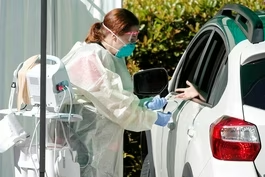
WILLIAM BRANGHAM: School districts across the country continue to close, and some districts, like this one in Oak Grove, Missouri, are now handing out breakfast and lunch to families who rely on their schools for meals.
DR. BRYAN THOMSEN, Superintendent, Oak Grove, Missouri, School District: We want to make sure that we're just erring on the side of safety and making sure that our student communities are as safe as possible.
WILLIAM BRANGHAM: Elsewhere, closures and cancellations continue to pile up.
St. Patrick's Day celebrations were noticeably muted, after many bars and restaurants coast to coast were forced to close and parades were canceled.
But some revelers still managed to enjoy their own personal parades.
In three states, Arizona, Florida and Illinois, Democratic presidential primaries went on as planned.
But there were reports of abnormally low voter turnout and of poll workers refusing to show up.
Ohio postponed its state primary just hours before voters headed to the polls because of health concerns.
And, in Florida, Governor Ron DeSantis says he will let local authorities decide whether to close beaches, but he's ordered all of the state's bars and nightclubs to close for 30 days.
Meanwhile, overseas, in Brussels, leaders of the European Union announced they're about to seal their external borders to contain the outbreak.
Nearly all non-E.U.
citizens would be barred from entering the 27-nation bloc for 30 days.
Iran, which is among the hardest-hit nations in the Middle East, set up a highway checkpoint today to check travelers' temperatures.
Iranian state television warned that millions could die in the Islamic Republic if people ignore public health warnings.
In another troubling development, this novel coronavirus continues its spread across the African continent.
Even though testing is scant, more than 150 infections have now been confirmed in at least 26 of the 49 countries in sub-Saharan Africa.
But, in China, in the city of Wuhan, which was the initial epicenter of this outbreak, there was just one newly recorded infection today.
For the "PBS NewsHour," I'm William Brangham.
JUDY WOODRUFF: For the latest on the federal response, we turn now to our Lisa Desjardins, who's been tracking these fast-moving developments on Capitol Hill, and Yamiche Alcindor, who's following all of the news coming out of the White House.
Hello to both of you.
So, Yamiche, first, what details do we have at this point about the administration's proposals, this economic stimulus package they have been rolling out?
YAMICHE ALCINDOR: Well, this morning, there was a major announcement at the White House.
President Trump and Treasury Secretary Steve Mnuchin both said that they are backing a plan to give every single American, except for maybe wealthy Americans, checks, individual checks, to deal with the coronavirus outbreak.
Now, they said that millionaires might be exempt from that.
But the president says people are hurting and they need to get cash now.
Now, Treasury Secretary Steve Mnuchin has said that he thinks that this could happen as early as in the next two weeks if Congress act quickly enough.
He said that the checks could be up to $1,000 each -- for each person.
The president, though, has also been on the phone with executives from industries like the restaurant industry, the cruise ship industry, supply chain industries, and he wants to have billions of dollars go to those industries as well.
Now, the White House is also pressing Congress, they say, to pass the bill that was passed in the House.
They want GOP senators now who have some issues with the bill on the House side, they want them to just vote for the bill, so they can get that out the way, so that they can start working on this trillion-dollar stimulus package.
But it was remarkable to hear the president say that he wants everyday Americans to get a check in the mail to deal with this virus.
JUDY WOODRUFF: So, Lisa, separately, proposals by the Congress to do something about all this.
What are you hearing there?
LISA DESJARDINS: There are competing plans.
The Republicans and the White House want this kind of payment to individuals.
Democrats say, wait a minute, we have a different plan.
We think other things are the priority for the big stimulus deal coming.
Let's look at what Democratic Leader Chuck Schumer was proposing today, $750 billion, near to what the White House is talking about in amount,, but different in where it would go.
First, $400 billion would go to hospitals for medical supply, to beef up health workers in sort of rural hospitals all around the country.
Then, the rest of it, $350 billion, in Democrats' plan, would go to the unemployed, to workers who've been laid off or who are losing time on the job.
Now, could they talk about including a payment in this deal?
Chuck Schumer did not close the door to that, Judy.
But the truth is, these negotiations are going to be tricky.
And I asked him, maybe there's yet another bill after this.
He said, yes, there could now be multiple stimulus bills coming down the pike.
Note that, in the Democrats' bill and in the White House proposal, there's not specific money for industries that have been affected, like the airlines.
People might get money in their pocket, but are they going to buy an airline ticket soon?
All of this is what Congress is trying to work out.
JUDY WOODRUFF: Yet to come.
And, lest we forget, it seems like a long time ago, but it was just a few days ago that the House passed a relief bill, stimulus bill.
LISA DESJARDINS: Right.
JUDY WOODRUFF: What's happened to that?
LISA DESJARDINS: Right.
As Yamiche reported, the White House has been pressing along with House Democrats to get that through.
And, in fact, I can report now that Leader McConnell has said it will pass through the Senate.
It's a question of when, in the next two to three days, as soon as tonight.
It's a procedural issue.
McConnell told me he has told Republicans to gag and swallow it.
They don't love it.
But I want to review -- it's very important.
This will be the first direct help for Americans affected by the virus passed by Congress.
Let's look at what's in it.
This is the Families First Act.
This will allow for two weeks of paid sick time for people directly affected by the virus, three months of leave time for those who have to care for a child whose school has been closed.
Now,businesses with fewer than 500 workers only must account for this.
Larger businesses do not have to pay for this sick time.
That's a problem Democrats have with this, a concession they made.
All of the businesses will have to pay this sick time up front.
They will receive the tax credit later.
That is also a problem that the lawmakers are hoping to address soon.
One more thing, Judy, I want to go through the timing ahead, because I know it's confusing, over all these bills.
First, in the next three days, pass that Families First Act for the people who are sick, basically, getting them some help with their sick time and child care.
Then, the Senate Republicans plan to work on their own on a possible stimulus bill, come up with their idea.
Then Republicans say they will get together with the White House and Democrats to negotiate.
Democrats say, that's ridiculous.
Let's just start the negotiating now.
But Leader McConnell wants his Republicans to have time to come up with their own plan.
How long will that take?
We don't know.
JUDY WOODRUFF: Meantime, a race against time.
LISA DESJARDINS: Yes.
JUDY WOODRUFF: And, Yamiche, separately, at the White House, they looked at public health proposals.
Tell us what they're saying in that regard.
YAMICHE ALCINDOR: Well, the president said he's approaching the coronavirus outbreak like we are now a nation at war.
He said that this feels like wartime and that Americans should be looking at this as if they can do anything that they possibly can for their nation.
He says, be vigilant, do what you can, to help this virus outbreak stop in this country.
On testing, specifically something that's been on the mind of a lot of Americans every single day, the White House says that the FDA, which is a large governing body that has looked at -- that looks at drugs and testing, they are now giving some states the ability to look at and develop and approve their own testing, so that the states, like Massachusetts and other places, can come up with their tests and use those tests.
The president, though, has been getting some pushback when it comes to public health, because he's been referring to the virus as a Chinese virus.
And there are also some White House officials who call it the kung-flu virus today.
There are a lot of critics of the president who say that that is racist language, that that's xenophobic.
The president, though, says that that is accurate language to use.
He's saying that he's pushing back on China because they're saying that U.S. service members were the ones who brought this over from China.
But what we see here, of course, is the president pushing back pretty hard.
But this is a real cultural issue here that the president's having to deal with, as he's also trying to tell people, stay safe, stay vigilant.
But people are saying also don't target Asian Americans in this country.
JUDY WOODRUFF: And just, finally, at least at a time when everybody's being told to stay home, how is Congress actually going to keep working through this?
LISA DESJARDINS: I asked Leader McConnell about this.
There is a scenario in which the Senate, after it passes whatever next stimulus bill, takes some time off from Washington.
He's not willing to commit to that yet.
He will say that the rules of the Senate will not change.
Even though Democrats are interested in the idea of remote voting, Leader McConnell said no.
Instead, what they would do is lengthen out a roll call vote, imagine this, so that senators would come in smaller groups to the floor of the Senate, two, three, four, five at a time, rather than in groups of 10 or more, an extraordinary change, but Mitch McConnell says no rule change would he allow in the Senate, no remote voting.
JUDY WOODRUFF: Interesting, trying to figure out the politics of that.
LISA DESJARDINS: Yes, indeed.
(LAUGHTER) JUDY WOODRUFF: Lisa Desjardins, thank you very much.
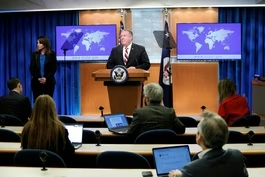
And now, for the wider response by the Departments of State and Defense, our Nick Schifrin is here with me now.
So, Nick, it was both the secretary of state and the secretary of defense who had news conferences today.
What did they have to say?
NICK SCHIFRIN: So, first Secretary of Defense Mark Esper laid out how the Department of Defense can try and help battle this virus in the U.S., millions of masks to be given to Health and Human Services from military stockpiles, ventilators as well.
Military testing labs are going to be opened up for civilian testing.
Governors, of course, beginning to ask the National Guard for help.
And the Department of Defense has been pretty transparent, Judy, about how this virus has impacted them, 39 positives across the department, 500 tests, how they have been protecting service members, civilians, dependents.
There are severe travel restrictions.
If you're a part of the Department of Defense right now, you cannot move, essentially, even inside the United States beyond the base or your home, social distancing inside the Pentagon.
Even the secretary of defense and his deputy cannot see each other in the same room.
As for the Department of State, there's a handful of cases, but we really don't know much beyond that.
JUDY WOODRUFF: So, Nick, we know the State Department has been pretty outspoken about China, China's role in all this, including talking about propaganda.
What are they saying right now?
NICK SCHIFRIN: Yes.
So, Yamiche referred to this.
JUDY WOODRUFF: Right.
NICK SCHIFRIN: So, let's just break that -- break this down.
There's been a concerted effort by the Chinese government to stir anger about the United States inside China and convince the rest of the world that none of this is China's fault.
And to that specifically, there was a tweet late last week by one of the spokespeople of the Foreign Ministry.
He wrote: "It might be the U.S. Army who brought the epidemic to Wuhan."
He wrote that in English and Mandarin.
It was retweeted by embassies of China and ambassadors all over the world.
U.S. officials and the experts I talk to say this is an effort to deflect blame.
The virus originated in Wuhan.
It has nothing to do with the U.S. Army.
But officials in Wuhan covered up the virus.
And Chinese people across the country widely criticized their own government.
So, the officials I'm talking to see this as a kind of diversion to internal criticism, a kind of crackdown that Xi Jinping is doing, but also a diversion for the worldwide impact that you're going to be seeing.
And so, on Friday, we saw the Pentagon spokeswoman, Alyssa Farah, write on Twitter: "This is a communist part of China, has chosen to promulgate false and absurd conspiracy theories."
And then you saw yesterday the secretary of state releasing a statement about strong U.S. objections to the efforts to shift blame for COVID-19 to the United States, so the U.S. pushing back on this hard.
JUDY WOODRUFF: And then, I guess in somewhat connection, they have been evicting foreign journalists.
And there was more on that today.
NICK SCHIFRIN: The connection is the crackdown.
The connection is the unwillingness of the Chinese Communist Party to accept any kind of responsibility and to really crack down on any kind of blame inside.
This was the largest expulsion of foreign journalists in China since Mao, New York Times, Washington Post, Wall Street Journal, Voice of America journalists all evicted from the country.
China says this is in response to U.S. moves, including capping personnel of state-run media here in the United States, and designating that state-run media as foreign missions.
But, again, it is part of Xi Jinping's crackdown on criticism, especially now, especially at a moment when we are dealing with the impact of a coronavirus that did start in Wuhan.
And it is less a response to U.S. moves than a real sense that this is a silencing of criticism, especially now, at a key moment, as Secretary of State Pompeo said today.
MIKE POMPEO, U.S. Secretary of State: I regret China's decision today to further foreclose the world's ability to conduct the free -- free press operations that, frankly, would be really good for the Chinese people, really good for the Chinese people in these incredibly challenging global times, where more information, more transparency are what will save lives.
NICK SCHIFRIN: And, Judy, the fear is that the U.S.-China relationship is getting worse right now, at the time that the world is facing an economic and medical crisis.
JUDY WOODRUFF: As if we needed another issue.
All right, Nick Schifrin, thank you very much.
NICK SCHIFRIN: Thank you.
JUDY WOODRUFF: Now the talk of federal aid for an ailing economy.
It came today as Wall Street recouped some of Monday's record losses.
The Dow Jones industrial average gained back 1,000 points, to close at 21237.
The Nasdaq rose 430 points, and the S&P 500 added 143.
Much of the market's reaction was because of the prospect for a major stimulus package, including the idea of potentially giving Americans as much as $1,000 apiece.
Jason Furman is an economist who worked for the Obama administration after the financial collapse.
He's now a professor at Harvard University who advocated for that basic idea.
And he joins me now from Massachusetts via Skype.
Jason Furman, thank you so much for being with us.
First of all, in your view, is the Trump administration identifying correctly what the needs are in this economy right now?
JASON FURMAN, Harvard Economics Professor: I think today was a really important step in identifying those needs.
They're understanding that we need to act in a way that's really big, that is really fast, and that gets money directly to the families that are going to be most affected by everything that's happened.
So, there's more I'd like to see, but I thought today was a very important step.
JUDY WOODRUFF: So, they're talking about $850 billion, although Treasury Secretary Mnuchin later threw out the number $1 trillion, including, as you mentioned, that $1,000 per individual.
Why is that, in your mind, a good idea?
JASON FURMAN: The economy is going to go through the largest dislocation it perhaps has ever gone through.
It's as if you simultaneously have hurricanes hitting every part of the country and every part of the global economy simultaneously.
Lots of people are going to lose money as a result of this.
It would be great if we could go out and find exactly who those people were and compensate them, but that's just a really hard thing to do.
And so what they have chose on the do, and I have advocated, is to paint with a broad brush, make sure you're not missing everyone, and get as much money out there in the pockets of families as we can.
JUDY WOODRUFF: For some families, $1,000 is going to be a lot of money.
For others, it's not going to mark much of a difference.
Why is that the right number?
JASON FURMAN: I think $1,000 a person, $500 a child.
JUDY WOODRUFF: Right.
JASON FURMAN: So, if you're family of four, you would get $3,000.
I think it should happen again if it's needed.
If the unemployment rate goes up, if the employment rate goes down, then there should be another round of checks.
I think that should be automatic in the legislation.
And, finally, I think there's a lot of other channels the federal government has to get money to families that need it.
It should be using them, in addition to this, expanding unemployment insurance, expanding nutritional assistance, expanding assistance to the states for Medicaid.
None of those were in the White House package, and all of those are essential complements to the ideas they have been talking about.
JUDY WOODRUFF: Jason Furman, as you know, there is also talk of tax cuts.
The president in particular has expressed a strong interest in the payroll tax cut.
That is not in the plan right now.
What's your opinion of that?
JASON FURMAN: I think a payroll tack cut in the best of times is a suboptimal policy.
It gives a lot to people that make a lot of money, less to people that don't.
I think, right now, it would be a crazy policy, because it gives nothing to people who aren't getting payroll.
And it tells you, if you want to get this money, you have to stay at your job.
And I don't think either of those are the right messages for this moment in time.
And it appears that the White House has wisely shelved that misguided idea.
JUDY WOODRUFF: What do you see as the businesses that are going to need the most assistance?
We hear the administration talking about helping the airlines, helping the tourist industry.
Where do you see that need most legitimately should go?
JASON FURMAN: Look, there's a lot of businesses they didn't make a mistake in business decision.
They were just hit with something huge.
The government is having to shut lots of things down, absolutely appropriately, for the sake of our health, but that has a lot of damage.
And so I think some degree of loans and compensation for all of that is appropriate.
Airlines, hospitality, mass transit, by the way, has been hit very hard by this.
I think they need help as well.
And then I would include small and medium-sized businesses all across the country.
JUDY WOODRUFF: Do you see what we're talking about now as the extent of what is ultimately going to be needed?
What more could be done, because we're facing the great unknown right now?
JASON FURMAN: Yes, I think it's a very open question how long the essential shutdown of much of America lasts.
If it last more than two or three months, I think it could have prolonged consequences for the economy.
Historically, unemployment rates can go up very quickly.
They never go down very quickly.
A business that goes bankrupt can do that quickly.
Going un-bankrupt is not something that you can do.
So I am worried not just about the next phase, where we particularly need to help families, but also, as we get beyond this phase, making sure the economy is in a position to rebound, because I don't think it can do that all on its own.
JUDY WOODRUFF: Jason Furman, professor at Harvard University, thank you so much.
JASON FURMAN: Thanks for having me.
JUDY WOODRUFF: New York City's Mayor Bill de Blasio announced today that he will decide in the next 48 hours if he will order his city's 8.6 million residents to shelter in place, in an effort to combat the spread of the coronavirus.
Amna Nawaz speaks to a mayor whose city is already living under lockdown.
AMNA NAWAZ: Nearly seven million people in San Francisco and the surrounding Bay Area were ordered to stay inside by city and county officials in an effort to stem the spread of the virus.
San Francisco Mayor London Breed is one of the officials who made that decision yesterday.
She's a Democrat, and she joins me now.
Mayor Breed, welcome back to the "NewsHour."
I want to ask you about what drove this decision.
Two weeks ago, you had your first confirmed case in San Francisco.
The latest numbers I saw yesterday were about 40 confirmed cases.
Why is this drastic a step necessary now?
LONDON BREED, Mayor of San Francisco, California: Well, I want to be clear that, in every decision we made here in San Francisco, even beginning with our emergency declaration on February 25, had everything to do with the information we had from public health experts.
In San Francisco, we have an incredible Department of Public Health.
They have been working with a number of our county health officers throughout the region.
And they have provided information that led to this decision.
It was important to do it to protect public health.
We see that there are more cases, but we also understand that, with the limited number of test kits, the challenges with protective gear and other things that we are lacking, we need to make sure that we are protecting public health, that we are making the right decision, so that, when people are sick and when they need to be hospitalized, we are at a capacity that can handle the influx of people in our system.
And part of what we did in providing this directive was to really interrupt and limit the number of people who are interacting with one another.
This is why the social distancing order is so important.
It really is about permitting -- protecting people and preventing the transfer of this disease, and having it continue to really move forward at such an alarming rate.
AMNA NAWAZ: Let me ask how this is going to work, though, because people have questions.
Basically, you say residents can take a walk.
They can exercise.
They can take their pet out.
But you're asking people not to leave their homes unless it is for a basic need.
How do you enforce that?
What should people expect to see?
Will law enforcement be asking them why they're out and about?
Do you arrest people who refuse to go indoors?
LONDON BREED: Well, just to be clear, our goal is to get people to understand the significance of what we're dealing with and to comply.
We are not here to be heavy-handed with what we're pushing, because we want people to understand and realize, this is a public health crisis.
And what they are doing outside of what they absolutely need to do could endanger people's lives.
People are walking around here in San Francisco who may not even be aware that they are infected with the virus.
And that could maybe transmit to someone who may have a respiratory issue, someone who is elderly, and who are at risk of death.
And I think that what's important is to understand that we are here to provide the information to the public, to try and get the public to comply with our directive, to use common sense, and to think about this as a situation where what you are doing could potentially compromise public safety and public health.
And so we are asking people to comply and to be good citizens of our city.
AMNA NAWAZ: Mayor Breed, last time we met, about two weeks ago in San Francisco, you said you were taking all these steps to get ahead of the spread.
And you had concerns about the amount of protective equip that you said you needed, all the resources for those front-line health care workers for a surge, an influx of patients that you know are coming.
Do you have right now everything you need to meet the needs of those health care workers?
LONDON BREED: To be clear, we do not have everything we need.
We are working with the CDC, the Centers for Disease Control, trying to be as cooperative as possible, but also being very aggressive about what our needs are.
Two weeks ago, I sent a letter to the vice president, who is in charge of this task force, to help address these issues, expressing the need for more protective gear for health care workers, and also just really a lot more assistance, a lot more support in our city and in our region, because this is not just something that's impacting San Francisco.
It's impacting our entire country.
And we need to make sure that we're prepared for any situation.
And we could meet the needs of our residents, and we can keep people healthy and safe.
AMNA NAWAZ: Well, you mentioned the federal government's response.
And last time we spoke, you were very critical of their response.
You said there had been a failure to respond adequately and that you weren't getting answers to the questions.
What do you make of the federal government's response and the White House sort of ramping up their response in the last week?
LONDON BREED: I think it's -- the ramp-up is -- it definitely is needed.
But we also need to go even further.
We need what we need when we need it.
And we need support and we need resources now.
And I'm hopeful, now that it seems to be really hitting home with the White House, that they are going to take the drastic steps necessary to help cities throughout this country address this real challenge.
AMNA NAWAZ: The steps that you're announcing with this shelter in place are undoubtedly going to have an economic hit on your city and the surrounding areas.
And I talked to one small business owner who said, look, I have bills, I have a family, I have rent.
None of those go away.
And he's very concerned about what's going to come after this.
What is your message to him?
LONDON BREED: And my message is, I understand, but public health has to be put first.
And the good news in San Francisco is, we have already put a number of steps into place so that we can help support especially people who are small businesses owners.
So, we are putting in some policies now to help ease the burden in the future, but we know there are going to be tremendous financial impacts on our city, and we are going to have to deal with that.
But we are trying to put forth policies now to lessen the burden.
AMNA NAWAZ: That's the mayor of San Francisco, London Breed, joining us tonight.
Thanks for your time, Madam Mayor.
LONDON BREED: Thank you.
JUDY WOODRUFF: And please join us on Thursday, when we are hosting a virtual town hall, "Confronting Coronavirus," at 8:00 p.m. Eastern, 7:00 Central on all PBS stations, and streaming on the PBS app and on the "PBS NewsHour" social channels, including YouTube, Facebook, and Twitter.
Please watch to hear some of your questions answered by people on the front lines of the crisis.
In Iraq, rockets struck near the U.S. Embassy in Baghdad, the latest in a series of assault.
Iraqi military officials say, hours earlier, rockets hit a coalition base outside Baghdad, with no apparent casualties.
Last week, two Americans died in a similar attack, and the U.S. retaliated with airstrikes on an Iranian-backed militia.
A Russian company says that it will sue the United States for $50 billion in damages.
Concord Management says that it and another Russian firm were falsely accused of funding interference in the 2016 presidential election.
The U.S. Justice Department dropped the charges on Monday, saying that a trial could expose classified information.
Former California Congressman Duncan Hunter was sentenced today to 11 months in federal prison for misusing campaign funds.
The six-term Republican spent some $250,000 on items ranging from his children's school tuition to parties and clothes shopping.
He pled guilty in December.
And the man who may be pro football's best-known player, Tom Brady, is leaving the New England Patriots after 20 years and six Super Bowl titles.
Brady is 42 years old.
He said today that he will become a free agent, and he expects to play someplace else.
Still to come on the "NewsHour": we have on-the-ground reports, as voters in several key primary states head to the polls; and at home with Philip Roth, an encore interview with the late author following the premiere of a miniseries based on his novel, "The Plot Against America."
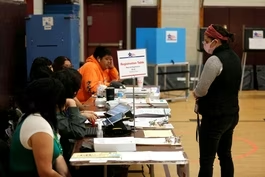
Now we return to the primary elections today in Florida, Illinois, and Arizona, where voters cast their ballots in the midst of the coronavirus pandemic.
That was the focus for Vermont Senator Bernie Sanders when he spoke to his supporters in a livestream earlier tonight.
He made a little mention of his candidacy for president, and instead laid out a long list of policy proposals he says he will be introducing to the Senate leadership to respond to coronavirus.
SEN. BERNIE SANDERS (I-VT), Presidential Candidate: We must make sure that our response to this health and economic crisis is not another moneymaking opportunity for corporate America and for Wall Street.
JUDY WOODRUFF: Senators Sanders just a short time ago.
And, with that, we turn to the state of Illinois, which voted today, where Joe Biden, as we have said, is the projected winner, with 155 delegates at stake.
Joining us is Paris Schutz of WTTW Chicago.
Paris, so, Joe Biden is the winner.
Was that something that looked like it was going to happen as you talked to voters today?
And tell us how coronavirus has affected people going out to vote.
PARIS SCHUTZ, WTTW: Well, first, with coronavirus, Judy, it really caused a lot of confusion early today.
Polling places didn't open.
Election judges, by the hundreds, did not show up for work, for fears of being exposed to the coronavirus.
So, there had to be a lot of consolidation.
A lot of voters had to go to different polling places.
And there were some people complaining about that, but most voters took that in stride.
So, the turnout was really low in the beginning of the day.
When all is said and done, it's going to be about 35 percent of eligible voters in Chicago.
That's pretty low, but kind of typical for a primary election, lower than what they had anticipated before coronavirus.
But when you look at who turned out, it was mostly those over 50 years old, turned out proportionately in huge numbers.
Those are the Biden voters; 18-to-34-year-olds did not turn out high, in high numbers.
Those were the Sanders voters.
They had counted on that.
But it looks like, with the returns tonight, that those voters did not put Sanders over the top, like he had hoped they would.
JUDY WOODRUFF: But, clearly, as you were saying, a lower-than-normal turnout this time?
PARIS SCHUTZ: A lower-than-normal turnout.
There were things happening at polling places, like Scotch tape being put on the ground to mark six-feet distance.
So, there was hand sanitizer, normal precautions.
And the voters we talked to said it was worth the risk today.
JUDY WOODRUFF: Paris Schutz of WTTW Chicago, thank you so much.
PARIS SCHUTZ: Thank you.
JUDY WOODRUFF: And across the country, Stephanie Sy joins us now from Phoenix, Arizona.
Stephanie.
We know the polls don't close there for a few more minutes.
But tell us about the effect coronavirus has had.
You were telling us earlier in the evening that there was confusion, some late poll closings -- polling places that were supposed to be open that turned out not to be.
STEPHANIE SY: Well, Judy, I will say that it doesn't seem, based on the turnout numbers I have right now, that voters were deterred, and there were no major hiccups.
I will tell you about one of those in just a second.
But with a half-hour left before polls close, we have seen a steady stream of voters continue to arrive at this voting location.
Not only is turnout at this point, Judy, eclipsing the 2016 in-person turnout, but the early votes that were received before today eclipsed 2016's total vote.
So, at this point, it doesn't seem, even under the shadow of the pandemic, that voters were deterred.
Of course, coronavirus fears are real here.
And we did see a couple of voters with face masks and even gloves drop off their ballots.
But, again, it doesn't seem to have affected the priority that Democratic voters here in Arizona have placed on this primary.
The longest wait time, by the way, Judy, this morning was about 15 minutes.
And the only other hiccup we heard about here was a rattlesnake that showed up at a precinct in North Scottsdale.
And we have been told that was taken care of.
(LAUGHTER) JUDY WOODRUFF: But -- well, we're glad -- taken care of without anybody -- with anybody being hurt.
But, bottom line, we hear you saying, Stephanie Sy, that, despite a little bit of confusion, people still were determined to vote today for the most part?
STEPHANIE SY: There wasn't a sense of confusion among the voters that we spoke to.
I just got off the phone with the Maricopa County recorder, who didn't report any major issues.
There were, of course, 80 polling locations that did have to close because of coronavirus concerns.
They were both concerned about elderly poll workers, as well as having enough cleaning supplies to disinfect all these polling stations in Maricopa County.
So, what they did is, they went to emergency voting protocols.
What did that mean?
It meant opening up voting centers, like this at the Central Phoenix Library, where anyone could cast a ballot.
It didn't have to be their assigned local voting precinct.
And, so far, that seems to have worked as far as turnout.
JUDY WOODRUFF: Stephanie Sy reporting for us from Arizona again, where the polls are closing momentarily.
Stephanie, thank you.
And now on to Ohio, where the governor announced late last night, literally at the 11th hour, that Ohio polls would close today, there would be no election, due to a public health emergency.
Karen Kasler of Ohio Public Radio and Television joins us from Columbus.
Karen, it was on and off last night.
Ultimately, though, no election today.
KAREN KASLER, Capitol Bureau Chief, Ohio Public Radio: Yes, I would describe yesterday as chaotic.
We were told at 10:00 in the morning that the election was still on.
By 2:00 in the afternoon, Governor Mike DeWine and Secretary of State Frank LaRose had said they were going to file a lawsuit to -- or a lawsuit was coming.
The state couldn't file it, but someone was going to file a lawsuit, and the state wouldn't contest it, that would allow the state to move the primary election.
The governor said he couldn't ask people to risk their health just to exercise a constitutional right, and that he was worried not only about voters, but also thousands of poll workers.
Well, they took that lawsuit -- the two plaintiffs took that lawsuit to a Franklin County judge here in Columbus.
The judge didn't agree.
The judge turned down the request to move the primary.
Then Governor DeWine, through his Department of Health director, Amy Acton, issued an order saying that the polling places, all 3,658 polling places, would be closed because of a significant risk of health damage to people who would be showing up to vote.
And so now the Ohio Democratic Party has filed a lawsuit.
They say that they want voting to be extended to April 28.
It would be by mail voting only, you can only vote by mail, no in-person voting.
But the secretary of state's office still says that the primary has been moved to June 2.
So, this is still being worked out here.
And you're right.
It happened late last night.
And it was very confusing for voters and for poll workers, who didn't know whether they were supposed to show up.
JUDY WOODRUFF: A state that I think Joe Biden was feeling good about, but no results at this point.
And, as you say, we don't know when Ohio Democrats are going to have a chance to vote.
KAREN KASLER: Exactly.
The lawsuit suggests that April 28, would be that day, all mail-in voting, no in-person voting, no Election Day voting.
But the confusion still is pretty obvious.
Poll workers last night were telling me they were getting conflicting messages, texts and e-mails, saying they should show up, they shouldn't show up.
There were Web sites saying the poll -- the primary was canceled, Web sites saying it was still on.
Some voters even showed up this morning at some of their polling places, because, when they went to bed last night, they thought the election was still on.
It was very confusing.
But Governor DeWine says it's the decision he felt he had to make.
JUDY WOODRUFF: An Election Day that -- or non-Election Day -- people will remember for a long time.
Karen Kasler in Columbus, thank you so much.
And now to the biggest prize of the night, the state of Florida, where Joe Biden, as we said, is the projected winner, 219 delegates up for grabs.
WLRN's Tom Hudson joins us via Skype.
So, Tom, tell us about what you're hearing from voters and the effect, if any, that the coronavirus has had on turnout.
TOM HUDSON, WLRN: There's no doubt that the virus has had an effect on turnout here in Florida, Judy.
In fact, for Democrats, they're going to have to figure out a way into the general election to get more folks to the polls in the Democratic heavy places in Florida, Broward County, Miami-Dade, Palm Beach, where turnout looks like to be below 30 percent total, and overall, for Democrats, about the same number of Democrats will have voted in this presidential preference primary as they did four years ago.
But the percent is going to drop.
And that has to be because of the virus over the last couple of weeks.
JUDY WOODRUFF: Well, we look to Florida, of course, every four years in the general election, but certainly, in the primary, it has been a state, a contested state, for Democrats as well.
When you talk to voters, do you find a high interest?
Are people still talking about this election, despite everything else that's going on?
TOM HUDSON: Listen, the virus obviously has dominated everybody's focus over the last week or so, as states of emergencies have been declared nationally, throughout the state here in Florida and then, of course, locally, bars and restaurants shutting down, beaches shutting down, cruises shutting down, hotels losing reservations.
The focus quickly, I think, in Florida, as well as the nation, right, has been moving from health care, the environment, as topics that Democrats have cared about.
It's going to be about the economy.
It's going to be about jobs now.
JUDY WOODRUFF: No question.
Tom Hudson, WLRN, thank you very much.
TOM HUDSON: Thank you.
JUDY WOODRUFF: We appreciate it.
And now to examine how all this fits into the national picture, Amy Walter of The Cook Political Report and public radio's "Politics With Amy Walter."
So, Amy, we now have projections in two states, in Florida and Illinois.
We have a new delegate count as a result of this, 1,121 for Joe Biden, 839 for Bernie Sanders.
What does today mean for this race?
AMY WALTER, The Cook Political Report: Yes.
Well, the momentum that has been carrying Joe Biden since his big win in South Carolina has not abated at all.
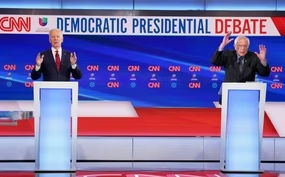
Bernie Sanders was hoping maybe he could slow it down with the debate that they had this week, raise questions about Joe Biden's record.
That didn't work either.
And we're on a trajectory right now, looking at that delegate count, Judy, if Bernie Sanders is to win the nomination, he's going to need to win over 62 percent of the remaining delegates.
That seems very hard to do, when he is barely cracking into the 40s in the states that are reporting tonight.
JUDY WOODRUFF: Just a few moments ago, Joe Biden spoke to his supporters.
Let's listen to just a little bit of that.
And we will come back to Amy.
JOSEPH BIDEN (D), Presidential Candidate: Today, it looks like, once again, in Florida and in Illinois -- we're still awaiting to hear from Arizona -- our campaign has had a very good night.
We have moved closer to securing the Democratic Party's nomination for president.
JUDY WOODRUFF: So, Joe Biden speaking just a few... AMY WALTER: Yes.
JUDY WOODRUFF: A subdued Joe Biden.
AMY WALTER: I mean, can you... (LAUGHTER) AMY WALTER: We just need to note how strange this moment is that, at any other time, this would be a candidate surrounded by his supporters, balloons dropping, the moment.
But, again, it's a subdued moment because of the fact that we are in the middle of a crisis right now.
JUDY WOODRUFF: For sure.
For sure.
Amy, meantime, you have been looking, I know, at surveys of voters in both Florida and Illinois, and I guess in Arizona, for that matter.
AMY WALTER: Right.
JUDY WOODRUFF: What are you seeing about in terms of, I don't know, the Latino vote... AMY WALTER: Right.
JUDY WOODRUFF: ... certainly in a couple of these states?
AMY WALTER: In a place like Florida, which does have a significant Latino vote.
And, of course, we know that's very diverse when we talk about the Latino vote, Puerto Rican, and Cuban, Venezuelan and other.
What is interesting is, you see up here that Joe Biden won the Latino vote handily, 58-32.
When you get a little bit deeper into the numbers, though, you find that, among those younger voters, 18-44, Joe Biden lost those voters narrowly.
So this divide we have seen throughout the campaign, younger voters, whether they are voters of color, other voters, younger voters going to Bernie Sanders, but Latino voters over the age of 45 overwhelmingly supported Joe Biden.
JUDY WOODRUFF: There's an Illinois number.
AMY WALTER: And then we see this Illinois breakdown.
This is of all voters 18-44, once again, Bernie Sanders winning those by about 16 points.
But now look at the 45-and-over number.
He won 75 percent, Joe Biden winning 75 percent of those voters 45 or older, so by almost 60 points.
This is the story, Judy, of almost every single one of these states that has gone on since Super Tuesday, the age divide continuing to be a big factor, but, once again, Bernie Sanders winning younger voters, but not by the huge margins that Biden is winning older voters.
JUDY WOODRUFF: And another reminder tonight earlier from Stephanie Sy that the older voters turning out in Arizona.
AMY WALTER: That's right, absolutely.
JUDY WOODRUFF: There was good turnout overall, but especially among the older.
AMY WALTER: Yes.
JUDY WOODRUFF: Very quickly, Amy, a poll done by the "NewsHour," NPR and Marist today telling us who the American people trust when it comes to this coronavirus crisis.
AMY WALTER: That's right.
When you look at the federal government, not surprisingly, Republicans trust the federal government, trust the president much more than Democrats do.
But, overall, it's only about 37 percent say they trust President Trump's information.
This is a sign of our increasing polarization.
We have been sort of stuck in this time for, well, quite a long time, actually, Democrats not taking information they don't like from partisan sources, Republicans not trusting what they see as Democratic sources.
But there is a little bit of a ray of hope here.
When asked in this Marist/PBS/NPR poll about whether they trust local government - - these are the people that we're seeing over and over again now on TV, we're hearing from, mayors, governors -- 72 percent of voters now, this is a much more bipartisan finding.
They trust state and local governments, which is a good sign.
It's not that everything is collapsing, Democrats are only going to listen Democratic governors, Republicans are only going to listen to Republican mayors.
It's that the locals are still much more trusted, at the federal level where we remain siloed.
JUDY WOODRUFF: And we're on the leading edge of this.
We will see if that continues.
AMY WALTER: That's right.
That's right.
JUDY WOODRUFF: Amy Walter, thank you.
AMY WALTER: You're welcome.
JUDY WOODRUFF: Finally tonight, a look back to another period of national trauma through the imagination of one of our greatest writers.
A new HBO series, "The Plot Against America," dramatizes an alternative American history, in which Charles Lindbergh, the famed aviator, defeated Franklin Roosevelt in the 1940 election.
The real Lindbergh was an isolationist and had made anti-Semitic speeches.
The series is based on the novel of the same name by Philip Roth, the celebrated writer who died in 201, who imagined the impact of this other history on his own Jewish family in New Jersey.
Roth talked to Jeffrey Brown when the book first came out in 2004 and said the idea came when he read that Republicans had come close to nominating Lindbergh.
Here's a short excerpt.
It's part of our ongoing arts and culture series, Canvas.
PHILIP ROTH, Author, "The Plot Against America": Immediately, you have to -- you have to answer that question.
And the answer to that question is dense.
It's not one line.
It's not one line.
What if they had?
I knew Lindbergh's history.
And I knew about Lindbergh's isolationism.
And the first thing I wanted to imagine, was what would it have been like if an isolationist had been elected president -- it needn't have been Lindbergh, by the way -- and we hadn't gone to war?
So that was the first, what if?
But Lindbergh carried another possibility, in that I knew he was famous for anti-Semitic remarks he'd made during his times as spokesman for America First.
And I realized that he would be a threat or a menace to American Jews as a candidate.
JEFFREY BROWN: Well, one of the things you're doing here is, you've got big history.
You've got one big change to history, but most of your story unfolds with one family.
So, how did you decide that you could look at history through the lens of this one small family?
PHILIP ROTH: Oh, I think it's the novelist's way, you know?
I think that decision was made for me when I became a writer.
That is, to see history through the lives of ordinary people has always interested me.
You're correct to say that there was just one change.
I was very conscious of that.
Just change the outcome of the 1940 election, and make everything else as close to reality as you possibly can, which is why I chose my family as the family to whom all this happens.
And that excited me, because it opened up a question, which is, how would we have behaved in these circumstances?
JEFFREY BROWN: It's a work of fiction, but it's a work of memory?
PHILIP ROTH: Well, yes.
It's -- well, it's a false memoir, isn't it?
So it's an act of -- it appears to be an act of memory, but it's a false memoir.
I had a little slogan I would use with myself when I was writing this book, and from -- if you want more falsification -- I said to myself whenever I got stuck, which was frequently, don't invent, just remember.
I think the subject of the book that interested me was, to put what I said earlier another way, how much pressure can you bring to bear on this family, and what will happen when you bring maximum pressure to bear on them?
They're all trying to cope with this menace, the menace of Lindbergh.
And the pressures are enormous.
And they're all trying to cope with the humiliation, too, even the little tiny boy, the humiliation of being, of the Jews somehow being separated out, of appearing to be not welcome.
JEFFREY BROWN: On the one hand, you've written a book, as you say, of menace.
And it's quite scary.
On the other hand, it didn't happen.
PHILIP ROTH: In a manner of speaking, my book gets it all wrong.
JEFFREY BROWN: Fortunately.
PHILIP ROTH: Luckily, yes, indeed.
JEFFREY BROWN: So, is it a book of fear or of hope?
PHILIP ROTH: Well, in a manner of speaking, it's an optimistic book.
It imagines something that did not happen, and, as you had said, could it have happened?
And the answer is, sure, it could have happened, but it didn't happen, which tells you a lot about the country, this country.
JEFFREY BROWN: Was it comforting to, you as a writer, as a human being, that history resumed?
(LAUGHTER) PHILIP ROTH: Yes, now that you -- now that you ask that question.
Yes, to know that this came to an end, that this nightmare came to an end, yes, it was a comfort.
JUDY WOODRUFF: Something worth listening to all over again.
And that's the news tower for now.
Please go to PBS.org/NewsHour for the latest results from tonight's Arizona primary and all the latest news on the coronavirus crisis.
I'm Judy Woodruff.
Thank you, stay safe, and we will see you soon.

Author Philip Roth on 'The Plot Against America,' now on HBO
Video has Closed Captions
Clip: 3/17/2020 | 5m 6s | A look back at what Philip Roth said about 'The Plot Against America,' now an HBO series (5m 6s)

How government can help Americans struggling financially
Video has Closed Captions
Clip: 3/17/2020 | 5m 34s | Many Americans will be hurt financially by pandemic. Here's how government could help (5m 34s)

How San Francisco's mayor is trying to fight virus outbreak
Video has Closed Captions
Clip: 3/17/2020 | 7m 18s | San Francisco mayor says 'drastic steps' by federal government needed to address crisis (7m 18s)
In U.S. and globally, normal life shuts down amid pandemic
Video has Closed Captions
Clip: 3/17/2020 | 6m 5s | In the U.S. and across the globe, normal life shuts down amid pandemic (6m 5s)

News Wrap: Rockets strike near U.S. embassy in Baghdad
Video has Closed Captions
Clip: 3/17/2020 | 2m 21s | News Wrap: Rockets strike near U.S. embassy in Baghdad (2m 21s)
Reports from states holding primaries amid pandemic
Video has Closed Captions
Clip: 3/17/2020 | 10m 11s | Reports from states holding 2020 Democratic primaries amid pandemic (10m 11s)
What the U.S. federal government is doing to fight COVID-19
Video has Closed Captions
Clip: 3/17/2020 | 11m 18s | What the U.S. federal government is doing to fight COVID-19 (11m 18s)
Who's turning out to vote in 2020 primaries amid pandemic?
Video has Closed Captions
Clip: 3/17/2020 | 4m 27s | Amy Walter on clarity and confusion in 2020 Democratic primaries (4m 27s)
Providing Support for PBS.org
Learn Moreabout PBS online sponsorship
- News and Public Affairs

FRONTLINE is investigative journalism that questions, explains and changes our world.

- News and Public Affairs

Amanpour and Company features conversations with leaders and decision makers.












Support for PBS provided by:
Major corporate funding for the PBS News Hour is provided by BDO, BNSF, Consumer Cellular, American Cruise Lines, and Raymond James. Funding for the PBS NewsHour Weekend is provided by...