Vermont This Week
March 20, 2026
3/20/2026 | 26m 46sVideo has Closed Captions
Lawmakers question state law enforcement after ICE raid | Health care bills advance at statehouse
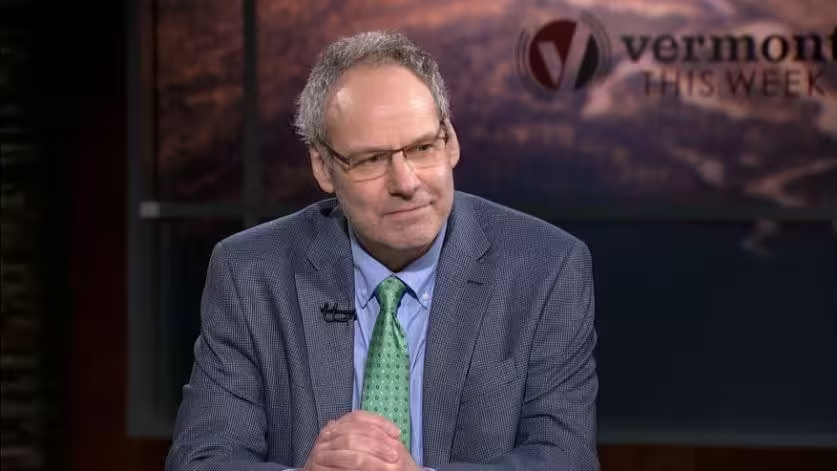
Lawmakers question state law enforcement after ICE raid | Health care bills advance at statehouse| Mark Johnson - Moderator, WCAX; Derek Brouwer - Vermont Public; Calvin Cutler - WCAX; Olivia Gieger - VTDigger.
Problems playing video? | Closed Captioning Feedback
Problems playing video? | Closed Captioning Feedback
Vermont This Week is a local public television program presented by Vermont Public
Sponsored in part by Lintilhac Foundation and Milne Travel.
Support provided by:


Vermont This Week
March 20, 2026
3/20/2026 | 26m 46sVideo has Closed Captions
Lawmakers question state law enforcement after ICE raid | Health care bills advance at statehouse| Mark Johnson - Moderator, WCAX; Derek Brouwer - Vermont Public; Calvin Cutler - WCAX; Olivia Gieger - VTDigger.
Problems playing video? | Closed Captioning Feedback
How to Watch Vermont This Week
Vermont This Week is available to stream on pbs.org and the free PBS App, available on iPhone, Apple TV, Android TV, Android smartphones, Amazon Fire TV, Amazon Fire Tablet, Roku, Samsung Smart TV, and Vizio.
Support the crew
Help Mitch keep the conversations going as a member of Vermont Public. Join us today and support independent journalism.Providing Support for PBS.org
Learn Moreabout PBS online sponsorshipThe fallout from a federal ice raid in South Burlington continued this week as the state's public safety commissioner defended the actions of the Vermont State Police.
We walked what I believe was a very clear, fair line in the face of many competing interests.
The action of providing a safe corridor to perform a lawful law enforcement action was a public safety function.
And to say it was anything but is, is showing that that you're looking at one policy interest only.
The Senate and House Judiciary Committee held a joint hearing yesterday looking for answers, plus a look at some of the bills that are making their way through the legislative session.
All that and more coming up on Vermont This Week.
From the Vermont Public studio in Winooski.
This is Vermont This Week.
Made possible in part by the Lintilhac Foundation and Milne Travel.
Thank you for joining us.
I'm Mark Johnson.
I'm following it today for Mitch Wertlieb.
It's Friday, March 20th.
Joining us on the panel today, Derek Brouwer is with Vermont Public.
Olivia Geiger is with VTDigger.
And joining us remotely is Calvin Cutler of WCAX news.
Thank you all for joining us.
The House and Senate Judiciary Committee, as I mentioned, had a joint hearing yesterday.
It was really quite a quite a wild scene.
And Calvin, why don't you start us off here?
There's just been a lot of questions that have been raised about whether or not the Vermont State Police and the local police inappropriately helped the feds.
Yeah.
I mean, even from the event in South Burlington last week where there was a number of state representatives, there were calls for a public hearing and for sort of legislative oversight on what happened, who knew what, what and when and why and what went down exactly.
And, you know, this this hearing was really multipronged.
It was part of it was held by the House and Senate Judiciary committees, really, to bring in, the South Burlington Police, State Police and Commissioner Jen Morrison to try to just examine what was police's thinking and what was their role in, facilitating this.
And responding to, you know, the really chaotic scene scene that we saw and like you heard in those clips, right off the top there from from the commissioner, you know, she and others are continuing to say and really defended the action of law enforcement officers, saying that they were there to keep the peace, that they were there to prevent violence from breaking out.
In fact, they said it could have been much worse if they had not responded.
They said, Ice officers in part escalated, and they also pointed the finger at some protesters as well that I believe, broke a back windshield of one of the cars that responded, or an Ice car that that was.
So we're going to take a listen to the South Burlington chief and also hear from the head of migrant Justice will land back.
The presence of local police and troopers stopped unnecessary and avoidable violence from happening.
There is no way that you can see the video and photo documentation and come to any conclusion, other than the fact that local law enforcement facilitated the detention of immigrant Vermonters.
So, Calvin, do you think that the police, the police chiefs and Jen Morrison were able to convince lawmakers or not?
Yeah, it's a really good question.
And, you know, by the by some of the questioning from some lawmakers, they absolutely had violated the fair and impartial policing policy.
And some lawmakers like Senator, Tanya Boesky, who was at the protest, really had deep concerns about the conduct of officers.
And then there were some other, lawmakers.
I'm thinking, Representative Zach Harvey of Castleton.
He, you know, really stood up and back to the police on this.
So I think it depends on who you ask.
I mean, that's that's what was so I think remarkable about this hearing is you have state police who are giving one interpretation of the chain of events and what that means for the state's anti-bias policing laws and whether they did break policy or not.
And then on the complete opposite side of the spectrum, you had some protesters and you had the advocates with migrant justice who are saying police absolutely broke, the fair and impartial policing and that they absolutely overstepped their boundaries.
So it's a real split screen interpretation of what's going on.
And I will say in the room, I mean, it was one of those hearings, you know, the statehouse is no stranger to, to really public high profile hearings, but you could cut the tension in the room with a knife.
There was about 100 people in the room and about 400 people watching live, while we were in the room, too.
So where do we go from here?
It's unclear.
Yeah, I would agree with you.
I haven't seen a hearing that tensing in quite some time.
Derek, what stood up for you at this?
Yeah.
I mean, look, the the local and state police helped Ice carry out the search warrant.
I mean, there's just no question about that.
They were trying to do two things at the same time here.
They were trying to help Ice carry out its order and help keep protesters safe.
Where this gets really awkward, I think, for local and state police here is the fact that that, as a result of this search warrant, Ice ended up conducting civil immigrant apprehensions here, civil detentions and and that, you know, so functionally, the the the fair and partial policing policy is invoked in that way in the sense that, you know, there is a carve out for, for criminal matters that they can work together with, with the feds on those.
But in this situation, it's very complicated because, from from what we know so far, it sounds like they believed they were they were assisting on a criminal matter.
But what I said once it got inside the home, was, apprehend three people who, in fact, were not wanted for any for any criminal offense.
Yeah.
I mean, the the subject of the warrant wasn't really even there or was not detained in any way.
As you mentioned, three people were detained.
What's their status?
Where does that stand?
Yeah.
So as we're taping right now, two of the three, have been released and, the third has a hearing shortly, where I think it's pretty likely that she will be released, as well.
These hearings have been interesting.
They have not all unfolded in the same manner.
But in one case, that of a, of a mother who lived in the home, who has a pending asylum claim, and was apprehended.
The judge was really pretty blistering about ICE's conduct in his, decision.
And and in some sense, you know, took a step he didn't need to.
And ruling that ice had, also violated her constitutional right to due process in the way it carried this, this out.
So that adds a whole nother wrinkle to how we understand the situation, in the sense that that we had activists who were trying to impede, the arrest or the apprehension of an individual Ice and, and local police said, well, they were the criminal warrant, but, but in fact, what a judge has now said is that, you know, the this operation was unconstitutional, at least with respect to one of these individuals.
And I think, we may hear something similar, but I'm very curious to hear how a different judge, views the situation, regarding her sister, who is, who is scheduled to be in court for a similar hearing, now, but, I think I think it sounds likely that that all three are going to be released.
However, I will note that the the the man who was detained, as a result of this now faces deportation proceedings.
He's been in the US for over ten years, and the authorities have no idea where he is at this point.
Well, the man who's apprehended, who's facing deportation proceedings, obviously they, they have him, but the man who is the original target of this operation, has still not been apprehended as far as we know.
Calvin, wrap this up here for us that there's going to be another hearing on this.
One of the complaints yesterday was that activists and people that were there at the event were really able to speak.
Yeah, I mean, they sort of had their own rebuttal afterward.
So in terms of press coverage and how it all filtered out, they did have an opportunity.
But to your point about talking to state lawmakers, they will have a, chance in the coming weeks.
They didn't say exactly when they're going to have a hearing in the evening hours.
Sometime when people can go, you know, after work, to hear sort of what happened from the protesters and from migrant justice and from, you know, several civil immigration, attorneys and, and others.
So there's going to be more on this to come.
But also there are several bills that are also percolating through the state House, moving in the House and Senate, dealing with Ice and the feds and whatnot.
So, you know, we'll we'll see where this goes.
But again, and it's going to be a real long time before we have a clear understanding.
And of course, there is still multiple reviews going ongoing from state police and both from, local police too.
Right.
Not the only action that the feds are taking these days.
Olivia.
A pretty remarkable story about the feds involvement with abortion coverage.
Tell us what's going on with that.
It's just another example of these federal hot button issues hitting really close to home, I think, on Wednesday, Thursday morning, Wednesday evening, the how the Federal Health and Human Services office sent 13 states, including Vermont letters investigating the state's essential abortion coverage mandate, which says if you are registered to provide health care in the state of Vermont, you must include abortion coverage.
As part of that suite of of essential health care benefits, essentially, is what they're called.
So right now what we're seeing is pretty early on, it's sort of an alarm bell.
The the state has 20 days to respond to the feds, kind of giving them a bit more insight and explanation on how they enforce this law.
Who is involved in enforcing it, what other details kind of are are incumbent on that enforcement and from there they will sort of assess and evaluate and decide whether they're going to take judiciary action or resolve it informally.
I think that this is really just the tip of the iceberg in terms of this story.
It'll certainly continue to unfold.
And right now, GFR in the attorney General's office are both telling me that they're going to respond to this incorporate and they stand by the Vermont state law that says this.
What's what are the what's the federal government's claim here?
Essentially, their claim is this extremely convoluted amendment that there has been this kind of interesting back and forth on randomly out of, cases that happened, I think, in 2018 at UVM.
AMC, has sort of been one of the hinge points for understanding whether or not an employer or an insurer can require, abortion coverage as part of this suite of essential health care that must be provided to somebody who needs it or wants it.
Essentially, they're going back on an earlier understanding that says, yes, this is essential.
Health care and an insurer, an employer must provide it for for those who need it.
And they're saying that this is a restriction of liberty for for those who object to abortion and would like to have the freedom from the obligation to even be in a health insurance plan that includes this as part of essential coverage.
We have talked a lot about education on this, show in terms of the legislature, but I know you've been covering health care.
What what are their health care?
Bills are floating around denim up here.
Here.
Yeah, there.
Calvin, also feel free to chip in on this, but the way that I'm thinking of it is there are two big bills in the House on health care and two big bills in the Senate that have kind of made it past this crossover deadline and are going to flip flop to each other.
So the ones that I'm particularly interested in in the Senate, there's one that is really focusing on primary care access and kind of changing the way that we can pay for primary care to make it less of a fee for service and more of something that is paid for and supported.
That you can access regularly and kind of with the aim of having more preventative care earlier on access.
The second is confusing, but essentially is changing the way that insurers, certain insurers pay hospitals.
And, really it's it's meant to be a step in the direction of just kind of bringing down costs and making hospitals stay solvent and insurers stay solvent, and people able to afford the health care that they're accessing.
So those are two big Senate bills that I'm particularly interested in.
The other two House bills are, there's this big bill that is essentially, and a big insurance, reform bill.
And rethinking kind of I think of it very much in tandem with some of these Senate bills and rethinking how insurers can do what health insurers do best and and still be affordable for Vermonters.
The other one is particularly interesting is about the role of private equity in health insurance, in health care.
And big issue health providers can be able to still access that money that comes with.
But keeping the private equity out of, clinical decision making, which is been a big topic.
So those are the four that I'm finding most interesting.
And I think lawmakers are also finding most interesting and worth discussing.
I would I would definitely, agree to I mean, the, the private equity, private equity bill that got, a fair amount of debate actually on, on the floor.
I mean, these are all really critical pieces.
And Mark, you mentioned, you know, this is also tied up with the education.
I mean, that's been a big piece of like what health education has been looking at and why some in the legislature really haven't been able to move on in terms of advancing act 73, because there is, especially in many in the education community, a feeling of if we just really get our health care costs under control, that will be a huge, alleviate or that will be a big relief for, you know, property taxes for school budgets, etc.. And so a lot of people for years now have been saying we need to tackle health care, not move forward with consolidation.
And the like.
So these, conversations are, you know, intertwined.
Absolutely.
And, we're we're continuing to see that at the state House.
Can you give us a short update here?
Where are we on the whole question of education reform?
And it seems, you know, one week it's here, next week it's over here.
Where are we?
Which way is the wind blowing this week?
Yeah.
So the wind is blowing on the house.
They'd been looking at a bill that would consolidate, to something like 20, 17, 20 ish districts.
This week there was some great reporting in Vermont Digger that basically showed that, they're now looking at the bowtie model, or sort of these regionalized districts where school districts can share resources, like mental health, transportation, food, etc.
and that was pretty much the main recommendation of the school redistricting task force.
So now, in some ways, on the House side, we're back to where we started this past session.
Meanwhile, the Senate's got a bill that has voluntary mergers for two years, then potentially forced mergers after this.
But you know, that model, you know, from from the governor.
He, he was still he's still adamant that he will not accept anything that does not move us forward towards, unless it moves us toward force consolidation.
And, Senate President Pro Tem Phil Bruce said the same this week.
So I think the committees are still really struggling, to continue.
I mean, they're working with different frameworks.
But, you know, as we enter the second half of the session here, these talks are just going to get more and more, more urgent and certainly, we'll, we'll have to see.
But we're not leaving until something happens, because the governor has said he will keep vetoing the budget.
Okay.
You get one an acronym, a share.
What's Boise?
Oh, that's a really.
Oh, boy.
You caught me.
Mark.
I wish I could phone a friend on this one.
But it's safer.
It's something I, I don't know, I'm.
So you get one free pass this year, too.
So, Derek, tell us, what's the latest in Montpelier?
The Supreme Court is now getting involved.
And the Addison County state's attorney controversy, with the state's attorney.
Vegas.
What's going on with that?
Yeah, I mean, this is a story that just never, never ends, right?
I mean, this is started with a DUI charge, that she that she faced.
And, right now there's an attempt to, revoke her law license.
And, while that process, unfolds, there's also a request to suspend her, her license in the interim that the Supreme Court this week weighed in on, on that request.
And, you know, there was the debate was was fairly interesting.
I thought, within the Supreme Court, vacancies attorney said, look, why, why two years after this charge, are we now contemplating this, this action regarding, the law license and and then also made the point that, you know, probably everyone here knows a lawyer who has had a misdemeanor DUI at some point.
I hope that's not the case, but, and then some of the justices made a point of, of of distinguishing this, this situation from something, like, like that.
And because this obviously, involves issues of abuse of power and things as well.
So, I think what we're seeing, you know, that's not the only thing to, to happen this week, I should mention is that the the, attorney general's office is now said that they're going to step in and handle, all of the really, weighty cases that go through Addison County.
So we're, you know, I think we're seeing as similar to how we've seen with sheriffs and in Vermont, with these elected officials who who, you know, run afoul of the law, that, they can be really hard to, to deal with.
And, and that, you see the, the, you know, the state apparatus trying to, marginalize them in various ways.
But ultimately, you know, when when these officials are defiant, it's likely to head to the ballot box and she's coming up for reelection soon.
Yeah.
Later this year.
Yeah.
Okay.
So that is anybody given any indication that they want to run against her or not?
You know, Mark, I'm not I'm not sure.
I think we have our filing period is coming up later this spring.
So we'll get some clarity on that on that race then, as well as another one to keep an eye on, I think is the, the, Franklin County sheriff's race, as well with John Gross, more, to waiting to see if he will, file for reelection.
Okay.
Just remind people quickly what that controversy was about.
Yeah, yeah, he, he was charged with assault for, kicking or foot pushing, as I think he he described it, a shackled, person.
And, there was ultimately a hung jury in the criminal case.
He has been stripped of his law enforcement certification.
But, you don't need to have that to be a sheriff in Vermont.
And so he's continued running the office.
Olivia, he had a really interesting story talking about Medicare patients and and people essentially paying different prices.
What how did you get onto that story?
How much time do you have?
I basically the thing that interested me is that the Green Mountain Care Board is actually taking this up as a big issue.
It's a national problem or perhaps problems, not the right word.
It's a national condition, but because we have so many Medicare patients here in Vermont and so many rural critical access hospitals, I think it's particularly acute here.
Essentially the way that Medicare bills for a rural critical access hospital versus a acute care hospital.
So your UVM and CS, your Hitchcocks is is different where at a acute care hospital for outpatient treatment.
So think like a knee replacement or MRI or something.
They are billing the the patient is paying their share based off of the the cost of care.
So what it actually costs at a hospital, at a rural hospital, at a critical access hospital, the patient's payment is based off of the charge, which is this extremely convoluted thing that is essentially this big list of how much things cost or how much they're going to charge, which is kind of a made up number.
No one actually pays what's on the chargemaster, but it's it's big and inflated.
And then commercial insurers based based their payment to the hospital based off of this number.
And so it's alarming because these charges are so much higher than the cost.
And it ends up being the case that critical access Medicare patients end up paying based off the charge.
And they can end up paying more than Medicare itself is paying to these hospitals.
And so there is this really striking line from, David Mermin, one of the care board members, during this first hearing that they had about this, where he described, really, the higher the charges are, the more the patient or their co-insurance is paying, and the less Vermont is getting from the federal Medicare dollars, and the hospital is still making the same amount of money.
So it's really the rural Medicare patients who are losing out in these situations.
And again, it's a story that I think we're only going to hear more of as the care board continues to work with the rural hospitals, who also are saying, we don't want this to be a situation either, where they're very alarmed by it, too, but they're in this position where they can't change the Medicare rules for how to pay for this.
And they feel kind of backed in with what the the Chargemaster is, are we know the story of our rural hospitals is one of very slim margins.
So they are also trying to figure out how in the world to even really respond to this, so that our rural Medicare patients aren't the ones holding the bag.
I think you did an outstanding job explaining what is one of the most complicated things out there.
And I'm tempted to ask Calvin the way in, but I think we'll move on to transportation funding.
This continues to be just a huge problem, and it kind of ties into everything else with what's going on with the transportation fund.
It's a massive issue.
And in terms of finding a systemic solution, it doesn't look like there is, one at least immediately in front of us.
But just for some context, you know, our cars have gotten more efficient.
We have more EVs on the road.
That means we're collecting last less gas taxes, plus the cost of employee health care, construction, asphalt, you name it.
Culverts.
I mean, the cost of just doing business for our roads and bridges has just gone through the roof.
Not to mention crude oil is now, going to be pretty expensive too.
But anyway, so there's been this long standing deficit in the transportation fund, and it's been getting worse and worse.
And the gap has been growing.
You know, lawmakers are trying to find ways to try to plug, or find new revenue to plug the holes.
They will be, you know, in this transportation bill, they're going to be rolling out new fees for electric vehicles.
There was talk about, using some of the when you pass a local option tax in some towns, some of that surplus goes to the states.
There's talk of that.
The governor also wanted to bring some money back from the education fund into the transportation fund.
But even then, I mean, the, the, the stakes, that's not going to be enough in the stakes here are really high.
You know, I was in Barrie this week talking with local leaders, and they said that they're doubling their road paving budget.
It's not even going to come close.
And this is one of those it's a basic function of government.
To have safe, passable, drivable roads because all it takes is you.
You hit a bump in the road, you break your axle, you bust a tire.
I mean, that's a huge cost to Vermonters.
So this is this is going to continue to be an issue.
And, you know, at the end of the day, it's also been a matter of priority.
I've been told about education and housing and the like.
Has is really taken up a lot of time and effort from leadership.
And they just haven't necessarily had the bandwidth to focus on the transportation funds, despite Senator Richard Westman last year, I think really, raised, raised the red flag.
So this still remains, really a moving target, but it has real world consequences for every Vermonter, no matter how you get to work or to school.
It's a big one.
Just want to make a note on the passing this week of the, former head of the Vermont Democratic Party, Terry Anderson, who was also really quite influential early on in continuing.
So in the as an aid activist and will be missed by by many want to thank Derek Brouwer Olivia Geiger and my, my friend Calvin Cutler joining us as well.
Thank you all for joining us.
And have a great week.

- News and Public Affairs

Top journalists deliver compelling original analysis of the hour's headlines.

- News and Public Affairs

FRONTLINE is investigative journalism that questions, explains and changes our world.












Support for PBS provided by:
Vermont This Week is a local public television program presented by Vermont Public
Sponsored in part by Lintilhac Foundation and Milne Travel.