Capitol Journal
March 20, 2026 - Week in Review
Season 21 Episode 55 | 56m 39sVideo has Closed Captions
We're recapping this week in the Alabama Legislature with just six legislative days remaining.
We're recapping this week in the Alabama Legislature with just six legislative days remaining. Todd's guests: ▶️ Washington Correspondent Alex Angle ▶️ University of Alabama SGA President-elect Samantha Simmons
Problems playing video? | Closed Captioning Feedback
Problems playing video? | Closed Captioning Feedback
Capitol Journal is a local public television program presented by APT
Capitol Journal
March 20, 2026 - Week in Review
Season 21 Episode 55 | 56m 39sVideo has Closed Captions
We're recapping this week in the Alabama Legislature with just six legislative days remaining. Todd's guests: ▶️ Washington Correspondent Alex Angle ▶️ University of Alabama SGA President-elect Samantha Simmons
Problems playing video? | Closed Captioning Feedback
How to Watch Capitol Journal
Capitol Journal is available to stream on pbs.org and the free PBS App, available on iPhone, Apple TV, Android TV, Android smartphones, Amazon Fire TV, Amazon Fire Tablet, Roku, Samsung Smart TV, and Vizio.
Providing Support for PBS.org
Learn Moreabout PBS online sponsorshipFrom our state House studio in Montgomery I'm Todd Stacey.
Welcome to Capitol Journal.
This week saw the Alabama Legislature meet for the 23rd and 24th days of this 2026 regular session.
That means we have just six legislative days remaining.
The Hous and Senate won't meet next week as lawmakers take their spring break.
They'll return Tuesday, Marc 31st to begin the homestretch.
More on the session in a moment.
But first, the leading story this week is the verdict in the trial of Ibrahim Yazeed for the murder of 19 year old Aniah Blanchard.
A macon County jury on Thursday found Yazeed guilty of felony murder.
That's a charge just below capital murder, which would have come with the possibility of the death penalty.
Attorney General Steve Marshall said he was disappointed to not be able to pursue the death penalty, but that his office, which prosecuted the case, will insist on Yazeed serving life in prison without the possibility of parole.
Blanchard's murder and the impending case made national headlines because at the time of th murder, Yazeed was out on bond after having been charged with assault.
That fact led Alabama lawmakers to pass a constitutional amendment, known as Elias Law, that allows judges to deny bail to those charged with violent crimes.
As news of the verdict reached lawmakers here at the state House.
The sponsor of the measure, State Representative Chip Brown of Mobile, said lives are being saved because of a nice law.
Well, it's been a long time coming.
I mean, I feel for the Blanchard and the Harris families as they've had to go through this over the last seven years and, you know, it's it's, a nice legacy continues every single day across this state.
And, you know, that's the thing I'm I'm most proud of.
And I know her family is most proud of that her legacy continue to change lives in this state.
And that's life through a nice law.
And it's used in, you know, counties across the state every day to keep guys that, you know, people that don't need to be out, awaiting trial, dangerous criminals off the streets.
And, and so I think there's a sense of relief that that's finally behind u and I know behind them as well.
I wanted to go back to Representative Brown's bill, a nice law, because had it not been for that bill and keeping her namesake in the public eye, keeping her name being spoken, as you just mentioned, not only in Alabama but across the country, to amend the law to ensure that those who just think they can kill or commit heinous crimes can easily walk out on bail and not represent defendants over the years.
So it was a tough one for me, even when he sponsored it.
But I was one on the phon with the family five years ago as they cried and wondere if aniya would ever come home.
As they searched.
This week, the House debated and passed a proposal that would take the state to closed primary election system.
Right now, Alabama voters don't register by political party.
Anyone can vote in either the Republican or Democratic primary.
The only restriction is crossover in the runoffs.
So if you vote in the Democrati primary, you were disqualified from turning around and voting in the Republican runoff.
But House Bill 541 from State Representative Ernie Yarborough would go beyon that to require Alabama voters to declare party affiliatio in order to vote in a primary.
Yarborough faced tough questions on the House floor, including from for some fellow Republicans concerned about the implication for independent voters.
Capital journal's Randy Scott has that story.
The bill we have before us, HB 541, known as the Slave Act, stands for the safeguard Alabama voter engagement.
This bill takes effect January 1st of 27 and just requires qualified voters to register for their party to vote in the party primary, either by voting or online or at the board of registrars.
The Alabama House is facing big debate over House Bill 541.
The proposal for Representative Ernie Yarborough seeks to change how voters vote in the state by registering for which party they'll vote for.
I liken it to a football team.
And so a football team, is always it's always good in politics and in football to know who you are and lean more into your identity and have clear separation of teams and values.
So the best outcome for those who are involved.
Hous response varied from all sides.
To have to have gone through all that we have gone through, for somebody to take a primary election, to say, you must read it, register for a party.
But when the general election come, I can vote the way I want to vote.
I remember the Republicans always used to brag, we have an open tent.
We want people to come to our party.
We want to hear diverse comments.
We want people who thin for themselves to be Republican.
And the Democrats are like no, no, we want to close ours.
And we railed on them about trying to close their primary because we bragged about having an open primary.
And now the Republicans want to close theirs.
And we don't want diverse thought.
We want everybody lockste walking in the most conservative hardcore right.
You can get.
I've got members in here.
I was chairman reapportionment and you're going to lose some of your members in here.
It's just a backwards policy.
And again, it's going to continue to alienate more people in the state of Alabama from your party.
And again, I'm supposed to just sit back and watch.
But unfortunately, the right to vote is very important to me as it is to a lot of people.
And I remember that a gentleman came to the committee who who said he was an independent and said he had voted for both Republicans and Democrats, is in the military and said eloquently that your bill disenfranchizes him.
Because for whatever reason, you want to pick the candidate that he gets to vote for and he can't participate in the process to pick that candidat unless he picks your team first.
It's backwards.
It doesn't work.
I'm afraid what we're doing now is going to harden the stances of both political parties.
The road we're going down right now will harden the stances, and we may sometime we know we get along.
We vote differently in here.
Democrats and Republicans very often do.
We vote differently, bu we're a more congenial groups.
And you're going to find in Washington DC, I don't want us to become so hardened that we that we will reject, you know, others just because they happen to have a deer and ar by their name in the end, House Bill 541 is approved at the Alabama Statehouse.
Randy Scott, Capitol Journal thank you.
Randy and I sat dow with Representative Yarborough to talk in more detai about his bill after it passed.
Stay tuned for that conversation later in the show.
The Senate this week took up legislation aimed at helping farmers with energy costs.
Senate Bill 159 from Stat Senator Jack Williams of Wilmar would exempt certain agricultural operations like poultry houses, irrigation systems and greenhouses from state utility taxes.
Supporters say the measure provides targeted relief for farmers facing rising input costs and tightening margins, especially in key in key sectors like poultry and row crops.
But some lawmakers are questioning where to draw the line.
Warning that expanding tax exemptions to broadly could have lon term impacts on state revenue.
But I'm concerned about where does this stop?
We want to help farmers.
But when the farm things come up about farm, anything that says farm you can just start with the FAA and there's okay, let's go to tax exempt.
I think w I think we need to be cautious.
The public doesn't realize how, tight agriculture is right now.
Cotton, you're operating at a loss.
Peanuts.
In this state, you're probably going to be operating at a loss this year.
Most things have gotten really, really tight.
This is one of the things that we can do to help production agriculture.
Our chicken industry is, Really, poultry industry is struggling so hard to stay afloat as our other farmers are.
I don't think people realize that we've lost 8% of our farmed state, Alabama, in the last two years.
That bill eventually passed by a vote of 29 to 1, and now heads to the House fo consideration later in the week.
The Senate got bogged down ove legislation, renaming and state law the Gulf of Mexico, the Gulf of America to match Presiden Donald Trump's executive order.
Democrats fiercely opposed the bill, calling it unnecessary and a waste of time.
They engaged in a filibuster that lasted hours before Republicans called it a day, carrying the bill over so it can potentially come up in the future.
The same thing happened to a bill requiring public school classroom to display the Ten Commandments.
Gas prices as high as they are today.
We're in the middle of a war that the president said he would never carry us into a war, but he has us into a war, and we are talking about a Gulf of America.
House Bill two, the Gulf of America Act.
And bring a dime to our coffers.
And we all know that we're going to have some real budgetary issues.
There are technical rules that we have on the floor, and we want to make sure that we're always have the majority that's out there of 21 votes or more.
There was two people tha have to go to speeches right now and we didn't want to take a chance of a quorum call and thus not being charged with that.
So the technical rules are we wanted to make sure that we stayed in control on the floor and not having that definite.
We wanted to go ahead and make a definite, which is go ahead and adjourn and we'll bring those bills back up.
And when we come back to the 31st in person.
With just si days remaining in the session.
Many will be paying attention to the Senate.
After all, it was about this point last year when delay tactics employed by Democrats created a bottleneck of legislation in the upper chamber, muc of which died on the final day.
Legislative leaders say the final stretch could bring some of the most debated bills of the year.
Capital Journal's Jeff Sanders has more.
Mr.. Over.
As lawmakers head home for spring break, Senate leadership says much of the work has happened out of the public view.
I think there's been a lot of progress made not only in the bills that we have passed already, but behind the scenes of getting the bills prepped and ready to be able to them.
I think that's where most of our progress is, man.
Senate President Pro Tem Garland Geiger says that groundwork will become more visible when lawmakers return.
Everybody's needin a much needed a rest relaxation for about a week.
We've been hit pretty hard for a while, and in our minds are abou as worn out as our bodies are.
So going home and seeing our families and our kids for a little while, I think is a positive thing.
We'll be ready to come back and hit it hard for the last two.
When lawmakers return.
One of the biggest priorities will be passing the state's two budgets.
The House still needs to pass the general fund budget, and the Senate needs to pass the education Trust fund.
But beyond the budget, Scudder points to a major issue that could take center stage.
Potential changes involving the Alabama Public Service Commission.
You know, I do think that you're going to see some agreements have been made on the PSC on both sides.
I think you'll be seeing tha come out.
That will be big news.
While details of those agreements have not been made public, any movement on the PSC could have wide ranging impacts on utility regulation and oversight in the state.
Other high profile bills that were delayed this week included the renaming of the Gulf of Mexico to the Gulf of America, and whether the Ten Commandments should be displayed in public schools.
They're also expected to return.
Governor says the final days of the session could bring an uptick in more controversial legislation.
The House passed the closed primary bill today.
What's the outlook for that up here?
Oh, we have been watching that bill somewhat closely.
We have not had a discussion, and we will be doing that discussion when we come back on that Tuesday, which is the 31st.
Then we'll be having those discussions then about exactly wher this body wants to handle that.
And when lawmakers return to Montgomery from their spring break, they'll have just six meeting days left in this legislative session.
Governor says the goal is to wrap up by mid-April so lawmakers can turn thei attention to the campaign trail.
Reporting from the statehouse in Montgomery.
I'm Jeff Sanders for Capitol Journal.
Thank you.
Jeff.
Over in the House, Hous Speaker Nathaniel Ledbetter also commented about what's ahead in the final six days.
It's the House's turn to take up the general fund budget, and there are other priorities he wants to see come to the floor.
I will first hav the general fund on the floor.
I think, you know, Chairman Reynolds has worked extremely hard along with Chairman Albright.
And so they're real close on what we need to be.
I'm not 100%, but we could go through it and concur o what the changes have been made.
So we'll see how that goes.
But, I feel pretty good about.
Had meeting with, the chairman yesterday.
Went over the budget with full budget, and they've done a really good job.
We're in a good shape.
I don't know what all gets filed.
I mean, we had some come in today and we'll kind of see where those are and what they are.
You know, we're getting short on time when it comes to House members filing House bills because of the when all this got to go throug the committees and the journal being open to move those mail.
So Tuesday were probably the last day we could even get a House bill across the finish line.
So for that I think you'll start seeing us moving more Senate bills.
Just the fact that to try to get them finished up, get them to the governor to be signed.
So, the days are running short and probably after Tuesday we'll be looking at all the Senate bills.
There was plenty o action in committee this week.
We'll start in the House Way and Means Education Committee, which handles most al legislation dealing with taxes.
Lawmakers are looking to reestablish a tax cut on overtime wages.
You may remember a few years ago the legislature eliminated all income tax on overtime wages, but that law was allowed to expire because it ended up costin the education trust fund as much as $300 million more than expected.
House Bill 52 from state Representative James Lomax of Huntsville would be a more measured approach to establishing an individual income tax deduction of up to $1,000 per year on overtime pay.
Committee Chairman Danny Garrett explained the numbers.
A few years ago, it's difficult to cap the overtime because you don't know how much, and collectively the overtime number would be because you kno how many people work overtime, what the hours would be.
So previously we just exempted overtime.
And there were very little guardrails in that.
That was a one and a half year period.
We thought that would b about a $40 million fiscal note.
It turned out to be almost $500 million.
So what this bill did wa to kind of mirror what they did in Washington with President Trump and his bill offer the deduction, which limit that deduction per individual.
And you can then kind o figure out what a cap would be.
So we have an 80,000 people working overtime, $1,000 off a deduction at the at the 5% tax rate would be about $37.5 million is what it would cost us.
So we've mirrored what the federal governmen did in terms of their structure.
Made a deduction, not just an exemption.
Off the top.
That bill was advanced by the committe and now goes to the full House.
The Senate Judiciary Committee this week held a public hearing on legislation aime at protecting first responders.
Senate Bill 293 from State Senator April Weaver of Brierfield, would make it a crime to interfere with police, firefighters or EMS workers.
It would prohibit getting within 25f after being told to move back.
Critics in the committee argue that the proposal could be used to squash the rights of protesters and even journalists, but supporters called i a commonsense measure to protect first responders and to kee emergency scenes under control.
If protesters cannot hear the instruction to vacate the premises and people are still less than 25ft away from the officer, how can the first responder accurately measure 25ft in real time?
Will first responder carry ample sound amplification devices instructing protesters to stand back?
What happens if no everyone hears the instructions?
What multiple people would be charged with a misdemeano that can carry up to one year in jail time?
And the 16ft rule i that a person with a sharp edge weapon can react within 1 to 3 seconds and cause you physical body harm from 16ft.
The towel above your head, or two by two if you count those towels.
This is 25ft.
I think everybody in this room can hear me.
Everybody in this room can see me 25ft is not an unreasonable distance for officer safety.
And all of our first responders.
It does not apply to newsgathering activities from bona fide news organizations.
And we are not trying to impede or interfere with, them collecting the information for news or interviews and a comment, if I can assure.
Thank you for defining a bona fide news organization.
No vote was taken on the bill.
It will likely be up for a vote two weeks from now, when lawmakers return from spring break.
The issue of sola farms came up again this week.
Lawmakers have already debated where solar farms can be located along the Gulf Coast.
Now, a north Alabama lawmaker wants to go further.
State Senator Larry Stutz of Tuscumbi has introduced Senate Bill 372, placing a one year moratorium on new solar farms in TVA served counties while exempting incorporated cities like Huntsville.
STAT says the solar projects take up too much land for too little power.
But the proposal drew pushbac from both parties with concerns over property rights and energy needs.
And the solar farm wo the sunshine, and it generates less than 10% of the electricity of the gas turbine plant.
So it's a very it's not it' terrible national energy policy.
So we're taking up thousands of acres of land, for very little electricity production.
I'm trying to get u to get an understanding of why you are saying that.
Because these panels take up a lot of property and they use blah, blah, blah, okay.
On your property while you make that decision about your property.
But we want to pass a la to deny other farmers the right, the same right to decide how they want to use theirs.
While I am not a huge proponent of solar, it is the only one we can put up quickly.
We don't have enough gas.
Now your area is a little different on gas.
I think you got the gas ove on the west side of the state.
We do not have it in limestone.
And, Jackson and Madison County, I guess, Senator, we're talking about the neighbors are the ones that are upset.
On the other hand, I'm not sure you know, got enough information without calling aroun to figure out what's going on.
You know, I hate to abstain, but I think that's where I'll be today, because I really need more information.
Eventually, lawmakers vote to have that bill carried over.
It's possible it could come back up before the end of the session, but it's not likely.
Speaking of North Alabama dozens of musicians, artists and restaurant tours representing 16 North Alabama counties.
We're in the capital city this week, hosting a picnic for lawmakers and legislative staff.
Each county had a booth showcasing their unique touris opportunities and destinations.
I caught up with Tammy Reese of the Mountain Lakes Tourist Association, who spearheaded the event.
We love this.
This is our fourth year of coming here, and it's a great way of showcasing all the things that we have to offer in our area.
And being our 250th birthday this year, we're making a huge splash.
In fact, North Alabama's biggest agenda was we became the first region to become all accessible through.
Will the world.
And so we're excite about what that means for people not only to have accessibility needs, but then our people that are retiring out, that may have some issue and we're prepared to take them and let them spend some of their money in our great state and especially North Alabama.
Well, I'm hearing some music in the background.
There is such a great musical legacy, not just in the Shoals but throughout North Alabama.
Talk about showcasing that down here, showcasing that.
It means a lot, you know because we are very fortunate.
I always say that the Muscle Shoals, until the movie, the documentary was released, a lot of people didn't realize all the artists that were coming to our area.
Now that that has been released, people are coming in internationally, domestically, coming and visiting.
We have what's called the Americana triangle, which represents five different states with music.
So our international families like to come in and just hit all of them while they have their month off with vacation things.
So we lov that we've got a part of that.
Yeah, absolutely.
Where can folks go to find out more about tourism in North Alabama?
They can visit North alabama.org.
And we also have a podcast.
It's called The Unexpected Adventures of North Alabama.
So I say tune in to that because you can discover from talking to people some of the great things that are going on in our area.
That was great.
We'll take a quick brea and be back with more recapping this week at the state House.
Stay with us.
Alabama Public Television is your place for quality educational services.
Free professional development for educators and childcare providers with access to free, curriculum aligned videos, lesson plans and instructional resources with PBS Learning Media and all the PBS kids programs, parents know and trust.
Learn something new every da with Alabama Public Television.
Visit us at AP tv.org/education to learn more.
Harpe Lee is best known as the author of one of the most affecting and widely read books of American literature, To Kill a mockingbird.
The native Alabamian drew deeply from her coming of age years in he small hometown of Monroeville.
The 1961 Pulitzer Prize winning novel explores the dimensions of prejudice, hate, loyalty and love through the eyes of a young girl as she awakens to the complexities of human nature and its capacity for both good and evil.
The film version of To Kill a mockingbird underscored the success of the novel with its own success.
Both novel and film continue to hold the public and academia's interests.
Lee was widely recognized throughout her life, including the presidential Medal of Freedom in 2007 and the 2010 National Medal of Arts.
Each week durin the session, we feature several lawmakers on Capitol Journals nightly shows.
Many times it's determined by what legislation is moving that day or what other issues are cropping up.
There's not enough time to show them in full on the Weekend Review show, but we like to offer clips to give you a glimpse into what's happening.
We'll start with State Representative Bernie Yarborough, who successively passed that closed primary bill this week.
As Randy reported the bill drew a lot of concerns from both Republicans and Democrats on the floor.
I asked Mr.
Yarborough about those concerns, specifically that independent voters could be effectively left out of the political process.
Here was his response.
No, because again, you can choose which primary you want to vote in.
But, you know, again, it is a it is a party's primary.
And in that context, you're also picking local and state officers for that party to set the direction of the party.
So I think absolutely not.
We're not leaving anyone behind.
And, you know the general election, you vote, we all get the same ballot.
It is what it is.
But but I do think that if if we're going to have parties and have primaries, then it is incumbent upon us to do our best to make sure that that a party is who they are and their candidate should reflect that.
You know, but there's a process there where you can come in and you can vote, like I said, the day of first primary.
And the goal here is not to to shut anyone out at all.
In fact, right now, if you go online.
Right.
If a person voted in a Republican or Democrat primary, that's all publicly accessible data right now.
So it's no as if that is not already there.
Right.
But I just believe that in this process, I know 6000 doors and I engage with voters, so there's never going to be a time and place where it's not incumbent upon u to to go and engage the voter.
Right.
There's no shortcut to that, regardless of what party you decide to run with or whatever.
But I do think that, you know, when I knock the door, one of the first questions I got asked was, are you Republican or Democrat?
Right.
Because that name, that party right, carries a concept or a understanding in people's minds.
So the fact that people have this, this ideological, you know, understanding of what that party means.
I think when you when you add clarity to that and you lean int whatever that party platform is, it actually gives clarity for the voters when they go to choose.
They know what they're getting and they know what to expect.
And so I think it's important from that perspective.
And as people I think we've seen people are moving to Alabama.
I think sometimes people are leavin other blue states potentially.
And I found that at least i my district, as a knock on doors because they wanted to com or that was more conservative.
And so I think it's important that we, we do all we can to structurally protect that and preserve it.
I also sat down with State Representative Jeremy Gray of Opelika this week.
He is moving legislation that would help public high schools track the eligibility of athletes, starting in the ninth grade, to help them keep up their coursework and qualify for college.
Gray said young people deserve the help to keep them eligible for college.
So we understand that everyone needs to be some kind of athlete, whether it's baseball or football.
And we some we just stop at the high school level.
Some of us go to the collegiate level and some of those that are fortunate.
We go to the pros and make the big bucks.
So what this bill would do historically, depending on where you are, if you had a seven day schoo where it's now six eight, now, maybe you have the resource where your athletic director is keeping up with it, or the head coach is keeping up with like as far as your classes.
And when recruiters come in, they can go talk to the guidance counselors and all those things where every school is not like that.
And so what this bill is, does, is it creates a mechanism to make that easier.
Or in the ninth grade, if I'm a ninth grader and I'm matriculatin through ninth through 12th, it's tracking everything that I'm doing.
So if I say that I'm in a ban or I want to go to school for, you know, performing arts or basketball, football is tracking me to make sure that I have the necessary credits.
So I actually go to college that my GPA and all that is aligned.
My colleague Randy Scott, this week sat down with Hous Minority Leader Anthony Daniels.
They covered a range of topics including economic development.
Daniels said the Seeds Act that passed a few years ago is helping local communities recruit new businesses and retain current ones.
You see that with other programs that we've started, where the seeds act really do a lot to really help, individuals there from of local, place that may have been overlooked, create an opportunity for them, give them a foundation.
When you see the, the health care side school for the cyber school and the math and science and, and the, you know, our school in Birmingham, and you're seeing the, you know, even, you know, you're seeing the especially the health side of school that's going to be tremendous for the black Belt region.
And so it's going to create opportunities for our larger employees, like our employers, like our hospitals throughout the state of Alabama was UAB, Huntsville Hospital and other systems.
And so we want to make certain that, that pipeline is continuing to move in, not just new employment opportunities or economic developmen opportunities, but also existing opportunities that we have within the state of Alabama.
Daniels also addresse the Education Trust Fund budget while he voted for the budget and supports it in general.
Daniels expressed concern about the amount being spent on education saving accounts under the Choose act.
He said such an amount might need to demand more accountability in future budgets.
Adamantly opposed to the lack of accountability especially on the Tuesday side.
If there was a mechanism to show me that students that are in situations that that are not getting any better for them, and they're just at the bottom, you know, they're the bottom, or there's a or F, from a school standpoint, then certainl you want to see those families that don't have opportunities to have opportunity.
But it doesn't appear that that's who's benefiting from the issues And that's been a concern to me.
A lot of homeschool students are benefiting more, and I'm nothing against them.
But if we if for me, the choice is I can pay for my child to go to get a private education.
But at the same time, I don't want to deny families that are not getting their children, not get adequately educated based upon where they are, because the lack of funding and other things.
I just think that for me, if you're, you know, and I've used this analog before, if you have Interstate 65 and you see some potholes in the road, you're going to not going t build Interstate 64 next to 65, you're going to repair 65.
And I think that for me, the approach would have been the investments that we made in, education last, last year, starting with, you know, th for changing the funding model.
This would have been done 4 or 5 years ago.
And then looking at the data as a result of that, then determining whether or no other alternative needs to be, implemented.
Instead of putting, 250 up to $250 million based upon the governor's announcement, doing the state of state was.
And so I think that, you may not necessaril see the $250 million right away.
But there's nothing that says that we're not that's not going to happen long term.
And so I just thin that we got to be very cautious and very inputs, accountability mechanisms in place to ensure that those individual are being adequately educated.
But right now we have no idea whether or not they're being adequately educated.
And then there are some institutions, some school that are raising their tuition.
And so the money that we gave per student is then still making it unaffordable for that child, that parent that's basically barely making it, making ends meet.
Because then if you increase tuition, the actual parent has to fill the gap with those dollars.
Also speaking o the education budget this week was State Representative Mark Gidley of Gadsden.
He said the legislature i prioritizing teacher pay raises and funding for schools based on need.
Unde the Raise act passed last year.
I appreciate Representative Danny Garrett, the chairman of the ETF, budget to chair, does a great job, and their team does a great job overseeing the, the education budget and really, watching out for and taking care of the money that has been given, to or to the state for that purpose.
A couple of thing I'll point out, of course, it's impossible to to go through everything because I don't even hav that information in front of me.
But yet a couple of things I want to point out, and that's number one.
We give a 2% raise again to teachers this year.
I think that is extremely important that we're continuing to fund our teachers, in a in a very powerful and good way, to keep good teachers there.
The raise act, something that was passed, I believe, last year that we passed that now gives additional money t our schools based on their need.
That was funded very well again this year as well.
I think that is another very important part of what we've done.
Now, of course, you know, there's money given to, special projects to different things.
One of the things that is really, I think so important is the money we allocate to our community colleges and to workforce development and to those entitie that are really getting there to where our, our, our, our young people especially with dual enrollment going into workforce development or those kind of things.
And of course, higher education, all of those things are so extremely important.
And, and I think our, our, chairman does a great job.
Our ATF Budget committee does a great job.
And I think we've placed a great, ETF budget for this year.
Utilizing the funds we have and also making sure that we're taking care of those funds so that we can continue to fund our education in a very good and responsible way.
Appreciate all those gentlemen for their time this week.
Remember, all those interview are available in their entirety on our Capital Journal YouTube channel.
Just go to YouTube and search Capital Journal to find us.
And while you're there, hit that subscribe button and never miss an episode.
We'll take another quick break and be back with apts.
Washington.
Correspond to Alex Engle.
Stay with us.
DeKalb County natives Charlie and IRA Loudermilk, better know as the Louvin Brothers, created some of the most impressive country music of the 1950s in both their lyrical and musical approach.
The Levins helped forg a link between country music's rustic roots and its movement toward urban sophistication, influencing young singers in both the country and popular music genres with their intricate harmonies and stellar musicianship.
The Levines were as adept at writing and singing heart wrenching songs like I Wish It Had Been a Dream as they were, with humorous tunes like cash on the Barrel Head.
They received numerous honors, among them their induction into the Nashville Songwriters Hall of Fame in 1979.
The Alabama music Hall of Fame in 1991, and the Country Music Hall of Fame in 2001.
As songwriters, singers, and musicians, the Louvin Brother excelled as all out performers and rightfully remain lauded as country music legends.
Welcome back to Capitol Journal.
Joining me next is a Washington correspondent Alex Angle.
Alex welcome to Montgomery.
Thank you.
Happy to be here.
Got a little cold here when I came but not super happy about that.
But happy to to be in Alabama for a couple days.
That's right.
You brought the weather with you.
Well, yeah.
We're used to getting your reports from Washington.
You're in town for a few days, and I really appreciate having the opportunity to catch up with you about what's been going on.
There's a lot going on in Washington, obviously.
Let's start with this Save America act.
It is really turned into the premier issue of the last month or so, where Republicans seem really insistent that, you know, the president's pushing it.
What does this bill do, and doe it have any chance of passing?
Yeah, I mean, that's kind of the marquee event for the Senate this week.
Is the Save America Act.
It's going to be a marathon debate.
And senators are going to be Republicans are going to be, arguing for it, and Democrats are going to be arguing against it basically this whole week, maybe even to the weekend next week.
We don't know how long this debate is going to last.
And the reaso why there's such strong focus on this is because President Trump has made this, as he says, his number on priority ahead of the midterms.
And it's basically an elections bill that the Republicans have been promoting for a while now.
And now it's getting a lot of attention and will require proof of citizenship to vote in federal elections.
Now, noncitizen into already like barred from voting in federal elections under federal law.
But this one there that they don't they don't usually need to like show proof of citizenship to vote.
But this one would require that.
So when you go to register to vote in any of your federal elections, you would have to show either like a passport or a birth certificate in order to register to vote.
And a lot of people don't have access to that, right.
People don't know where their birth certificates are, or they just don't have a passport because they don't need a passport.
So there's a lot of concerns from Democrats that this could really, you know, prevent people from actually getting to go out and vote becaus of these stricter requirements.
And then you also have to present a photo ID at the polls when you actually go to cast your ballot.
Now, a lot of states like Alabama already have those requirements in place but I think the more concern to some of the ones that have to do with having to require the proof of citizenship, but this is probabl still not going to pass, right?
Even though there's a lot of hoopla about it in Washington and Trump keeps pressuring Republicans, the math just isn't going to math, right.
You need at least 60 votes to pass legislation in the Senate unless you get rid of the filibuster.
But there's not enough votes to get rid of the filibuster.
So even if this debate goes o and on and on, there's really no chance as of now that this bil will ever become law right now.
Right.
And I was I was going to get to tha because I definitely understand the need, by Republicans or the desire by Republicans to say, look, only, you know, proof of citizenship, proof of, you know, all that.
However, you're right about these documents.
I mean, I don't I will admit, I don't kno where my birth certificate is.
I'm sure I could get another one made.
And there's a process there.
I do have a passport, so I guess I could get there, but not everybody travels, like that.
So you talk about the filibuster because that's been I mean, as I follow things on Twitter, it's all about we have to get rid of the filibuster.
Tommy Tuberville has been saying that the biggest proponents will just bust the filibuster, but that would also usher I mean, that would take away that 60 vote threshold fo not just this, but a lot of her.
Is that why there's reluctanc by some Republicans to do that?
Yes, for sure.
So definitely, Senator Tuberville is one of the most outspoke senators in the Senate right now who would suggest, say, nuke the filibuster right to in order to get any of their legislative priorities through the Senate.
You have to work with Democrats or the opposing party right now.
That's just kind of been the the lay of the land for the Senate, since it's existed.
But, you know, a lot of these, strong conservative Republicans are very, very anti this because they want to get their work done.
But you have to remember that when the shoe flips and Democrats will eve get control of the Senate again, which I'm sure will happen at some point in the future.
Right.
It's not you know, it's not going to be Republican control forever.
Democrat would use the same legislative filibuster to get their party line votes through, and Republicans would be, I would guess, not very happy about that.
So that's kind of where the hesitation lies with some of the Republicans.
You know, Senator Barrett has not been she doesn't she's not outright, no, publicly supportive o totally nuking the filibuster.
She has been kind of sai she's supportive of this talking filibuster that has been kind of kind of getting some traction for some Republicans, which would basically force them on the floor and have continuous debate.
Right.
Nonstop debate could kind of usher in a limited amendment.
And I just really hasn't been done in, you know, tens of years.
I mean, you know, for a long time, not in modern history, I guess.
And so no one really knows what that would look like or how much floor time they would take.
And I mean that for time i the Senate is precious, right?
That would stop nominations, that would stop other legislation that could tackle affordability.
As we know, voters are really focused on that ahead of the midterms.
So it just probably would not be successful.
So the majority leader, Senator John Thune, has really said, you know, I know there's pressure, bu we just don't have the votes to to do either of those things.
Yeah, sometimes the politics and the practicalities don't always line up You mentioned Senator Barrett.
I know she has been just really outspoken about DHS funding.
I mean, we're still in a shutdown.
We're still on a DHS shutdown.
That's the only agency, really that is not funded right now.
Well, she's the chairman of that appropriations subcommittee.
That's why she's she's so animated to talk about this issue and why the prospects maybe you're getting from her and her team about getting something across the finish line in terms of ending the DHS shutdown.
Yeah, she has been right at th forefront of this conversation.
Spend many times on the floor recently kind of arguing to fully fund DHS.
Right.
And to do it no because as we've seen, airport lines are getting longer and longer by the day.
FEMA is not getting funding.
So natural disasters happen.
You know, that that's also a problem.
So there's a lot of, you know, practical implications of DHS that people might not think about as in the forefront, but it is being impacted by this shutdown.
And so Senator Brett is very passionat about trying to get this done.
You know, I think we've seen her on the floor recently.
She's been going u and trying to talk to Democrats because she's been saying they haven't been willing to, like actually sit down in a room and like, have a full fledged conversation.
And, you know, I talked to her last week about it, and she was just she was very animated and kind of upset that she felt like she wasn't getting the conversation, that she wanted to have to get those negotiations going on.
A, on a real compromise.
You know, it's mostl been though the debate has been between the white House and Senate Democrats.
But, you know, she's kind o the lead Republican negotiator.
And when there's been like weeks upon weeks of no end in sight, you know, she wants to get in ther and try to get something done.
But Democrats argue they're willing to find all of DHS except for Ice in CBP.
So the immigration arms of the department.
But Republicans are not budging on that.
All at all.
Senator Brady is actually very not for that.
You know, she's like, we don' want to defund law enforcement.
We want to make sure that Ice and cap also already have.
Then they want to she want to fund those two agencies too.
But it is important to note that those two agencies gotten money from the One big Beautiful Bill act, so they're not really being harmed right now.
What's really being harmed i the agencies like TSA and FEMA that are not getting any funding right now, but Republicans are holding steady that they're not going to fun anything unless it's everything.
And I think that that political calculation will be interesting to see if that stays true the longer this shutdown goes, right.
When you see those lines at airports.
And and we're in a situation with Iran, right, with the terrorists.
Exactly.
That's also a big talking point.
Well, I had to ask you about state of the Union because you were obviously there in person.
I think that was really cool.
You know, you're part of the press gallery and everything, but I didn't realize until you told me a minute ag just who you were surrounded by.
I mean, some of the top names in journalism.
So talk about how you got to attend the state of the Union as a member of the press and what that was like.
Yeah.
So they allow journalists in the press gallery to attend the state of the Union.
It's kind of like the back area.
So you see, like the Presiden or President Trump in this case kind of talking.
And right behind him, up above is where the press it.
And so you kind of request a space if you're credentialed member of the gallery.
And so I requested a space and they said they didn't give me a very good space first off.
And then I they're like after I got my pass to get in, it's a very like, you know, measured system, very like by the book.
You have to follow specific rules.
Obviously, it's a very big, important event with lots of security.
They're like, oh, actually they're going to get you a better seat.
I was like, oh, okay, a better see, I'll take that.
Right.
Yeah.
So I go and I sit down fron row of the press gallery, like, you know, President Trump's in the center here.
I'm just like slightly off to the right.
So I have a great view of the whole gallery and all the lawmakers.
And so I was constantly looking for the Alabama lawmakers to see their reactions to things and who they were talking to.
I think that's the most fascinating part, because that's something yo don't really see on TV as much.
You mostly see the president, you know, giving his speech.
And so that was also interesting because I got to see the Supreme Court justices like their faces when he was talking about the tariffs and the ruling.
And I had like a perfect vie of the justices that were there.
So it was very neat to just be like right in the middle of the action.
And I was next to The New York Times and the AP news.
And so all of us for Alabama Daily News and APT were right there.
So Alabama press corps was really represented in the state of the Union.
So was a great experience I love it.
New York Times, Associated Press, Alabama Daily News AP.
You know, right there.
Right, right in the action.
Where else would I be, right.
The big names in journalism, right.
Well, it's it's great and it's it's such a and we talk about it all the time.
But you being on the ground in D.C., keeping in touch with the delegation, it's unique.
Nobody has that.
And I hear feedback from our audience all the time about how valuable that is.
So thank you for what you do.
And clearly you have respect amongst your colleagues.
So congratulations on that.
Thank you.
Okay.
We're out of time I know speaking of airport lines, you go ahead, I will.
I know I'm hoping Montgomery is a little bit better than some of the big ones.
There you go.
Well thanks again.
Thank you.
We'll be right back.
You can watch past episodes of Capital Journal online any time at Alabama Public Television's website.
aptv.. org.
Click on the online video tab on the main page.
You can also connect with Capital Journal and link to past episodes on Capital Journal's Facebook page.
Montgomery native Katherine C Thornton is a physicist and former NASA astronaut.
A veteran of four spaceflights, Thornton has logged over 975 hours in space, including more than 21 hours of extravehicular activity.
During her time with NASA.
She served on the crew of 649, the maiden flight of Space Shuttle Endeavor, and helped prepare the Hubble Space Telescope and conducted microgravity experiments in Space Lab.
Welcome back to Capitol Journal.
Joining me next is Samantha Simmons, recently elected SGA president at the University of Alabama.
Samantha, welcome to the show and congratulations.
What an honor.
Thank you so much, Todd.
It's the honor of a lifetime.
I'm so grateful to be here with you today.
So when was the election?
February.
The election was February 24th.
Okay.
And when you take off, you're still president elect, right?
Yes.
Lucy Barnhouse is our current SGA president.
I have very big shoes to fill.
I take office April 2nd.
Okay.
Right around the corner.
What's the big deal?
I mean, you look at the history of SGA presidents.
The University of Alabama go on to big things.
I mean, no pressure there.
Anything?
Well, what brings you to town?
I saw you on social media meeting with the governor.
I mean, that's pretty cool.
What brings you to town?
To the state house?
You're right.
We have absolutely incredible alumni from SGA, and the goal of me coming into town was to visit with them and get their wisdom before I take office.
So I'm actually on my spring break right now.
And so I have been traveling with the state, learning from SGA presidents in Huntsville, Birmingham, Al, Montgomery and Anniston tomorrow.
Just gaining knowledge from their experience and hopefully using that to guide me as I take office.
Right.
And there's reall too many to name because of us.
I started to try to nam all the former state presidents.
I would leave somebody out, but that's just that's just the point.
There are so many that used to be in that role that have gone on to serve in political office.
I mean, the most prominent being Katie Brooke.
Right?
I mean, and she certainly exemplifies that young leadership kind of role.
Talk about what that means.
When you see people like that when you meet some of the you're you know, like I said, forme SGA presidents, what that means to you in terms of inspiration, that means the world to me.
I know that our founder of SGA, Lister Hill, created our organization to provide student leaders at the University of Alabama the ability to serve students early.
Serving in SGA prepares you for civic life in the state of Alabama.
And so SGA is a 500 plus member organization.
And so it's not surprising that many CEOs, public officials, and civic leaders across the state come from the University of Alabam Student Government Association.
And it means a lot to see leaders like Katie Britt in our SGA archives.
Learning from what she did in college and how it took her to the United States Senate.
We'll talk about the election.
What did you run on?
What was your platform campaigning for office?
That's a great question.
We had a very ambitious platform.
I am currently servin as the University of Alabama's vice president for academic affairs in SGA.
And so I know that students come to the University of Alabama to receiv an education first, and students need holistic resources to succeed in the classroom.
So my campaign was centere around improving quality of life for students across campus, enhancing academic resources, preparing students for graduation, and so much more.
Okay.
Well, I gotta tell you that's a lot, like, more mature and, like, serious and meaningful because when when I was in SGA at Auburn, I mean, it was things like cheape football tickets, these things.
And that's important too.
Well, absolutely.
I, I'm giving you credit like that.
It sounds like it's very well thought through.
And you're right.
You know, to say that, you know, academics should come first and support for that and, and the, the wraparound services and all that kind of stuff.
You know, kudos on on having that well thought through.
I know that you interned for Governor Ivey.
That's where I met you, y'all.
The interns came and did a little tour of the studio a couple years ago.
I guess that was.
That was the summer, my freshman year.
Yeah.
How about that So talk about that experience.
Now you're full circle.
Coming to meet her, you know, as the recently elected SGA president.
Talk about that internship experience and what you would maybe you advise others in terms of opportunities to pursue.
I'll tell you, Todd I have a very special connection to Governor Ivey.
I look up to her so much.
She was Auburn University's first female vice president of their SGA.
She was a girls stater and went to Girls Nation like myself, and was also a distinguished young woman, which I was able to represent Morgan County in that.
And so I feel very connected to her and getting to intern with her team was amazing.
You know that they have talent from across the state.
I was able to work with Gina Mahola in her communications office, and when I tell you when you interned for her, you were getting real work.
I was doing her speeches, her media advisories, assisting with social media and all of the thing I would really advise interns.
I came to the office early, in late, as often as I could.
Young interns in Alabama.
I want y'all to be able to innovate.
I've said that to my team when I'm trying to recruit people to work under me in SGA.
I really think that Gina miller appreciated the fact that me and my fellow interns, we were really self-starters.
We saw projects and tried to think three steps ahead, whether that was, you know, making coffee for the press office or drafting a social media post before they asked.
I think that that's really important, being committed to every task that you're doing.
Absolutely.
Stepping up, making yourself stand out.
Yeah.
And and become indispensable.
That's great.
And I agree with you.
Intern, interning, pursuing those internships.
You know, even if they're unpaid and, you know, we pay our interns, but it's so much great experience.
A foot in the door an so many of these great careers of the people you're talking about started or something just like that.
I wanted to ask you about one thing that you and your fellow SG presidents throughout the state have been kind of focused on and really, throughout higher education.
And that is retention.
We talk about this because, you know, too often we see student go to the University of Alabama.
You mentioned Auburn, all kinds of, you know, all the universities throughout the state and, you know, leave, go elsewhere.
Which is natural and in many cases in terms of pursuing jobs in Nashville, New York and Washington, wherever.
And, you know, I certainly did some of that.
I went to wash and I went to Nashville, but I came back and I know that there's a big push to to try to keep folks here, to try to keep our talent and the resources that we spend on that.
Talk about what that means to you as a current student.
But somebody who's seen this issue, right.
I love the state of Alabama.
Hartsville is home to me, and that community means the world to me.
And I learned about this concept of brain drain when I was interning in th governor's office freshman year.
And it hits close to home for me, because I care so deeply about the state retaining the out-of-state and in-state talent that we get when students come to the university.
And then they choose where they want to live post-graduation.
And so I, as vice president for academic affairs, worked really hard to support retention efforts in my community of Tuscaloosa and college.
I created an internship program that matched 22 students to 22 different internship opportunities, right in Tuscaloosa.
And so I paired accounting majors with Wes Alabama works and communications majors with the Tuscaloosa County Commission, where they were abl to learn about government comms.
I really believe that when students are paired with workforce opportunities and see what the state has to offer, they'll feel bought into the mission of the communities that they're currently placed in, and they'll feel the desire to stay there.
So an issue close to my heart and an opportunity that I hope to expand as SGA president.
Yeah.
Actions, not just words.
Well, look, we're out of time.
Congratulations again.
And we look forward to watching your career.
Thank you so much.
Thanks.
We'll be right back.
Alabama Public Television is your place for quality educational services.
Free professional development for educators and childcare providers with access to free, curriculum aligned videos, lesson plans and instructional resources with PBS Learning Media and all the PBS kids programs, parents know and trust.
Learn something new every da with Alabama Public Television.
Visit us at AP tv.org/education to learn more.
You can watch past episodes of Capital Journal online any time at Alabama Public Television's website.
aptv.. org.
Click on the online video tab on the main page.
You can also connect with Capital Journal and link to past episodes o Capital Journal's Facebook page.
That's our show for this week.
Thanks for watching.
Remember the legislature is on spring break next week.
So Capital Journal will not have nightly shows next week.
We will return next Friday at the same time right here on Alabama Public Television for our Capital Journal team.
I'm Todd Stacey.
We'll see you next time.
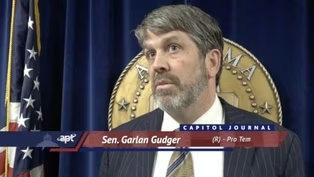
Alabama lawmakers head into a weeklong spring break
Clip: S21 Ep55 | 2m 18s | Alabama lawmakers head into a weeklong spring break before a fast-paced final stretch. (2m 18s)
Providing Support for PBS.org
Learn Moreabout PBS online sponsorship
- News and Public Affairs

Top journalists deliver compelling original analysis of the hour's headlines.

- News and Public Affairs

FRONTLINE is investigative journalism that questions, explains and changes our world.












Support for PBS provided by:
Capitol Journal is a local public television program presented by APT