Northwest Profiles
March 2021
Season 34 Episode 2 | 27m 46sVideo has Closed Captions
Downton Abbey fashion, Meme Artist, Training service dogs, Ukranian Easter eggs.
See the costumes of the TV series Downton Abbey and Spokane’s own Aristocratic families; Meet a Spokane artist who takes the normal, and gives it a twist all his own! See what does it take to be the right Service dog and become a friend and helper. Visit a Calgary artist and her beautiful work creating Ukrainian Easter Eggs.
Problems playing video? | Closed Captioning Feedback
Problems playing video? | Closed Captioning Feedback
Northwest Profiles is a local public television program presented by KSPS PBS
Funding for Northwest Profiles is provided by Idaho Central Credit Union, with additional funding from the Friends of KSPS.
Support provided by:

Northwest Profiles
March 2021
Season 34 Episode 2 | 27m 46sVideo has Closed Captions
See the costumes of the TV series Downton Abbey and Spokane’s own Aristocratic families; Meet a Spokane artist who takes the normal, and gives it a twist all his own! See what does it take to be the right Service dog and become a friend and helper. Visit a Calgary artist and her beautiful work creating Ukrainian Easter Eggs.
Problems playing video? | Closed Captioning Feedback
How to Watch Northwest Profiles
Northwest Profiles is available to stream on pbs.org and the free PBS App, available on iPhone, Apple TV, Android TV, Android smartphones, Amazon Fire TV, Amazon Fire Tablet, Roku, Samsung Smart TV, and Vizio.
Providing Support for PBS.org
Learn Moreabout PBS online sponsorship♪ Hello and welcome to this edition of Northwest Profiles I'm your host Lynn Veltrie and I don't know about you but with the arrival of daylight savings time and the promise of more sunshine it seems as though feel-good stories abound.
Case in point over the next 30 minutes our stories will take us back to the Victorian age, through fashion, Downton Abbey style expose us to the quirky world of a talented meme artist; show us what it takes to groom a canine into a service dog and finally give us a chance to experience an art form whose canvas is eggshells.
Sounds like a lot because it is so let's get rolling, shall we?
Our region is a tapestry of history.
And we're fortunate to have many organizations, museums and even broadcasters like KSPS to connect us with history, both here and globally.
In our first story we weave all these things together as we see how Spokane's Northwest Museum of Arts and Culture has brought history to life through their latest exhibition called dressing the abbey.
♪ Brooke Wagner: This exhibition is a traveling exhibition.
It consists of 35 costumes that were featured in Downton Abbey.
It also talks a little bit about that time in history from 1912 to, um, the early 1920s, what people were wearing and how that shows the changing times.
♪ Freya Liggett: We're really looking to capitalize on our own collections and tell local stories, but maybe from that larger perspective of either a national or international story, I like we have with the Downton Abbey exhibit.
>> The Northwest Museum of Arts and Culture, and neighboring Campbell House are windows into a vibrant past, linking historical global themes with regional topics.
Exhibits like Pompeii: The Immortal City have been paired with local tales about the 1980 eruption of Mount Saint Helens.
More recently, the Campbell House has been presenting Spinning A Yarn an exhibit of fashions and lifestyles of early Spokane.
Meanwhile, the MAC has been featuring costumes from Downton Abbey.
Brooke: So was a fun one because as soon as we got a signed contract, uh, we jumped in and tried to start working with the Spokane Civic Theatre on designing vignettes to, because this exhibition was just the costumes and the text panels.
And so we wanted to make it come alive for our visitors.
Jake Schaefer from the Civic Theatre kind of compiled things into vignettes to make it a little bit more immersive.
So, the dining room table, for instance was all him, his idea, and his team creating this dining scene.
The kitchen scene, additionally, all the fake food and that sort of thing was from his team, which was lovely because that's not something that we have.
So he made a really good effort to blend our collection with his props, with the costumes.
I don't think we've ever to this degree partnered with the Spokane Civic Theatre.
Um, and so I was admittedly a little nervous at the beginning.
Um, we had a really tight turnaround and to add a new voice to the table was a little scary.
But it ended up being this amazing, amazing opportunity.
♪ For example, with the modernized fashions in the 1920s with the really cool white flowy fabric and the different colors, you know, he was playing with that.
And, I knew I would love it, but I had to wait to see it until the end, I guess, because, he's got an impeccable design taste.
But it's so different from mine that it's best to sit on it for a minute, I think.
(LAUGH) ♪ The globe is one of my favorite pieces that we got to bring out.
It's a piece that was given to us by the Louis Davenport estate.
If you look closely at the globe over there, you can see that someone has pointed at Spokane so many times that Spokane is basically obliterated from the globe.
You know, you can almost imagine people standing over and talking about their home and pointing at it and making it basically go away.
♪ Freya: Spinning a Yarn was conceived as a companion for the Dressing the Abbey exhibit.
And it really capitalizes on our, our largest collection item here at the museum.
And that is the historic Campbell House where we're sitting right now.
The Campbell House was built in 1898 by a Amasa and Grace Campbell.
Today the Campbell House is restored back to essentially what would have been, uh, the house in about 1910, to kind of bring us back to a life in the Campbell's era.
A lot of the costumes are ones that may have been on display before.
So we know just a little bit about them, but this exhibit dove in a little bit deeper to say, okay, well, we know where this came from.
We know who it belonged to, but who was that?
And, and what's the deeper story behind them?
We do have stories here that are not just Spokane stories.
We've got folks here in Spinning A Yarn in that come from Wilbur or Reardan.
So there's a little bit broader reach, uh, throughout the Inland Northwest that you'll, you'll encounter when you meet these characters.
Bell ringing Brooke: we also have a couple picture frames kind of scattered about almost like Easter eggs.
There's one at the intro and there's a couple more, and they feature portraits from the Campbell family.
And there's no labels, it's just kind of a fun, little, another little poke.
So we've got a picture of Helen in a fine dress staring in a mirror in one scene, we've got a picture of the Campbell family trip to Egypt in another.
And just kind of a fun, little, another little poke, ode to Campbell House.
Freya: I have fallen in love with these stories and these individuals, um, they are stories that, you know, they're very personal.
Um, each of these stories here that you encounter in the house are, are tiny snapshots from that individual's life.
And, you know, in some way I hope that we've been able to, put some context around that to make people feel something.
Dressing the Abbey and Spinning a Yarn have been part of the Mac's social fabric series, which shows the role that fashion has played in society through the years.
Art washes away from the soul the dust of everyday life.
That is a quote from Pablo Picasso, but it surely must also apply to the subject of our next story.
Travis Chapman is a roofer by day.
But when situated at his kitchen table, Travis the artist creates paintings that usually make a statement, and even poke fun at his chosen subjects.
Sitting at his kitchen table, with a brush and some paint.
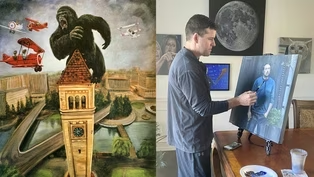
Spokane's Travis Chapman, a roofing businessman by trade, weaves a quirky narrative in his paintings that oftentimes are meant to elicit a laugh or a nod, but will nearly always bring forth a response.
Welcome to the world of a meme friendly guy who revels in the fun of creating images that he says are opposing to an expected visual.
Travis Chapman: It's relaxing to paint, I just liked doing it.
I liked doing opposite things like, sometimes I would just paint something and then I would think what would be funny to have in this picture that doesn't fit sort of, or would be weird or, you know, strange and ironic.
I don't know if it's a meme, but I like movies and in the karate kid, Mr. Miyagi says, there's no defense for the crane kick.
So, I had him going against Darth Vader, because it's like, he would never win, but there's no defense for this thing.
And also, against jaws, like he's on a sinking boat, but he's going to win because he's got this indefensible kick.
What I found is you need to be able to see it within like two seconds because people are scrolling.
if you don't catch them immediately, they're not going to take the time to look at the description necessarily, so you've got to catch them quick.
>>Travis strives to paint things that are pop culture oriented and relatable.
Without formal training, he latched onto painting shows on television like Bob Ross in the Joy of painting and the show Paint this with Jerry Yarnell on PBS.
Travis Chapman: I did a painting called the canvas assassin and it's Bob Ross in the Bruce Lee pose with his shirt off in like the cut chest where he got cut in the movie Enter the Dragon, but Bob's holding the paint brushes up, like he's about to, you know, attack because he paints so fast that, uh, he attacks.
As a kid I would watch like a guy Jerry Yarnell on PBS and then, you know, Bob Ross, but Bob Ross paints so fast, it's almost like more of a show than to paint along with him.
He would do a whole painting in like 20 minutes.
Jerry Yarnell, I liked a lot.
Um, and he would teach you techniques, he's still teaching himself.
>>His work graces the pages online on sites like Pinterest and Etsy, places that get a lot of attention and views, but interestingly, presumably with tongue planted firmly into cheek, was one unique place he initially thought would garner the most attention.
Travis Chapman: Originally, I thought the best place for a painting is behind a urinal because you have to look, I mean, you can't even be on your phone.
It's like, it's captive audience.
But of course, I'd rather have it in a more prestigious place, but that's like the most where someone will look at it and pay attention to it.
I usually have an idea and then I start painting it.
And then it changes because it's like, Oh, I put this too close to here.
Or, Oh, there's a big space in the painting Cause I'm not that good at drawing stuff out before I do it.
I did one where Quint from jaws, the captain guy is like pouring a beer in jaws' mouth.
I painted the jaws painting, and it was just Jaws in the ocean.
And it sat there for probably two weeks and I just kept looking at it, deciding what else to put in there.
I was going to have him be like a flame thrower.
And then I decided that Quint pouring a beer in his mouth.
And that's been like one of my most popular paintings.
it could have went either way.
I didn't have a plan at all.
I just looked at it long enough and decided what I was going to finish the painting with.
The best thing is if I can have an idea, that's easy to paint, that's succinct and you can get it really fast.
Those are my favorite, but they don't come along that often.
>>With a house full of his paintings both on the walls, and in storage, Travis keeps Painting, creating and uploading his images, hoping that his avocation of being an artist will supplant his current roofing business as his main profession.
Travis Chapman: I'm transitioning slowly, I still have, my roofing business to be a safety net, but I'm working harder and going deeper into art.
And that's the goal.
I'm just painting things I want to paint, and I figure if I want to paint them or I liked the image or it's nostalgic for me, then it's going to be nostalgic for somebody else and it's going to make them feel like I feel when I look at that image.
Up next we change course from free expression through art to the ridged discipline of dog training, and for that we turn to Karin Wagmann certified instructor and master trainer for K9 police dogs, and for our story, service dogs!
Karin, with the help of her four-legged friend maple, happily shows off the skills needed for a dog to become a fun loving and devoted comrade in service.
(joyful music) - Stay.
Bring.
( Karim giggles) Oh man, what went down?
Bring.
The best part of having a service dog, right?
They're not perfect, so they are gonna make mistakes.
- It was harder to train me than to train Shadow, Shadow has been quite a natural because well Karin is a great trainer, but it's the human...
Excuse me, I'm speaking.
(woman giggles) - I am Karin Wagemann, and I'm the owner and head trainer of Nine Realms Canine Training specializing in police canines and service dogs.
Hey Maple.
So I went to Carroll College in Helena, Montana and I got a degree in Anthrozoology, and Anthrozoology is the study of the human-animal bond.
I then proceeded to do some online schooling through London, Hanover university.
And I got a master's degree in canine behavioral sciences.
(ambient music) - [Karin] When I went to college, we got to foster a dog for a year, and for that year, it was a rescue dog, you got to train the dog in whatever sort of behaviors you wish to train the dog for.
So I decided to train that dog in narcotics detection as well as service tasks.
So we did tasks such as walking next to a wheelchair, picking up objects, pressing handicap buttons, going and finding help, sound alerts for people who maybe are hard of hearing, and that dog learned all of those tasks as I was learning to teach all of those tasks.
So that's where I got my start in the service dog world and then when I started the business, I realized the need for people who are owner training their own service dogs.
Service dogs are very expensive, right?
And not a lot of people can afford to go get one, and the wait list for program dogs where you get the dogs for free is sometimes five years.
So it's just not realistic sometimes to get a program dog, but if you have a really nice dog and you're willing to do the training yourself, you can partner with a trainer like myself and learn and owner train your dog.
So that's when I really started getting into helping people like Elodie train their own dog for service work.
- I wanted him to be a service dog but Karin from Nine Realms, interviewed him so to speak and evaluated him and she saw the potential in him, and that's how she took him on as a client.
It took us a year, with intensive training with Karin, one-on-one, so this boy went from almost being put down to rescue to service dog.
- Wanna grab the wallet?
Stay, okay.
Bring!
Attagirl, bring it here, good job Maple.
The Americans with disability act, only states that a service dog is a service dog if it's task trained to help mitigate a handler with a disability, no sort of certification is required and people who say my dog is service dog certified usually it's a little bit of a red flag, but you can still have a dog that's certified through an organization, performing tasks, right?
Helping it's handler and it's a legit dog.
(joyful music) - [Karin] You really wanna look for a dog that's focused on their handler, you don't want a dog that's more interested in the world, that's going on other animals or a dog that just doesn't really care about their people.
Helms can be like that, they're not... Or huskies they're not super in tune with their people, so you look for dog that already has a bond, right?
And that's the first thing I asked.
How do you feel your bond is with your dog?
And if they're like, he doesn't care about me, usually a red flag.
And then we're testing to see if the dog is social and public, if they're fine with other people, if they're fine with other dogs, if they're nervous in new environments, if they are, they're not gonna make a good service dog, and then from there you start your training with basic obedience, start adding in tasks and advanced obedience, and actually along the way, it's generally when you start to see whether or not the dogs truly gonna make it.
So you can do all your initial evaluation, dog can look fine, and then as you start to train the dog it's like, I don't like this career, it's not for me, and then you have some dogs that just start and you're like, it doesn't look great, and then they really start to blossom and you're like, huh!
You made it, look at that, you're doing great.
Take it, take it.
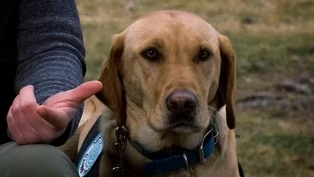
So Maple is about a year and a half, almost two, yellow lab, she was donated by a lovely labrador retriever breeder, out here at six months of age, and she's been puppy raised by some good folks and friends of mine for the past year and a half, and she is going off to Texas with her handler who is an 18 year old girl in a wheelchair.
So she's trained to pick up objects, open cabinets, go get help, press the handicap button, help her take off her jacket, take off shoes, turn on lights, you name it, she's trained to do.
And this is probably one of those one in a million dogs, every trainer says, there's those dogs that really change your life that you know are really, really special and this is one of those dogs, definitely.
Maple heel.
Maple understands her heel command, incredibly well, right?
And she backs up with it, heel, she goes forward, heel, and she turns nicely, heel, so that her person who's in a wheelchair, right?
Isn't having to constantly use her leash to guide her around, she's just using her verbal or her body position heel, to move the dog around with her.
Attagirl.
(ambient music) - [Karin] So dogs that work with either people that have autism or children that have autism have a very tough mentally in a way that all of that emotion that's coming through their handler or that child isn't going to affect them, they're not gonna absorb that... but they're also able to pick up on that person's needs and desires and then go and assist them, comfort them.
So there's this fine line between overly stressed about your handler, right?
And not paying enough attention.
When these dogs, they pick up on either physical movements that their handlers are doing just their voice inflections.
- [Woman] Do not leave it.
(all giggling) - So Maple wouldn't make a good autism service dog even though she's already a trained service dog for somebody else, because she's too sensitive.
She picks up on all of her handlers emotions and she takes them in, which makes her a good dog in that she picks up on it and she goes, and she assists them, she sits by their lap, she naturally alerts but then she starts to become anxious and insecure, and over time she needs her own service dog, right?
So you have to have a dog that feels those emotions that the handler's feeling but then also isn't constantly absorbing them and becoming stressed as well.
So I think that's the real special thing about autism service dogs.
(calm music) - [Elodie] I can take him where I go without any problems.
Life is, less scary with Shadow in it.
And, I do have a constant partner.
- [Karin] I've always wanted to help people, so it just seemed like the logical fit, when I first stumbled upon service dog as a young, young kid.
I love seeing every minute that I see these dogs change people's lives.
That's really what I live for, that's why I do it.
(ambient music) Karin's expertise includes training antipoaching dogs.
Four of them are currently on duty at a Tanzania game reserve, tracking poachers that smuggle illegal wildlife products such as ivory, hippo teeth and rhino horn.
Amazing what dogs can do!
Now, for our final story we return to the world of artistic expression.
These days, we're surrounded by elaborate visual images, often created with computers and apps.
But right now, let's meet a Calgary artist whose hand-drawn designs are not only complex and beautiful, but are steeped in culture and history.
♪ Daena Diduck: Every line, every color has a different meaning, has different symbolism.
So, you can actually write a story.
If you want fertility or if you want love, health you can all put it on an egg.
Pysanka is the art of Ukrainian Easter eggs.
It's a pre-Christian tradition for the Ukrainian culture.
It's done in the spring and it's a symbol of life.
And now we do them for Easter, as well.
Easter being pysanky everybody pretty much does them for their basket at Easter.
And it's mostly to promote the culture what we do in the community, how vibrant our community is to teach people about the pysanky.
♪ >> Calgary artist Daena Diduck uses real eggs for her art.
Usually, the yolks are blown out beforehand.
To color the eggs, Daena first draws melted wax onto some areas, covering them so that they'll stay protected while the colored dye only goes to the areas that she wants.
Daena: The next step on this pysanka would be to cover over the red star areas in the middle section with wax and cover just the red spots where we want to keep red.
Then I would put it into a black dye for the black background.
Take the wax off.
And that would be a traditional pysanka.
♪ I actually find it very relaxing.
For me, I learned it in school.
It was part of the actual school system in Saskatoon, only one in Saskatchewan.
♪ ♪ So this is an example of more traditional designs from Ukraine.
So, they're more simplistic, usually only a couple of colors, as well These are more modern versions of pysanky.
And so this is a version of the modern colors and the modern looks.
So, very different from the traditional style.
This is the Trypillian in style of pysanky.
So they were originally on pottery.
And very prehistoric culture from Ukraine.
I'm kind of known for the Trypillian style.
I do quite a few of these and they're done on brown eggs, as well so they look more like the pottery.
This is another modern style that we've been using so, these eggs are off white.
So the one in the back is actually a brown egg.
The one in the middle is a brown egg and they've been treated with acid to take away the brown color.
The one in the back has been dyed and the other eggs are actually that's their natural shell color.
So, you can get light green eggs you can get beige eggs you can get different tones of brown, and blue.
And there's been some pink I haven't had those in a while.
I have everything from quail eggs that I've got at home.
I've got pheasant, chicken.
I've got emu eggs.
I've got ostrich, I've got duck and goose and turkey.
The pysanka in the middle is a chicken egg and that would be probably a medium sized chicken egg.
The little star one in the front is actually a tiny, tiny chicken egg that I got from someone.
The two other smaller eggs are pheasant.
And the two in the back are either small goose eggs or turkey.
♪ In Canada and U.S. and across the world we have a whole bunch of different artists that we keep in touch online, get together in groups and little play dates and workshops and retreats.
♪ And every single egg that I see that people make even if it's a beginner or not, every one's beautiful.
Daena confesses she doesn't know exactly how long it takes to create one of her eggs, but the larger, more intricate designs can take up to 30 hours to create one egg.
And with those beautiful images fresh in our minds, I do believe it's time to turn the page and close out this edition of Northwest Profiles please note if you would like to learn more about the stories you've just seen simply go online to ksps.org Until we meet again this is Lynn Veltrie saying so long and reminding you here in the Inland Northwest and western Canada there is always a full supply of adventure so venture out and when you do, in this age of Covid, do it safely and take time to enjoy the view.

Video has Closed Captions
Clip: S34 Ep2 | 6m 20s | Exhibit costumes from Downton Abbey and fine clothing from Spokane’s Campbell family. (6m 20s)
Video has Closed Captions
Clip: S34 Ep2 | 7m 32s | A Spokane trainer gives us an overview about what makes a good service dog. (7m 32s)

Preview: S34 Ep2 | 1m 30s | Downton Abbey fashion; Spokane meme artist, Service dog training; Creating Pysanka eggs (1m 30s)
Video has Closed Captions
Clip: S34 Ep2 | 5m 12s | Travis Chapman uses creative juxtapositions to create memorable memes. (5m 12s)
Providing Support for PBS.org
Learn Moreabout PBS online sponsorship













Support for PBS provided by:
Northwest Profiles is a local public television program presented by KSPS PBS
Funding for Northwest Profiles is provided by Idaho Central Credit Union, with additional funding from the Friends of KSPS.